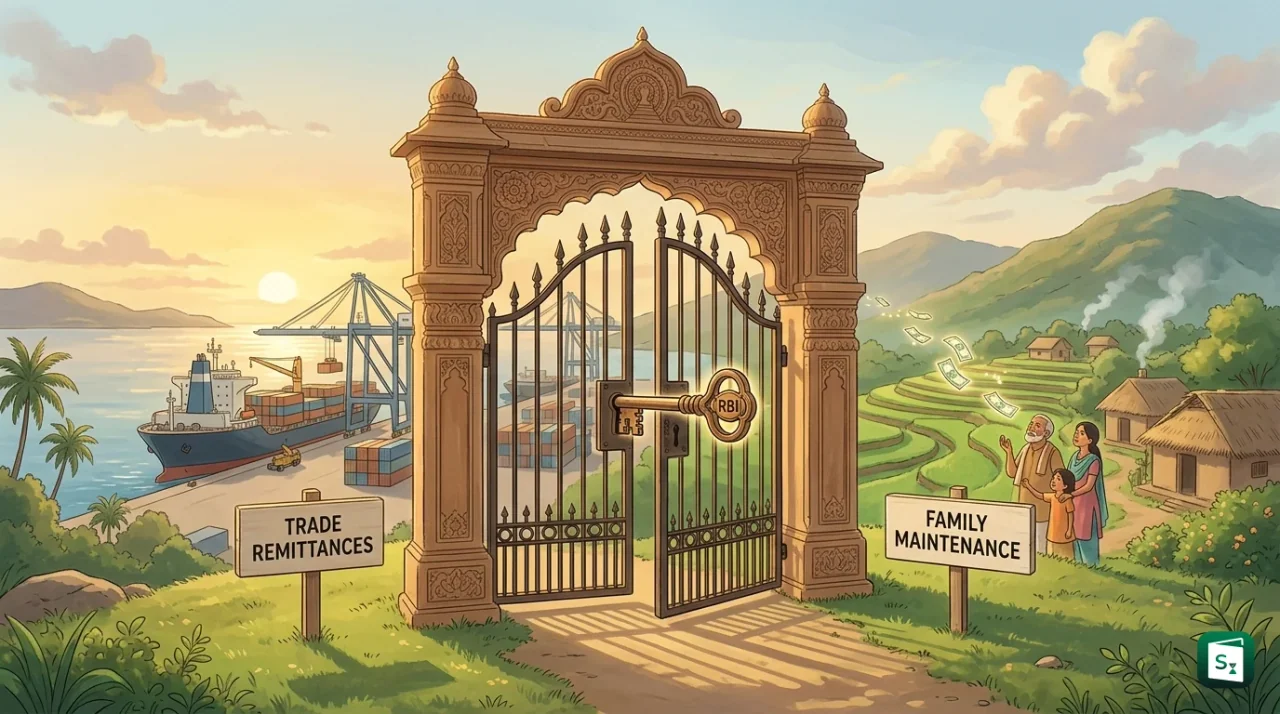
EbixCash World Money Ltd has become the first Authorised Dealer Category-II (AD-II) entity in India to receive a perpetual RBI licence with permission to handle trade remittances and family maintenance remittances, a business segment historically dominated by banks. The enhanced licence, granted under the revised Foreign Exchange Management Act (FEMA) framework introduced in May 2026, allows EbixCash to process trade remittances of up to ₹25 lakh per transaction. The company has also received RBI authorisation to maintain Nostro accounts, enabling direct settlement of international transactions without routing them through intermediary correspondent banks.
What Is an Authorised Dealer?
An Authorised Dealer (AD) is an entity licensed by the Reserve Bank of India (RBI) under Section 10(1) of the Foreign Exchange Management Act (FEMA), 1999, to deal in foreign exchange. FEMA, which replaced the earlier Foreign Exchange Regulation Act (FERA), 1973, was enacted to consolidate and amend the law relating to foreign exchange in India. The RBI classifies authorised persons into different categories based on the scope of activities they are permitted to undertake.
Categories of Authorised Dealers
| Category | Eligible Entities | Permitted Activities |
|---|---|---|
| AD Category-I | Banks licensed by RBI | All current and capital account transactions permissible under FEMA |
| AD Category-II | Banks, NBFCs registered with RBI, FFMCs with at least 2 years of experience | Non-trade current account transactions and foreign trade transactions up to ₹25 lakh per transaction |
| AD Category-III | Entities requiring forex incidental to their business | Activities as specified in the authorisation issued by RBI |
Full Fledged Money Changers (FFMCs) are a separate category authorised to purchase and sell foreign currency notes for travel-related purposes. Under the new Foreign Exchange Management (Authorised Persons) Regulations, 2026 (Notification No. FEMA 401/2026-RB dated April 30, 2026), RBI has stopped accepting fresh applications for FFMC authorisation, signalling a move towards consolidating the forex ecosystem under fewer but more capable entities.
The Regulatory Shift: FEMA Framework Revision
The landmark change that made this development possible came in May 2026, when the RBI revised the Foreign Exchange Management (Authorised Persons) Regulations through Notification No. FEMA 401/2026-RB. The new framework, published in the official gazette on May 6, 2026, fundamentally expanded the scope of activities permitted for AD Category-II entities.
Before this revision, trade-related foreign exchange transactions were the exclusive preserve of banks and AD Category-I institutions. AD-II entities could only handle non-trade current account transactions such as private travel, business travel, and remittances under the Liberalised Remittance Scheme (LRS). The LRS, introduced in 2004, allows resident individuals to remit up to $250,000 per financial year for permissible current and capital account transactions.
The revised framework opened two critical categories to AD-II entities: non-trade current account transactions permissible under FEMA and foreign trade transactions up to ₹25 lakh per transaction.
This structural shift has allowed non-bank entities like EbixCash to enter a market segment that was previously inaccessible to them.
What the New Licence Allows
The perpetual AD-II licence granted to EbixCash World Money comes with an expanded mandate that includes three key capabilities.
Trade remittances up to ₹25 lakh per transaction. This allows the company to process payments for import and export of goods and services on behalf of Indian businesses. For a micro, small, or medium enterprise (MSME) that needs to pay a foreign supplier for raw materials or receive payment from an overseas buyer, this creates a direct channel outside the traditional banking system.
Family maintenance remittances. Indian residents with family members living abroad can now send money for maintenance and support through EbixCash’s network, a service that was previously routed almost entirely through banks.
Nostro account maintenance. This is a capability historically reserved for banks. A Nostro account (from the Latin “nostro” meaning “ours”) is an account that a domestic bank holds with a foreign bank, denominated in the foreign currency. For example, if an Indian entity holds an account in US dollars with a bank in New York, that account is a Nostro account from the Indian entity’s perspective.
Why Nostro Account Access Matters
The ability to maintain Nostro accounts fundamentally changes how EbixCash processes cross-border payments. Without a Nostro account, a non-bank entity must route every international transaction through one or more correspondent banks, each adding its own fees, delays, and compliance checks. With a Nostro account, EbixCash can settle international transactions directly with the foreign bank, reducing costs, speeding up settlement times, and eliminating reliance on intermediary banks.
This is particularly significant for MSMEs that often face higher transaction costs and slower processing times when using traditional correspondent banking channels for low-value trade payments.
EbixCash World Money: From FFMC to Perpetual AD-II
EbixCash World Money’s journey reflects the gradual liberalisation of India’s foreign exchange sector. The company was formally established in 1999 as a Full Fledged Money Changer (FFMC). In 2008, it was upgraded to Authorised Dealer Category-II status, allowing it to move beyond simple currency exchange into cross-border remittance services.
The company’s growth has been substantial. It now operates more than 100 branches across 70 cities and has counters at 20 international airports across India. It facilitates more than 75% of India’s cash-to-cash inward remittances and about 20% of outward remittances under the RBI’s Liberalised Remittance Scheme through the AD-II channel. The company supplies foreign currency to over 40 partner banks and serves customers through more than 25,000 touchpoints nationwide.
EbixCash has also built a strong digital infrastructure. It was the first authorised dealer in India to enable real-time cross-border payments to the United Kingdom through the Faster Payments Service and to Europe through SEPA Instant. It is a Principal Member of both Visa and Mastercard, issuing multicurrency prepaid travel cards in over 12 currencies. The company also holds a Payment Service Provider licence in GIFT City, Gujarat, positioning itself in India’s emerging international financial services hub.
Why This Matters for MSMEs and the Remittance Market
India’s MSME sector contributes nearly 30% of the country’s GDP and employs over 110 million people. Yet, these businesses have historically faced a structural bottleneck when it comes to cross-border payments. To send or receive payment for goods and services abroad, an MSME needed a full banking relationship, often accompanied by slower turnaround times, heavier documentation, and higher costs.
The entry of a non-bank AD-II entity into trade remittances addresses this gap. MSMEs engaged in export and import can now access a dedicated channel for foreign exchange payments without the friction of traditional banking. The ₹25 lakh per transaction limit covers a significant portion of MSME trade transactions, which are typically of lower value compared to large corporate trade.
For family maintenance remittances, the new licence opens a channel for millions of Indian households with dependents abroad. India is the world’s largest recipient of remittances, receiving over $125 billion in inward remittances in 2025. While this development concerns outward remittances from India, it reflects the broader trend of expanding non-bank participation in the cross-border payments ecosystem.
The perpetual nature of the licence is another important feature. Unlike time-bound licences that require periodic renewal, a perpetual licence remains valid unless revoked or surrendered by the entity, reducing regulatory uncertainty and allowing long-term business planning.
Key Takeaways
- EbixCash World Money Ltd became the first AD Category-II entity in India to receive a perpetual RBI licence for trade and family maintenance remittances.
- The licence permits trade remittances of up to ₹25 lakh per transaction under the revised FEMA framework notified in May 2026.
- The company has received RBI authorisation to maintain Nostro accounts, enabling direct settlement of international transactions without correspondent banks.
- FEMA, 1999, enacted under Section 10(1), governs all foreign exchange transactions in India. The RBI classifies authorised persons into AD Category-I, II, and III.
- EbixCash was established as a Full Fledged Money Changer in 1999 and upgraded to AD-II in 2008.
- The Liberalised Remittance Scheme (LRS), introduced in 2004, allows resident Indians to remit up to $250,000 per financial year.