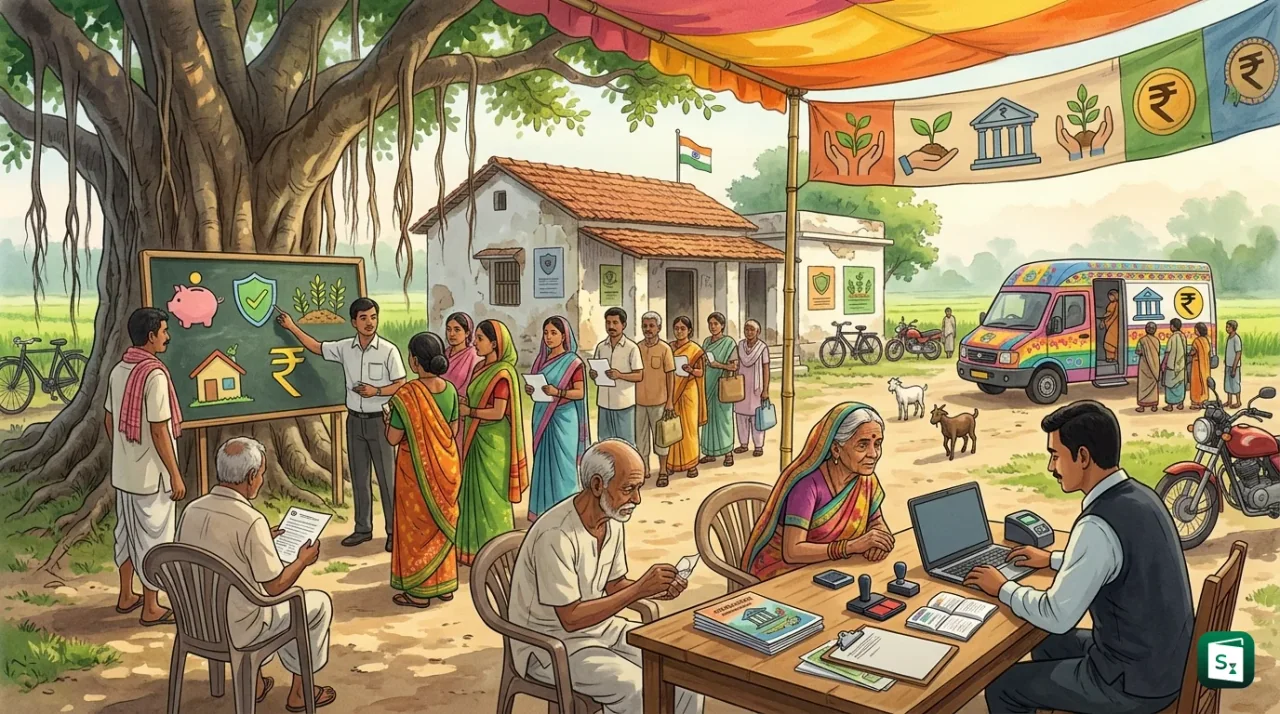
The Department of Financial Services (DFS) under the Ministry of Finance will run a nationwide Financial Inclusion Saturation Campaign from 21 October to 31 December 2026. Banks will hold special camps in all 2.70 lakh Gram Panchayats and Urban Local Bodies to open Jan Dhan accounts, enrol people in insurance and pension schemes, and complete Re-KYC. The drive links savings, insurance, pension, farm credit and fraud awareness in a single last mile push.
What Is Financial Inclusion?
Financial inclusion means every household can access useful and affordable banking, credit, insurance and pension services. The Reserve Bank of India (RBI), the central bank and banking regulator headquartered in Mumbai, defines it to include access, usage and quality of services across banking, insurance, pension, postal savings and investments. In India this also includes digital access through Aadhaar linked accounts, mobile banking and Business Correspondents who deliver branchless banking in villages.
This idea matters because a bank account is the gateway to direct benefit transfers, low cost insurance and old age pension. Without an account, a family cannot receive subsidies directly or build a formal credit history. With one, savings earn interest, payments become safe and the family can borrow for farming or small business at lower rates. That is why the government calls the campaign saturation. It aims to leave no eligible person uncovered in any panchayat or town ward.
Financial Inclusion Saturation Campaign 2026: Dates, Coverage and How Camps Work
The Department of Financial Services announced the Financial Inclusion Saturation Campaign on 19 October 2026. The Department of Financial Services functions under the Ministry of Finance and oversees banks, insurance and pension inclusion programmes. The campaign runs from 21 October to 31 December 2026 and covers 2.70 lakh Gram Panchayats and Urban Local Bodies across the country.
Banks will organise at least one camp in each local body. State Level Bankers Committees (SLBCs) coordinate the camps with district administrations, lead banks and Business Correspondents. A preparatory meeting chaired by the Joint Secretary for Financial Inclusion reviewed readiness with senior bank executives. Progress will be tracked jointly by state officials, banks and the Department of Financial Services.
The camps combine enrolment, servicing and awareness in one place. Residents can open new accounts, join insurance and pension schemes, seed Aadhaar, update records and learn about frauds. The table below lists the nine tasks banks will complete during the campaign.
| Camp Activity | What It Means for Residents |
|---|---|
| Enrolment in PMJJBY, PMSBY and APY | Join life insurance, accident insurance and pension with small yearly contributions |
| Aadhaar seeding in PMJJBY and PMSBY | Link Aadhaar to insurance records for correct identification and faster claims |
| Opening of PMJDY accounts | Open zero balance basic savings accounts for unbanked adults |
| Re-KYC for existing accounts | Update identity and address proof to keep PMJDY and other savings accounts active |
| Generation of C-KYC ID | Create a Central KYC number so one KYC record works across banks and insurers |
| Nomination updating | Add or update nominees for savings accounts, lockers and other facilities |
| Awareness on schemes, digital frauds and unclaimed assets | Learn about fraud prevention and the Aapki Poonji Aapka Adhikar drive for unclaimed money |
| Sourcing of KCC applications | Collect Kisan Credit Card forms to cover eligible PM-KISAN beneficiaries |
| Enrolment in PM Fasal Bima Yojana for Rabi season | Insure winter crops against drought, flood, hailstorm, pests and other natural risks |
What Is Jan Dhan Yojana?
The Pradhan Mantri Jan Dhan Yojana (PMJDY) is the National Mission for Financial Inclusion launched in August 2014 to give every unbanked household a basic savings account. Any person without a bank account can open a Basic Savings Bank Deposit Account at a bank branch or Bank Mitra outlet with no minimum balance requirement.
PMJDY is the foundation of the saturation drive. The account works as an entry point to Direct Benefit Transfer (DBT), insurance, pension and micro credit. DBT sends welfare payments straight into the bank account of the beneficiary. This system rests on the Jan Dhan, Aadhaar and Mobile (JAM) trinity which links identity, account and phone to cut delays and leakages.
The scale is large. PMJDY accounts stood at 59.09 crore on 19 August 2026, with deposits of ₹3.16 lakh crore. Average balance per account was ₹5,356. About 55.7 percent of account holders are women and 77.8 percent of accounts are in rural and semi urban areas. Banks have issued 41.29 crore RuPay debit cards to account holders. New accounts opened after 28 August 2018 carry accident cover of ₹2 lakh on the RuPay card. Eligible holders can also seek overdraft up to ₹10,000.
Accounts alone are not enough if they turn inactive. Many older accounts need Re-KYC, which means fresh submission of identity and address proof. The camps will help holders complete this step and keep access to DBT and other services without interruption.
What Is PMJJBY and PMSBY?
The Pradhan Mantri Jeevan Jyoti Bima Yojana (PMJJBY) is a yearly renewable life insurance plan that pays ₹2 lakh on death due to any reason. The Pradhan Mantri Suraksha Bima Yojana (PMSBY) is a yearly renewable accident insurance plan that pays up to ₹2 lakh on accidental death or full disability.
Both schemes were launched in May 2015 to secure the unsecured. They use auto debit from a bank or post office savings account and run on a policy year from 1 June to 31 May. A person can join through only one account even if that person holds several accounts. The Jan Suraksha Portal now routes new enrolments and claim records for these schemes through banks and insurers, which improves data quality and speeds up service.
The table below compares the two plans on the facts that matter for enrolment at the camps.
| Feature | PMJJBY | PMSBY |
|---|---|---|
| Full form | Pradhan Mantri Jeevan Jyoti Bima Yojana | Pradhan Mantri Suraksha Bima Yojana |
| Type of cover | Life insurance for death due to any reason | Accident insurance for death and disability due to accident |
| Eligible age | 18 to 50 years | 18 to 70 years |
| Yearly premium | ₹436 per year, less than ₹2 per day | ₹20 per year, less than ₹2 per month |
| Sum insured | ₹2 lakh on death of subscriber | ₹2 lakh on accidental death or full disability, ₹1 lakh on partial disability |
| How it is managed | Offered through Life Insurance Corporation of India and other life insurers tied to banks and post offices | Offered through public sector general insurers and other general insurers tied to banks and post offices |
PMJJBY carries a 30 day lien period from enrolment for non accidental death. Accidental death is covered from day one. PMSBY pays strictly for accident linked outcomes and does not cover natural death. Enrolment stays valid only if sufficient balance exists for auto debit on renewal.
Uptake is already wide. Cumulative enrolments under PMJJBY crossed 27.43 crore by 29 April 2026, with ₹21,512.50 crore paid for 10,75,625 claims. Cumulative enrolments under PMSBY crossed 58.09 crore on the same date, with ₹3,667.52 crore paid for 1,84,662 claims. Women hold 12.72 crore PMJJBY covers and 27.45 crore PMSBY covers. The Department of Financial Services has asked banks to raise awareness about claim eligibility so nominees actually receive the money after the death of a subscriber.
Social Security and Pension Cover Under the Campaign
The Atal Pension Yojana (APY) is a voluntary pension scheme for workers in the unorganised sector that guarantees a monthly pension after the age of 60. The Pension Fund Regulatory and Development Authority (PFRDA), the statutory regulator for pensions headquartered in New Delhi, administers APY within the National Pension System architecture.
APY is open to bank account holders in the age group of 18 to 40 years who are not income tax payers. The subscriber chooses a pension slab of ₹1,000, ₹2,000, ₹3,000, ₹4,000 or ₹5,000 per month. Monthly, quarterly or half yearly contributions depend on entry age and chosen slab. After the subscriber turns 60, the pension goes first to the subscriber, then to the spouse. After both pass away, the accumulated corpus returns to the nominee. If the subscriber dies before 60, the spouse can continue contributions for the remaining years.
Enrolments stood at more than 9.04 crore on 30 April 2026, with July 2026 data showing about 9.40 crore enrolments. Women form nearly half of all subscribers. The Department of Financial Services has asked banks to improve persistency, which means keeping subscribers contributing regularly so accounts do not drop out before pension starts.
The Jan Suraksha Portal supports all three Jan Suraksha schemes, namely PMJJBY, PMSBY and APY. Bank staff will use the portal at the camps for fresh enrolments and to seed Aadhaar in PMJJBY and PMSBY records. The portal is being integrated with banks and insurers. This link will reduce duplicate entries and make claim settlement cleaner.
Re-KYC, Nominations, Unclaimed Assets and Farm Credit
Account hygiene is a central part of the 2026 drive. Re-KYC means the bank verifies the identity and address of an existing customer again after a gap. C-KYC ID refers to a number issued by the Central KYC Registry, a central store of KYC records that banks and other financial firms can use with common norms. Updating the nomination means recording who will receive the money in the account, locker or other facility if the holder passes away.
These steps prevent frozen accounts, failed DBT credits and long disputes for legal heirs. Banks will generate pending C-KYC numbers at the camps and update nominations for savings accounts and lockers. Holders who face no change in details can often complete low risk Re-KYC through a self declaration by email, internet banking, mobile banking, Aadhaar OTP or a branch visit. Officially valid documents include Aadhaar, passport, driving licence and voter ID.
The camps will also push the Aapki Poonji Aapka Adhikar initiative, which means your money your right. This three month awareness effort from October to December 2025 helped citizens trace unclaimed deposits, insurance proceeds, dividends, shares, mutual fund balances and pension dues. Unclaimed bank deposits are accounts with no customer led operation for 10 years or more. Such balances move to the Depositor Education and Awareness Fund held by the RBI. Citizens can search the RBI UDGAM portal and bank websites for such funds and file claims with identity and address proof. Nomination and Re-KYC directly reduce fresh additions to this pool.
Fraud awareness is the other pillar. Staff will explain safe digital practice, grievance redress and the need to report fraud quickly on helpline 1930 and the National Cybercrime Reporting Portal. The message is simple. Never share OTPs or passwords, and verify payment requests before acting.
The farm component is timed for the Rabi season, the winter cropping season sown around October to December. Banks will collect Kisan Credit Card (KCC) applications to cover eligible PM-KISAN beneficiaries. The KCC provides working capital for seeds, fertilisers and other needs at concessional rates with prompt repayment incentives. Banks will also enrol farmers in the Pradhan Mantri Fasal Bima Yojana (PMFBY), the national crop insurance scheme launched in Kharif 2016. PMFBY charges a maximum premium of 2 percent for Kharif foodgrain and oilseed crops, 1.5 percent for Rabi foodgrain and oilseed crops and 5 percent for commercial and horticultural crops. Central and state governments share the balance subsidy. More than 92.46 crore farmer applications have been insured since launch, with claims above ₹2.06 lakh crore paid by August 2026.
Why the Campaign Matters: RBI Financial Inclusion Index and Last Mile Access
The RBI Financial Inclusion Index (FI-Index) is a composite score from 0 to 100 that tracks access, usage and quality of financial services. The RBI built the index with government and sector regulators and first published it in August 2021 for the year ending March 2021. The score stood at 70.0 in March 2026, up from 67.0 in March 2025. The rise came mainly from better usage, which shows that people are not only opening accounts but also using insurance, pension and digital payments more actively.
This 2026 campaign builds on two recent saturation efforts. A nationwide drive from 1 July to 30 September 2025 held more than 2.30 lakh camps, opened 61.69 lakh new PMJDY accounts, completed Re-KYC for 2.32 crore accounts and recorded over 2.6 crore fresh enrolments under the three Jan Suraksha schemes. A one month intensive drive from 15 June to 15 July 2026 covered hilly states and Union Territories including Himachal Pradesh, Uttarakhand, Jammu and Kashmir and Ladakh. The October to December 2026 round extends the same model to all panchayats and urban bodies, including the seven northeastern states where SLBC Assam coordinates camps.
The policy anchor is the National Strategy for Financial Inclusion. The RBI released the National Strategy for Financial Inclusion 2025 to 2030 to deepen credit delivery, literacy and consumer protection. The Centre for Financial Literacy project supports this goal with 2,421 centres across the country, each covering about three blocks. Financial Literacy Centres run by lead banks add village level camps for farmers, small entrepreneurs, self help groups and senior citizens.
For daily life, the payoff is practical. A complete account with updated KYC and nomination keeps subsidies flowing, lets a family claim ₹2 lakh insurance without delay and protects unclaimed savings for heirs. For banks, cleaner records cut fraud and failed transactions. For the wider economy, wider use of formal credit and insurance supports farm investment, small business growth and resilience against health or crop shocks.
Key Takeaways
- The Financial Inclusion Saturation Campaign runs from 21 October to 31 December 2026 across 2.70 lakh Gram Panchayats and Urban Local Bodies.
- The Department of Financial Services under the Ministry of Finance organises the camps with banks, SLBCs and state administrations.
- PMJDY accounts stood at 59.09 crore on 19 August 2026 with deposits of ₹3.16 lakh crore and 41.29 crore RuPay cards issued.
- PMJJBY offers ₹2 lakh life cover for ages 18 to 50 at ₹436 per year, while PMSBY offers up to ₹2 lakh accident cover for ages 18 to 70 at ₹20 per year.
- Atal Pension Yojana guarantees a monthly pension of ₹1,000 to ₹5,000 after age 60 for subscribers aged 18 to 40 and had crossed 9.04 crore enrolments by April 2026.
- The RBI Financial Inclusion Index rose to 70.0 in March 2026 from 67.0 in March 2025, reflecting deeper usage of formal financial services.