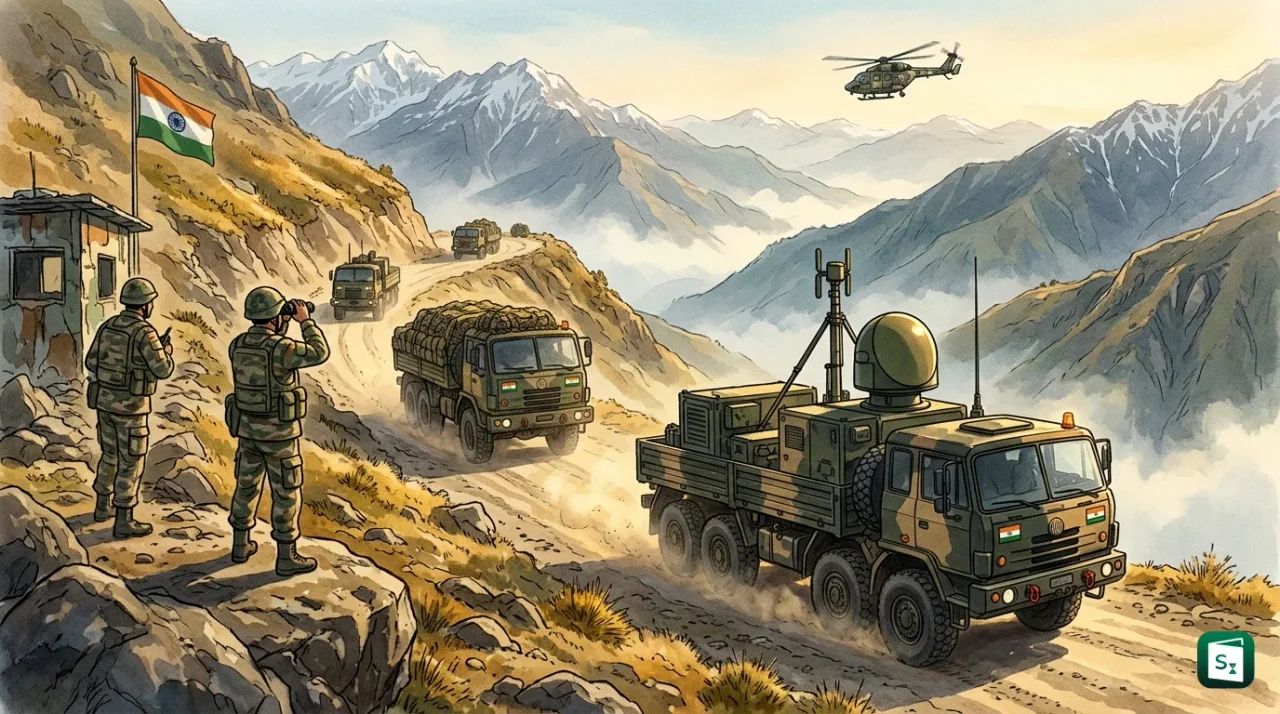
The Defence Acquisition Council, chaired by Defence Minister Rajnath Singh, accorded Acceptance of Necessity for capital acquisition proposals worth about ₹2.12 lakh crore on 26 October 2026. The clearances cover the Indian Army, Navy and Air Force and include High Mobility Vehicles, the Active Offboard Decoy System and Mobile X-Band Doppler Weather Radar Systems. About 82% of the approved procurements will be sourced from Indian industry, making it one of the largest indigenous focused clearances in recent years.
What Did the Defence Acquisition Council Approve?
The Defence Acquisition Council approved capital acquisition proposals worth about ₹2.12 lakh crore for the three services at its meeting on 26 October 2026 in New Delhi. The Defence Acquisition Council granted Acceptance of Necessity, which is in principle administrative approval, for a wide mix of artillery, helicopters, air defence systems, drones and naval systems. The Ministry of Defence has stated that approximately 82% of the total value will come from Indian industry.
The service wise equipment list announced by the Ministry of Defence is summarised below.
| Service | Approved Equipment |
|---|---|
| Indian Army | High Mobility Vehicles (HMV), Self-Propelled Tracked Gun System, Gun Shot Response System (GSRS), Light Multi Role Helicopters (LMRH), Very Short Range Air Defence System (VSHORADS), Platform Based Counter Unmanned Aerial System (C-UAS), Unmanned Aerial System Brick Long Range, Surveillance UAVs, Integrated Surveillance and Strike System, Long Range Kamikaze Drone System |
| Indian Navy | Active Offboard Decoy System (AODS) and other major indigenously designed and constructed naval platforms |
| Indian Air Force | Helicopters including Special Utility Helicopters, air defence systems, weapons and Mobile X-Band Doppler Weather Radar System |
The scale stands out when placed beside recent clearances. The Defence Acquisition Council had cleared proposals worth about ₹1.10 lakh crore in September 2026 and about ₹52,000 crore in July 2026. The October package is roughly double the September value and close to four times the July value, which underlines the pace of capital acquisition decisions in 2026.
What Is the Defence Acquisition Council and How Does Defence Procurement Work?
The Defence Acquisition Council, commonly shortened to DAC, is the highest decision making body in the Ministry of Defence for capital procurement for the Army, Navy, Air Force and Coast Guard. The Defence Minister chairs the Defence Acquisition Council and its members include the Minister of State for Defence, the Chief of Defence Staff and the Chiefs of the Army, Navy and Air Force along with the Defence Secretary.
The Defence Acquisition Council is not a statutory body. The Defence Acquisition Council was created in 2001 after the Group of Ministers on Reforming the National Security System gave its report following the 1999 Kargil War. The Group of Ministers had found that procurement was slow and spread across many agencies. The government therefore created a dedicated structure with the Defence Acquisition Council at the top, supported by the Defence Procurement Board and the Defence Production Board.
The core work of the Defence Acquisition Council is to give in principle approval to the 15 year Long Term Integrated Perspective Plan (LTIPP), to accord Acceptance of Necessity to individual proposals and to decide procurement policy. Once the Defence Acquisition Council clears a proposal, the case moves to tendering, trials, cost negotiation and final approval by the competent financial authority. Day to day procurement follows the Defence Acquisition Procedure (DAP) 2020, which came into effect on 1 October 2020 and gives first preference to indigenous design and manufacture. The Defence Procurement Manual 2025 and the Defence Procurement Portal and e procurement system support revenue purchases and tender access for registered vendors.
What Is Acceptance of Necessity in Defence Procurement?
Acceptance of Necessity, shortened to AoN, is the in principle administrative approval by which the Defence Acquisition Council confirms that a weapon or system is needed by the armed forces. The AoN fixes the quantity, the broad technical parameters and the procurement category before tendering, trials and price talks begin.
An AoN is the starting point, not the final order. The process after AoN includes issue of the request for proposal, field trials, staff evaluation, cost negotiation by the Contract Negotiation Committee and final financial sanction. An AoN carries a validity period, so the service must move the case forward within the time set under the Defence Acquisition Procedure. If the approval lapses, the service must seek a fresh AoN. This system ensures that money is committed only after need, category and indigenous content are fixed at the top level.
Indian Army: High Mobility Vehicles and New Firepower
The largest share of the October list belongs to the Indian Army. The Army secured approval for High Mobility Vehicles, which are multi axle all terrain trucks that carry troops, guns and supplies across deserts, mountains and marshy ground. These vehicles improve mobility in difficult terrain and keep logistics moving close to forward areas.
Artillery and battlefield awareness form the second part of the Army package. The Self-Propelled Tracked Gun System is an artillery gun mounted on a tracked armoured chassis. It moves with tank formations and gives them matching firepower while on the move. The Gun Shot Response System (GSRS) is a sensor network that detects gunfire and gives real time location data, which improves situational awareness for small units.
Air power and protection against drones form the third part. The Light Multi Role Helicopter (LMRH) will be used by both the Army and the Air Force for reconnaissance and surveillance, combat tasks, search and rescue, humanitarian assistance and disaster relief. The Very Short Range Air Defence System (VSHORADS) is a short range missile system meant to hit small and low flying threats such as drones and helicopters. The Platform Based Counter Unmanned Aerial System (C-UAS) is designed to protect tanks and other armoured vehicles from drone attack, a lesson reinforced by recent conflicts where cheap drones have damaged heavy armour. The remaining Army items, which include UAS Brick Long Range, surveillance UAVs, the Integrated Surveillance and Strike System and the Long Range Kamikaze Drone System, combine long endurance watch with precision strike. A kamikaze drone, also called a loitering munition, circles over the target area and dives onto the target on command.
Indian Navy: Active Offboard Decoy System and Major Naval Platforms
For the Indian Navy, the Defence Acquisition Council approved the Active Offboard Decoy System (AODS) and other major naval platforms that will be designed and built in India. An offboard decoy is an expendable device towed behind or launched away from a warship. It sends out signals that copy the radar and radio signature of the ship. Incoming anti ship missiles are then drawn toward the false target and away from the real vessel.
The Ministry of Defence has said the Active Offboard Decoy System will strengthen anti missile defence, especially against modern anti ship missiles. Modern seekers can filter simple chaff clouds, which are strips of metal foil scattered to confuse radar. An active decoy answers this problem because it transmits a lifelike electronic image and keeps the missile engaged until it misses. The other approved naval platforms will be built by Indian shipyards to modern warfare standards and will add to the combat strength of the fleet.
Indian Air Force: Mobile X-Band Doppler Weather Radar and Air Defence Push
For the Indian Air Force, the Defence Acquisition Council approved helicopters, air defence systems, weapons and the Mobile X-Band Doppler Weather Radar System. The Special Utility Helicopters in this package will meet critical air transport needs, including movement to high altitude and forward posts.
The radar part of the approval deserves special attention. A Doppler weather radar sends radio pulses and studies the return signal to track rain, wind and storm motion. The term X-Band refers to the frequency range of about 8 to 12 gigahertz. X-Band gives very sharp and localised images over a shorter range, while S-Band covers a larger area with lower detail. A mobile X-Band system can therefore be moved to forward airfields and give pilots and air defence units precise local weather warning for take off, landing and missile operation. The Ministry of Defence has said the system will provide high resolution localised weather surveillance in forward areas, which directly supports flight safety and war fighting in mountain weather where conditions change fast.
Indian Industry Sourcing and the Self Reliance Share
Out of the total approvals, about 82% by value will be sourced from Indian industry. The Defence Acquisition Council routes most capital cases through indigenous categories under the Defence Acquisition Procedure, such as Buy Indian, Buy and Make Indian and Make. These categories require Indian design, Indian manufacture or transfer of technology to an Indian partner.
The 82% figure fits a clear trend in 2026. The September 2026 clearance of about ₹1.10 lakh crore had about 98% indigenous content, which shows that high domestic share is now the norm for large packages. For industry, this pipeline supports order books for vehicle makers, shipyards, drone startups and radar firms. For the services, local sourcing shortens repair cycles and keeps spares available during long operations. The emphasis also connects with the wider Make in India push in defence, which aims to cut import dependence and build a domestic manufacturing base for weapons and systems.
Key Takeaways
- The Defence Acquisition Council accorded Acceptance of Necessity for proposals worth about ₹2.12 lakh crore on 26 October 2026.
- The Defence Acquisition Council is the highest decision making body for defence procurement and is chaired by the Defence Minister.
- The Defence Acquisition Council was created in 2001 after the Group of Ministers report following the 1999 Kargil War and is not a statutory body.
- The Indian Army will get High Mobility Vehicles, Self-Propelled Tracked Guns, VSHORADS and long range kamikaze drone systems.
- The Indian Navy will get the Active Offboard Decoy System to deflect modern anti ship missiles and new indigenously built platforms.
- The Indian Air Force will get Special Utility Helicopters and the Mobile X-Band Doppler Weather Radar System for forward area weather surveillance.
- About 82% of the approved value will be sourced from Indian industry under Make in India categories.