The National Scheduled Tribes Finance and Development Corporation (NSTFDC) has signed a tripartite Memorandum of Understanding (MoU) with the National Skill Development Corporation (NSDC) and the Steel Authority of India Ltd (SAIL) to create livelihood and entrepreneurship opportunities for Scheduled Tribe youth. The pact was signed on 22 October 2026 at Rourkela in Odisha, with the Livelihood Business Incubation Centre (LBI) at Rourkela as the field hub. It links concessional finance, industry linked skill training and plant level support in a single chain from classroom to income.
What Does the Tripartite MoU Aim to Achieve?
The NSTFDC, NSDC and SAIL-Rourkela Steel Plant combine three strengths through this pact. NSTFDC brings low cost credit and grant support for tribal beneficiaries. The skill partner brings course design, training centres and certification. SAIL brings local infrastructure, outreach in its peripheral areas and funding support through its community programmes.
The MoU was signed on 22 October 2026 at the Livelihood Business Incubation Centre in Rourkela, Sundargarh district, Odisha. The focus group is Scheduled Tribe youth from Sundargarh and nearby districts, with special emphasis on women. Reports on the signing indicate that more than 60% of the initial trainees are women, which aligns with NSTFDC schemes meant for tribal women.
The core idea is simple. Skills alone do not create income. Credit alone does not create enterprise. The pact ties both together. A youth who completes vocational training can get guidance on project reports, loans and market linkage, so training leads to self employment rather than stopping at a certificate.
What Is NSTFDC and How Does It Support Scheduled Tribes?
The National Scheduled Tribes Finance and Development Corporation (NSTFDC) is the apex finance body for the economic uplift of Scheduled Tribes. NSTFDC was set up in 2001 under the Ministry of Tribal Affairs and has its head office in New Delhi. It works through State Channelizing Agencies, public sector banks and other partners to reach beneficiaries across the country.
NSTFDC gives concessional loans for income generating work. It also gives grants for skill and entrepreneurship training so that trainees can use the loans well. Its best known schemes show how finance and training are joined.
| Scheme | Who It Serves | Key Feature |
|---|---|---|
| Term Loan Scheme | Eligible tribal individuals and groups for viable units up to ₹50 lakh | Loan up to 90% of project cost at interest up to 6% per year |
| Adivasi Mahila Sashaktikaran Yojana (AMSY) | Scheduled Tribe women for projects up to ₹2 lakh | Loan up to 90% of cost at 4% per year |
| Adivasi Shiksha Rinn Yojana | Tribal students for higher education | Education loan on soft terms |
| Micro Credit Scheme for Self Help Groups | Tribal Self Help Groups | Small loans for group enterprises |
| Tribal Forest Dwellers Empowerment Scheme | Forest dwelling tribal families | Support for forest based livelihoods |
The Ministry of Tribal Affairs itself was formed in 1999 to plan tribal welfare in one place. NSTFDC is its lending and promotion arm. In Rourkela, NSTFDC supports the Livelihood Business Incubation Centre model. The centre offers workspace, machines and mentors for a fixed period, so a new entrepreneur can test production before taking a full loan.
What Is NSDC and What Is Its Role in Skill Training?
The National Skill Development Corporation (NSDC) is a public private partnership body that builds the skill training system of India. NSDC stands for National Skill Development Corporation. It was incorporated in 2008 and started work in 2009. It functions under the Ministry of Skill Development and Entrepreneurship, which was created in 2014 and is headquartered in New Delhi. The Central Government holds 49% equity in NSDC and the private sector holds 51% through industry bodies.
NSDC does not run most training centres itself. It funds training partners, sets quality standards with Sector Skill Councils and supports certification. An NSDC certificate is a joint certification by NSDC and the relevant Sector Skill Council after assessment. Candidates can apply through approved training partners and download or verify the certificate through NSDC portals. This system helps employers trust the skill level of a new worker.
NSDC is the main implementation partner of the Skill India Mission. The Skill India Mission was launched in 2015 to train youth in industry relevant skills. Its flagship training parts include the Pradhan Mantri Kaushal Vikas Yojana (PMKVY) for short term training and recognition of prior learning, the National Apprenticeship Promotion Scheme for on the job training and the Jan Shikshan Sansthan network for non literate and school dropout groups. Under this MoU, NSDC linked training brings that national method to tribal youth in Sundargarh. Courses are short, practical and tied to local demand, with certification that is valid across India.
Steel Authority of India Profile and Partnership Role
The Steel Authority of India Ltd (SAIL) is one of the largest steel producers in India. SAIL stands for Steel Authority of India Limited. It was incorporated in 1973 and has its registered office in New Delhi. SAIL works under the Ministry of Steel. The Government of India holds about 65% equity in the company (as of March 2024). SAIL has Maharatna status. Maharatna is the highest category for Central Public Sector Enterprises, and it gives the board greater financial and operational powers.
SAIL runs five integrated steel plants at Bhilai in Chhattisgarh, Durgapur and Burnpur in West Bengal, Rourkela in Odisha and Bokaro in Jharkhand. It also runs three special steel plants at Salem, Durgapur and Bhadravati. The Rourkela Steel Plant (RSP) in Sundargarh district is the plant linked to this MoU. RSP provides the local base for training, mobilization of youth and community support.
Yes, SAIL is a government company. It is a Central Public Sector Enterprise and a Maharatna PSU. This MoU is not a recruitment notice. It does not announce jobs, vacancies or management trainee posts in SAIL. It is a development partnership in which SAIL supports skill and livelihood work around Rourkela through space, outreach and corporate social responsibility funds. Candidates looking for SAIL jobs should use only the official SAIL careers portal and not confuse this training programme with plant recruitment.
How Will Training and Livelihood Support Work on the Ground?
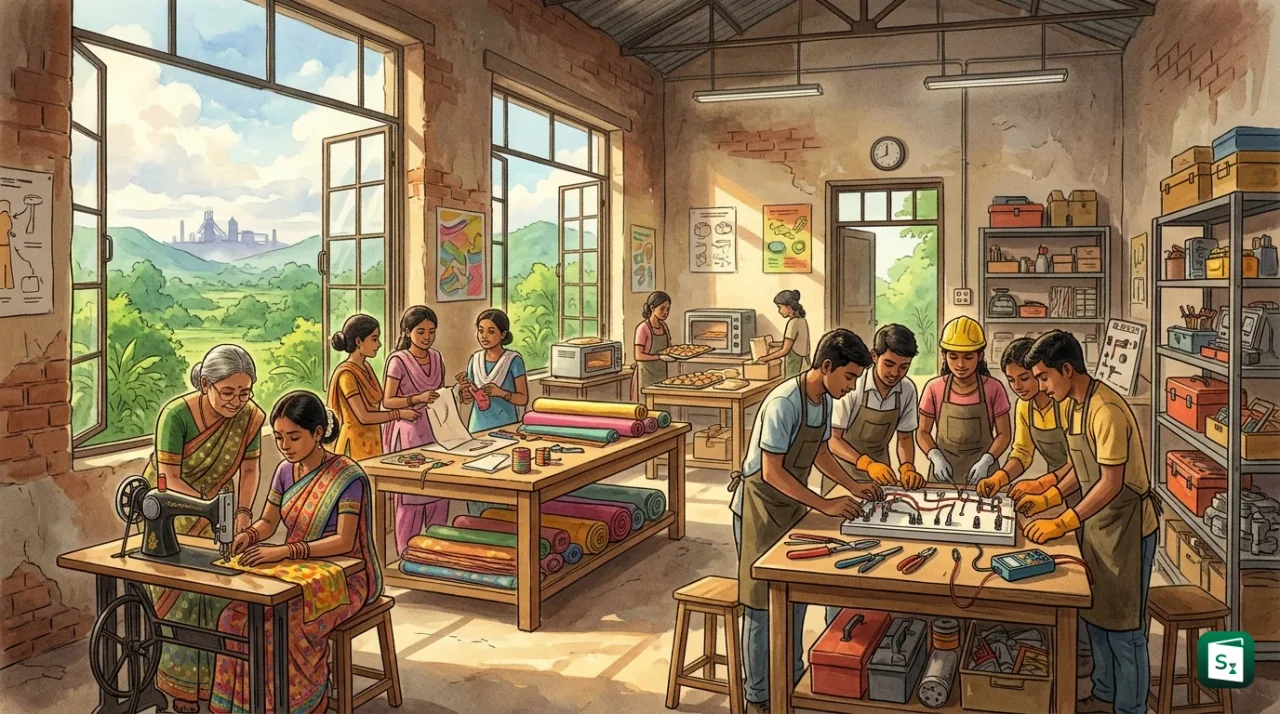
The Livelihood Business Incubation Centre at Rourkela is the execution point. The centre was set up to turn traditional skills into marketable trades. Under the new pact, vocational courses will be offered in six trades that need low starting capital and have local buyers. These are self employment tailoring, assistant beautician work, assistant computer operator work, bread and bakery making, mushroom farming and electrician work.
Training is hands on. A tailoring trainee learns cutting, stitching and costing. A bakery trainee learns hygiene, baking and packing. A mushroom farming trainee learns shed preparation, spawn use and harvest care. An electrician trainee learns house wiring and repair with safety rules. Each course ends with assessment and certification. After that, NSTFDC linked agencies guide willing candidates on loans, subsidy linkage and group formation.
The MoU itself is a statement of intent. An MoU, or Memorandum of Understanding, records what each party will do, but it is generally not a binding contract like a work order. Funds flow only after detailed project approvals, batch sanctions and utilization checks. Success will depend on regular batches, low dropout rates and actual loan disbursal after training.
Why This Pact Matters for Tribal Youth
Sundargarh has a large tribal population and hosts major industry, yet many tribal families remain in casual work. Young people often migrate for low paid jobs because they lack certified skills and collateral for loans. This pact addresses both gaps at the chosen location. Training happens near home in Rourkela. Finance comes on soft terms through NSTFDC norms.
The focus on women is important. Tailoring, beautician services, food processing and mushroom farming can be run from home or a small unit. A loan up to ₹2 lakh under AMSY at 4% interest can cover a sewing machine set, a beauty kit or a small bakery oven. Group loans through Self Help Groups can reduce risk further. For computer operator and electrician trades, wage jobs in local shops and service centres offer a second path.
In the larger policy picture, the pact fits the shift from one time assistance to enterprise creation. The Ministry of Tribal Affairs pairs schooling support through Eklavya Model Residential Schools with higher education and livelihood finance through bodies like NSTFDC. The Skill India system adds national certification. A steel plant adds stable local anchoring. If batches convert into loans and sales, the Rourkela model can be repeated in other tribal districts with large public sector units.
Key Takeaways
- The tripartite MoU was signed on 22 October 2026 at Rourkela between NSTFDC, NSDC and SAIL-Rourkela Steel Plant for tribal livelihood and entrepreneurship.
- NSTFDC, set up in 2001 under the Ministry of Tribal Affairs, provides concessional loans up to ₹50 lakh under its Term Loan Scheme.
- NSDC stands for National Skill Development Corporation and works under the Ministry of Skill Development and Entrepreneurship as the implementation partner of the Skill India Mission launched in 2015.
- SAIL, incorporated in 1973 and headquartered in New Delhi, is a Maharatna PSU under the Ministry of Steel.
- Initial training covers six trades including tailoring, beautician work, computer operator work, bakery, mushroom farming and electrician work, with over 60% women trainees.