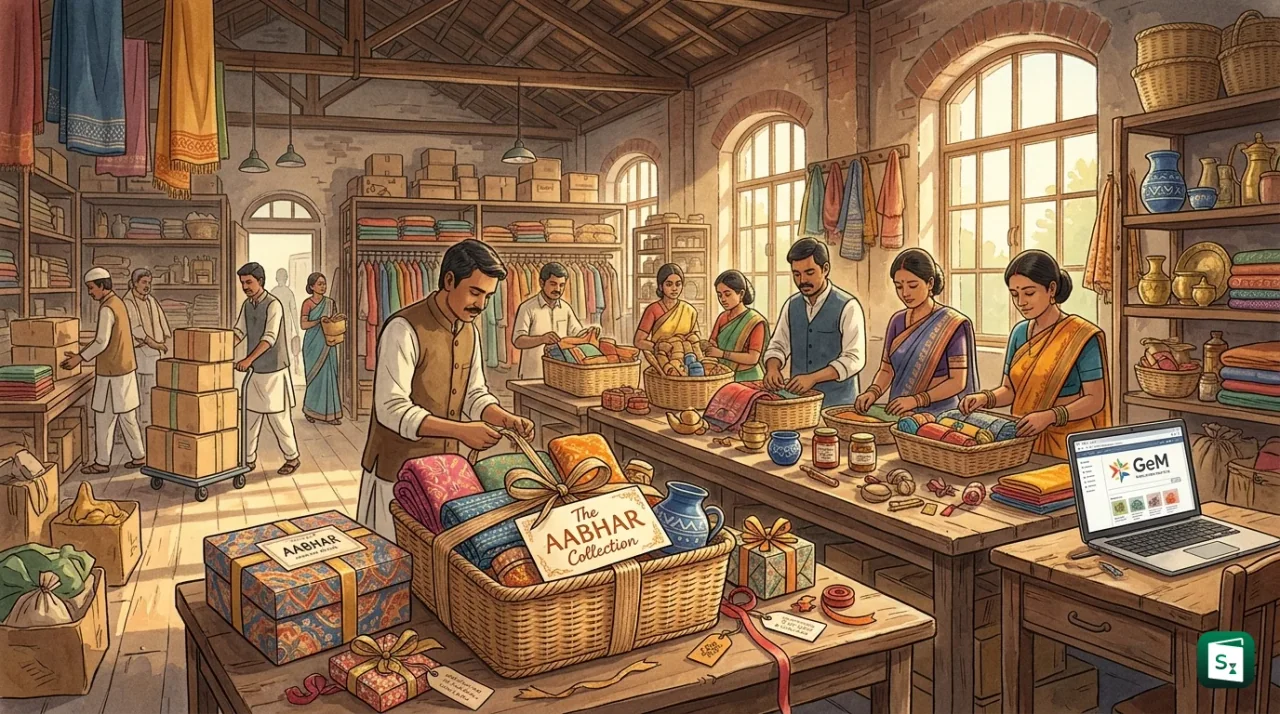
The Government e-Marketplace has started promoting The AABHAR Collection, a dedicated online storefront for curated Indian gift items and hampers, on 26 October 2026. The store hosts 294 product listings from 10 State and Central handloom and handicraft emporiums, with a focus on One District One Product items and Geographical Indication tagged crafts. The move links public procurement directly to artisans, weavers and women-led enterprises under the Vocal for Local push.
What Is the AABHAR Collection?
The AABHAR Collection is a dedicated Vocal for Local storefront on the Government e-Marketplace for curated gift items and hampers that showcase the cultural heritage of India. The word aabhar means gratitude in Hindi, and the store is designed for official gifting that thanks recipients while supporting local makers.
The store brings together handicrafts, handlooms, artisanal foods, pantry products and personal care items in ready to gift formats. Government buyers can access the collection at gem.gov.in/Aabhar and use it for official ceremonies, conferences, State events, gifts for foreign delegations, employee recognition, retirement functions and festive occasions.
The idea for the store was first developed in July 2024 to give the artisanal ecosystem a direct link to public procurement. GeM Chief Executive Officer Mihir Kumar (as of October 2026) said the collection improves the visibility of indigenous arts and crafts and empowers underserved seller groups through Central and State emporiums. GeM Additional Chief Executive Officer Ajit B. Chavan, who handles social inclusion, said the store allows Ministries, Departments and public sector undertakings to meet gifting needs while supporting indigenous products and local livelihoods.
What Is the GeM Portal and How Does It Work?
The GeM Portal is the Government e-Marketplace, India’s national online platform for public procurement. It functions as a transparent end to end marketplace where government buyers purchase common use goods and services from registered sellers, with online ordering, bidding and contract generation.
The GeM initiative was launched on 9 August 2016 by the Ministry of Commerce and Industry and operates under the administrative control of the Department of Commerce. The platform was built in about five months with technical support from the National e-Governance Division and the Ministry of Electronics and Information Technology, following recommendations by two Groups of Secretaries in January 2016 and an announcement in the Union Budget for 2016-17.
The Union Cabinet approved the creation of the GeM Special Purpose Vehicle (SPV) on 12 April 2017, and the SPV was set up as a Section 8 not for profit company on 17 May 2017. Use of GeM by government buyers was made mandatory through Rule 149 of the General Financial Rules, 2017 issued by the Ministry of Finance. The old Directorate General of Supplies and Disposals was wound down as GeM became the central procurement portal.
GeM is open for buying only to government users. These include Central and State Ministries and Departments, public sector enterprises, autonomous institutions, local bodies, panchayats and cooperative societies. Sellers can be from any segment, including micro and small enterprises, startups, artisans, weavers, women entrepreneurs and large firms.
Buyers on GeM can purchase directly for low value orders, invite bids for competitive requirements, or hold a reverse auction where sellers compete to offer the lowest price. The portal provides rich product and service listings, price trend insights, integrated payments and system generated contracts. GeM charges no high commission. It levies only a nominal transaction fee of 0.3 percent once a seller crosses cumulative business of ₹20 lakh in a year.
What Is a GI Tag and Why Is It Given?
A Geographical Indication (GI) tag is a sign that identifies agricultural goods, natural goods or manufactured goods including handicrafts as originating from a specific place. The tag is given when a given quality, reputation or other feature of the product is essentially linked to its geographical origin.
In India, GIs are protected under the Geographical Indications of Goods (Registration and Protection) Act, 1999, which came into force on 15 September 2003. India enacted the law as a member of the World Trade Organization to meet its duties under Articles 22 to 24 of the TRIPS Agreement. GIs are also recognised as an element of industrial property under the Paris Convention. The Geographical Indications Registry located in Chennai examines and registers applications, and works under the Office of the Controller General of Patents, Designs and Trade Marks.
A GI is owned collectively by producers of a region, not by a single company. It cannot be transferred or licensed like a private trademark. A trademark identifies one business, such as Tata or Haldiram’s, while a GI identifies all genuine makers from one place, such as Darjeeling Tea, Banarasi Saree, Kanchipuram Silk Saree, Chanderi Saree and Bikaner Bhujia. Darjeeling Tea became the first Indian product to receive the tag in 2004. Registration gives legal protection, prevents unauthorised use and assures buyers of authenticity. Misuse of a registered GI to mislead buyers is a punishable offence.
For the AABHAR Collection, the GI link matters in two ways. It guarantees that a government buyer receives an authentic regional craft with a verified origin story, suitable for presentation to dignitaries and delegations. It also helps artisan clusters earn a premium for heritage, skill and place based reputation rather than competing only on price.
What Is the ODOP Scheme?
The One District One Product (ODOP) scheme is a programme that selects one signature product from each district and builds support around it for production, branding, packaging, finance and market access. The full form of ODOP is One District One Product, and an ODOP product can be a craft, textile, food item or other local speciality with employment potential.
The model began in Uttar Pradesh on 24 January 2018, when the State government launched ODOP for its 75 districts to create product specific hubs, reduce migration and raise rural incomes. Products such as leather goods from Agra, sports goods from Meerut and locks from Aligarh became well known examples of district specialisation. The State later reported strong export growth and training of more than one lakh artisans with modern toolkits.
Seeing this result, the Central government extended ODOP to all States and Union Territories as a step towards Aatmanirbhar Bharat. The initiative was operationally merged with the Districts as Export Hub (DEH) initiative of the Directorate General of Foreign Trade in the Department of Commerce, with the Department for Promotion of Industry and Internal Trade (DPIIT) as a major stakeholder. The Ministry of Food Processing Industries also adopted the ODOP approach under the PM Formalisation of Micro Food Processing Enterprises (PMFME) Scheme to gain scale in input purchase, common services and marketing.
For GeM buyers, the ODOP tag works like a ready directory. It tells a buyer which district is known for what, and assures a supply chain that has received government attention on quality and packaging. For makers, it converts a scattered local craft into a branded district asset that can reach buyers in Delhi or any other State through an online marketplace.
Ten Emporiums and 294 Listings: Inside the Storefront
The AABHAR storefront currently hosts 294 product catalogue listings sourced from 10 State and Central handloom and handicraft emporiums. These emporiums act as aggregators. They collect quality checked products from artisans, weavers and rural entrepreneurs and list them on GeM, so a government office does not need to approach hundreds of small sellers individually.
| Emporium Name on GeM | Parent Organisation or State |
|---|---|
| COTTAGE | Central Cottage Industries Emporium |
| KHADI INDIA | Khadi and Village Industries Commission |
| Garvi Gurjari | Gujarat |
| Himcrafts | Himachal Pradesh |
| Jharcraft | Jharkhand |
| Cauvery | Karnataka |
| Mrignayani | Madhya Pradesh |
| Marhati | Maharashtra |
| Purbashree | North East region |
| Poompuhar | Tamil Nadu |
The Central Cottage Industries Emporium retails crafts from across India and serves as a national showcase for handloom and handicraft clusters. The Khadi and Village Industries Commission (KVIC) is a statutory body set up under the Khadi and Village Industries Commission Act, 1956 and works under the Ministry of Micro, Small and Medium Enterprises to promote khadi and village industries. State emporiums such as Poompuhar, Cauvery and Mrignayani similarly carry the craft identity of their States, from textiles and woodwork to metal craft and handloom weaves.
GeM has said seven more government emporiums and organisations are at an advanced stage of seller onboarding. These are the Coffee Board, Manjusha and Biswa Bangla from West Bengal, the Jammu and Kashmir Handloom and Handicrafts Marketing Corporation, Merakai from Nagaland, Utkalika from Odisha and Panthoibi from Manipur. Their entry is expected to widen regional representation, especially from the east, north and northeast, and to add plantation products such as coffee alongside crafts.
Significance for Artisans and Government Buyers
For artisans, the store solves the oldest problem of craft livelihoods, which is access to a large and reliable buyer. A weaver in a remote cluster can now reach a Ministry in New Delhi without an intermediary chain that eats into margins. The focus on women-led enterprises, rural entrepreneurs and underserved seller groups places the collection within GeM’s wider inclusion mission. GeM had reported more than 10 lakh micro and small enterprises, 1.3 lakh artisans and weavers and 1.84 lakh women entrepreneurs on the platform (as of May 2025), and the AABHAR store builds directly on that base.
For government buyers, the store simplifies official gifting. Offices often need culturally appropriate gifts at short notice for ceremonies and delegation visits. A single curated catalogue with fixed product details, clear pricing and online contracts reduces search time and improves transparency compared to local market purchases. Because the products carry ODOP and GI identities, the gift also carries a clear regional story, which is valuable when honouring guests, recognising staff or marking State functions.
The initiative also supports the broader goals of Vocal for Local, Make in India and Aatmanirbhar Bharat by turning routine public spending on gifts into demand for domestic heritage products. Institutional orders can smooth seasonal income swings for craft families, though such demand will still follow the official calendar and festival season.
The Way Forward
The immediate next step is the onboarding of the seven additional emporiums and organisations that are already in the pipeline. Their catalogues will increase the count beyond 294 listings and fill current gaps in representation from West Bengal, Jammu and Kashmir, Nagaland, Odisha and Manipur. The addition of the Coffee Board will also test whether plantation and artisanal food products can sit comfortably alongside handlooms in a gifting catalogue.
Sustained success will depend on quality control, attractive packaging, timely delivery and clear product stories that explain the ODOP or GI link to the end user. If the store maintains these standards, it can become a regular channel for Ministries, public sector undertakings, autonomous bodies and local governments to combine protocol needs with support for local livelihoods.
Key Takeaways
- The AABHAR Collection was promoted by GeM on 26 October 2026 as a dedicated storefront for Indian heritage gift items and hampers.
- The store hosts 294 product listings from 10 State and Central handloom and handicraft emporiums.
- Products in the collection are linked to the One District One Product initiative and Geographical Indication tags.
- GeM was launched on 9 August 2016 by the Ministry of Commerce and Industry and its SPV was set up on 17 May 2017.
- The Geographical Indications of Goods Act, 1999 came into force on 15 September 2003 and the GI Registry is located in Chennai.
- The ODOP programme began in Uttar Pradesh on 24 January 2018 and was later extended across India with support from the Districts as Export Hub initiative.