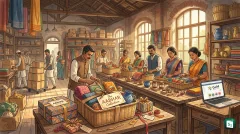
The Government e Marketplace (GeM) and the Textiles Committee have signed an agreement to bring recycled and upcycled textile products into government buying in Mumbai during the 62nd Foundation Day celebrations of the Textiles Committee. The pact will create a Waste-to-Value-to-Market system that turns pre-consumer waste, post-consumer waste, factory scrap and second-hand clothes into certified products for government offices. It links sustainability and the circular economy in India with the scale of public procurement.
What Did GeM and the Textiles Committee Agree To Do?
The Government e Marketplace (GeM), which works under the Ministry of Commerce and Industry, and the Textiles Committee, which works under the Ministry of Textiles, signed a Memorandum of Understanding (MoU) to promote recycled and upcycled textile products through government procurement. The MoU was signed in Mumbai during the 62nd Foundation Day celebrations of the Textiles Committee in early September 2026. It was signed by Ajit B. Chavan, Additional Chief Executive Officer of GeM, and Kartikay Dhanda, Secretary of the Textiles Committee, in the presence of Union Textiles Minister Giriraj Singh and Maharashtra Textiles Minister Sanjay Savkare.
The pact covers products made from pre-consumer and post-consumer textile waste, factory scrap and second-hand clothes. Pre-consumer waste means offcuts, rejected fabric and scraps that never reached a shop. Post-consumer waste means used clothes and home textiles thrown away by households. Instead of sending this material to landfills, the two bodies want to convert it into quality assured goods that government departments can buy for offices, schools, hospitals, hostels and gifting needs.
The central idea is called the Waste-to-Value-to-Market ecosystem. Waste generators will supply discarded textiles. Recyclers and upcyclers will process them into new products. The Textiles Committee will check quality and certify genuine makers. GeM will then list these products in special online categories so that more than 1.37 lakh government buyer organisations can discover and purchase them easily.
What Is the Government e Marketplace (GeM)?
GeM stands for Government e Marketplace. It is the national online portal for government procurement, which means purchase of goods and services by government departments using public money. GeM was launched on 9 August 2016 by the Ministry of Commerce and Industry. It is owned by GeM SPV, a 100 percent government owned non-profit company under the same ministry. The chief executive officer of GeM is Mihir Kumar.
The portal was created to replace slow, paper based buying with a transparent, paperless, cashless and contactless system. Purchases through GeM are backed by Rule 149 of the General Financial Rules, 2017, issued by the Ministry of Finance. Central ministries, departments, public sector undertakings, autonomous bodies, local bodies, panchayats and cooperatives can buy through the portal. State governments are also encouraged to use it.
In ten years GeM has grown into one of the largest public buying platforms in the world. By August 2026 it had crossed ₹20 lakh crore in cumulative procurement value through more than 3.78 crore orders. Annual buying crossed ₹5 lakh crore in both 2024-25 and 2025-26, up from only ₹422 crore in 2016-17. The platform now connects nearly 25 lakh sellers and service providers with buyers across India. It offers more than 10,660 product categories and 350 service categories. Micro and small enterprises hold a share of more than 40 percent, with orders worth over ₹9.07 lakh crore fulfilled by them.
How Government Procurement Works on GeM
A seller first registers on gem.gov.in and lists products with prices and specifications. A government buyer searches for the item, compares options and places an order through direct purchase, bidding or reverse auction. A reverse auction is a process where sellers compete by lowering their price to win the order. Payment is made online after delivery and acceptance. The full trail from listing to payment stays on the portal, which helps reduce human interference, allows price discovery and makes it easier to spot cartelisation or order splitting with data tools.
What Is the Textiles Committee?
The Textiles Committee is a statutory body set up under the Textiles Committee Act, 1963. Parliament passed the Act in its 14th year of the Republic. It received the assent of the President on 3 December 1963 and the Committee started functioning from 22 August 1964. It works under the administrative control of the Ministry of Textiles and has its headquarters in Mumbai. The present Union Textiles Minister is Giriraj Singh.
Its main job is to ensure standard quality of textiles and textile machinery for both domestic use and exports. Under Section 4 of the Act, it can carry out scientific and economic research, fix standard specifications, set up laboratories for testing, train people in quality control methods, inspect textiles and machinery, promote exports, collect statistics and advise the central government on textile development. The Committee is managed by a body of 29 members as laid down in the Act and the Textiles Committee Rules, 1965. It includes a Chairman from industry, a Vice Chairman who is the Textile Commissioner, a Secretary who acts as the chief executive, along with ex-officio members and representatives from federations and export promotion councils.
Over the years the Committee has built a pan India network of laboratories and regional offices in major textile centres such as Tirupur, Coimbatore, Chennai, Karur, Ahmedabad, Bengaluru, Ludhiana and Kolkata. These labs test fibre, yarn, fabric and garments for strength, colour, chemical safety and other parameters. This testing and certification experience is the reason GeM has chosen the Committee as the quality partner for recycled textiles.
What Are Recycled and Upcycled Textile Products?
Textile recycling means collecting waste fabric and converting it back into fibre, yarn or new fabric. For example, old sweaters are sorted by colour, shredded into soft fibre and spun again into yarn for blankets, carpets, bath mats and denim. Colour based sorting often avoids fresh dyeing, which saves large amounts of water and chemicals.
Recycled textiles are products made mainly by breaking down waste and rebuilding it, such as shoddy yarn, recycled polyester fibre from PET bottles and blankets made in Panipat. Upcycled textile products are products where waste material is reused creatively to make an item of equal or higher value without fully breaking it down, such as tote bags from old sarees, cushion covers from factory offcuts or decorative items and gifts from second-hand clothes. Both types keep material in use for longer and reduce demand for fresh cotton, wool and crude oil based polyester.
India generates about 7,073 kilo tonnes of textile waste every year, as estimated in the Ministry of Textiles study titled Mapping of Textile Waste Value Chain in India. About 58 percent of this is post-consumer waste and 42 percent is pre-consumer waste. Nearly 97 percent of pre-consumer waste is already recovered through recycling, upcycling and downcycling networks. More than 70 percent of total textile waste is channelled back into reuse or recycling. The ecosystem creates economic value of about ₹22,000 crore per year and is projected to support nearly 1 lakh new green jobs in the next five years.
Panipat in Haryana, often called the cast-off capital, shows how this system works on the ground. The cluster processes around 4,000 tonnes of textile waste daily, or about 14.5 lakh tonnes per year, and supplies recycled yarns, blankets and home furnishings to domestic and foreign markets. It supports livelihoods for more than 4 lakh workers, with women forming about 30 to 40 percent of the workforce in sorting and stitching work.
Circular Economy vs Linear Economy
The MoU is rooted in the idea of a circular economy. A circular economy is a system where products and materials are reused, repaired, recycled and kept in the economy for as long as possible. Sustainable procurement means the government prefers to buy goods that save resources, last longer and cause less harm to nature, along with looking at price and quality.
| Feature | Linear Economy | Circular Economy |
|---|---|---|
| Basic idea | Take raw material, make product, throw after use | Reduce use, reuse product, recycle material back into economy |
| Waste treatment | Waste is a burden to be dumped in landfill | Waste is a resource for new products |
| Example in textiles | Buy new uniform, discard old uniform | Collect old uniform, shred and spin into yarn for new blankets |
| Benefit | Simple in short term | Saves water, energy and raw material and creates jobs in collection and recycling |
How Will the Waste-to-Value-to-Market System Work?
The system connects three stages in one chain. First, waste is collected from factories, traders, municipalities and households. Second, recyclers and upcyclers add value by cleaning, sorting, processing and manufacturing finished goods. Third, these goods reach the market through GeM where government buyers can place assured orders. Quality checks at the middle stage give buyers confidence that a recycled blanket or upcycled gift meets the same specifications as a regular product.
The Textiles Committee will act as the quality hub. It will identify eligible makers, visit their units for on-site verification, certify genuine recyclers and upcyclers and recognise them for onboarding to GeM. It has already prepared a Standard Operating Protocol (SOP) for registration of upcycled makers, with an application fee of ₹5,000 plus 18 percent GST, and will help write technical specifications and catalogues for items like recycled towels, bedsheets, uniforms, carry bags and office furnishings. It will also hold stakeholder meetings, conduct market research and run capacity building programmes with artisans and enterprises.
GeM will act as the market gateway. It will create dedicated categories for recycled and upcycled textile products, simplify seller onboarding and build online linkages between certified sellers and buyers. It will promote these categories among ministries, departments, public sector units, schools and hospitals. It will also provide training and handholding so that small recyclers, women led units and last mile upcyclers can bid, receive orders and get payments on the portal without middlemen.
| Institution | Key Responsibility |
|---|---|
| Textiles Committee | Identify, verify, certify and recognise eligible producers |
| Textiles Committee | Develop technical specifications, catalogues and test methods |
| Textiles Committee | Carry out outreach, mobilisation, market research and capacity building through regional offices |
| GeM | Create dedicated recycled and upcycled product categories |
| GeM | Support seller registration, listing and digital market linkage |
| GeM | Promote products among government buyers and provide training for small sellers |
The partnership will follow a hub-and-spoke model. In this model, the central offices in Mumbai and New Delhi act as the hub that frames rules and categories, while regional offices of the Textiles Committee act as spokes that reach small units in clusters like Panipat, Tirupur, Surat and Ludhiana. This design matters because most recycling work is done by micro, small and medium enterprises (MSMEs), self help groups and informal sorting units that need local support to complete paperwork, testing and online listing.
This is not the first step in this direction. In 2024 the Textiles Committee, GeM and the Standing Conference of Public Enterprises (SCOPE) had signed a tripartite MoU to push upcycled products among central public sector enterprises. The present MoU widens that effort from only upcycled goods for public sector units to both recycled and upcycled goods for the entire government buyer base on GeM.
Why This Pact Matters for India
Government buying has the power to create steady demand. When thousands of offices and institutions start ordering certified recycled towels, linen and bags, recyclers get a clear signal to invest in better machines, sorting sheds and testing. This can lift the income of waste collectors, sorters, weavers and artisans, especially women, MSMEs, local enterprises and artisan clusters. The pact is therefore linked with Vocal for Local, Make in India and Atmanirbhar Bharat, because it turns domestic waste into domestic products for domestic institutions.
It also supports resource conservation and responsible consumption and production. Studies in the Panipat cluster show that recycling can cut key environmental impacts like greenhouse gas emissions and fossil fuel use by 30 to 40 percent compared to making fresh fibre. Colour sorted recycling avoids fresh dyeing and saves water in a sector where dyeing units use crores of litres daily. By keeping cloth in use, India also reduces landfill pressure and dependence on imported virgin fibre.
For buyers, certification solves a real problem. Earlier many officers hesitated to buy recycled goods because quality and specifications were unclear and there was no separate HSN code or catalogue for upcycled products. With standard specifications, lab testing and dedicated GeM categories, a buyer can compare a recycled product on price, quality and sustainability in the same way as any other product.
The Way Forward
The next test will be execution on the ground. The Textiles Committee will need to expand certification quickly without diluting quality, and GeM will need to ensure that listings are easy to find and that small sellers actually win orders. Clear catalogues, fair technical specifications and timely payments will decide whether last mile units stay on the platform.
The pact also fits into wider policy moves. The Union Budget for 2026-27 announced the Tex-Eco Initiative to support recycling technologies, recycled fibres and new materials from discarded textiles in partnership with research bodies and industry. The National Technical Textiles Mission is funding research on advanced recycling, including aramid fibre from protective gear, while PM Mega Integrated Textile Region and Apparel (PM MITRA) Parks aim to provide modern common infrastructure for sustainable manufacturing. If these supply side schemes and the new demand side channel through GeM move together, textile waste can shift fully from an environmental burden to a source of jobs and value.
Key Takeaways
- GeM under the Ministry of Commerce and Industry signed an MoU with the Textiles Committee under the Ministry of Textiles to promote recycled and upcycled textiles through government procurement.
- The MoU was signed in Mumbai during the 62nd Foundation Day of the Textiles Committee by Ajit B. Chavan and Kartikay Dhanda in the presence of Giriraj Singh.
- The pact creates a Waste-to-Value-to-Market system for goods made from pre-consumer waste, post-consumer waste, scrap and second-hand clothes.
- GeM was launched on 9 August 2016 and has crossed ₹20 lakh crore in cumulative procurement through more than 3.78 crore orders.
- The Textiles Committee is a statutory body under the Textiles Committee Act, 1963, functioning since 22 August 1964 with headquarters in Mumbai.
- India generates about 7,073 kilo tonnes of textile waste yearly, with Panipat processing about 4,000 tonnes daily as a global recycling hub.