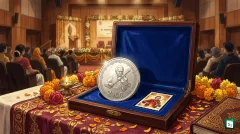
Vice President C. P. Radhakrishnan released a commemorative postage stamp for the Dinamalar 75th anniversary in Chennai on 5 September 2026. The stamp honours 75 years of the Tamil daily Dinamalar, which began publication on 6 September 1951. It recognises the newspaper’s long record of truthful reporting, patriotism and public service.
What Happened at the Chennai Event?
The release function was held in Chennai on 5 September 2026 to mark the platinum jubilee of Dinamalar, which means a daily flower in Tamil. The Vice President unveiled the stamp and presented the first album as part of the formal release. A senior official of the Department of Posts was present on the dais, along with the Editor and publishers of the Dinamalar group.
In his address, the Vice President said running a newspaper is hard, but running it with neutrality is even harder. He said a newspaper earns the trust of readers only when it stands firm against pressure and reports the truth without fear. He added that Dinamalar had built such trust over 75 years by placing patriotism and public service above other concerns.
The programme also included a short film on the 75 year journey of the newspaper. Greetings from Prime Minister Narendra Modi and Tamil Nadu Chief Minister M. K. Stalin were read out at the event. The Vice President specially praised Pattam, the group’s publication for school students, for building general awareness, language skills and interest in science among young readers.
Who Founded Dinamalar and How Did It Grow?
Dinamalar is a Tamil daily newspaper founded by T. V. Ramasubbaiyer, popularly known as TVR. He was born on 2 October 1908 near Nagercoil in present day Kanyakumari district of Tamil Nadu. He was a freedom fighter influenced by Gandhian ideas, and he worked for compulsory primary education and social welfare in the princely state of Travancore before entering journalism.
Ramasubbaiyer launched Dinamalar at Thiruvananthapuram on 6 September 1951. The name was suggested to convey clearly that it was a daily flower of news. The paper was inaugurated by noted Tamil scholar Vaiyapuri Pillai, who is known for compiling an early Tamil lexicon. At the launch, Ramasubbaiyer declared that the paper would not belong to any political party or religion and would give space to different views.
The early years were difficult. Tamil type setters were hard to find in Thiruvananthapuram, typesetting costs were high, and newsprint was costly. Yet the paper kept its price low at one anna and focused on local news with a fair share of national and world reports. Operations were later shifted to Tirunelveli in 1957, and new editions were opened across Tamil Nadu and Puducherry over the next five decades.
| Edition Centre | Year of Launch |
|---|---|
| Thiruvananthapuram (first launch) | 1951 |
| Tirunelveli | 1957 |
| Tiruchirappalli | 1966 |
| Chennai | 1979 |
| Madurai | 1980 |
| Erode | 1984 |
| Puducherry | 1991 |
| Coimbatore | 1992 |
| Vellore | 1993 |
| Nagercoil | 1996 |
| Salem | 2000 |
Today Dinamalar is headquartered in Chennai and is published by Professional Publication Private Limited, which is fully owned by the family of Ramasubbaiyer’s son R. Lakshmipathy. After Ramasubbaiyer’s death in 1984, his sons and grandsons expanded the group. The paper is now among the most read Tamil dailies, with a circulation of about 6.9 lakh copies and a readership of more than one crore, and it is known for weekly supplements for women, students, farmers and professionals.
Who Is Vice President C. P. Radhakrishnan?
Chandrapuram Ponnusamy Radhakrishnan is the 15th Vice President of India. He was born on 4 May 1957 in Tiruppur, Tamil Nadu, and completed a Bachelor’s degree in Business Administration from V. O. Chidambaram College, Thoothukudi. Before entering full time public life, he worked as a garment exporter. He joined the Rashtriya Swayamsevak Sangh as a young volunteer and became a member of the Tamil Nadu executive of the Bharatiya Jana Sangh in 1974.
Radhakrishnan was elected to the Lok Sabha from Coimbatore in 1998 and 1999 as a Bharatiya Janata Party candidate. In Parliament he served on committees on commerce, textiles, public undertakings and finance. He later served as president of the Tamil Nadu unit of the BJP, as Chairman of the Coir Board in Kochi from 2016 to 2020, and as the party’s in charge for Kerala. He was appointed Governor of Jharkhand in February 2023, held additional charge as Governor of Telangana and Lieutenant Governor of Puducherry in 2024, and served as Governor of Maharashtra from July 2024 to September 2025.
He was elected Vice President on 9 September 2025 after the resignation of former Vice President Jagdeep Dhankhar. He secured 452 votes against 300 votes for former Supreme Court judge B. Sudershan Reddy. He took oath on 12 September 2025. The President Droupadi Murmu administered the oath at Rashtrapati Bhavan.
The office of Vice President is created by Article 63 of the Constitution. Under Article 64, the Vice President is the ex officio Chairman of the Rajya Sabha, which is the Council of States and the upper House of Parliament. Under Article 66, the Vice President is elected by members of both Houses of Parliament through proportional representation by single transferable vote and secret ballot. A candidate must be a citizen of India, must have completed 35 years of age, and must be qualified to be a member of the Rajya Sabha. Under Article 67, the term is five years. Under Article 65, the Vice President acts as President when the post falls vacant by death, resignation or removal, until a new President takes charge.
What Is a Commemorative Postage Stamp?
A postage stamp is a small paper slip issued by the postal authority as proof that postage has been paid for a letter or parcel. A commemorative postage stamp is a special stamp issued to honour an important event, institution, personality, place, or cause. It is different from a definitive stamp, which is printed in large numbers for everyday postal use. Commemorative stamps are printed in limited numbers and are sold mainly through philatelic bureaux and Philatelic Deposit Accounts.
In India, commemorative stamps are issued by the Department of Posts, which works under the Ministry of Communications. Any citizen can send a proposal for a stamp. The Department allows not more than 50 issues, or 100 stamps, in a year. A stamp is issued only for subjects of national or global importance that can be shown in a clear and attractive design. A stamp on an apex institution can be issued on its 50th, 75th, 100th, 125th or 150th anniversary. No stamp is issued on a living person. A stamp on a person is normally considered only on a birth centenary or on the 10th, 25th, 50th or 100th death anniversary, and not earlier than ten years after death.
The study and collection of stamps is called philately. Collectors often buy a first day cover, which is an envelope carrying the new stamp cancelled with a special seal on the first day of issue, along with an information brochure about the subject. India Post runs philatelic bureaux in major cities and offers deposit accounts for regular collectors.
India has a long stamp history that often appears in general knowledge questions. The world’s first adhesive postage stamp was the Penny Black, issued in Britain in 1840. Asia’s first adhesive stamp was the Scinde Dawk, a half anna embossed stamp issued on 1 July 1852 in Sindh province under Sir Bartle Frere. India’s first national stamp series was issued in October 1854 after postal reforms that introduced uniform postage based on weight. Since August 1947, India has issued hundreds of stamps on freedom fighters, leaders, culture, nature, sports and institutions.
Why This Honour Matters for Journalism and Public Service
A commemorative stamp is more than a postal receipt. It is a national honour that preserves a milestone in public memory. For Dinamalar, it marks survival and growth from a 3,000 copy paper in 1951 to a multi edition daily that has stayed non aligned to any party or religion. The honour places a Tamil newspaper’s journey within the larger story of free press in independent India.
The event also underlines the link between journalism and public trust. The Vice President’s message placed three tests for the press, which are truth, neutrality under pressure, and service to readers. Dinamalar’s work in school education through Pattam shows how a newspaper can shape young readers beyond daily news. By honouring such service, the stamp reminds readers that credible journalism supports learning, social reform and democratic debate.
Key Takeaways
- Vice President C. P. Radhakrishnan released the Dinamalar 75th anniversary commemorative stamp in Chennai on 5 September 2026.
- Tamil daily Dinamalar was founded by T. V. Ramasubbaiyer at Thiruvananthapuram on 6 September 1951.
- C. P. Radhakrishnan is the 15th Vice President of India and took oath on 12 September 2025 after winning 452 votes.
- Under Article 64, the Vice President is the ex officio Chairman of the Rajya Sabha, and under Article 66 is elected by members of both Houses of Parliament.
- A commemorative stamp is a limited issue honour, while philately is the study and collection of stamps through India Post.
- Asia’s first adhesive stamp was the Scinde Dawk issued on 1 July 1852, and the world’s first was the Penny Black of 1840.