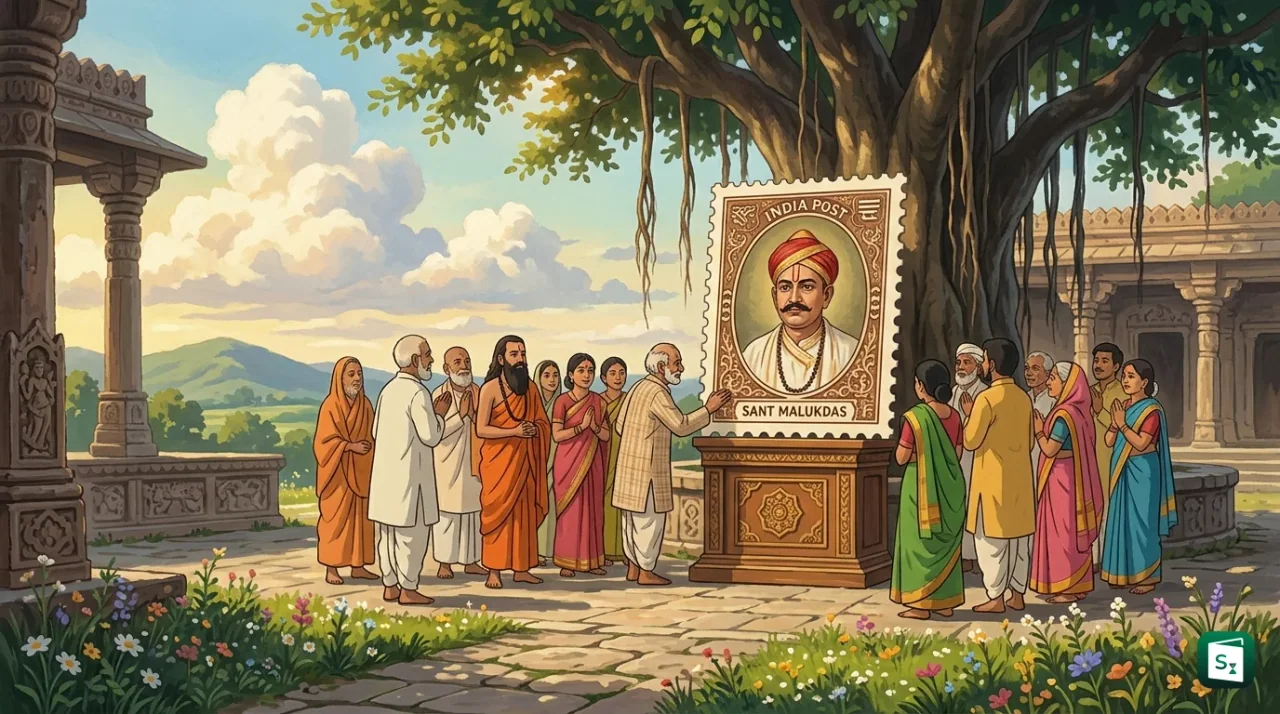
Union Minister for Communications Jyotiraditya Scindia released a commemorative postage stamp of India honouring Bhakti saint Sant Malukdas on 15 September 2026. The Department of Posts issued the stamp and the release took place during the Sant Samagam organised in memory of the saint. The honour places the 17th century poet saint of Kara in Prayagraj into the national philately record read in homes across the country.
What Is a Commemorative Stamp?
A commemorative stamp is a special postage stamp issued by India Post to honour a person, event, institution or aspect of heritage. It is valid for postage but printed in limited quantity for collection and memory. It differs from a regular definitive stamp used daily.
A commemorative postage stamp is a stamp brought out for a fixed purpose and period. Philately, the study and collection of stamps, treats such issues as a record of national memory. India Post issues commemorative stamps on personalities, anniversaries, cultural traditions, flora and fauna, institutions and events of national or international importance.
A definitive stamp is different. It is the ordinary stamp printed in large numbers for everyday postal use and reprinted as needed. A commemorative stamp is printed once, sold through Philately Bureaux and the ePostOffice portal, and withdrawn after stocks end. Collectors keep it with its First Day Cover and information brochure.
India’s first commemorative issue after Independence honoured Mahatma Gandhi. The four-stamp Gandhi memorial set was released on 15 August 1948, the first anniversary of Independence. Since then, India Post has issued stamps on saints and poets, artists, scientists, freedom fighters and public institutions, building a visual archive of Indian history.
Stamp Release at Sant Samagam
The Department of Posts released the Sant Malukdas commemorative stamp on 15 September 2026. Union Minister Jyotiraditya Scindia, who holds the portfolios of Communications and Development of North Eastern Region (as of September 2026), unveiled the stamp during the Sant Samagam organised in memory of the saint.
The Department of Posts stated that the stamp links the message of Sant Malukdas on devotion, service and humanity with national memory. The release also coincided with the inauguration of Shri Ram Katha at the venue. The Department of Posts underlined the devotion of Sant Malukdas to Lord Ram as a teaching on duty, truth, compassion, sacrifice, justice and public welfare.
The event was attended by saints, mahatmas, devotees from different parts of the country and office bearers of the Shri Maluk Peeth Seva Sansthan Nyas, the trust connected with the preservation of the saint’s seat and tradition. The Minister said such postal honours help younger generations connect with India’s spiritual heritage and carry that heritage from city to village through letters and collections.
Meaning and Format of Sant Samagam
The term Sant Samagam means a gathering of saints. A Samagam brings saints, followers and scholars together for discourse, bhajan, katha and collective remembrance of a saint or teaching.
The Sant Samagam for Sant Malukdas was a memorial gathering. Such gatherings usually include prayer, narration of the saint’s life, singing of dohe and vani, and addresses by senior saints. In this case, the gathering also served as the venue for a state honour, the release of a postage stamp, which gave the religious event a national and archival character.
Who Was Sant Malukdas?
Sant Malukdas was a 17th century Bhakti poet saint from Kara, near Prayagraj in present day Uttar Pradesh. He taught the unity of God, equality of all humans and devotion without pride or show. His simple Hindi couplets made him one of the most remembered householder saints of north India.
Sant Malukdas was born in 1574 in Kara (also written Kada), now in Kaushambi district on the bank of the Ganga. His childhood name was Mallu. He was born in a prosperous Kakkar Khatri family engaged in farming, and his father’s name is recorded as Sundardas. Traditional accounts say he lived a very long life of 108 years and passed away in 1682.
The Department of Posts places Sant Malukdas in the Bhakti movement, the medieval devotional movement that stressed direct love of God, use of local languages and rejection of caste pride and empty ritual. Like Kabir, Guru Nanak, Mirabai and Surdas, Sant Malukdas spoke of one God present in all beings. His famous line sums up his view, jati pati poochhe nahi koi, Hari ko bhaje so Hari ka hoi, which means no one is asked about caste in the house of God and whoever worships God belongs to God.
Sant Malukdas lived as a householder, not as a renouncer. He married and had a daughter, and after the early death of his wife and daughter he turned fully to devotion and public service. Tradition records that Mughal emperor Aurangzeb respected him and granted two villages for the upkeep of his gaddi, the spiritual seat. The seat at Kara, along with the samadhi complex, remains a centre of the Maluk tradition.
A well known episode in his life explains his most famous couplet. When dacoits in the forest forced him to eat food that had mysteriously reached them, he saw it as proof that God provides for all beings without asking. After returning to his village, he composed the doha that made him famous across north India.
Literary Legacy and Dohe of Sant Malukdas
Sant Malukdas wrote in simple Hindi and Awadhi, the language of common people, so that even those without formal schooling could sing and remember his words. His short dohe, or rhyming couplets, and vani, or sacred sayings, focus on trust in God, honest work, compassion and freedom from maya, the illusion of pride and greed.
His most quoted doha is:
Ajgar kare na chakri, panchhi kare na kaam, Das Maluka keh gaye, sab ke data Ram.
It means the python does no service and the bird does no labour, yet God as Ram gives food to all. The couplet teaches that the provider of the world sustains every creature, so humans should live with faith, humility and care for others.
Scholars attribute around 21 works to Sant Malukdas, though lists vary because many verses survived through oral singing and handwritten copies. The most cited works include Ratna Khan (also called Das Ratna), Gyan Bodh and Maluk Shatak, a collection of about one hundred couplets. Other titles mentioned in Hindi literary histories are Sukh Sagar, Gyan Parochi, Dhruv Charit and Maluk Parichai. Together they present a nirgun path, devotion to a formless God beyond images and rituals, combined with service to people.
The saint’s inclusive approach is seen in the story of his Muslim disciple. An officer sent during Mughal rule became his follower after a test of sincerity and was given the name Meer Mahdav, joining the words Meer and Madhav. The samadhi of this disciple stands near the samadhi of Sant Malukdas at Kara, a symbol of Hindu Muslim harmony often recalled in accounts of his life.
Department of Posts and India Post Philately
The Department of Posts, which operates under the Ministry of Communications, issued the Sant Malukdas stamp. The Department of Posts, founded in its modern form in 1854, runs India Post, one of the largest postal networks in the world with more than 1.5 lakh post offices, most of them in rural areas.
The Postal Services Board is the apex management body of the Department of Posts. It is headed by the Chairperson and includes members in charge of personnel, operations, technology, financial services and other functions. Philately is one of its core verticals, along with mail, savings, insurance and retail services.
India Post follows a yearly stamp calendar for commemorative issues. Proposals for saints, artists, institutions and events are examined for national importance, anniversaries and heritage value. Recent 2026 issues show this pattern. India Post released a set of eight stamps on Puppets of India in February 2026 and a stamp on artist Satish Gujral in August 2026 to mark his birth centenary. The Sant Malukdas issue continues this focus on cultural icons in the 2026 postal issue timeline.
| Aspect | Detail for Sant Malukdas Issue |
|---|---|
| Issuing authority | Department of Posts, Ministry of Communications |
| Released by | Union Minister Jyotiraditya Scindia |
| Date of release | 15 September 2026 |
| Venue and occasion | Sant Samagam in memory of the saint |
| Category | Commemorative postage stamp on personality and heritage |
India Post Stamps Online and Availability
India Post sells commemorative stamps through Philately Bureaux in major head post offices and online through ePostOffice. Collectors can buy the stamp, First Day Cover and brochure as philatelic items and can also open a Philately Deposit Account to receive new issues regularly.
Young collectors increasingly buy India Post stamps online through the ePostOffice portal. For such buyers, India Post provides a catalogue, images of new designs and a calendar of releases. The India Post stamp catalogue helps collectors track issues by year, theme and denomination without visiting a post office.
Such easy access matters because a stamp is more than postage. A small stamp travels from city to village and preserves history, culture and collective memory. By placing Sant Malukdas in the commemorative stamps of India series, the Department of Posts has made his teaching on equality and trust available to schools, libraries and stamp albums for years to come.
Key Takeaways
- The Sant Malukdas commemorative postage stamp was released on 15 September 2026 by Union Minister Jyotiraditya Scindia at the Sant Samagam.
- The stamp was issued by the Department of Posts under the Ministry of Communications.
- Sant Malukdas was born in 1574 at Kara near Prayagraj and is remembered for the doha Ajgar kare na chakri.
- His key works include Ratna Khan, Gyan Bodh and Maluk Shatak, written in Hindi and Awadhi.
- India’s first commemorative stamp set honoured Mahatma Gandhi on 15 August 1948.