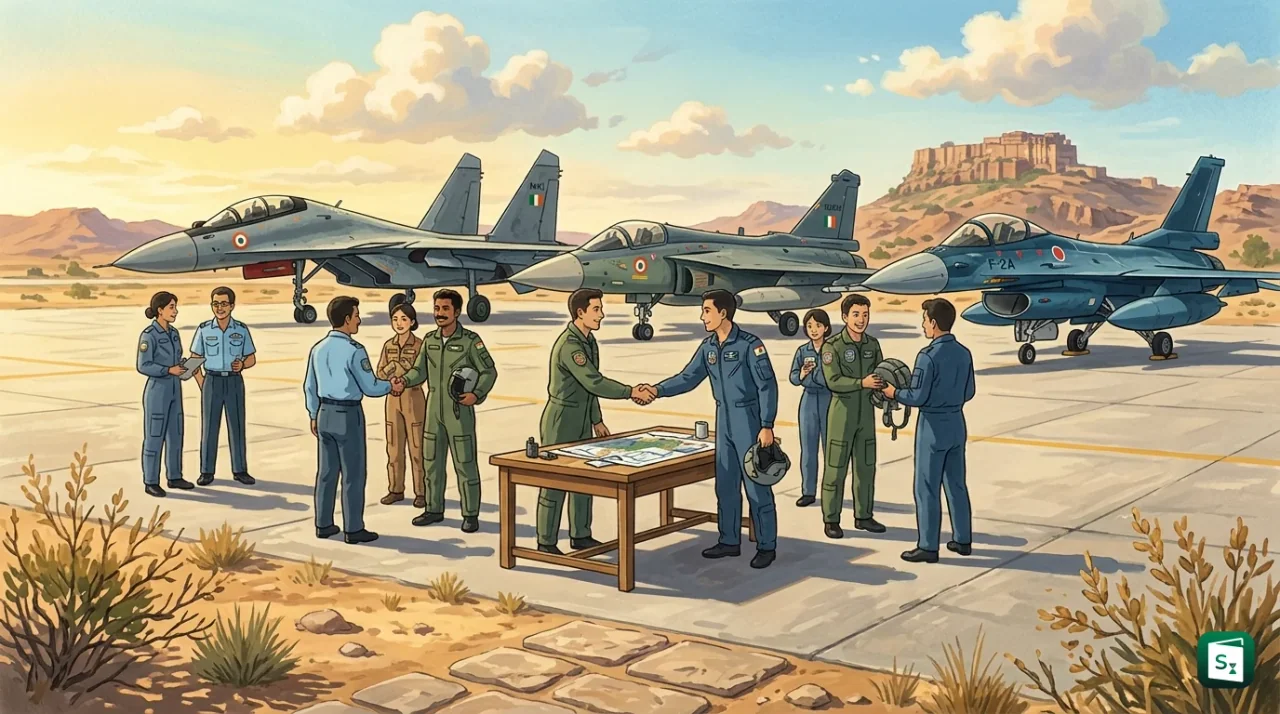
The bilateral air exercise Veer Guardian 2026 between the Indian Air Force and the Japan Air Self Defense Force concluded at Air Force Station Jodhpur in Rajasthan after a 14 day schedule from 9 to 22 September 2026. Three Japanese F-2A fighters operated from Indian soil for the first time and trained alongside Indian Su-30 MKI, Rafale and indigenous Light Combat Aircraft Tejas fighters. The second edition of the exercise focused on joint air combat manoeuvring, mission planning and interoperability to deepen the India Japan strategic partnership.
What Is Exercise Veer Guardian and Which Countries Take Part in It?
Exercise Veer Guardian is the bilateral air combat exercise between India and Japan, conducted by the Indian Air Force (IAF) and the Japan Air Self Defense Force (JASDF). The JASDF is the air branch of the Japan Self Defense Forces, while the IAF is the air arm of the Indian Armed Forces. The exercise aims to improve tactical skills, build mutual understanding and enable the two air forces to operate together in realistic conditions.
The Veer Guardian exercise is held between India and Japan only. The first edition, Veer Guardian 2023, was held at Hyakuri Air Base in Japan from 12 to 26 January 2023. The second edition, Veer Guardian 2026, was held at Air Force Station Jodhpur in Rajasthan from 9 to 22 September 2026. The two editions show an alternating host pattern, with each side taking turns to host frontline fighters of the other side.
Veer Guardian 2026 at Jodhpur: Aircraft and Training Missions
Exercise Veer Guardian 2026 was conducted at Air Force Station Jodhpur in Rajasthan and in the surrounding airspace. The Indian Air Force hosted the exercise from 9 to 22 September 2026, a period of 14 days. The Japan Air Self Defense Force has stated the core flying phase as 9 to 21 September, with deployment and return movement spread from 1 to 30 September. Two Japanese C-2 transport aircraft reached Jodhpur in early September with support crew and equipment, followed by the fighter detachment.
The Indian Air Force fielded a mixed package of three frontline fighter types. The package included the Russian origin Su-30 MKI air dominance fighter, the French origin Rafale multirole fighter and the indigenous Light Combat Aircraft (LCA) Tejas. The LCA Tejas is a single engine multirole fighter developed by the Aeronautical Development Agency and manufactured by Hindustan Aeronautics Limited. The Japan Air Self Defense Force fielded three F-2A fighters from the 8th Air Wing based at Tsuiki Air Base in Fukuoka Prefecture, along with about 110 personnel.
The training focused on air combat manoeuvring, interception and air defence missions in both visual range and beyond visual range settings. Beyond visual range means combat where aircraft target each other using radar and long range missiles without direct visual contact. The air crews also took part in mission planning conferences, exchanges between subject matter experts, and joint discussions on engineering practices and aerospace safety. These ground interactions helped both sides understand each others operating methods, communication procedures and maintenance practices.
Veer Guardian 2023 vs Veer Guardian 2026
The 2026 edition was the second edition of Exercise Veer Guardian. The first edition was conducted in Japan in January 2023. A comparison of the two editions shows how the scale and balance of participation have changed.
| Feature | Veer Guardian 2023 | Veer Guardian 2026 |
|---|---|---|
| Host location | Hyakuri Air Base in Japan | Air Force Station Jodhpur in Rajasthan, India |
| Dates | 12 to 26 January 2023, 16 days of joint training | 9 to 22 September 2026, 14 days |
| Indian participation | Four Su-30 MKI fighters, two C-17 Globemaster transport aircraft, one IL-78 refuelling aircraft, about 150 personnel | Su-30 MKI, Rafale and LCA Tejas fighters |
| Japanese participation | Four F-2 fighters and four F-15 fighters | Three F-2A fighters from the 8th Air Wing, about 110 personnel, supported by C-2 transport aircraft |
| Historic first | First ever bilateral fighter exercise between the IAF and the JASDF | First time JASDF fighter aircraft operated from Indian soil |
During Veer Guardian 2023, air crews of both sides also flew in each others fighter aircraft to understand different operating philosophies. The same spirit continued in 2026. On 20 September 2026, IAF Chief Air Chief Marshal Amar Preet Singh and JASDF Chief of Staff General Takehiro Morita flew in a Tejas formation at Jodhpur. Air Chief Marshal Singh led in a fighter version, while General Morita flew in a trainer version with Group Captain I. Samrat, the Commanding Officer of the Tejas squadron. The IAF chief described the Japanese chiefs Tejas sortie as a clear sign of faith in the homegrown aircraft.
Why the First F-2A Deployment to India Matters
The biggest milestone of Veer Guardian 2026 was the first operational deployment of Japanese fighter aircraft to India. The three F-2As flew from Tsuiki Air Base via Naha Air Base in Okinawa and Thailand to reach Jodhpur. Such a long distance ferry flight tested planning, refuelling support, maintenance and coordination across countries. It also put into practice the India Japan Acquisition and Cross Servicing Agreement (ACSA).
The Acquisition and Cross Servicing Agreement was signed in September 2020 and came into force in July 2021. It creates a framework for the reciprocal provision of supplies and services between the Indian Armed Forces and the Self Defense Forces of Japan. In simple terms, it allows each side to provide food, fuel, transport, accommodation and other logistics support to the other during exercises, training, peacekeeping, humanitarian relief and evacuation operations. The agreement makes joint exercises smoother and faster to organise.
The aircraft choice added training value. The Mitsubishi F-2A is a single engine multirole fighter jointly developed by Mitsubishi Heavy Industries of Japan and Lockheed Martin of the United States, with manufacturing shared in an approximate 60 to 40 ratio. The F-2A entered service in 2000 and is derived from the American F-16 Fighting Falcon, but it has a larger wing, greater use of composite materials and an advanced active electronically scanned array radar. Japan operates about 91 F-2A and two seat F-2B aircraft (as of March 2025) across three tactical squadrons, alongside F-15 and F-35 fighters.
Training against the F-2A is useful for the Indian Air Force because the F-2A shares the basic design family of the F-16, a type operated by Pakistan. The exercise therefore gave Indian pilots direct exposure to the flight profile, radar use and tactics of an F-16 class aircraft in a controlled training setting. For Japan, the deployment showed a growing ability to project air power far from home, following its historic deployment to the United Kingdom in 2025, and a willingness to operate with India in the Indo Pacific region.
Complete List of India Japan Military Exercises
India and Japan conduct a full set of service wise bilateral exercises covering the army, navy, air force and coast guard. Veer Guardian and Dharma Guardian are often confused because of their similar names. Veer Guardian is the air force fighter exercise, while Dharma Guardian is the army exercise.
Exercise Dharma Guardian is the annual joint military exercise between the Indian Army and the Japan Ground Self Defense Force (JGSDF). The JGSDF is the land branch of the Japan Self Defense Forces. The exercise started in 2018 and is held alternately in India and Japan. The sixth edition was held at East Fuji in Japan from 24 February to 9 March 2025, and the seventh edition began at the Foreign Training Node in Chaubattia in Uttarakhand from 24 February to 9 March 2026. The 2026 edition brought together about 120 personnel from each side, with Japan represented by the 32nd Infantry Regiment and India by the Ladakh Scouts, and focused on joint operations in semi urban terrain under a United Nations mandate.
Exercise JIMEX, formally called the Japan India Maritime Exercise, is the bilateral naval exercise between the Indian Navy and the Japan Maritime Self Defense Force (JMSDF). The JMSDF is the naval branch of the Japan Self Defense Forces. JIMEX started in 2012 and is now a complex drill covering anti submarine warfare, surface gunnery, cross deck helicopter operations and joint surface and air missions. The exercise is the naval pillar of the bilateral defence relationship and complements the multilateral Malabar exercise, which includes India, Japan, the United States and Australia.
Exercise Shinyuu Maitri is the bilateral air transport exercise between the Indian Air Force and the Japan Air Self Defense Force. Shinyuu Maitri means close friendship. The first edition was held in December 2018, which was also the first ever joint exercise between the JASDF and the IAF. Later editions focused on transport aircraft, such as the Indian C-17 Globemaster III and the Japanese C-2, with discussions on transport operations and tactical manoeuvring followed by joint flying drills. The 2023 edition was organised on the sidelines of Exercise Dharma Guardian at Komatsu in Japan on 1 and 2 March 2023.
| Exercise | Forces Involved | Domain | Started | Focus |
|---|---|---|---|---|
| Veer Guardian | Indian Air Force and Japan Air Self Defense Force | Fighter air combat | 2023 | Air combat manoeuvring, interception, air defence, mission planning |
| Dharma Guardian | Indian Army and Japan Ground Self Defense Force | Land warfare | 2018 | Joint urban and semi urban operations, counter terrorism, UN mandate tasks |
| JIMEX | Indian Navy and Japan Maritime Self Defense Force | Maritime | 2012 | Anti submarine warfare, surface firing, interoperability |
| Shinyuu Maitri | Indian Air Force and Japan Air Self Defense Force | Air transport | 2018 | Transport operations, tactical airlift, best practice exchange |
| Sahyog Kaijin | Indian Coast Guard and Japan Coast Guard | Maritime law enforcement | Regular series | Search and rescue, pollution control, maritime law enforcement |
India Japan Defence Partnership: The Larger Framework
The air exercise sits inside a wider defence and strategic partnership. India and Japan share a Special Strategic and Global Partnership, a status announced in September 2014 during the Tokyo Declaration. The relationship was earlier raised to a Global Partnership in 2000 and a Strategic and Global Partnership in 2006, with annual summits held since 2006. The two countries marked 10 years of the Special Strategic and Global Partnership in 2024 and will mark 75 years of diplomatic relations in 2027.
Defence cooperation rests on several formal agreements. The Joint Declaration on Security Cooperation was signed in 2008. The Agreement on the Protection of Classified Military Information was followed by the Agreement on Defence Equipment and Technology Cooperation in 2015. The Acquisition and Cross Servicing Agreement of 2020 added logistics support. The two sides also hold a 2 Plus 2 dialogue involving the foreign and defence ministers of both countries. This format brings diplomacy and defence together in one table.
The partnership is also linked to wider groupings. India and Japan work together in the Quad, which includes Australia, India, Japan and the United States. The Quad supports a free, open and inclusive Indo Pacific, a term that refers to the combined Indian Ocean and Pacific Ocean region and the sea routes that pass through it. India and Japan also work together in the India Japan Australia Supply Chain Resilience Initiative, which aims to reduce dependence on single sources for critical goods. Regular staff talks and reciprocal visits, such as the defence ministers meeting in New Delhi in August 2026 before Veer Guardian 2026, keep the exercise cycle aligned with policy goals.
The Way Forward
Exercise Veer Guardian 2026 has set a clear baseline for the next cycle, which is expected to return to Japan. The two air forces are likely to expand the scope from basic air combat manoeuvring to larger and more complex missions involving more aircraft types, joint surveillance and coordinated strike packages. The interaction between the two air chiefs at Jodhpur and the discussion on widening flying engagement beyond set piece exercises point in this direction.
The logistics lessons from the first F-2A deployment will make future long distance deployments faster and less costly. Repeated use of the Acquisition and Cross Servicing Agreement will build standard procedures for fuel, spares and ground handling. For India, the visibility given to the Tejas, including the joint chiefs sortie, supports the wider effort to build confidence in indigenous fighters. For both countries, regular air, land and sea exercises together strengthen deterrence and support shared goals for peace and stability in the Indo Pacific.
Key Takeaways
- Veer Guardian 2026, the second India Japan bilateral air exercise, was held at Air Force Station Jodhpur from 9 to 22 September 2026.
- Three Japanese F-2A fighters from the 8th Air Wing at Tsuiki operated from Indian soil for the first time, with about 110 personnel.
- The Indian Air Force fielded Su-30 MKI, Rafale and LCA Tejas, while Japan fielded the F-2A multirole fighter.
- The first edition, Veer Guardian 2023, was held at Hyakuri Air Base in Japan from 12 to 26 January 2023.
- Dharma Guardian is the India Japan army exercise, JIMEX is the naval exercise, and Shinyuu Maitri is the air transport exercise.