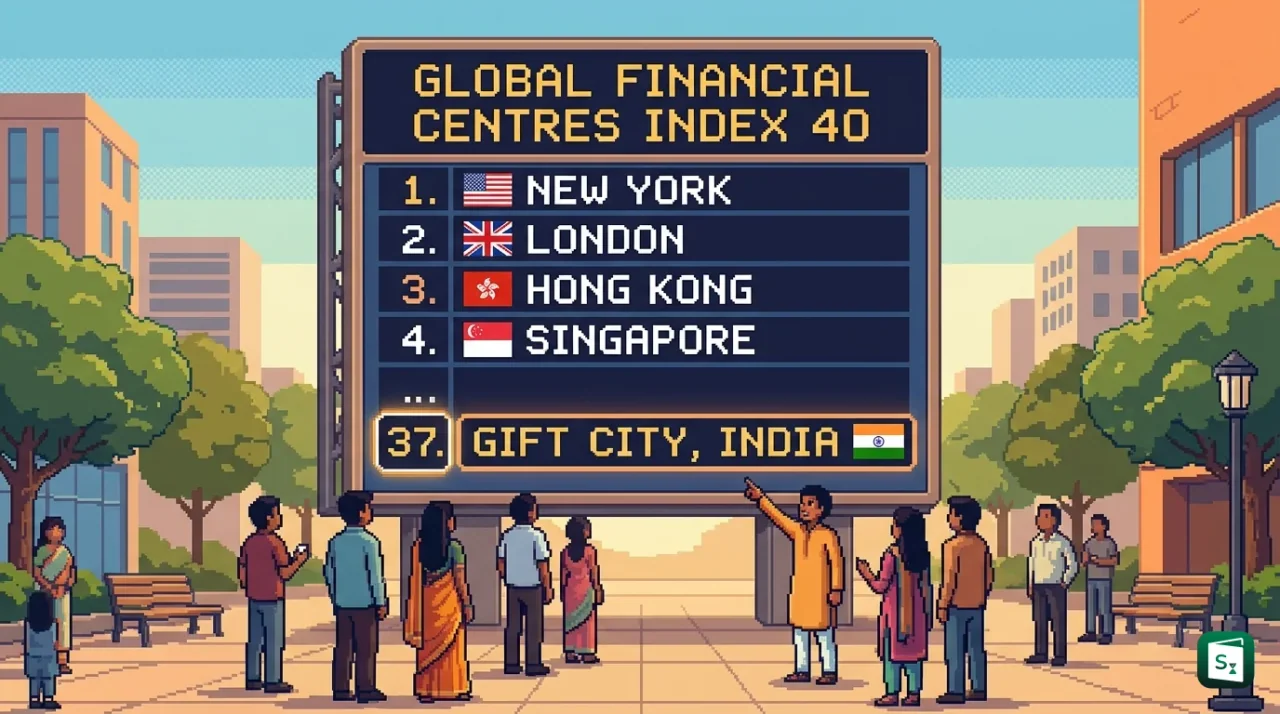
Gujarat International Finance Tec-City (GIFT City) has climbed nine places to 37th rank globally in the 40th edition of the Global Financial Centres Index (GFCI 40) published on 16 September 2026. New York retained the top position, followed by London, Hong Kong and Singapore. The jump places GIFT City inside the world top 40 and among the top 15 centres in Asia and the Pacific, with a parallel rise to 26th rank in financial technology.
What Is the Global Financial Centres Index?
The Global Financial Centres Index (GFCI) ranks the competitiveness of major financial centres around the world. It is published twice a year, in March and September, by Z/Yen Partners of London with the China Development Institute of Shenzhen. GFCI 40, published on 16 September 2026, rated 117 centres.
The GFCI started in 2007 and is now the most widely followed comparison of financial centres. Z/Yen Partners is a commercial think tank based in London, while the China Development Institute (CDI) is a policy research body based in Shenzhen, China. The two bodies bring out the index together every March and September to help policy makers and investors judge where each centre stands.
GFCI 40 studied 139 centres in total and gave final ratings to 117 centres. The rating combines two types of inputs. The first input is hard data through 144 instrumental factors supplied by outside bodies such as the World Bank, the Organisation for Economic Co-operation and Development (OECD) and the United Nations (UN). These factors measure business rules, transport and digital networks, availability of skilled people, financial market depth and city reputation. The second input is opinion data through 39,531 assessments from 6,147 financial sector professionals who answered an online survey.
GFCI 40 Rankings: Top Centres and India’s Position
GFCI 40 kept New York at the first position with a rating of 761 points, closely followed by London at 757 points. Hong Kong held third place with 756 points, just ahead of Singapore with 755 points. The narrow gap among the top four shows how tight the contest for global financial leadership has become.
Shanghai moved up one step to fifth place, while Tokyo jumped four steps to sixth. Seoul, Shenzhen, Dubai and Zurich completed the world top 10. Zurich entered the top 10 by replacing San Francisco, which slipped to 11th place.
| Rank in GFCI 40 | Financial Centre | Rating | Change in Rank from GFCI 39 |
|---|---|---|---|
| 1 | New York | 761 | No change |
| 2 | London | 757 | No change |
| 3 | Hong Kong | 756 | No change |
| 4 | Singapore | 755 | No change |
| 5 | Shanghai | 754 | Up 1 |
| 6 | Tokyo | 753 | Up 4 |
| 7 | Seoul | 752 | Up 1 |
| 8 | Shenzhen | 751 | Up 1 |
| 9 | Dubai | 750 | Down 2 |
| 10 | Zurich | 749 | Up 1 |
For India, the headline result is the sharp rise of GIFT City-Gujarat to 37th rank with 722 points, up from 46th rank with 703 points in GFCI 39. The gain of nine places and 19 rating points is one of the strongest improvements in this edition. The report also places GIFT City among the top 15 centres in Asia and the Pacific, the only Indian centre in that group.
| Indian Centre | Rank in GFCI 40 | Rank in GFCI 39 | Change |
|---|---|---|---|
| GIFT City-Gujarat | 37 | 46 | Up 9 |
| Mumbai | 49 | 52 | Up 3 |
| New Delhi | 56 | 54 | Down 2 |
GFCI 40 also publishes a separate ranking for financial technology. In that FinTech ranking, GIFT City moved up to 26th place from 29th place, based on an assessment of 115 centres. Hong Kong leads the FinTech table, followed by New York, Shenzhen, Singapore, Shanghai and London. The FinTech table gives weight to innovation support, access to finance, skilled talent, regulatory quality and digital infrastructure.
What Is GIFT City in India?
GIFT City means Gujarat International Finance Tec-City. It is India’s first operational smart city and first International Financial Services Centre, located between Ahmedabad and Gandhinagar in Gujarat on the Sabarmati River. It allows financial transactions in foreign currency for domestic and global firms.
GIFT City sits between the business hub of Ahmedabad and the political capital of Gandhinagar in Gujarat. This location often creates confusion about whether GIFT City is in Ahmedabad or Gandhinagar. In administrative terms, GIFT City falls in Gandhinagar district and uses a Gandhinagar postal code, but it serves both cities as a single economic zone on the banks of the Sabarmati River.
The city is spread over 886 acres. Of this, 261 acres are notified as a Multi-Service Special Economic Zone (SEZ), which forms the core financial zone, and 625 acres form the Domestic Tariff Area (DTA) for homes, schools, hospitals and shops. Plans now aim to expand the total area to more than 3,300 acres to meet rising demand for office space, homes and social facilities.
GIFT City was set up to bring back to India the international financial business generated from India but booked in places such as Singapore and Dubai. A committee on financial services set up by the Ministry of Finance in 2007 had estimated that Indian firms and households would buy international financial services worth nearly $50 billion by 2015, a figure that could cross $120 billion by 2025. The GIFT Multi-Service SEZ became operational in April 2015 as India’s maiden international financial zone where banks, insurers, fund managers, stock exchanges, technology firms and support offices can work in foreign currency under global standards.
Institutional Framework for International Financial Centres
An International Financial Services Centre (IFSC) is a zone that provides financial services to non-resident clients and to resident firms for cross border business, largely in foreign currency. The IFSC at GIFT City is treated as a non-resident zone under India’s foreign exchange rules. This means a bank branch, fund or broker inside the IFSC can deal in dollars and other foreign currencies under a separate set of rules from the domestic market.
Yes, GIFT City functions as a Special Economic Zone (SEZ) for its financial core. The financial business sits inside the GIFT SEZ set up under the Special Economic Zones Act, 2005, while homes and domestic shops sit in the Domestic Tariff Area. SEZ status gives the zone customs and compliance advantages and a clear boundary for the special financial rules.
The centre is regulated by the International Financial Services Centres Authority (IFSCA). IFSCA was set up on 27 April 2020 under the IFSCA Act, 2019 and is headquartered at GIFT City in Gandhinagar. IFSCA works as a single unified regulator for the IFSC. From October 2020, the powers of four domestic regulators for IFSC business moved to IFSCA. These four bodies are the Reserve Bank of India (RBI), which is India’s central bank, the Securities and Exchange Board of India (SEBI), which regulates securities markets, the Insurance Regulatory and Development Authority of India (IRDAI) and the Pension Fund Regulatory and Development Authority (PFRDA). A bank or fund in GIFT IFSC therefore deals mainly with IFSCA for approvals and supervision, which reduces overlap and speeds up decisions.
GIFT IFSC is often described as tax friendly, but it is not fully tax free. Units in the IFSC receive a package of tax benefits and a long tax holiday subject to conditions, along with exemptions on certain transfers and lower withholding on some payments. The aim is to match the cost of operating in competing hubs while keeping full reporting and anti-money laundering checks. For investors, the IFSC hosts bank units, fund management entities, mutual funds, brokers, two international stock exchanges and platforms for foreign stocks, foreign currency accounts and outbound funds. Resident Indians can use approved routes and non-resident Indians can use dollar-based products to invest through GIFT City without routing orders through overseas centres.
Why GIFT City’s Rise to 37th Matters
The move from 46th to 37th rank matters because it marks GIFT City’s entry into the global top 40 and confirms steady progress rather than a one time jump. The centre added 19 rating points to reach 722 points, at a time when the average rating of all centres rose by only 0.8 percent. In Asia and the Pacific, average ratings rose by 1.48 percent, the fastest of any region, so gains in this group reflect real competition with fast improving hubs such as Tokyo, Seoul and Shenzhen.
The Asia and Pacific result carries special weight for India. GIFT City is now the only Indian centre among the top 15 in the region, ahead of Mumbai at 49th rank and New Delhi at 56th rank. GFCI 40 also names GIFT City among 15 centres expected to become more important over the next two to three years, based on 26 mentions in the survey. The FinTech climb to 26th rank supports the same signal, since the FinTech table rewards practical strengths such as digital systems, talent supply and regulatory clarity.
GFCI 40 lists four priority areas for financial centres over the next five years. These are strong digital infrastructure including cloud services and data links, growth of FinTech and digital asset business with cyber safety, tighter controls against money laundering and financial crime, and deeper capital markets with more products and liquidity. Progress on talent, city connectivity, housing and ease of doing business will decide whether GIFT City can convert its current momentum into lasting depth that matches older hubs.
Key Takeaways
- GFCI 40 was published on 16 September 2026 by Z/Yen Partners with the China Development Institute (CDI) and rated 117 financial centres.
- GIFT City-Gujarat rose nine places to 37th rank with 722 points, up from 46th rank in GFCI 39.
- New York ranked first in GFCI 40, followed by London, Hong Kong and Singapore in that order.
- GIFT City is the only Indian centre in the top 15 of Asia and the Pacific, while Mumbai ranked 49th and New Delhi ranked 56th.
- GIFT City improved to 26th rank in the separate FinTech ranking and was named among 15 centres expected to gain importance in the next two to three years.
- IFSCA, set up on 27 April 2020 under the IFSCA Act, 2019 and headquartered at GIFT City, acts as the unified regulator for the IFSC.