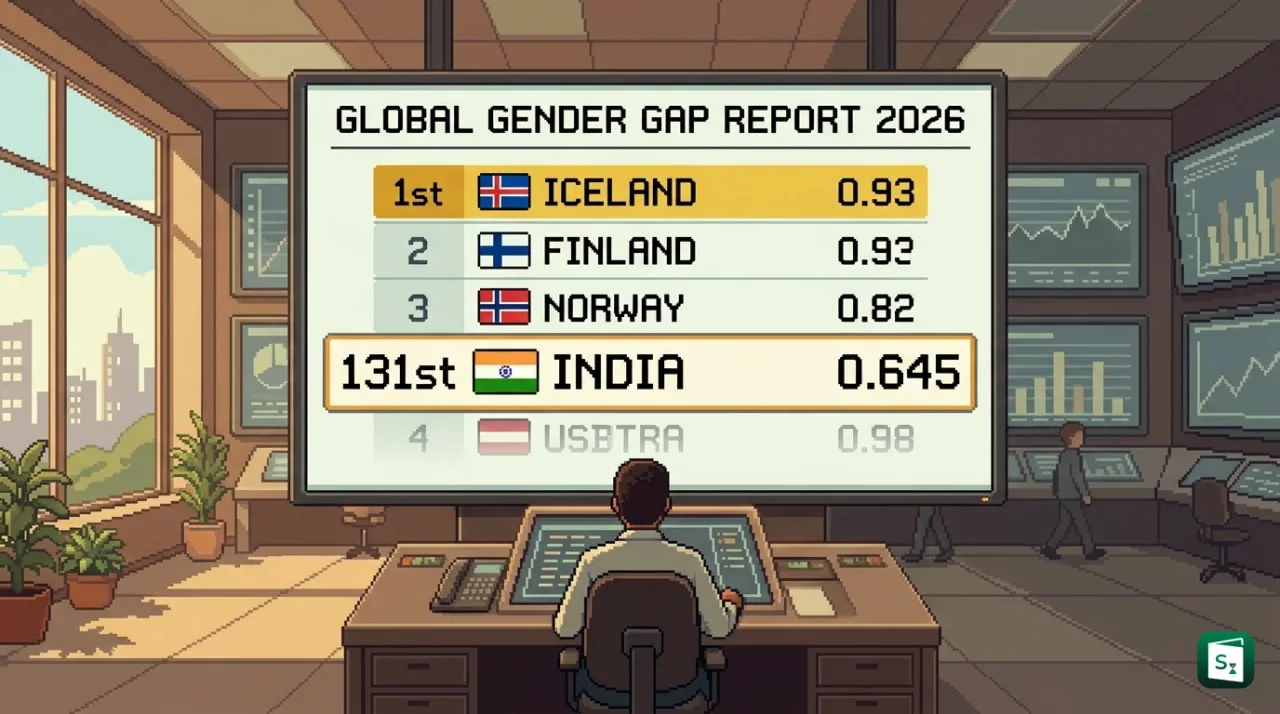
India has retained the 131st rank out of 145 countries in the 20th edition of the Global Gender Gap Report 2026, released on 16 September 2026, with an overall parity score of 0.645 or 64.5 percent. The report places India below the global average of 69.2 percent and leaves only 14 countries below it. Iceland tops the list for the 17th straight year with a score of 0.93, followed by Finland and Norway.
What Is Gender Gap and What Is the Gender Gap Index?
The gender gap is the difference between women and men in access to resources, opportunities and decision making power in areas such as work, education, health and politics. When the gap is fully closed, women and men have equal outcomes. When it is wide, women face clear disadvantage in income, leadership roles or public life.
The Global Gender Gap Index is a composite score published every year to measure how close each country is to full parity between women and men. The Global Gender Gap Index covers 145 economies in 2026 and gives every country a score on a scale from 0 to 1, where 1 means full parity and 0 means complete disparity. A score of 0.645 for India, for example, means the country has closed 64.5 percent of its gap.
The Global Gender Gap Index tracks four separate areas called subindices. These are Economic Participation and Opportunity, Educational Attainment, Health and Survival, and Political Empowerment. Each subindex has several hard data indicators taken from bodies such as the International Labour Organization (ILO), the World Health Organization (WHO) and the United Nations Development Programme (UNDP). The four scores are then combined into one overall parity score and rank.
What Is the Global Gender Gap Report?
The Global Gender Gap Report is the annual flagship publication of the World Economic Forum (WEF) that presents the Global Gender Gap Index results, country profiles and trend analysis. The Global Gender Gap Report was first published in 2006, so the 2026 edition is the 20th edition. The Global Gender Gap Report 2026 was released on 16 September 2026.
The purpose of the Global Gender Gap Report is to give governments, businesses and civil society a consistent tool to compare progress over time. The Global Gender Gap Report does not measure absolute levels of development or welfare. It measures relative gaps between women and men within each country, so a low income country and a high income country can be compared on fairness of outcomes.
The 2026 report covers 145 economies, slightly fewer than the 148 economies covered in 2025. The report uses the latest available hard data for 14 indicators grouped under the four subindices. For politics, it also looks at the presence of women as heads of state over the last 50 years, which rewards countries with a history of women leaders.
Global Gender Gap Index 2026: Key Global Findings
The Global Gender Gap Report 2026 finds that the world has closed 69.2 percent of its overall gender gap. This is an improvement of 0.4 percentage points over 2025. At this pace, the World Economic Forum estimates that full global parity is still about 120 years away. Nearly every economy tracked since 2006 has moved forward, but the pace remains slow.
Iceland remains the only country to cross the 90 percent mark. The World Economic Forum reports Iceland’s score at 0.93 or 93 percent in 2026. Finland holds second place and Norway holds third place, continuing a pattern seen in almost every edition since 2006. In fact, Iceland, Finland, Norway and Sweden are the only four economies to appear in the top 10 in every edition since 2006.
| Rank in 2026 | Country | Parity Score | Notable Point |
|---|---|---|---|
| 1 | Iceland | 0.93 | Top rank for 17th straight year, only country above 90 percent |
| 2 | Finland | About 0.88 | Consistent top three performer since 2006 |
| 3 | Norway | About 0.86 | Consistent top three performer since 2006 |
| 4 | Namibia | Above 0.81 | Highest ranked country in Sub Saharan Africa, up four places |
| 5 to 10 | United Kingdom, New Zealand, Sweden, Australia, Germany, Ireland | Above 0.80 each | Australia enters top 10 for first time |
At the bottom of the table, Chad ranks 145th and last. Iran and Pakistan join Chad in the bottom three. The World Economic Forum notes that only 14 countries rank below India, including Papua New Guinea, Kuwait, Oman, Qatar, Tajikistan, Saudi Arabia, Egypt, Morocco, Mali, Algeria and Congo.
Three wider trends stand out in the 2026 edition. First, political leadership has slipped. Women hold 19.1 percent of chief executive officer roles globally, but the share of countries led by a woman has fallen back to levels last seen in 2016. Only one in ten ministerial posts held by women is counted as highly influential. Second, work breaks hurt women more. Women are almost twice as likely as men to take career breaks, mainly for parenting, and they face slower growth after return. Third, technology shows a fresh divide. Women account for fewer than one in five artificial intelligence (AI) engineers and remain underrepresented across AI companies. AI here means computer systems that learn from data to perform tasks such as language processing and image recognition.
Global Gender Gap Index 2026 India Rank and Score
The Global Gender Gap Report 2026 places India at 131st out of 145 countries with a score of 0.645. India’s rank is unchanged from 2025, when India was also 131st but out of 148 countries. India’s score has improved slightly from about 64.1 percent in 2025 to 64.5 percent in 2026, yet it remains below the global average of 69.2 percent.
The result looks modest when seen over two decades. The World Economic Forum finds that India’s overall parity has risen by 4.3 percentage points since 2006, largely due to gains in education. At the same time, India is the world’s most populous country with about 1.5 billion people, so slow movement in India pulls down progress in Southern Asia as a whole. Southern Asia remains among the lowest scoring regions for economic opportunity.
The year on year table below puts the recent trend in one place.
| Edition | Countries Covered | India Rank | India Score | Global Average |
|---|---|---|---|---|
| 2024 | 146 | 129th | About 64.1 percent | About 68.5 percent |
| 2025 | 148 | 131st | About 64.1 percent | 68.8 percent |
| 2026 | 145 | 131st | 64.5 percent | 69.2 percent |
The table shows a clear pattern. India’s score has stabilised and inched up, but its rank has slipped or held steady because other countries have improved faster.
How India Performed Across the Four Dimensions
India’s overall score hides sharp differences across sectors. Education and health are close to parity, while economy and politics pull the average down.
| Dimension | India Score in 2026 | What It Measures in Simple Terms |
|---|---|---|
| Economic Participation and Opportunity | 41.2 percent | Jobs, wages for similar work, share in senior roles |
| Educational Attainment | 96.6 percent | Literacy and enrolment of girls versus boys at school and college |
| Health and Survival | 95.6 percent | Sex ratio at birth and healthy life expectancy |
| Political Empowerment | 24.5 percent | Seats in parliament, minister posts, women heads of state in last 50 years |
Economic participation remains the weakest link
India closed only 41.2 percent of its economic gap in 2026, up 0.5 percentage points from 2025 but still 3.5 percentage points below its best score of 44.7 percent in 2013. Parity in labour force participation stood at 44.1 percent, with little change over two decades. This means far fewer women than men are in paid work or looking for work.
There is one bright spot inside this weak score. Parity among professional and technical workers rose from 26.6 percent in 2006 to 49.9 percent in 2026. However, this has not carried into top jobs. Women hold only 13.1 percent of posts as legislators, senior officials and managers, though this is 10 percentage points higher than in 2006. The gender pay gap, which is the average difference in earnings between men and women, remains wide in estimated earned income.
Education and health are close to parity
India reached 96.6 percent parity in education, with near full balance between boys and girls in secondary and higher education enrolment. The score slipped by 0.5 percentage points from 2025, but education remains India’s strongest long term gain since 2006.
Health improved to 95.6 percent parity. Healthy life expectancy has moved in a positive direction since 2017. The concern is the sex ratio at birth, which is the number of girl babies born for every boy baby. The World Economic Forum notes that India’s sex ratio at birth in 2026 remains nearly one percentage point below its 2006 level, which points to continuing preference for sons.
Political empowerment ranks highest but stays low
Political Empowerment is India’s best ranked subindex at 67th globally, with 24.5 percent of the gap closed. Women held a 16.1 percent share in parliament in the 2026 assessment, an overall gain of 7 percentage points since 2006.
The ministerial picture is weak. India’s parity score for women ministers rose from 3.5 percent in 2006 to 5.9 percent in 2026, far below the peak of 30 percent in 2019. The head of state indicator, which counts years with a woman as president or prime minister in the last 50 years, rose from 42.9 percent in 2006 to 72.3 percent in the first decade, but has fallen since 2021 to 40.7 percent in 2026. This long view explains why India once scored higher in politics despite low day to day representation in parliament.
World Economic Forum: The Institution Behind the Index
The World Economic Forum, universally shortened to WEF, is an independent not for profit foundation for public private cooperation. The World Economic Forum was founded in 1971 by German economist Klaus Schwab and is headquartered in Geneva, Switzerland, with offices in New York, Beijing and Tokyo. The World Economic Forum is best known for its annual meeting in Davos, Switzerland, held every January.
Apart from the gender gap study, the World Economic Forum publishes other widely tracked reports such as the Global Risks Report, the Future of Jobs Report and the Travel and Tourism Development Index. For competitive learning, the key static facts are the founding year (1971), the founder (Klaus Schwab), the headquarters (Geneva) and the nature of the body (independent, not for profit, focused on cooperation between business, government and civil society).
How the Gender Gap Index Differs From the Gender Inequality Index
Readers often confuse the Global Gender Gap Index with the Gender Inequality Index (GII). The names sound similar but the issuing body, purpose and method are different.
| Feature | Global Gender Gap Index | Gender Inequality Index |
|---|---|---|
| Released by | World Economic Forum (WEF) | United Nations Development Programme (UNDP) as part of the Human Development Report |
| First published | 2006 | 2010 |
| Scale meaning | 0 to 1, where 1 means full parity | 0 to 1, where 0 means full equality and higher values mean greater inequality |
| Dimensions | Four: economy, education, health, politics | Three: reproductive health, empowerment, labour market |
| Focus | Relative gaps between women and men inside each country | Loss in human development due to inequality between women and men |
In simple terms, the Gender Gap Index asks how equal women and men are, while the Gender Inequality Index asks how much a country loses in overall human development because of that inequality. India’s rank of 131st in 2026 refers only to the World Economic Forum index.
Why the 2026 Outcome Matters for India
The 2026 result matters because education gains alone are not lifting India’s overall position. Girls are now close to boys in school and college enrolment, yet this success is not converting into paid jobs, senior leadership or ministerial posts. Labour force parity at 44.1 percent and senior manager share at 13.1 percent show that the pipeline from classroom to workplace and boardroom is broken.
The political signal is equally important. Parliament share at 16.1 percent and ministerial parity at 5.9 percent remain low, even though the Constitution provides 33 percent reservation for women in local bodies under the 73rd and 74th Constitutional Amendments of 1992, and Parliament has passed the Women’s Reservation Act, 2023, which reserves one third of seats in the Lok Sabha and state assemblies for women after delimitation. Past experience shows that quotas, crèche support, safe transport, skills training and shared parental leave help retain women at work. The 2026 report underlines that faster action on these practical steps, plus closing the digital and AI skills divide, will decide whether India moves up from the 130s in future editions.
Key Takeaways
- India ranked 131st out of 145 countries in the Global Gender Gap Report 2026 with a parity score of 0.645.
- The World Economic Forum, founded in 1971 and headquartered in Geneva, released the 20th edition on 16 September 2026.
- Iceland topped the index for the 17th straight year with a score of 0.93, followed by Finland and Norway.
- The world has closed 69.2 percent of the gender gap, but full parity is still about 120 years away at the current pace.
- India scored 41.2 percent in Economic Participation, 96.6 percent in Education, 95.6 percent in Health and 24.5 percent in Political Empowerment.
- Women hold only 13.1 percent of senior manager posts and 5.9 percent ministerial parity in India, down from 30 percent in 2019.