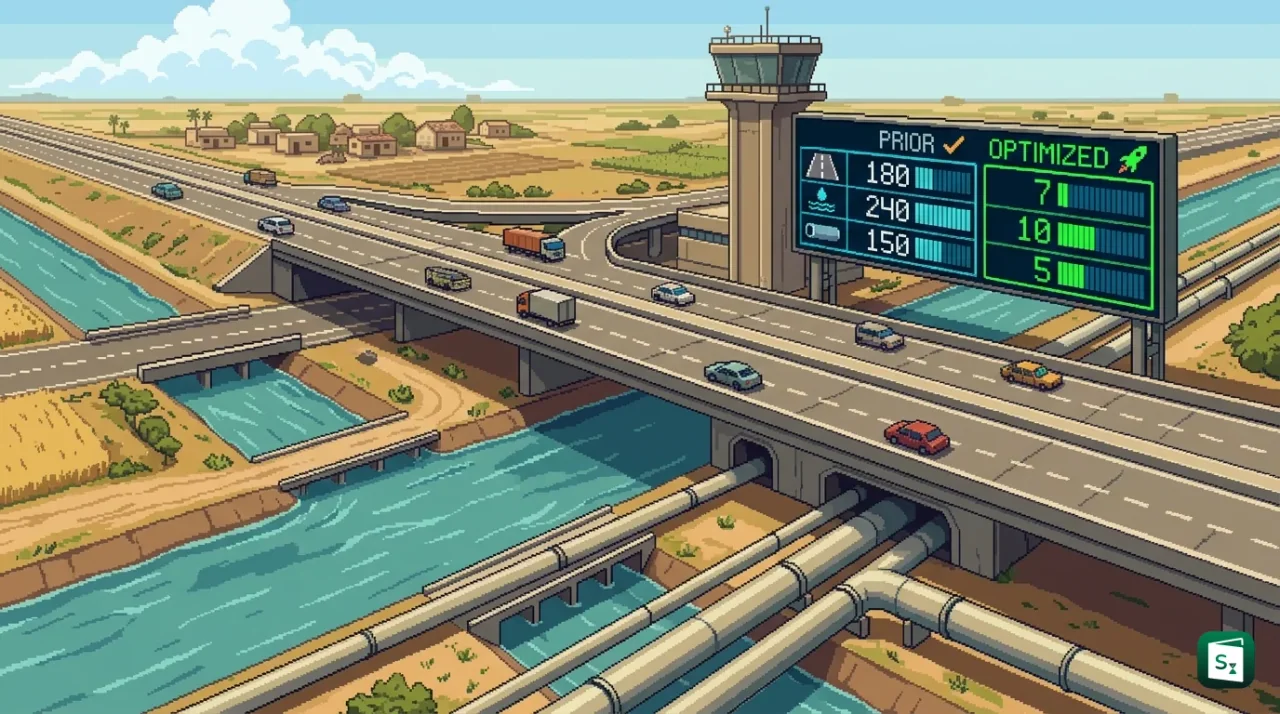
The National Highways Authority of India (NHAI) and Sardar Sarovar Narmada Nigam Ltd (SSNNL) signed a Memorandum of Understanding (MoU) on 22 September 2026 in Gandhinagar, Gujarat. The pact creates a simplified and time bound system for approving crossings where National Highways meet Narmada canals and pipelines. A central feature is the mutual waiver of fees and charges by both agencies to cut project costs and speed up highway and irrigation works.
What Does the NHAI SSNNL Pact Provide?
The NHAI SSNNL MoU sets up a single, simplified procedure for all cases where a National Highway has to cross an SSNNL canal or pipeline, and where an SSNNL canal or pipeline has to cross a National Highway in Gujarat. The Regional Officer of NHAI in Gandhinagar and the Chief Engineer (Quality Control, Technical and Canal Planning Cell) of SSNNL signed the pact in Gandhinagar in the presence of SSNNL directors and senior officials.
The agreement fixes three working rules for future projects. First, NHAI and SSNNL will share project plans at an early stage so that road alignment and canal alignment do not clash later. Second, both agencies will follow standard engineering practices for the design and building of crossing structures such as bridges, culverts, underpasses and pipeline supports. Third, the MoU clearly divides who will build and who will maintain each crossing structure, so upkeep does not fall into a gap between two departments.
The most important commercial term is the mutual waiver of fees, charges and other levies for crossings covered under the pact. NHAI will not charge SSNNL for canal and pipeline crossings over its highways, and SSNNL will not charge NHAI for highway crossings over its canals. The two bodies have stated that this step will lower project costs, remove repeated payment files and help use public money in a better way.
What Is NHAI in India?
The National Highways Authority of India, written in short as NHAI, is the central agency that builds, maintains and manages National Highways in India. NHAI is an autonomous statutory authority set up under the National Highways Authority of India Act of 1988 and made operational in 1995. NHAI works under the Ministry of Road Transport and Highways and has its headquarters at Dwarka in New Delhi.
NHAI is not a private company and it is also not listed as a Public Sector Undertaking in the usual commercial sense. NHAI is a statutory body created by Parliament to carry out a public function, which is the development, maintenance and management of highways entrusted to it by the central government. Its work includes land acquisition, project planning, tendering, construction supervision, toll collection through systems such as FASTag and upkeep of highway assets.
NHAI manages more than 50,000 km of National Highways out of a total National Highway network of over 132,000 km in India. Major programmes handled by NHAI in the past include the National Highways Development Project and the Bharatmala Pariyojana. NHAI also issues bonds, including tax saving infrastructure bonds, and works with models such as Build Operate Transfer, Hybrid Annuity Model and Engineering Procurement Construction to fund road building.
What Is the Sardar Sarovar Project?
Sardar Sarovar Narmada Nigam Ltd, written in short as SSNNL, is a company fully owned by the Government of Gujarat. The Gujarat government created SSNNL in March 1988 to execute the Sardar Sarovar Project on the Narmada river. SSNNL is headquartered at Gandhinagar and looks after the dam, the vast canal system, hydropower stations, drinking water supply and resettlement works linked to the project.
The Sardar Sarovar Project is a multipurpose river valley project that provides irrigation water, drinking water, hydropower and flood control. The project benefits four states, which are Gujarat, Madhya Pradesh, Maharashtra and Rajasthan, as decided under the award of the Narmada Water Disputes Tribunal. The main built parts are the Sardar Sarovar Dam, the Narmada Main Canal and a branch canal network of about 75,000 km within Gujarat.
The power complex of the project has an installed capacity of 1,450 MW. This comes from six units of 200 MW each in the River Bed Power House and five units of 50 MW each in the Canal Head Power House. SSNNL also operates canal top and canal bank solar plants of about 35 MW and small hydropower plants of about 85.46 MW. The irrigation plan aims to serve about 1.8 million hectares in Gujarat and about 70,000 hectares in the Barmer and Jalore areas of Rajasthan, along with drinking water for more than 9,000 villages and many towns in Gujarat.
Sardar Sarovar Dam on Which River and in Which State?
Sardar Sarovar Dam is built on the Narmada River at Navagam near Kevadia in Narmada district of Gujarat. The dam is a concrete gravity structure that serves Gujarat, Madhya Pradesh, Maharashtra and Rajasthan for irrigation, drinking water and power generation. It is the largest dam in the Narmada Valley Project.
The Narmada is a west flowing river that rises at Amarkantak in Madhya Pradesh and travels about 1,312 km through Madhya Pradesh, Maharashtra and Gujarat before meeting the Arabian Sea in the Gulf of Khambhat. The Sardar Sarovar Dam stands near the Gujarat and Maharashtra border, downstream of the dams in Madhya Pradesh. The town of Ekta Nagar near the dam hosts the Statue of Unity, which draws heavy tourist traffic and adds to road demand in the area.
The dam is 1,210 metres long and 163 metres high above its deepest foundation. The Full Reservoir Level is fixed at 138.68 metres, and the spillway can discharge 85,000 cumecs of water, which places it among the largest spillways in the world. The foundation stone of the project was laid in 1961, main construction started in 1987 and the dam was dedicated to the nation on 17 September 2017 after reaching its full height.
| Feature | Detail |
|---|---|
| River | Narmada River |
| Location | Navagam near Kevadia, Narmada district, Gujarat |
| Type | Concrete gravity dam |
| Length | 1,210 metres |
| Height above deepest foundation | 163 metres |
| Full Reservoir Level | 138.68 metres |
| Narmada Main Canal length | About 532 km with 458.32 km up to Gujarat Rajasthan border |
| Canal capacity at head | 1,133 cumecs |
Why This Agreement Matters for Gujarat
Gujarat presents a special crossing problem because the state has both a fast growing highway network and one of the densest canal grids in India. SSNNL has built tens of thousands of kilometres of main, branch, distributary and minor canals across 17 districts including Kutch, Saurashtra and north Gujarat. Almost every new highway stretch or widening project in the state meets a canal, a distributary or a water pipeline. In the earlier system, each such meeting point needed separate permission files in two offices, with separate fees and separate inspections.
The time bound framework directly addresses this delay. Early sharing of road and canal drawings will let engineers shift a road culvert or a canal siphon at the design stage instead of stopping work after construction starts. Standard designs will reduce disputes over the size of bridges, the depth of pipelines and safety clearances. Fixed responsibility for repair will help during monsoon damage, when both road traffic and canal water supply suffer if a crossing fails.
The financial effect is also clear. Highway and canal works are both paid from public funds, so a fee paid by one government body to another only raises the final bill for the taxpayer. The mutual waiver removes this circular cost and lets the saved money be used for actual construction. NHAI has linked the pact to its wider goal of building world class highways that cut travel time and logistics costs.
The timing adds weight to the move. A day before this MoU, on 21 September 2026, NHAI released fresh guidelines for the design of high speed access controlled National Highways other than expressways. Those guidelines standardise lane patterns and safety designs for corridors that will form part of the plan for 50,000 km of access controlled corridors under Viksit Bharat 2047. Smooth canal and utility crossings in a state like Gujarat will be vital if these high speed corridors are to be built without long halts.
Key Takeaways
- NHAI and SSNNL signed an MoU on 22 September 2026 in Gandhinagar for time bound approvals of highway, canal and pipeline crossings in Gujarat.
- The pact provides mutual waiver of fees, charges and levies for all covered crossings to cut costs and remove procedural delays.
- NHAI, the statutory body under the NHAI Act, 1988 working under the Ministry of Road Transport and Highways, builds and manages over 50,000 km of National Highways.
- The Sardar Sarovar Dam is a concrete gravity dam on the Narmada River at Navagam in Narmada district, Gujarat, with a length of 1,210 metres and height of 163 metres.
- The Sardar Sarovar Project provides 1,450 MW of hydropower and irrigation to about 1.8 million hectares, with Full Reservoir Level fixed at 138.68 metres.