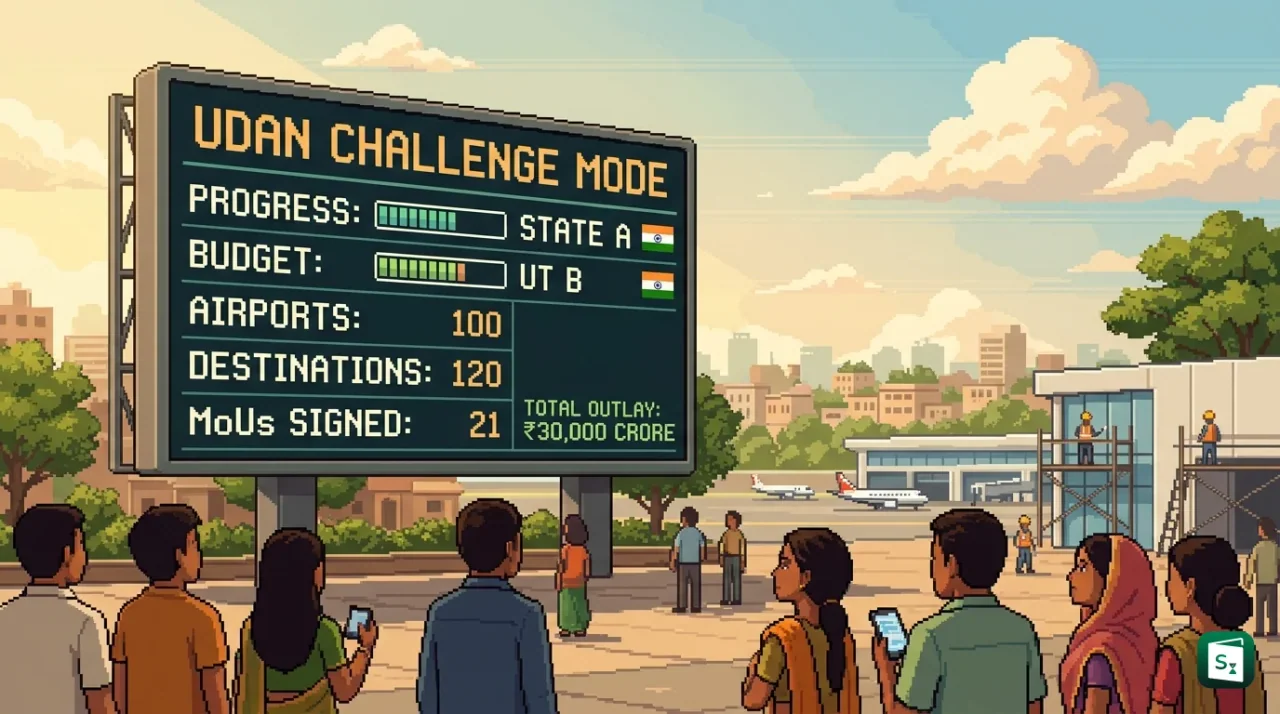
Civil Aviation Minister Kinjarapu Ram Mohan Naidu launched the Challenge Mode Portal for Aerodrome Development in New Delhi on 22 September 2026 to start on-ground work under the Modified UDAN scheme. The Ministry of Civil Aviation signed 21 agreements with states, Union Territories and the Airports Authority of India at the same event to identify and build new regional airports. The move shifts airport selection to states and aims to cut construction time to 18 months while adding 100 airports and 120 destinations over ten years.
What Is the UDAN Scheme?
The UDAN scheme is the Regional Connectivity Scheme (RCS) for affordable air travel in India. The full form of UDAN is Ude Desh ka Aam Nagrik, which means let the common citizen of the country fly. The Ministry of Civil Aviation launched the scheme on 21 October 2016 under the National Civil Aviation Policy 2016 to link small towns and remote areas with major cities through low cost flights.
The first UDAN flight operated between Shimla and Delhi on 27 April 2017. The central idea was simple. Airlines would start flights on unserved and underserved routes where few or no flights existed. In return, the government would give them support through fee concessions and Viability Gap Funding (VGF), which is financial help to cover the loss on routes with low passengers in the early years. A part of seats on these flights was kept at capped affordable fares so ordinary passengers could use them.
Over nearly a decade, the UDAN scheme widened the aviation map beyond the six large metro cities which earlier handled most air traffic. The Ministry of Civil Aviation reports that UDAN has operationalised 687 routes connecting 95 airports, heliports and water aerodromes. More than 3.5 lakh flights under the scheme have carried over 1.68 crore passengers. The number of operational airports in India rose from 74 in 2014 to 166 at present. Aviation sector jobs also grew from around 3 million in 2014 to nearly 7.7 million in 2026.
What Is the Challenge Mode Portal for Aerodrome Development?
The Challenge Mode Portal for Aerodrome Development is an online platform where state governments and Union Territory administrations can propose airstrips and helipads for development under Modified UDAN. The Ministry of Civil Aviation launched the portal in New Delhi on 22 September 2026 along with the scheme document for the next round of UDAN route bidding. The portal moves the next phase of UDAN from policy discussion to on-ground identification of projects.
An aerodrome is a defined area on land or water which is meant for arrival, departure and movement of aircraft. It includes runways, buildings and equipment. It is a wider term used by the International Civil Aviation Organization (ICAO) and the Directorate General of Civil Aviation (DGCA) in India. An airport is a special type of aerodrome which has met certification, safety and passenger facility standards for regular public flights. In simple terms, all airports are aerodromes, but all aerodromes are not airports. The new portal therefore covers small airstrips, helipads and water aerodromes which can later grow into full airports.
| Term | Meaning in Simple Words |
|---|---|
| Aerodrome | Any defined land or water area for aircraft arrival and departure, including airstrips, helipads and water aerodromes |
| Airport | A certified aerodrome with runway, terminal, air traffic, safety and passenger services for regular flights |
| Heliport | An aerodrome meant mainly for helicopter operations |
| Water aerodrome | A stretch of open water used regularly by seaplanes for landing and take off |
Under Challenge Mode, the Ministry of Civil Aviation has asked states to identify high potential locations based on passenger demand, tourism, trade and local need. The example of Purnea in Bihar was cited, where strong passenger demand made the airport project viable. Nominated sites will be ranked and taken up on priority, while other sites will be developed in phases. Airlines will then bid for routes linked to these sites through a transparent e-bidding process. The selected airline gets exclusive rights for three years and financial support to start operations.
Ministry, AAI and States Join Hands Through 21 MoUs
The Ministry of Civil Aviation is the policy owner of the UDAN scheme. It frames the rules, approves routes and provides central funds. The Airports Authority of India (AAI) is the implementing agency. AAI was formed on 1 April 1995 by merging the erstwhile International Airports Authority of India and the National Airports Authority under the Airports Authority of India Act, 1994. AAI functions under the Ministry of Civil Aviation and is headquartered at Rajiv Gandhi Bhawan, Safdarjung Airport, New Delhi. Its work includes designing, building and maintaining runways, terminals and air traffic services.
On 22 September 2026, the Ministry of Civil Aviation signed 21 Memoranda of Understanding (MoUs) with participating states and Union Territories along with AAI at The Ashok in Chanakyapuri, New Delhi. The event was led by Civil Aviation Minister Kinjarapu Ram Mohan Naidu in the presence of Minister of State Murlidhar Mohol, Civil Aviation Secretary Samir Kumar Sinha and AAI Chairman Vipin Kumar (as of September 2026). The MoUs create a clear framework for joint action. The Centre will provide policy and funds, AAI will build and manage infrastructure, and states will provide land free of cost, share costs, and ensure road links, water, power, and police and fire services at regional airports.
The signing follows two earlier steps. The Prime Minister opened the next phase of UDAN at Jodhpur on 4 July 2026, and the Ministry held a national UDAN workshop on 16 July 2026 with states, airlines and airport operators. The September launch therefore completes the shift from consultation to execution, with team work between the Centre and states placed at the centre of the plan.
100 New Airports and 120 Destinations: Targets and Funding
The Regional Connectivity Scheme Modified UDAN was approved by the Union Cabinet chaired by the Prime Minister in March 2026. The scheme will run for ten years from FY 2026-27 to FY 2035-36. The approved central outlay is ₹28,840 crore, which is described in public announcements in rounded form as ₹30,000 crore. The goal is to develop 100 new airports from existing unserved airstrips, connect 120 new destinations and enable air travel for 4 crore additional passengers over the decade.
A key change is speed. Earlier, a regional airport took an average of 3 years to build. Under Challenge Mode, the target is to complete projects within 18 months through early land availability, standard designs and close Centre state monitoring. This faster cycle is meant to keep costs low and make routes operational quickly.
The funding is divided into clear parts. The largest part supports aerodrome construction, the second part supports airline operations, and the third part supports helicopter links for hilly and island areas.
| Component | Target | Proposed Outlay |
|---|---|---|
| Development of 100 airports from unserved airstrips | 100 airports in 8 years at about ₹100 crore per airport | ₹12,159 crore |
| Development of 200 modern helipads for hilly, remote, island and aspirational districts | 200 helipads at about ₹15 crore per helipad | ₹3,661 crore |
| Viability Gap Funding for airlines to operate regional routes | Support for 10 years, 5 years per route | ₹10,043 crore |
| Total Modified UDAN outlay from FY 2026-27 to FY 2035-36 | 120 destinations and 4 crore passengers | ₹28,840 crore |
The Union Budget for 2026-27 raised the annual UDAN allocation to ₹550 crore from ₹540 crore in the previous year. The scheme also links to the wider aim of Viksit Bharat 2047, which calls for modern infrastructure and a globally competitive aviation system.
Key Changes in Modified UDAN Compared to the Earlier Phase
The Ministry of Civil Aviation has said that Modified UDAN rests on four pillars. These are affordability for passengers, sustainability of operations, a transparent Challenge Mode framework for projects, and promotion of indigenous manufacturing. This marks a shift from only adding routes to building a lasting regional aviation system.
The first change concerns Viability Gap Funding. Under the original UDAN, airlines received VGF for three years. Regional routes often need more time to attract steady passengers. Under Modified UDAN, airlines will receive support for five years, with a tapered system from the third year onward. This means support will gradually reduce as traffic grows. Exclusivity to operate the route will still remain for three years to protect the first operator while allowing competition later.
The second change is a reboot for underserved airports. Several airports built in the first phase later lost flights because demand was weak or airlines withdrew. Under Modified UDAN, states and the Ministry will jointly identify such airports and offer the routes again to airlines through fresh bidding. This is expected to bring idle infrastructure back into use.
The third change expands the network to helipads and water aerodromes. The scheme plans 200 modern helipads in hilly, remote, island and aspirational districts to improve last mile links, health access and disaster response. It also supports seaplane operations with water aerodromes. The Union Budget for 2026-27 announced incentives for indigenous seaplane manufacturing and a separate VGF window for seaplane flights. In October 2025, the government had already awarded 48 seaplane routes, mostly in Kerala, to operators including SpiceJet, IndiaOne Air and MEHAIR.
The fourth change supports domestic manufacturing. The scheme proposes to procure two HAL Dhruv helicopters for Pawan Hans and two HAL Dornier aircraft for Alliance Air. Hindustan Aeronautics Limited (HAL), a Bengaluru based defence public sector company, makes both platforms. Pawan Hans Limited, a central public sector helicopter operator, and Alliance Air, a regional airline, serve remote routes. The use of home built aircraft suits short runways and high altitude strips and advances the Atmanirbhar Bharat goal of self reliance in aerospace.
Significance for Regional Connectivity and the Economy
The Modified UDAN scheme matters because air traffic in India is still concentrated in a few large cities. Better links to Tier 2 and Tier 3 cities can spread jobs, tourism and investment to smaller centres. Airports like Tezu in Arunachal Pradesh and Purnea in Bihar, which were once hundreds of kilometres away from the nearest flight, are now cited as examples of how a small airport can drive local trade, hotels and services. Faster 18 month construction will help such towns gain links without long delays.
The scheme also supports the wider aviation economy. Demand for small aircraft, helicopters and seaplanes will create work in maintenance, repair and overhaul, pilot training and ground handling. The Ministry of Civil Aviation has noted that aviation linked jobs could rise to 25 million by 2040 if regional growth continues. Affordable capped fares keep flying within reach of first time flyers, while longer VGF helps airlines stay on difficult routes till they turn viable. By giving states the power to choose sites, the Challenge Mode aims to match infrastructure with real local demand and keep airports in regular use.
Key Takeaways
- The Challenge Mode Portal for Aerodrome Development was launched on 22 September 2026 by Civil Aviation Minister Kinjarapu Ram Mohan Naidu in New Delhi.
- UDAN stands for Ude Desh ka Aam Nagrik and was launched as the Regional Connectivity Scheme on 21 October 2016, with the first flight on 27 April 2017 between Shimla and Delhi.
- The Ministry of Civil Aviation and the Airports Authority of India (AAI) signed 21 MoUs with states and Union Territories for Modified UDAN implementation.
- Modified UDAN will run from FY 2026-27 to FY 2035-36 with a central outlay of ₹28,840 crore to develop 100 airports and connect 120 destinations for 4 crore passengers.
- Challenge Mode aims to cut airport construction time to 18 months from the earlier average of 3 years through state led site selection.
- Modified UDAN extends airline Viability Gap Funding to five years with tapering from the third year, while route exclusivity stays at three years.