The Uttar Pradesh Cabinet chaired by Chief Minister Yogi Adityanath cleared 23 development proposals at its meeting in Lucknow on 15 September 2026. The approvals include the UP Toy Manufacturing Promotion Policy 2025 and a 120 KLPD ethanol plant at the closed Chhata sugar mill in Mathura. Together, the decisions link industrial growth, farm incomes and jobs across infrastructure, education and welfare sectors.
UP Cabinet Meeting: Overview of 23 Development Proposals
The Uttar Pradesh Cabinet met at the Chief Minister’s official residence in Lucknow on 15 September 2026 under the chairmanship of Chief Minister Yogi Adityanath. The Council of Ministers, which is the top decision making body of the state government, cleared 23 proposals in a single sitting. State Finance and Parliamentary Affairs Minister Suresh Kumar Khanna briefed the media after the meeting, along with Transport Minister Dayashankar Singh and Sugarcane Development Minister Laxmi Narayan Chaudhary.
The proposals cover industry, agriculture, education, employment, health, security and urban development. The mix shows a clear focus on investment and jobs alongside farm support and social welfare. Two industrial decisions drew the most attention, the new toy manufacturing policy and the revival of the closed Chhata sugar mill in Mathura for ethanol production. The other approvals deal with roads, schools, courts, farm credit, job reservation for former Agniveers, and support for village guards and ration dealers.
| Area | Major Approval by Uttar Pradesh Cabinet |
|---|---|
| Industry | UP Toy Manufacturing Promotion Policy 2025, 120 KLPD ethanol plant at Chhata |
| Roads | 15.172 km Chitrakoot Link Expressway at ₹1,008.67 crore in EPC mode |
| Education | 14,429 council primary schools to become smart schools |
| Agriculture | Farm loans up to ₹6 lakh at 6 percent interest |
| Jobs | 20 percent horizontal reservation for former Agniveers in two recruitments |
| Justice and welfare | 900 new courts, higher allowance and cashless care for PRD volunteers |
What Is the UP Toy Manufacturing Promotion Policy 2025?
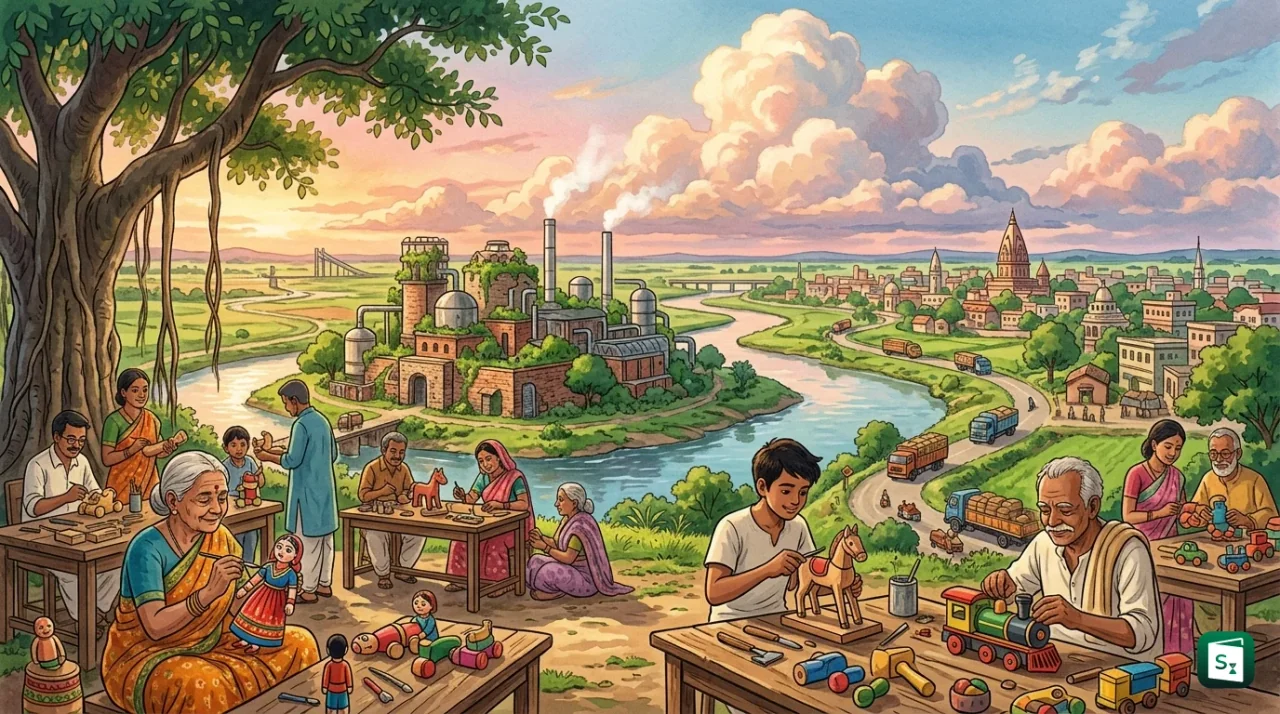
The Uttar Pradesh Toy Manufacturing Promotion Policy 2025 is a special incentive package to make the state a major hub for toy manufacturing in India. Toy manufacturing here means the full chain of making, marketing, skilling and upgrading toy units, from handmade wooden toys to plastic, soft, electronic and educational toys. The Uttar Pradesh Cabinet approved the policy on 15 September 2026 to attract new investment, support expansion of existing units and create jobs in toy clusters.
The policy will remain valid for five years from the date of notification or till a new policy is announced, whichever is earlier. The Micro, Small and Medium Enterprises (MSME) Department of the state government will implement the policy. Invest UP, which is the investment promotion and facilitation agency of the Uttar Pradesh government, will handle incentives for large and higher category projects. Incentives will be paid only after commercial production begins, and the policy includes a provision for front end subsidy, which means part of the support is released early to reduce the initial cost of setting up the unit.
Under the policy, micro, small and medium toy units will get incentives as fixed under the UP MSME Promotion Policy 2022 or the policy that replaces it. New large units and existing large units that expand or diversify will get incentives under the new toy policy through Invest UP. A project that takes benefits under this toy policy cannot claim incentives under any other state government policy, but it can claim additional benefits available under central government schemes.
The policy gives special attention to industrially backward regions. Toy units set up in Poorvanchal (eastern Uttar Pradesh), Bundelkhand and Madhyanchal (central Uttar Pradesh) will receive extra incentives. The aim is to spread factories beyond the western industrial belt and create local work for artisans, women and rural communities across skilled, semi skilled and unskilled segments. The government will also support land, common infrastructure and technology upgradation for toy clusters.
The push builds on Uttar Pradesh’s existing base. The state accounts for nearly 50 percent of India’s exports of festival related articles. Varanasi, Jhansi and Chitrakoot are known for lacquerware and handcrafted wooden toys, and several of these crafts carry a Geographical Indication (GI) tag, which is an official label that links a product’s quality and reputation to its place of origin. These strengths connect with national programmes such as the National Action Plan for Toys of 2020, the One District One Product (ODOP) scheme and mandatory quality certification for toys.
Nationally, toy manufacturing in India has moved from heavy import dependence to a trade surplus in a decade. Toy exports in key categories rose from 152.7 million dollars in 2017-18 to 384.7 million dollars in 2025-26, a growth of over 151.9 percent, while imports of traditional and educational toys fell by 66 percent. India recorded a surplus of 152 million dollars in 2025-26 against a deficit of 213.01 million dollars in 2017-18. Import duty on toys was raised from 20 percent to 60 percent in 2020 and then to 70 percent in 2023, and Indian toys are now exported to 153 countries, with the United States as the largest buyer.
How to Set Up a Toy Manufacturing Unit in India?
A person who wants to set up a toy manufacturing unit in India must first choose the product segment and business scale, then register the enterprise, secure land in an industrial area or toy cluster, and obtain mandatory quality certification before starting commercial production to claim incentives. The unit must comply with the Bureau of Indian Standards norms for toy safety, follow MSME or large industry approval routes in the concerned state, and arrange marketing and skill linkages for workers. In Uttar Pradesh, eligible MSME units apply through the MSME Department and large units through Invest UP after production starts.
Mathura Ethanol Plant and Ethanol Blending in India
The Uttar Pradesh Cabinet has approved a 120 KLPD ethanol plant at Chhata Sugar Company Ltd in Mathura. KLPD stands for kilo litres per day and measures the daily distillation capacity of an ethanol unit. The Chhata sugar mill has been closed for nearly 19 years, and the new plant will be set up on its 96 acres of land through a concession cum lease arrangement. The project will cost more than ₹200 crore.
The plant will first produce ethanol from sugarcane and then use maize and paddy after the cane crushing season ends. It will operate for 11 months in a year with an annual capacity of 3.96 crore litres. A smooth sugar mill operation at this site would need about 50 lakh tonnes of sugarcane a year, which is not available in the Chhata area at present. The government has therefore chosen ethanol production now, and sugar production can restart once cane availability improves. The move is expected to give cane and grain farmers a nearby market and create direct and indirect jobs in storage, transport and plant operations.
The Mathura decision fits into India’s national Ethanol Blended Petrol (EBP) Programme. Under this programme, public sector oil marketing companies mix ethanol, which is a biofuel made mainly from sugarcane juice, molasses, maize and surplus grains, with petrol. E20 means petrol blended with 20 percent ethanol. The National Policy on Biofuels 2018, as amended in 2022, advanced the E20 target from 2030 to Ethanol Supply Year (ESY) 2025-26. An Ethanol Supply Year runs from November to October for accounting ethanol supplies.
India achieved the 20 percent blending target in 2025-26, five years ahead of the original schedule. Blending rose from less than 1.5 percent in 2013-14 to 10 percent in June 2022 and then to 20 percent. Ethanol procurement grew from about 38 crore litres in 2013-14 to more than 1,200 crore litres (projected) in 2025-26. Distillation capacity expanded from 421 crore litres in 2014 to about 2,000 crore litres in 2026. The expansion has cut crude oil imports, saved foreign exchange, lowered carbon dioxide emissions and sent over ₹1.36 lakh crore to farmers since 2014-15.
| Ethanol Supply Year | Blending Level Achieved |
|---|---|
| 2013-14 | Less than 1.5 percent |
| 2021-22 | 10 percent in June 2022 |
| 2022-23 | 12.06 percent |
| 2023-24 | 14.60 percent |
| 2024-25 | About 19.2 percent |
| 2025-26 | 20 percent (E20 target met) |
Infrastructure, Jobs and Welfare Reforms Under UP Government Schemes
On infrastructure, the Uttar Pradesh Cabinet approved the revised proposal for the 15.172 km Chitrakoot Link Expressway at an estimated cost of ₹1,008.67 crore. The project is a six lane, access controlled greenfield road to be built in Engineering, Procurement and Construction (EPC) mode, which means a single contractor designs and builds the road for a fixed price. The state government will bear the full cost and will invite global bids to select the builder. The link will connect Bharatkoop on the Bundelkhand Expressway with Chitrakoot Dham and is expected to improve pilgrim travel and tourism in Bundelkhand.
In education, the Uttar Pradesh Cabinet cleared the plan to develop 14,429 council primary schools under the Basic Education Council as smart schools. Smart schools in this context mean government primary schools equipped with smart classes and information and communication technology laboratories for digital learning. The proposal aims to improve basic infrastructure and bring modern teaching tools to children in state run schools.
For farmers, the Uttar Pradesh Cabinet approved long term loans under the Mukhyamantri Krishak Samriddhi Yojana. Small and marginal farmers can get loans of up to ₹6 lakh at 6 percent annual interest through the Uttar Pradesh Cooperative Gram Vikas Bank Ltd. The loans are meant for farming, irrigation, animal husbandry and other rural needs at an affordable rate.
On jobs, the Uttar Pradesh Cabinet approved 20 percent horizontal reservation for former Agniveers in direct recruitment to two posts, jail warder and enforcement constable in the Transport Department. Horizontal reservation means the quota is applied within each social category without crossing the overall 50 percent reservation ceiling. Agniveers who complete four years of service under the central Agnipath scheme for short term military recruitment will be eligible. Their four years of service will count toward the maximum age limit, with an additional relaxation of up to three years.
For welfare and justice, the Uttar Pradesh Cabinet approved 900 new courts across 75 districts to reduce case pendency. These include 237 courts of Higher Judicial Service officers, 391 courts of Civil Judge (Senior Division) and 272 courts of Civil Judge (Junior Division). The Uttar Pradesh Cabinet also raised the daily duty allowance of Prantiya Raksha Dal (PRD) volunteers from ₹500 to ₹600, with an additional burden of ₹608.68 crore, and approved cashless medical treatment up to ₹5 lakh for PRD personnel and their families at an extra cost of ₹9.34 crore. PRD is a state volunteer force that supports police and local administration in security and disaster duties.
Other UP government schemes and administrative decisions include free allotment of about 65 acres in Pure Lal Khan village in Milkipur tehsil of Ayodhya to the central government for a Regional Centre of the National Security Guard (NSG), which is India’s federal counter terror commando force headquartered in Manesar, Haryana. The Uttar Pradesh Cabinet also approved exemption of stamp duty and registration fees on tenancy and lease deeds up to 10 years to make renting houses and shops easier, an agreement with WorldFish for a fisheries project in Poorvanchal, changes to the policy for Automated Testing Stations (ATS) for vehicle fitness checks, additional margin money of ₹25 per quintal for fair price shop dealers, and funds for new city development in Lucknow, Unnao and Rae Bareli under the Chief Minister’s Urban Expansion Scheme.
Key Takeaways
- The Uttar Pradesh Cabinet cleared 23 proposals at its meeting in Lucknow on 15 September 2026 chaired by Yogi Adityanath.
- The UP Toy Manufacturing Promotion Policy 2025 will remain valid for five years and gives special incentives for units in Poorvanchal, Bundelkhand and Madhyanchal.
- The 120 KLPD ethanol plant at Chhata in Mathura will produce 3.96 crore litres annually at a cost of over ₹200 crore on 96 acres.
- India achieved 20 percent ethanol blending (E20) in 2025-26, rising from less than 1.5 percent in 2013-14 under the Ethanol Blended Petrol Programme.
- The 15.172 km Chitrakoot Link Expressway was approved at ₹1,008.67 crore, while 14,429 council primary schools will become smart schools.
- Former Agniveers will get 20 percent horizontal reservation in jail warder and enforcement constable recruitment, and 900 new courts will be set up across 75 districts.