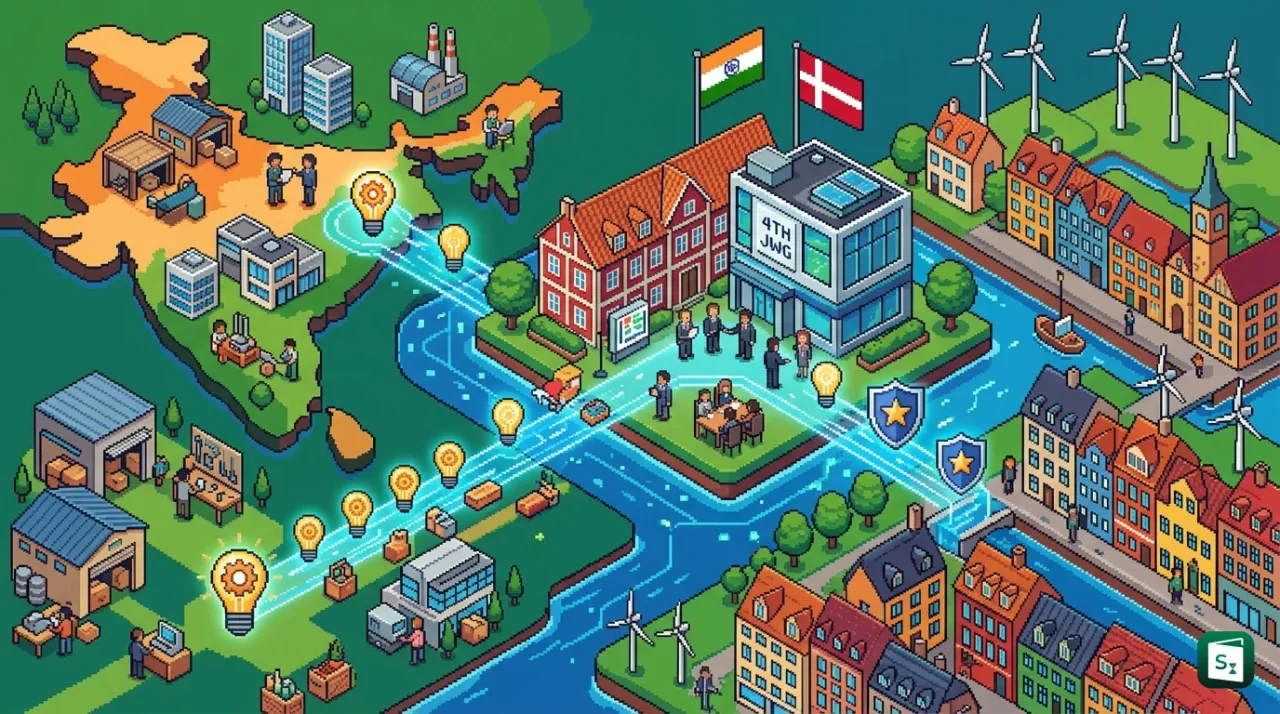
The 4th meeting of the India-Denmark Joint Working Group (JWG) was held in Copenhagen, Denmark, from 24 to 28 August 2026, bringing together India’s Ministry of Micro, Small and Medium Enterprises (MSME) and Denmark’s Danish Patent and Trademark Office (DKPTO). The five-day session reviewed past cooperation and set fresh priorities across MSME development, innovation and intellectual property (IP), reaffirming a partnership that has been quietly shaping the architecture for India’s small business and IP ecosystem for over a decade.
India and Denmark Hold the 4th Joint Working Group Meeting in Copenhagen
The two sides reviewed the outcomes of all three previous JWG rounds and used the Copenhagen meeting to expand cooperation in areas that go to the heart of how small businesses innovate, protect, and commercialise their work. The Indian delegation was led by Dr. Rajneesh, Additional Secretary and Development Commissioner in the Ministry of MSME, with senior officials from the Ministry and the National Institute for Micro, Small and Medium Enterprises (ni-msme) in Hyderabad. The Danish delegation was headed by Ms. Maria Skou, Deputy Director General and Chief Operating Officer of the DKPTO, with colleagues from the Royal Danish Embassy in New Delhi.
India’s Ambassador to Denmark, Mr. Manish Prabhat, and Counsellor Mr. Ashish Arya from the Embassy of India in Copenhagen also participated in the bilateral sessions, lending diplomatic weight to the technical exchanges. On the Danish side, Mr. Mattias Dinnetz, Senior Advisor for International Cooperation at DKPTO, and Ms. Louise Boisen, Counsellor for Intellectual Property Rights at the Royal Danish Embassy in New Delhi, rounded out the team.
What the India-Denmark Joint Working Group Is
The India-Denmark Joint Working Group on MSME Development, Innovation and Intellectual Property is a dedicated bilateral mechanism set up under the broader India-Denmark cooperation framework. Its job is to provide a regular, structured platform where the two sides can compare their MSME and innovation ecosystems, share technical know-how, and identify concrete areas for joint action.
The JWG sits inside a wider web of bilateral dialogues between the two countries. India and Denmark have 12 Joint Working Groups in total, covering renewable energy, shipping and ports, agriculture and animal husbandry, food processing, science and technology, labour mobility, environment, smart cities, digitisation, energy cooperation, health and medicine, and water. A Joint Commission at the Foreign Ministers’ level (established in 2008) and Foreign Office Consultations at the Secretary level (since 1995) provide the umbrella political framework. The MSME-IP JWG is, however, the only one of these groups that brings the two countries’ IP offices and small business ministries face to face on a regular cycle.
India’s lead institution is the Ministry of Micro, Small and Medium Enterprises, which is headquartered in New Delhi and operates through bodies such as the Office of the Development Commissioner (MSME), the MSME Development Institutes (MSME-DIs) spread across cities including Mumbai, Chennai, Kolkata, Bengaluru, Hyderabad and Agra, and the ni-msme in Hyderabad. Denmark’s counterpart is the Danish Patent and Trademark Office (DKPTO), the national authority responsible for patents, trademarks and designs, headquartered in Copenhagen.
What Was Discussed: Six Core Cooperation Areas
Both sides used the Copenhagen meeting to exchange perspectives on their respective MSME and innovation ecosystems, with talks organised around six broad themes. Discussions covered technology adoption, innovation, intellectual property, technology commercialisation, entrepreneurship, and cluster-based MSME development. The two sides also reviewed the outcomes of previous rounds of engagement and identified priorities for future collaboration under the existing JWG framework.
A recurring thread through the discussions was the idea that India and Denmark are at very different points on the same journey. India has a vast and growing MSME base with strong manufacturing depth, while Denmark has a relatively smaller SME universe that has been deeply integrated into a mature, IP-led, cluster-based innovation model. The JWG is essentially the bridge that lets Indian policymakers see how a small, knowledge-intensive economy turns innovation into commercial output, and lets Danish officials see how the Indian ecosystem absorbs and scales technology.
Dr. Rajneesh used the platform to present “India’s Growth Engine: MSMEs”, highlighting the sector’s role in India’s economic growth and the major government interventions in credit facilitation, technology adoption, market access, productivity, innovation, IP protection, and technology commercialisation. On the Danish side, Maria Skou walked the Indian delegation through the role of DKPTO in Denmark’s innovation ecosystem, particularly how patent and trademark tools are used as instruments of industrial policy, not just legal formalities.
Site Visits and the Nordic-India Startup Summit
A defining feature of the 4th JWG was the field exposure built into the programme. The Indian delegation visited two of Denmark’s most studied innovation clusters: the Aarhus University Innovation “Kitchen” and the Agro Food Park, both located in the city of Aarhus, Denmark’s second-largest city. Aarhus University is one of the country’s top public research universities, and the Innovation Kitchen functions as a structured, mentored space where student researchers, start-ups, and industry partners turn early-stage ideas into investable businesses. Agro Food Park is one of Europe’s largest dedicated clusters for food and agribusiness enterprises, where companies share infrastructure, R&D facilities, and market access under a single umbrella.
The visits gave the Indian side first-hand exposure to Denmark’s approach to mentoring, start-up support, industry-academia linkages, and cluster-based assistance for entrepreneurs and MSMEs. These are areas where India is increasingly investing, through programmes such as the MSME Innovative Scheme, the Atal Innovation Mission, and the network of Technology Business Incubators, but where on-the-ground cluster models are still evolving.
The Indian delegation also held a working session with the Danish Ministry of Industry, Business and Financial Affairs, exchanging views on business development, innovation policy, and the broader SME ecosystem in Denmark. A highlight of the week was participation in the Nordic-India Startup Summit 2026, organised by TechBBQ, one of the leading Nordic start-up events. The summit offered the Indian side direct access to Nordic venture funds, accelerators, and founders, and gave Denmark-based stakeholders a window into India’s MSME and start-up landscape.
Leadership at the Table: Delegations and Key Officials
The JWG was designed to be a working-level engagement, but the seniority of the participants shows that both governments treat MSME-IP cooperation as a strategic file, not a routine exchange. The Indian side was led by Dr. Rajneesh, Additional Secretary and Development Commissioner in the Ministry of MSME, who is also the head of the Office of the Development Commissioner (MSME). He was joined by Md. Salik Parwaiz, Director in the Ministry of MSME, Ms. Bhagya Jagadiswaran, Assistant Director in the Ministry, and Ms. Swapna Vanamala, Faculty Member at ni-msme. The diplomatic side was represented by Mr. Manish Prabhat, India’s Ambassador to the Kingdom of Denmark, and Mr. Ashish Arya, Counsellor at the Embassy of India in Copenhagen.
The Danish delegation was led by Ms. Maria Skou, Deputy Director General and Chief Operating Officer of the DKPTO, and included Mr. Mattias Dinnetz, Senior Advisor for International Cooperation at DKPTO, and Ms. Louise Boisen, Counsellor for Intellectual Property Rights at the Royal Danish Embassy in New Delhi. The presence of the Royal Danish Embassy’s IP counsellor in the team is significant, because it ensures that the JWG’s work is plugged into Denmark’s wider diplomatic engagement in India, particularly through the Green Strategic Partnership delivery architecture.
Ambassador Manish Prabhat used the closing session to appreciate the effective functioning of the JWG mechanism, acknowledge the deepening of India-Denmark cooperation, and reaffirm India’s commitment to continued engagement under the existing framework. He encouraged both sides to explore new and complementary areas of cooperation, signalling that the JWG is likely to remain a permanent feature of the bilateral calendar rather than a periodic exercise.
India-Denmark Green Strategic Partnership: The Umbrella Framework
The MSME-IP JWG does not exist in isolation. It operates under the umbrella of the India-Denmark Green Strategic Partnership, which was established on 28 September 2020 through a virtual summit between Prime Minister Narendra Modi and his then Danish counterpart, Prime Minister Mette Frederiksen. The partnership built on the older Joint Commission for Cooperation signed on 6 February 2009 and is implemented through an India-Denmark Joint Action Plan (2021-2026) that covers energy and climate change, environment and water, circular economy, sustainable urban development, science and innovation, shipping, labour mobility, smart cities, and digitisation.
The Green Strategic Partnership is the only one of its kind in India’s bilateral portfolio, in the sense that the “green” label is built into its core identity, not added as a sectoral layer. The framework channels Danish expertise in offshore wind, district energy, and water management into India’s renewable energy build-out, while giving Danish companies access to one of the world’s largest and fastest-growing markets for clean technology. India and Denmark established diplomatic relations in September 1949, and the 2026 JWG falls in a year that marks the deepening of a partnership now more than 75 years old.
The Strategic Sector Cooperation on Intellectual Property Rights, a separate bilateral track launched after 2020, gave the JWG a strong operational base. The cooperation, anchored by DKPTO on the Danish side and by the Department for Promotion of Industry and Internal Trade (DPIIT) under the Ministry of Commerce and Industry on the Indian side, focused on three outcomes: institutional and technical capacity for IP examination and registration, awareness and enforcement of IP rights, and a framework for commercialisation of IP rights. A tangible output was the groundwork for a bilateral green Patent Prosecution Highway, which would let Indian and Danish patent offices share search and examination results to speed up green technology patents.
Why the MSME-IP Linkage Matters for India
The choice of MSME development and intellectual property as the JWG’s core themes reflects a deliberate policy choice. India’s MSME sector contributes about 30 percent of the country’s GDP and 45 percent of its exports, and employs more than 110 million people across manufacturing and services. The classification of MSMEs was revised in June 2020 through a composite criterion of investment in plant and machinery or equipment, and annual turnover, brought together through the Udyam Registration portal that went live on 1 July 2020. Micro, small, and medium enterprises are now defined by investment thresholds of ₹1 crore (micro), ₹10 crore (small), and ₹50 crore (medium), paired with turnover ceilings of ₹5 crore, ₹50 crore, and ₹250 crore respectively.
Intellectual property, in turn, is increasingly central to how Indian MSMEs compete in global value chains. The National Intellectual Property Policy 2016, approved on 12 May 2016, is the governing framework for India’s IP regime. The Controller General of Patents, Designs and Trade Marks (CGPDTM), under the Department for Promotion of Industry and Internal Trade (DPIIT) in the Ministry of Commerce and Industry, administers the Patents Act 1970, the Trade Marks Act 1999, the Designs Act 2000, the Geographical Indications of Goods (Registration and Protection) Act 1999, the Copyright Act 1957, the Protection of Plant Varieties and Farmers’ Rights Act 2001, the Semiconductor Integrated Circuits Layout-Design Act 2000, and the Biological Diversity Act 2002. The statutory backbone of the Indian IP system is therefore broad, but its effective use by small businesses remains uneven.
The JWG is, in effect, an attempt to close that gap by giving Indian MSMEs direct exposure to Denmark’s cluster-based and IP-led growth model. Denmark, with a population of less than 6 million, consistently ranks among the world’s most innovative economies in the Global Innovation Index, and its small businesses use IP tools as routine business instruments rather than as last-resort legal remedies. Bringing this practice into the Indian MSME conversation is the central strategic objective of the working group, and the 4th meeting in Copenhagen is the latest step in that longer journey.
India-Denmark Trade and Investment: The Wider Context
The JWG sits on top of a steadily deepening commercial relationship. According to data shared by the Embassy of India in Denmark, bilateral trade in services between the two countries rose to about $4.25 billion in 2025, up from $4 billion in 2024. India’s services exports to Denmark stood at roughly $1.9 billion in 2025, with services imports at about $2.3 billion. In goods, bilateral trade was around $2.05 billion in 2025. Data from India’s Ministry of Commerce also showed that India achieved 106 percent of its export target to Denmark in 2025-26, exceeding the target set for the year.
Danish direct investment into India between 2000 and 2023 was about $2.1 billion, with around 200 Danish companies active in sectors ranging from shipping, renewable energy, environment, agriculture, food processing, and smart urban development. Major Danish companies present in India include AP Moller Maersk, Vestas, LM Wind Power, Grundfos, Danfoss, Carlsberg, FLSmidth, Novo Nordisk, Haldor Topsoe, Ramboll, and Cowi. Indian investment in Denmark totals about $560 million, with around 40 Indian companies, including Infosys, Tata Consultancy Services, L&T Infotech, HCL, Tech Mahindra, and OYO, operating primarily in IT, renewable energy, and engineering services. The MSME-IP JWG is designed to broaden this base by bringing smaller Danish and Indian firms into the relationship, where the volume of trade may be modest but the value of technology and IP transfer is high.
Key Takeaways
- The 4th India-Denmark Joint Working Group meeting was held in Copenhagen from 24 to 28 August 2026, between India’s Ministry of MSME and Denmark’s Danish Patent and Trademark Office (DKPTO).
- The meeting focused on six themes: technology adoption, innovation, intellectual property, technology commercialisation, entrepreneurship, and cluster-based MSME development.
- The Indian delegation was led by Dr. Rajneesh, Additional Secretary and Development Commissioner, Ministry of MSME, while the Danish delegation was led by Ms. Maria Skou, Deputy Director General and Chief Operating Officer of DKPTO.
- The Indian delegation visited Aarhus University Innovation “Kitchen” and Agro Food Park, and participated in the Nordic-India Startup Summit 2026 organised by TechBBQ.
- The JWG operates under the India-Denmark Green Strategic Partnership, established on 28 September 2020, which is implemented through a Joint Action Plan (2021-2026) covering energy, climate, water, innovation, and several other sectors.
- India and Denmark have 12 Joint Working Groups in total, but the MSME-IP track is the only one that brings the IP offices and small business ministries of the two countries together on a regular basis.
- The JWG draws on Denmark’s cluster-based innovation model and India’s vast MSME base, which contributes about 30 percent of GDP and 45 percent of exports, with the Udyam Registration portal (live since 1 July 2020) as the central classification and registration system.
- The National Intellectual Property Policy 2016 governs India’s IP regime, with the Controller General of Patents, Designs and Trade Marks (CGPDTM) under DPIIT, Ministry of Commerce and Industry as the main administrative body.
- Bilateral services trade between India and Denmark rose to about $4.25 billion in 2025, and India achieved 106 percent of its export target to Denmark in 2025-26.