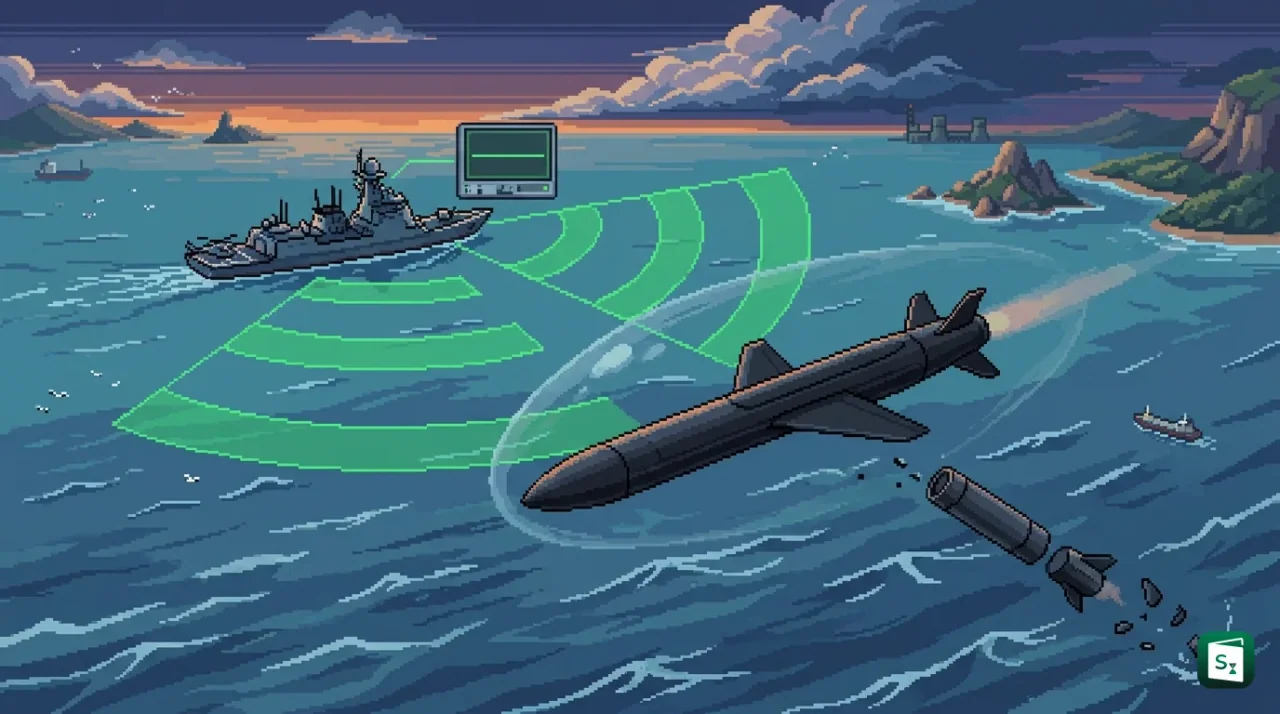
China has test-fired a new variant of its YJ-18A anti-ship cruise missile fitted with a black stealth coating that absorbs radar waves and improves the weapon’s ability to evade detection. Footage released by Chinese state broadcaster CCTV showed the missile being launched from a warship’s vertical launch system (VLS) during an extreme-performance test in an undisclosed sea area in late August 2026. The test signals China’s growing focus on stealth across its naval arsenal, as the improved missile combines low observability with a supersonic terminal attack to penetrate modern warship defences.
What the Test Involved
The footage showed a missile being fired vertically from a naval vessel’s vertical launch system during what Chinese state media described as an extreme-performance test of a new type of anti-ship missile. The broadcast drew attention to the missile’s distinct black finish, which is rarely seen on Chinese naval weapons. Most ship-borne missiles in active service with the People’s Liberation Army Navy (PLAN) are painted in lighter shades such as grey, white or blue.
Chinese military commentators identified the weapon as an improved variant of the YJ-18A, noting that the black coating is a form of stealth coating with strong radar-wave-absorbing properties. The footage was originally shown in early July 2026 as part of a longer report on a PLAN equipment testing unit, but the black coating was highlighted only in the later broadcast. The broadcast noted that the test team captured the missile’s flight parameters despite complex and severe sea conditions, collecting several times more data than originally planned to support further improvements to the weapon system.
The video also showed the missile performing quick direction changes, or vector manoeuvres, shortly after launch. This allows the missile to begin sea-skimming flight as soon as possible, flying just metres above the water to stay below enemy radar coverage. By keeping its flight profile low, the missile reduces the chance of being detected and engaged by warship air defences.
The YJ-18A: The ‘Eagle Strike’ Anti-Ship Missile
The YJ-18 (Yingji, meaning ‘Eagle Strike’, NATO designation CH-SS-NX-13) is China’s primary anti-ship cruise missile family. It is widely believed to be derived from the Russian 3M-54E Klub missile, though it has been substantially redesigned and produced domestically. The missile is designed for a single decisive purpose: penetrating the layered defences of modern surface warships, including aircraft carriers and guided-missile destroyers.
What makes the YJ-18 distinctive is its two-stage flight profile. It cruises at subsonic speed (around Mach 0.8) to save fuel and extend its range, then accelerates to supersonic speed (Mach 2.5 to 3.0) during the final attack run, using a solid-rocket booster. This terminal sprint gives the defending warship only a very short window to react, while the slow, efficient cruise phase keeps the missile’s range long. The missile is guided by an inertial navigation system assisted by China’s BeiDou satellite navigation system, with an active radar seeker for terminal homing.
Key Specifications of the YJ-18
| Parameter | Value |
|---|---|
| Type | Anti-ship cruise missile (land-attack variants also exist) |
| Length | About 8.2 metres (including booster) |
| Launch weight | Around 1,579 kg |
| Warhead | 140 to 300 kg high explosive |
| Range | 220 to 540 km |
| Cruise speed | Mach 0.8 (subsonic) |
| Terminal speed | Mach 2.5 to 3.0 (supersonic) |
| Guidance | BeiDou-assisted inertial navigation plus active radar homing |
| Launch platforms | Surface ships, submarines, coastal launchers |
The YJ-18 Missile Family
The YJ-18 family has grown into several specialised variants. The original YJ-18 is a submarine-launched and ship-launched anti-ship missile that entered service around 2014 to 2015. The YJ-18A, which was publicly displayed in 2019 during the 70th anniversary parade of the People’s Republic of China, is the improved ship-launched version commonly carried by the PLAN’s destroyers. The YJ-18C is a land-attack variant that was unveiled at a military parade in September 2025, designed to strike targets such as airfields, ports, missile positions and logistics hubs.
The black-coated missile seen in the latest footage appears to be a further improvement over the YJ-18A, distinguished mainly by its stealth coating. The YJ-18C already reportedly uses a multi-faceted stealth design that reduces its radar cross-section (RCS), the amount of radar energy an object reflects back, to as little as 0.005 square metres, comparable to that of a seabird. The new black coating now extends this low-observability treatment to the anti-ship YJ-18A variant.
How the Black Stealth Coating Works
The black finish on the YJ-18A is a stealth coating, a layer of specialised material applied to a weapon’s surface to make it harder to detect. It works in two ways: it absorbs radar waves, and it provides visual camouflage over the ocean.
Radar Absorption: The Science of Stealth
Radar works by sending out radio waves and listening for the waves that bounce back from a target. A larger reflected signal means a larger radar cross-section, and an easier target to track. A radar-absorbing material (RAM) disrupts this process by soaking up the incoming radar energy and converting it into small amounts of heat, instead of reflecting it back to the radar transmitter.
These materials are typically composites made by mixing conductive or magnetic fillers, such as carbon, iron or ferrite particles, into a polymer binder. When radar waves strike the coating, the particles absorb the electromagnetic energy and dissipate it as heat through electrical and magnetic losses. The result is that far less radar energy returns to the enemy radar, so the missile appears much smaller, or not at all, on a warship’s screens.
Analysts note that the YJ-18A’s black coating likely combines both radar stealth and visual camouflage. Deep ocean water can appear dark, almost black in colour, so a black missile flying low over the sea blends into its background and becomes harder to spot with the naked eye or with optical sensors. Most operational ship-borne missiles are painted in light tones, which makes the black finish on this new variant unusually significant.
Limits of Stealth Coating
A stealth coating does not make a missile completely invisible. Different coatings are tuned to absorb certain radar frequencies better than others, and a missile still has a detectable signature from its engine heat, its shape and its size. What the coating does is shorten the detection range and reduce the warning time available to the defender. When combined with the YJ-18A’s sea-skimming flight and its supersonic terminal sprint, the coating makes the missile considerably harder to intercept before it reaches its target.
Strategic Significance: Strengthening China’s Naval Deterrence
The YJ-18A is a core component of China’s anti-access, area-denial (A2/AD) strategy, a military doctrine designed to prevent an adversary from operating freely in a region. By fielding long-range anti-ship missiles, coastal batteries, submarines and warships, China aims to keep foreign naval forces, especially aircraft carrier battle groups, at a safe distance from its shores and from disputed waters in the South China Sea and East China Sea.
The missile is routinely carried by two of China’s most advanced surface combatants. The Type 052D destroyer, a guided-missile destroyer of about 7,500 tonnes, entered service from 2014 and carries 64 vertical launch system cells. The larger Type 055 destroyer, sometimes classed as a cruiser, displaces about 12,000 tonnes and carries 112 VLS cells, giving it the firepower to launch large salvos of YJ-18 missiles, air-defence missiles and land-attack cruise missiles. Both ships use a common, multi-purpose vertical launch system that can fire anti-ship, anti-air and anti-submarine weapons from the same cells.
The First Island Chain and Beyond
China’s naval strategy is closely tied to the concept of the First Island Chain, a chain of islands and archipelagos running from Japan through Taiwan and the Philippines down to the Malay Peninsula. Chinese military planners see this arc as a maritime defensive boundary. The YJ-18’s range of up to 540 km, combined with its deployment on destroyers and submarines, allows the PLAN to threaten warships operating well inside this region.
The addition of a stealth coating to the YJ-18A is significant because it directly improves the missile’s most important quality: the ability to penetrate enemy defences. Defence analysts point out that an anti-ship missile can defeat a warship’s layered defences in two ways, through high speed or through stealth, and the YJ-18A now combines both. A stealthier missile that is detected later, and at closer range, gives a carrier group’s air-defence systems less time to track, engage and shoot it down, raising the risk of catastrophic damage to high-value ships.
Cruise Missiles vs Ballistic Missiles
To understand why the YJ-18A is built the way it is, it helps to know the difference between the two main families of missiles. A cruise missile is essentially a small, unmanned, pilotless aircraft. It is powered for its entire flight by a jet or rocket engine, stays within the atmosphere, and flies at low altitude, often just metres above the sea or ground, to stay hidden from radar. A ballistic missile, by contrast, is launched high into the upper atmosphere or space by a rocket, then coasts along an unpowered, arcing trajectory, much like a thrown ball, before falling onto its target under gravity.
| Feature | Cruise Missile | Ballistic Missile |
|---|---|---|
| Flight path | Low, level flight within the atmosphere | High arcing trajectory, partly outside the atmosphere |
| Propulsion | Powered for the entire flight | Powered only during the initial boost phase |
| Speed | Subsonic to supersonic (Mach 0.7 to 3) | Very high, often hypersonic on re-entry |
| Guidance | Continuously guided, can change course mid-flight | Path largely fixed after launch |
| Altitude | Sea-skimming, as low as a few metres | Reaches very high altitudes |
| Accuracy | Very high, precise targeting | Improving, but traditionally less precise |
| Typical role | Precision strikes, including anti-ship | Longer-range strategic strikes |
The YJ-18A belongs to the cruise missile family, and its two-stage design deliberately blends the advantages of both speed types. The subsonic cruise stage is fuel-efficient and keeps the missile low over the water, while the supersonic terminal stage delivers the penetrating power needed to defeat a warship’s close-in defences. This makes it a highly effective anti-ship weapon, able to skim the waves and then strike at three times the speed of sound.
India’s BrahMos: A Comparable Supersonic Missile
India fields its own formidable anti-ship cruise missile in the BrahMos, a supersonic cruise missile developed jointly by India’s Defence Research and Development Organisation (DRDO) and Russia’s NPO Mashinostroyeniya. The two organisations formed the joint venture BrahMos Aerospace in 1998. The name is a blend of the Brahmaputra and Moskva rivers, symbolising the India-Russia partnership behind the weapon.
Unlike the YJ-18, which cruises at subsonic speed and accelerates only near its target, the BrahMos flies at supersonic speed of about Mach 2.8 to 3 for almost its entire flight. It can be launched from ships, submarines, aircraft and land-based mobile launchers, and it carries a warhead of up to 300 kg. It is widely regarded as one of the fastest operational cruise missiles in service. India is also developing the smaller BrahMos-NG, or Next Generation, which will have a reduced radar cross-section to make it harder to detect, and the hypersonic BrahMos-II, currently under development.
| Feature | China’s YJ-18A | India’s BrahMos |
|---|---|---|
| Flight profile | Subsonic cruise, supersonic terminal | Supersonic for almost the entire flight |
| Cruise speed | Mach 0.8 | Mach 2.8 to 3 |
| Terminal speed | Mach 2.5 to 3 | Mach 2.8 to 3 |
| Range | 220 to 540 km | About 300 to 500 km |
| Launch platforms | Ships, submarines, coastal launchers | Ships, submarines, aircraft, land launchers |
| Stealth treatment | New radar-absorbing black coating | Reduced-signature design on NG variant |
The comparison shows that both countries have converged on the same design philosophy for anti-ship warfare: speed, sea-skimming altitude and penetration power. While China has emphasised adding stealth to an already fast missile, India has chosen sustained supersonic speed as its primary defence-penetration strategy. India’s indigenously developed Nirbhay is a subsonic, long-range land-attack cruise missile, giving India a subsonic option as well for different mission requirements.
Key Takeaways
- China has tested a new variant of the YJ-18A anti-ship cruise missile fitted with a black stealth coating that absorbs radar waves and provides visual camouflage over deep water.
- The YJ-18 (Yingji, meaning ‘Eagle Strike’, NATO designation CH-SS-NX-13) cruises at Mach 0.8 and accelerates to Mach 2.5 to 3.0 in its supersonic terminal attack, with a range of 220 to 540 km.
- The missile is deployed on the Type 052D destroyer (64 VLS cells) and the Type 055 destroyer (112 VLS cells), and is central to China’s anti-access, area-denial (A2/AD) strategy and the First Island Chain concept.
- A radar-absorbing material (RAM) reduces an object’s radar cross-section (RCS) by absorbing radar energy and converting it to heat, rather than reflecting it back.
- BrahMos, jointly developed by India’s DRDO and Russia’s NPO Mashinostroyeniya under BrahMos Aerospace (formed in 1998), is a supersonic cruise missile flying at Mach 2.8 to 3 with a range of about 300 to 500 km.
- A cruise missile is powered for its entire flight and flies low within the atmosphere, while a ballistic missile follows an unpowered high arc after an initial rocket boost.