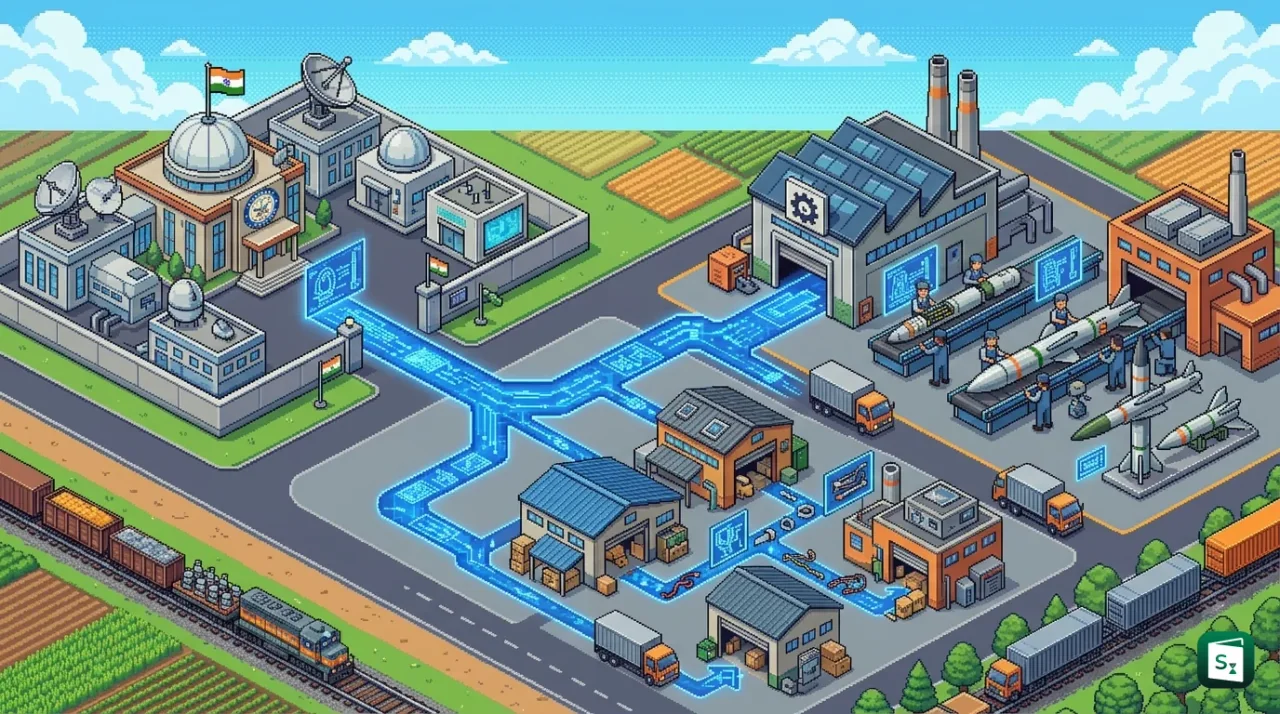
Defence Minister Rajnath Singh approved on 25 August 2026 the Transfer of Technology (ToT) of every conventional missile system developed by the Defence Research and Development Organisation (DRDO) to Indian private defence manufacturers and Micro, Small and Medium Enterprises (MSMEs). The approval, announced in New Delhi, ends the decades-long monopoly of state-run Bharat Dynamics Limited (BDL) and allows qualified private firms to undertake end-to-end production of tactical missile systems within India. With defence exports touching a record ₹38,424 crore in FY 2025-26, the move marks the most decisive step yet in converting India’s missile laboratories into an industrial-scale manufacturing base.
What Was Approved: All Conventional Missile Systems Now Open to Industry
Defence Minister Rajnath Singh cleared the Transfer of Technology (ToT) of all conventional missile systems developed by DRDO to Indian industries on 25 August 2026. The Ministry of Defence described the decision as an “important milestone” in expanding the role of domestic industry in the defence ecosystem and enabling the transition of missile systems from the laboratory stage to industrial-scale production.
Under the approval, Indian defence companies that meet the prescribed qualifications, certifications and regulatory requirements can now take up production of DRDO-developed conventional missile technologies within the country. DRDO, however, will retain responsibility for design certification and quality assurance of every system handed over to industry. The objective is to enhance domestic manufacturing capabilities, strengthen the defence industrial base and create opportunities for Indian MSMEs and other technology partners to enter the missile supply chain.
Conventional Missiles in Scope
The conventional portfolio opened up to private industry is extensive. Defence establishment sources indicate that the systems covered include air defence systems such as Akash and Akash-NG surface-to-air missiles, the man-portable Very Short Range Air Defence System (VSHORADS), and the Astra family of beyond-visual-range air-to-air missiles, including the upcoming Astra Mk-2 with a range of more than 200 km. The anti-radiation and strike category is represented by the Rudram series of supersonic and hypersonic air-to-surface missiles.
Anti-tank systems such as Nag, SANT and the Man-Portable Anti-Tank Guided Missile (MP-ATGM) are also part of the opening. Naval strike and land-attack roles are covered through the Naval Anti-Ship Missile-Short Range (NASM-SR), indigenous long-range land-attack cruise missiles (LR-LACM), and the Pralay quasi-ballistic tactical missile, designed for conventional strikes in the 150-500 km range. Around 370 Pralay missiles have already been contracted by the armed forces, while a fresh proposal for about 1,000 Akash-NG missiles is under active consideration.
Strategic and Joint-Venture Systems Kept Outside the Framework
The Ministry of Defence has clearly distinguished the conventional portfolio from strategic nuclear-capable systems. The Agni series of land-based ballistic missiles and the submarine-launched K-series (K-4, K-5, K-6) form the core of India’s nuclear deterrence and remain under strict government control through the Strategic Forces Command (SFC). They are administered under the Nuclear Command Authority and are not part of the conventional ToT framework.
Joint-venture systems are also excluded. The BrahMos supersonic cruise missile is developed by BrahMos Aerospace, a joint venture between India and Russia, and is governed by separate bilateral arrangements. The Medium Range Surface-to-Air Missile (MRSAM), co-developed with Israel, similarly falls outside the new policy. Any transfer of production rights for these systems would require approval under existing inter-governmental agreements.
Inside the Transfer of Technology Framework
Transfer of Technology is the formal process by which a research organisation hands over technical knowledge, drawings, processes and production rights to industry so that the recipient can manufacture a system at scale. In the defence context, the technology package typically includes detailed design know-how, engineering drawings, process specifications, quality assurance plans, spares data and ongoing maintenance support. In India, the framework for such transfers is governed by the DRDO ToT Policy 2025, which lays down the rules for handing over technologies whose intellectual property rights or know-how are owned by DRDO.
The DRDO ToT Policy 2025 Architecture
The DRDO ToT Policy 2025 classifies all DRDO-developed technologies into two categories. Category “A” covers military technologies (called “MILTECH”) whose only end users are the Indian Armed Forces, the Ministry of Home Affairs and other Central or State government agencies. The ToT for these technologies is granted to Indian industries for domestic manufacture and supply to the armed forces and other government agencies, including supply chain integrators, subject to availability of an End User Certificate. Category “B” covers dual-use technologies that have commercial potential beyond defence. Their ToT is permitted for manufacture and sale in domestic and global markets, subject to the security classification of the underlying technology.
The policy also fixes the maximum validity of a Licensing Agreement for Transfer of Technology (LAToT) at ten years in general, after which the holder may approach DRDO for renewal. It allows industries to undertake value addition to base technology in consultation with DRDO, provided the changes improve performance or economic viability. ToT is granted free of cost to Development-cum-Production Partners (DcPPs), Production Agencies (PAs) and Development Partners (DPs). A revised technology-transfer policy has further waived the earlier 20 per cent ToT fee for certain categories of partners.
Who Can Receive the Technology
The policy defines an “Indian Industry” as an entity incorporated under the Companies Act, a partnership firm, a proprietorship or any other model permitted by Indian law and compliant with the Department for Promotion of Industry and Internal Trade (DPIIT) guidelines. For defence items requiring an industrial licence, the firm must hold one issued under the Industries (Development and Regulation) Act, 1951. For high-energy materials involving explosives, propellants and pyrotechnics, an additional licence from the Petroleum and Explosives Safety Organisation (PESO) is mandatory.
Foreign direct investment in the recipient company is capped at 49 per cent, with more than 50 per cent of the capital required to be directly or beneficially owned by resident Indian citizens. No pyramiding of foreign investment through Indian holding companies is permitted. For dual-use (Category B) technologies, transfer to a foreign entity or an entity with foreign equity is allowed only with the approval of the Secretary, Department of Defence Research and Development, and the Chairman of DRDO.
Why the Move Matters: Ending the BDL Monopoly
For decades, missile production in India followed a single-track model. After DRDO developed a missile and completed user trials, it was assigned to a nominated production agency for series manufacture. That role was dominated by Bharat Dynamics Limited (BDL), a defence public sector undertaking headquartered in Hyderabad. BDL traditionally held the production rights for most of the indigenous missile portfolio, including Agni variants, Prithvi and Akash, while Bharat Electronics Limited (BEL) handled electronics and integration.
The 25 August 2026 approval breaks that arrangement. It allows private firms to move beyond component supply and become prime integrators of full missile systems. The shift is significant because missile production is not limited to the company that assembles the final weapon. A single missile can involve hundreds of suppliers across propulsion, guidance, seekers, warheads and electronics. Opening the system to multiple qualified manufacturers widens India’s overall production capacity and pulls MSMEs deeper into the supply chain instead of restricting participation to a few large conglomerates.
The Ministry of Defence has been building up to this point. In May 2026, Defence Secretary Rajesh Kumar Singh indicated at a CII event that the government was willing to transfer ballistic missile technology to private companies. Earlier, in June 2026, the Ministry of Defence had distributed 10 to 12 DRDO tactical missile programmes among four private firms under a new partnership model. The latest approval simply scales up that approach across the entire conventional missile portfolio.
The Development-cum-Production Partner (DcPP) Model
The Development-cum-Production Partner (DcPP) model, conceived by DRDO, is the operational vehicle through which the new ToT policy will work. Under this framework, capable manufacturing partners are identified from both public and private sectors through a competitive selection process. The selected partner co-develops a functional prototype with DRDO, completes design refinement, trials and evaluation, and then receives the manufacturing technology for series production once orders begin to flow from the armed forces.
DRDO now draws on a network of over 2,200 industries capable of producing sub-systems, systems and equipment. By March 2026, 134 companies had signed on as DcPPs or Production Agencies. More than 2,180 technology transfer agreements had been signed, and over 2,780 Intellectual Property Rights had been opened up for the private industry to use. The four major private DcPPs selected in June 2026 are Adani Defence and Aerospace, Bharat Forge (through its subsidiary Kalyani Strategic Systems), ICOMM Tele and Solar Defence and Aerospace. Tata Advanced Systems and Mahindra are also expected to participate in upcoming Requests for Proposal (RFPs).
Some programmes already in advanced collaboration include the NASM-SR helicopter-launched anti-ship missile, the Rudram anti-radiation family (Rudram-I, Rudram-II and Rudram-III), the VSHORADS man-portable air defence system, the Long-Range Glide Bomb (LRGB) and the UAV-Launched Precision Guided Missile (ULPGM-V3). Adani Defence broke ground in July 2026 on a ₹2,500 crore missile complex at Shivpuri in Madhya Pradesh for composite propellant and TNT production, reflecting the scale of private investment flowing into the sector.
Defence Manufacturing and Exports: The Bigger Picture
The ToT approval is part of a wider push to convert India’s defence industry from a buyer of foreign equipment into a developer and exporter of advanced military systems. The Department of Defence Production (DDP), which operates under the Ministry of Defence, coordinates the production of weapons, aircraft, ships and other military hardware across India. Defence Public Sector Undertakings (DPSUs), ordnance factories and private firms all function under its framework.
India’s defence exports tell the story of the sector’s expanding global footprint. Exports touched a record ₹38,424 crore in FY 2025-26, marking a 62.66 per cent jump over the previous fiscal’s ₹23,622 crore and a near 25-fold rise from ₹1,522 crore in FY 2016-17. The country now exports defence equipment to more than 80 countries, with the number of exporters rising to 145 from 128 in the previous year. Major destinations include Myanmar, the Philippines, Armenia, Sri Lanka, Mauritius, Seychelles and Vietnam. India has set a target of ₹50,000 crore in defence exports by 2029.
In FY 2025-26, defence PSUs contributed 54.84 per cent of exports (₹21,071 crore) while private industry contributed 45.16 per cent (₹17,353 crore). Major export items include high-value missile systems such as BrahMos cruise missiles (used by the Indian armed forces during Operation Sindoor), artillery systems, radars, electronic warfare systems, armoured vehicles, Dornier-228 aircraft, mine-protected vehicles and body armour. Missile systems, in particular, have a growing export profile. Indonesia has expressed interest in the Astra air-to-air missile, while Armenia has placed orders for Pinaka rocket systems produced by private industry.
Key Defence Manufacturing and Export Indicators
| Indicator | Figure | Reference Year |
|---|---|---|
| Total defence exports | ₹38,424 crore | FY 2025-26 |
| Year-on-year growth in exports | 62.66 per cent | FY 2025-26 over FY 2024-25 |
| Number of countries importing Indian defence equipment | More than 80 | FY 2025-26 |
| Number of defence exporters in India | 145 | FY 2025-26 |
| PSU share of exports | 54.84 per cent (₹21,071 crore) | FY 2025-26 |
| Private sector share of exports | 45.16 per cent (₹17,353 crore) | FY 2025-26 |
| Government’s defence export target | ₹50,000 crore | By 2029 |
| Industries in DRDO supply ecosystem | Over 2,200 | March 2026 |
| Companies signed as DcPPs or Production Agencies | 134 | March 2026 |
| Technology transfer agreements signed | Over 2,180 | March 2026 |
| DRDO intellectual property rights opened up | Over 2,780 | June 2026 |
Institutional Framework Behind the Decision
| Body | Role |
|---|---|
| Defence Research and Development Organisation (DRDO) | Apex defence R&D body, formed in 1958, headquartered in New Delhi. Operates around 30 laboratories and establishments across India. Retains design certification and quality assurance under the new ToT. |
| Department of Defence Research and Development (DDR&D) | Parent department of DRDO, headed by the Raksha Mantri. Provides policy direction on indigenous defence R&D. |
| Department of Defence Production (DDP) | Apex body under the Ministry of Defence for indigenous production of weapons, platforms and equipment. |
| Ministry of Defence | Nodal ministry under Rajnath Singh. Cleared the ToT approval on 25 August 2026. |
| Bharat Dynamics Limited (BDL) | Hyderabad-headquartered defence PSU traditionally tasked with missile production. Continues alongside private players. |
| Bharat Electronics Limited (BEL) | Bengaluru-headquartered defence PSU specialising in electronics, radars and missile systems integration. |
| Integrated Test Range (ITR), Balasore | DRDO test and evaluation centre in Odisha established in 1982. Provides launch facilities for rockets, missiles and airborne weapon systems. |
Significance and Implications
The 25 August 2026 approval represents more than a routine policy update. It signals a structural shift in how India designs, produces and supplies missile systems. By allowing private firms to compete for technology licences through a bidding process, the government is replacing a closed, single-vendor model with an open, multi-vendor industrial framework.
Four implications stand out. First, surge capacity for the armed forces. Recent conflicts, including those in Ukraine and West Asia, have shown the importance of maintaining deep weapons stockpiles and the industrial capacity to scale production quickly. Multiple qualified manufacturers mean the armed forces are no longer dependent on a single production line. Second, a wider MSME base. MSMEs can now participate directly in missile sub-systems, components and supply chains instead of being confined to peripheral roles. Third, cost and import compression. Greater domestic value addition and reduced dependence on imported components should help bring down the lifecycle cost of missile systems. Fourth, a sharper focus for DRDO. With production duties offloaded to industry, DRDO can concentrate on the next generation of weapons, including hypersonic systems and advanced air defence architectures.
There are, however, real constraints. Missile technologies contain highly sensitive information relating to propulsion, guidance, seekers, warheads and electronic systems. The government must balance wider industrial access with strict security oversight, particularly because India is a member of the Missile Technology Control Regime (MTCR), an export-control arrangement that sets strict rules on the transfer of missile-related technology. The DRDO ToT Policy 2025 addresses this by classifying all defence technologies into Category A and Category B, allowing only dual-use (Category B) technologies to be transferred to foreign-owned or foreign-equity entities, and only with the approval of the Secretary, DDR&D, and the Chairman, DRDO.
The decision also dovetails with the proposed Defence Acquisition Procedure (DAP) 2026, which encourages the entry of private players across the defence industrial base. If the model succeeds in missiles, the same approach is likely to be extended to other mature DRDO technologies in aerospace, naval systems and armaments. The move is best understood as the operational expression of the Atmanirbhar Bharat (self-reliant India) vision in one of the country’s most strategically sensitive industrial segments.
Key Takeaways
- Defence Minister Rajnath Singh approved on 25 August 2026 the Transfer of Technology (ToT) of all DRDO-developed conventional missile systems to Indian private defence manufacturers and MSMEs, with DRDO retaining design certification and quality assurance.
- The approval covers the Akash and Akash-NG surface-to-air missiles, VSHORADS, Astra air-to-air missiles, Rudram anti-radiation series, Nag, SANT, MP-ATGM anti-tank systems, NASM-SR anti-ship missile, LR-LACM cruise missiles and the Pralay quasi-ballistic missile.
- Strategic nuclear-capable systems such as the Agni series and the submarine-launched K-series, along with joint-venture systems BrahMos (India-Russia) and MRSAM (India-Israel), are kept outside the new ToT framework.
- The framework is governed by the DRDO ToT Policy 2025, which classifies all DRDO technologies into Category A (military) and Category B (dual-use), with ToT provided free of cost to DcPPs, Production Agencies and Development Partners.
- The DRDO, formed in 1958 and headquartered in New Delhi, now operates across over 30 laboratories and has a network of more than 2,200 industries, with 134 companies already signed on as DcPPs or Production Agencies.
- Major private defence partners include Adani Defence and Aerospace, Bharat Forge (Kalyani Strategic Systems), ICOMM Tele, Solar Defence and Aerospace, with Tata Advanced Systems and Mahindra as expected future bidders.
- India’s defence exports reached a record ₹38,424 crore in FY 2025-26, a 62.66 per cent jump over the previous year, with the country now exporting to over 80 countries and targeting ₹50,000 crore by 2029.
- The move ends the decades-long production monopoly of Bharat Dynamics Limited (BDL), headquartered in Hyderabad, and aligns with the proposed Defence Acquisition Procedure (DAP) 2026 to widen private-sector participation in defence manufacturing.