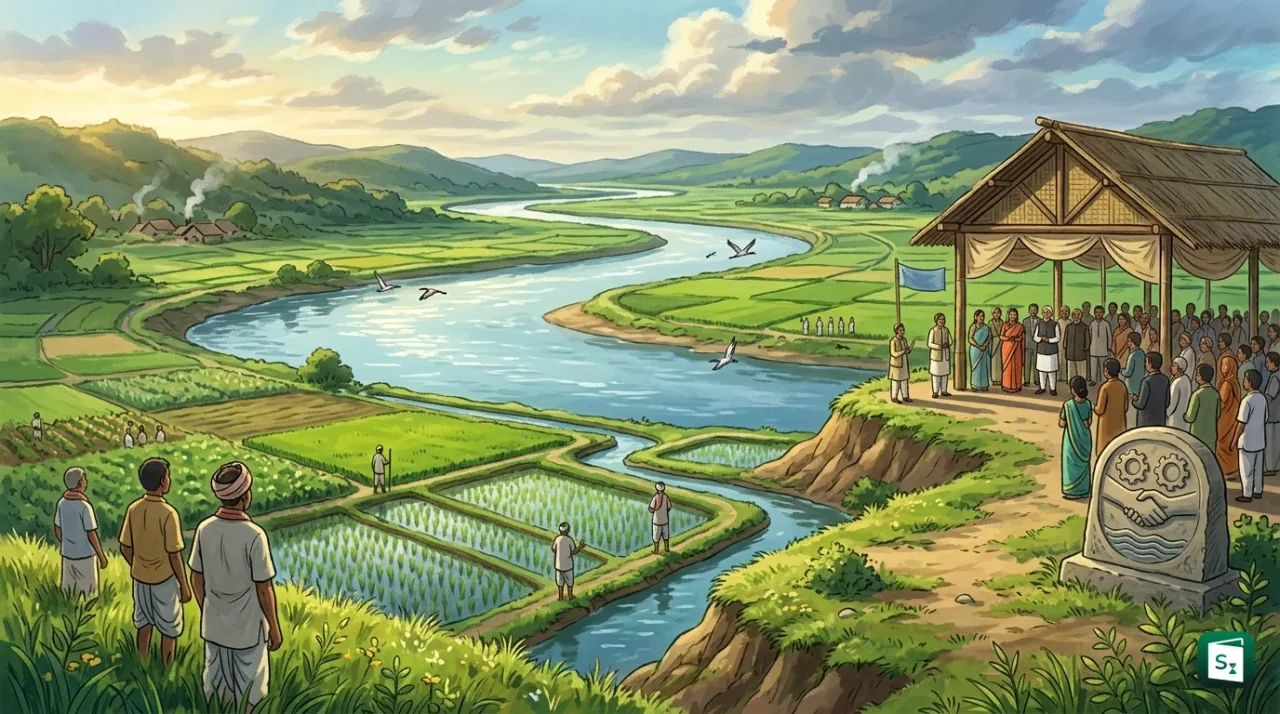
Bihar and Jharkhand signed a Memorandum of Understanding (MoU) on 31 August 2026 in New Delhi to share the waters of the Sone River, ending a dispute that had remained unresolved for nearly 25 years since Jharkhand was carved out of Bihar in 2000. The agreement was signed in the presence of Union Home Minister and Minister of Cooperation Amit Shah, Bihar Chief Minister Samrat Choudhary and Jharkhand Chief Minister Hemant Soren, along with Union Jal Shakti Minister C. R. Patil. It allocates 5.75 million acre feet (MAF) to Bihar and 2 MAF to Jharkhand from the 7.75 MAF originally allotted to undivided Bihar, and is set to secure irrigation and drinking water for lakhs of farmers across eastern India.
What Is the Sone River?
The Sone River, also spelt Son, is a major perennial river of central and eastern India and the second largest southern tributary of the Ganga after the Yamuna. Called Shona in Sanskrit, it is one of the few Indian rivers with a masculine name, a feature it shares with the Brahmaputra and Damodar. In ancient Sangam Tamil literature, it is mentioned as SoNai in the Kuṟuntokai dating to around the 2nd century CE, and in the Valmiki Ramayana the river is described as being crossed by Rama and Lakshmana with sage Vishvamitra.
The river originates near Amarkantak Hill in the Maikal Range of the Vindhya hills. Official records place the source at Sonmuda near Amarkantak at an elevation of about 1,067 metres, close to the headwaters of the Narmada. While the Narmada flows west to the Arabian Sea, the Sone flows east. It starts in present-day Gaurela Pendra Marwahi district of Chhattisgarh, just east of the Narmada source, and enters Madhya Pradesh through Shahdol and Sidhi districts.
From there it flows north and then turns sharply east after it meets the Kaimur Range, which is an extension of the Vindhya Range. It then runs parallel to the Kaimur hills in an east northeast direction through Uttar Pradesh, Jharkhand and Bihar. After travelling about 784 kilometres (about 881 kilometres as per some hydrological estimates), it joins the Ganga on its right bank at Maner near Patna in Bihar, about 16 kilometres upstream of Patna. Geologically, the lower Sone valley is considered a continuation of the Narmada valley.
The Sone flows through five states: Chhattisgarh, Madhya Pradesh, Uttar Pradesh, Jharkhand and Bihar. Its total catchment area is about 70,055 to 71,259 square kilometres, of which nearly 68.9 percent lies in Madhya Pradesh. The catchment up to the Bansagar Dam site alone is 18,648 square kilometres. The river channel is very wide, about 5 kilometres at Dehri and up to 5 to 8 kilometres near its confluence with the North Koel, but its floodplain is narrow at 3 to 5 kilometres. With a steep gradient of 35 to 55 centimetres per kilometre, the river becomes a roaring torrent during the monsoon but shrinks to disconnected pools in the dry season and is not used for navigation. It is also widely known for its sand, which is in demand across the country, and for the Koilwar Bridge, India’s oldest river bridge, which connects Arrah and Patna over the Sone.
Major Tributaries and storage projects
The Sone has several important tributaries that bring water from the surrounding plateaus and hills. On its left bank it is joined by the Ghaghar, Johilla, Chhoti Mahanadi and Madhawal, and on its right bank by the Banas, Gopad, Rihand, Kanhar and North Koel. The Rihand and Kanhar are among the largest, with the Kanhar forming part of the boundary between Jharkhand and Chhattisgarh in its lower reach.
Key structures built on the Sone system shape how its water is used:
| Project | Location | Main Purpose |
|---|---|---|
| Bansagar Dam | On the main Sone in Madhya Pradesh (Rewa Shahdol region) | Stores 14.25 MAF and regulates releases for three states |
| Indrapuri Barrage (also called Sone Barrage) | At Dehri Rohtas district, Bihar, 1,407 metres long | Diverts Sone water into Bihar’s canal network |
| Rihand Dam (Govind Ballabh Pant Sagar) | On the Rihand tributary in Uttar Pradesh | Major storage and hydropower |
| Anicut at Dehri (1873 to 74) | Original low diversion weir | Britain era irrigation for Shahabad, Gaya and Patna, later replaced by Indrapuri |
| Sone Canal System | Branching from Indrapuri | About 3,266 kilometres of main, branch and distributary canals, designed for 6,350 cusecs |
At Dehri, the headworks of the Sone canal system begin. Two main canals, the Main Western Canal and Main Eastern Canal, feed the low level system, while the Sone Western High Level Canal (80.42 kilometres) and Sone Eastern High Level Canal (81.68 kilometres) extend irrigation to higher plateau areas. The command area covers seven south Bihar districts: Rohtas, Bhojpur, Buxar, Kaimur, Patna, Gaya and Aurangabad, with link canals connecting the old and new systems.
Why Was There a Dispute Over Sone Water?
The 1973 Bansagar Agreement
The present sharing pattern goes back to the Bansagar Agreement signed on 16 September 1973 between Madhya Pradesh, Uttar Pradesh and undivided Bihar. The agreement was signed to share both the waters of the Sone and the cost of the Bansagar Dam in Madhya Pradesh. It was assessed that the total annually available water in the Sone basin at that time was 14.25 MAF. This was divided as follows:
| State as per 1973 agreement | Allocation |
|---|---|
| Madhya Pradesh | 5.25 MAF (1.0 MAF upstream of Bansagar plus 2.0 MAF from Bansagar storage plus 2.25 MAF downstream) |
| Uttar Pradesh | 1.25 MAF (0.25 MAF from the Kanhar sub basin plus 1.0 MAF from Bansagar storage or by lifting from the Sone) |
| Undivided Bihar | 7.75 MAF (including 1.0 MAF from Bansagar storage) |
The cost of the dam was to be shared in the ratio 2:1:1 among Madhya Pradesh, Uttar Pradesh and Bihar, matching their use of stored water. The agreement also recognised that Bihar’s old irrigation under the Sone Barrage required about 5 MAF as priority supply from the 7.75 MAF, and that any increase or shortfall in total flow would be shared pro rata in the ratio 5.25:2.75:1.25 after meeting that priority demand. A provision was also made for a Special River Commission to study the Sone’s hydrology within 5 to 10 years for future planning, and for Bihar to supplement about 0.25 MAF by pumping from the Ganga if needed. To execute the dam, the Bansagar Control Board was set up on 30 January 1976 under the Ministry of Agriculture and Irrigation.
How Bihar’s Bifurcation Created a 25 Year Deadlock
On 15 November 2000, Jharkhand was carved out of Bihar under the Bihar Reorganisation Act, 2000. The 1973 agreement had allocated 7.75 MAF to undivided Bihar as a single block. It contained no internal division for a future successor state, so after 2000 a new question arose: how should that 7.75 MAF be split between Bihar and Jharkhand.
The absence of a defined share created practical and legal uncertainty. Jharkhand argued that a large part of the Sone’s catchment and submergence area now lay in its territory, especially in Garhwa and Palamu districts, and therefore it deserved a clear entitlement. Bihar, which had long depended on the Sone canal system for its south Bihar districts, relied on the original 1973 allocation and on the fact that 5 MAF was already tied to existing irrigation under the Sone Barrage.
Negotiations stalled the clearance of new projects. The preliminary report for the Indrapuri Reservoir Project was submitted to the Central Water Commission (CWC) on 24 December 2018. Because the reservoir’s submergence stretches from Kadwan in Garhwa (Jharkhand) to Matiwan in Rohtas (Bihar), the CWC sought inter-state consent. Jharkhand withheld approval until its share of Sone water was formally fixed. A Joint Technical Team meeting in Ranchi on 13 September 2023 failed when Jharkhand demanded the entire remaining 2.75 MAF beyond the 5 MAF of old irrigation, a demand Bihar opposed. The issue was then referred to the Eastern Zonal Council, where it remained pending for two more years.
What Does the New Bihar Jharkhand MoU Provide?
Sharing formula and signing details
The deadlock was broken on 31 August 2026 at Kartavya Bhavan in New Delhi with the signing of a formal Memorandum of Understanding between Bihar and Jharkhand on sharing the Sone’s waters. The ceremony was held in the presence of Union Home Minister and Minister of Cooperation Amit Shah, who also chairs the Inter State Council and the Zonal Councils, along with Jal Shakti Minister C. R. Patil, Bihar Chief Minister Samrat Choudhary, Jharkhand Chief Minister Hemant Soren, Bihar Deputy Chief Minister and Water Resources Minister Vijay Kumar Choudhary, the Union Home Secretary and senior officials of the Centre and both states.
The core of the agreement is a division of the 7.75 MAF that had been allocated to undivided Bihar:
| Successor State | New Allocation | Share of Old 7.75 MAF |
|---|---|---|
| Bihar | 5.75 MAF | About 74.2 percent |
| Jharkhand | 2.00 MAF | About 25.8 percent |
| Total | 7.75 MAF | 100 percent |
This division applies only to the undivided Bihar quota. The allocations to Madhya Pradesh (5.25 MAF) and Uttar Pradesh (1.25 MAF) under the 1973 agreement remain unchanged, so the total of 14.25 MAF for the basin is preserved. Both state cabinets had already cleared the draft, with Jharkhand approving it in January 2026 and Bihar clearing it on 13 January 2026. The Central Water Commission prepared the draft MoU and circulated it for consent before the final signing.
Amit Shah described the pact as permanently resolving issues concerning vast geographical areas, farmers, rural regions and drinking water supplies in both states and as an example of cooperative federalism and the Team Bharat vision. He noted that this was the fourth interstate water agreement facilitated through the Inter State Council in 2026 alone, after the Narmada cost sharing settlement among Maharashtra, Gujarat, Rajasthan and Madhya Pradesh on 7 July 2026, the Yamuna water conveyance agreement between Rajasthan and Haryana on 29 June 2026 for 580 million cubic metres through underground pipelines, and the consensus on the Kishau Multipurpose Dam on 16 June 2026.
Districts set to benefit
The agreement directly improves water assurance for some of the most drought prone and plateau areas of eastern India. According to the Home Ministry, the pact will ensure adequate water for irrigation and drinking across eight districts of Bihar, namely Bhojpur, Buxar, Rohtas, Kaimur, Aurangabad, Arwal, Gaya (Gaya ji) and Patna, which form the core command of the Sone canal system, and across Palamu, Garhwa and adjoining areas of the Sone basin in western Jharkhand.
Bihar Chief Minister Samrat Choudhary said the pact would strengthen water availability in the plateau and drought affected regions of south Bihar, while Jharkhand gets for the first time a formally recognised quantified entitlement to use Sone water within its territory.
How Was the Deadlock Resolved?
The breakthrough came through the Zonal Council mechanism, not through a water tribunal. The Eastern Zonal Council, established under Sections 15 to 22 of the States Reorganisation Act, 1956, comprises Bihar, Jharkhand, West Bengal and Odisha. The Union Home Minister is its Chairman and a Chief Minister of a member state serves as Vice Chairman by rotation. Zonal Councils act as platforms for dialogue between states and between states and the Centre, with proposals first examined by a Standing Committee of Chief Secretaries before reaching the Council.
At the 27th meeting of the Eastern Zonal Council held in Ranchi on 10 July 2025 under the chairmanship of Amit Shah, the Sone sharing dispute was taken up as a priority agenda item. The meeting also discussed other long pending eastern issues such as the Masanjore Dam, Taiyabpur Barrage and the Indrapuri Reservoir, as well as division of assets and liabilities of public sector undertakings that had remained unsettled since the 2000 bifurcation.
Bihar placed its case strongly for a 5.75 MAF retention, linking it to existing canal commitments and future reservoir needs, while Jharkhand pressed for recognition of its basin share. The Council recorded a major consensus on the 5.75 to 2 MAF formula at that meeting, which had been attended by Jharkhand Chief Minister Hemant Soren, Odisha Chief Minister Mohan Charan Majhi, Bihar Deputy Chief Minister Samrat Choudhary (representing Bihar) and West Bengal Finance Minister Chandrima Bhattacharya. Following that political direction, the Central Water Commission vested the understanding in a draft MoU, which both states vetted and finally signed in New Delhi on 31 August 2026.
The Home Ministry noted that this council led approach has become more active in recent years. Between 2004 and 2014, 25 Zonal Council meetings were held, while between 2014 and 2025, 63 meetings were held, about six per year. Of 1,580 issues discussed, 1,287 or about 83 percent have been resolved, making the councils an actionable rather than advisory forum for cooperative federalism.
Why Does This Agreement Matter for Farmers and Water Security?
Irrigation, drinking water and industrial gains
The most immediate gain is for agriculture. The Sone canal system supports kharif and rabi cultivation across south Bihar and adjoining Jharkhand. By fixing each state’s share, the MoU removes uncertainty for canal scheduling in the dry season, when the Sone’s flow drops sharply and releases from Bansagar and Rihand must be carefully regulated. Assured water means more reliable sowing, better crop intensity and reduced dependence on groundwater in districts that face repeated drought.
The pact also addresses drinking water shortages in plateau habitations where groundwater recharge is poor and rivers like the Falgu, Morhar and Jamune around Gaya run dry for much of the year. Stable Sone supplies can supplement piped water schemes and lift schemes in both states. Bihar has also linked the agreement to broader development, noting that assured water can provide fresh momentum to industrial development, including the proposed Integrated Manufacturing Cluster at Gaya, where road and water supply infrastructure is being fast tracked.
For lakhs of rural households, the change is practical: expanded irrigated area, fewer crop failures, and longer availability of canal water beyond the monsoon months.
Unlocking the Indrapuri Reservoir and Sone Falgu Link
Two long pending projects now move from paper to implementation.
Indrapuri Reservoir Project: Planned between Kadwan in Garhwa (Jharkhand) and Matiwan in Rohtas (Bihar) on the main Sone, the reservoir is designed to stabilise the Sone canal system and store monsoon flows for use in the lean season. It had been held up because its submergence spans both states and the sharing formula was unsettled. With the formula fixed, the project can proceed to detailed clearances and construction, benefiting the eight Bihar districts mentioned above and improving dry season flows for Jharkhand as well.
Sone Falgu River Link: Bihar is accelerating a plan to link the Sone with the Falgu River to relieve acute water stress in Gaya. The scheme involves about a 9 kilometre pipeline and a 22 kilometre canal to carry Sone water to the Falgu basin. Gaya does not have a perennial river, the Falgu flows sub surface and its retention has been weakened by deep sand mining, and the Morhar and Jamune have poor carrying capacity. Transferring Sone water will help recharge the Falgu, improve groundwater levels and support both urban supply and religious needs, as increased flow in the Falgu aids devotees visiting Gaya ji during Pitripaksha for tarpan and pind daan. Earlier demands for this link, raised even at recent state visits, had stalled for want of a settled Sone allocation. That constraint is now removed.
Together, the two projects illustrate how a water sharing formula becomes the foundation for storage, transfer and integrated basin planning.
How Are Interstate River Water Disputes Resolved in India?
The Sone pact is a negotiated settlement, not a tribunal award. India’s framework for interstate river disputes rests on two pillars.
Constitutional provision: Article 262 of the Constitution deals with adjudication of disputes relating to waters of inter state rivers or river valleys. Clause 1 empowers Parliament to provide by law for adjudication of any such dispute, and Clause 2 allows Parliament to provide that neither the Supreme Court nor any other court shall exercise jurisdiction over a dispute referred under such a law. Under the Constitution, water is a State subject under Entry 17 of the State List, while regulation of inter state rivers falls under Entry 56 of the Union List, creating the need for a national adjudication mechanism.
Statutory framework: Parliament enacted the Inter State River Water Disputes Act, 1956 (IRWD Act) under Article 262. The Act was amended in 1986, 2002 and other years, with a major Amendment Bill introduced in 2019 that proposed a single permanent tribunal and dispute resolution through mediation, but that bill lapsed in June 2024 and the ad hoc tribunal system continues.
Key features of the 1956 Act show how a dispute moves from negotiation to adjudication. A state may request the Centre to refer a dispute to a tribunal if negotiations fail, and the Centre must constitute a Water Disputes Tribunal within one year of receiving the request. The tribunal consists of a Chairman and two members nominated by the Chief Justice of India from among sitting Supreme Court or High Court judges, with assessors to advise it. The tribunal investigates and gives its decision within three years, extendable by two years, and if published in the Official Gazette under Section 6, the award has the force of law and is binding on the parties, with the force of a Supreme Court decree. Under Section 11, the jurisdiction of the Supreme Court under Article 131 (original jurisdiction) is barred for a dispute referred to a tribunal, but the Supreme Court’s appellate jurisdiction under Article 136 (Special Leave Petition) remains available, as confirmed in the Cauvery judgment of February 2018. The River Boards Act, 1956, which was meant to create river boards for integrated development, has never been operationalised in practice, and Section 8 of the IRWD Act bars reference to a tribunal for matters that could go to a river board.
So far, nine tribunals have been constituted under the Act. Awards of five, namely Krishna Water Disputes Tribunal I, Godavari, Narmada, Cauvery and Mahadayi, have been gazetted and are effective. Awards of Ravi and Beas, Krishna II and Vansadhara remain ungazetted, and the Mahanadi tribunal is still in proceedings. The Sone case shows that many disputes can also be settled through negotiation in Zonal Councils and the Inter State Council without invoking a tribunal, which is the path Bihar and Jharkhand have now taken.
The Way Forward
With the sharing ratio settled, the next steps are technical and administrative. The Central Water Commission and state water resources departments will need to translate the MAF figures into seasonal release schedules, gauge monitoring and joint accounting, especially for monsoon versus lean season flows. Clear protocols for Bansagar and Rihand regulated releases, data sharing for each basin as required under Section 9A of the IRWD Act, and joint inspection of canal headworks will be essential to prevent future friction.
For Bihar, the priority is to move the Indrapuri Reservoir through final approvals, land related reports and financing, while simultaneously advancing the Sone Falgu link to provide relief to Gaya before the next dry season. For Jharkhand, the task is to build intake and distribution infrastructure in Palamu and Garhwa to actually use its newly quantified 2 MAF within the basin in a planned manner.
At the national level, the Centre has signalled that council led mediation will remain its preferred tool for legacy disputes. The fact that four agreements were closed in 2026 suggests that negotiated formulas, backed by technical work from the CWC and political backing at the Inter State Council, can deliver faster outcomes than prolonged adjudication. Sustained follow up through the Eastern Zonal Council Standing Committee will be needed to ensure that what was signed in New Delhi translates into water in the canals and taps of both states.
Key Takeaways
- The Bihar Jharkhand Sone River Water Sharing MoU was signed on 31 August 2026 at Kartavya Bhavan, New Delhi in the presence of Amit Shah, Samrat Choudhary, Hemant Soren and C. R. Patil.
- The MoU divides the 7.75 MAF allocated to undivided Bihar under the 1973 Bansagar Agreement into 5.75 MAF for Bihar and 2 MAF for Jharkhand.
- The 1973 Bansagar Agreement among Madhya Pradesh (5.25 MAF), Uttar Pradesh (1.25 MAF) and undivided Bihar (7.75 MAF) for a total of 14.25 MAF remains the parent framework.
- The Sone River is a 784 kilometre long perennial and the second largest southern tributary of the Ganga, originating at Sonmuda near Amarkantak in the Maikal Range and joining the Ganga at Maner near Patna.
- Beneficiary districts include Bhojpur, Buxar, Rohtas, Kaimur, Aurangabad, Arwal, Gaya and Patna in Bihar and Palamu and Garhwa in Jharkhand, with gains for irrigation, drinking water and long term water security.
- The pact unlocks the Indrapuri Reservoir Project (Kadwan Garhwa to Matiwan Rohtas) and the 9 kilometre pipeline plus 22 kilometre canal Sone Falgu Link for Gaya.
- The dispute, pending since Jharkhand’s creation on 15 November 2000, was resolved through the Eastern Zonal Council (27th meeting in Ranchi on 10 July 2025) and a CWC drafted MoU, not a tribunal, and marks the fourth interstate water agreement in 2026 under the Inter State Council.