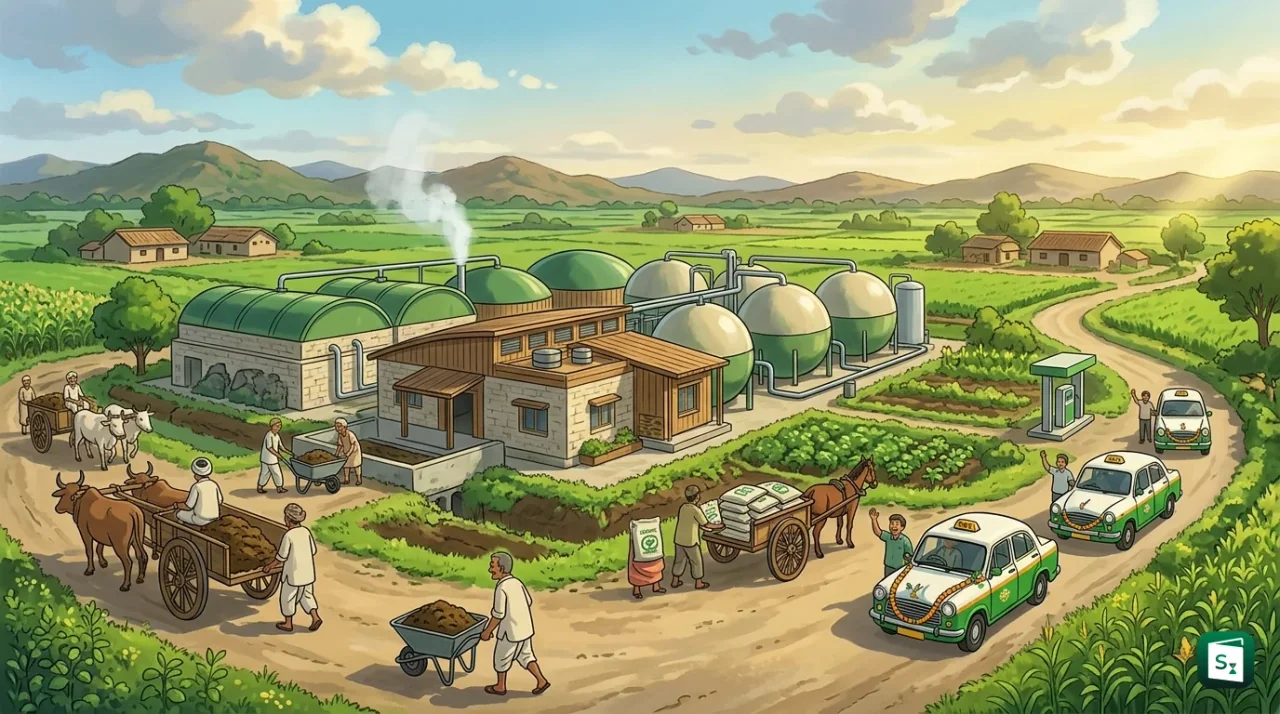
The Banas Bio-CNG Model Plant has been inaugurated at Vinchhiwadi in Dhanera taluka of Banaskantha district, Gujarat, as a joint initiative of Banas Dairy, Suzuki Motor Corporation and the National Dairy Development Board (NDDB). The 100 Metric Tonnes Per Day (MTPD) facility converts cattle dung into Bio-CNG and organic manure through anaerobic digestion, linking waste management with clean fuel production. Along with a new Bio-CNG filling station, nine taxis were flagged off under the Gramin Bharat Taxi, described as India’s first rural-level cooperative taxi service where drivers own their vehicles.
What Is Bio-CNG and How Is It Different from CNG?
Bio-CNG, also called Compressed Biogas (CBG), is a renewable fuel made by purifying biogas and compressing it to high pressure. Biogas itself is the gaseous mixture produced when microorganisms break down organic matter such as cattle dung, agricultural residue, food waste, municipal solid waste and sewage in the absence of oxygen, a process known as anaerobic digestion. After purification to remove carbon dioxide, hydrogen sulphide and moisture, the remaining methane content rises to more than 95 percent, and the gas is compressed to 200 to 250 bar so that it matches the specification of fossil Compressed Natural Gas (CNG).
CNG is a fossil fuel extracted from underground natural gas reserves, while Bio-CNG is produced from continuously generated organic waste and is therefore renewable. This difference shapes their environmental impact. CNG burns more cleanly than petrol or diesel but still releases fossil carbon, whereas Bio-CNG captures methane that would otherwise escape from decomposing waste and then substitutes for fossil gas, giving a double climate benefit. Studies have reported that replacing fossil diesel with CBG can cut greenhouse gas emissions by 90 percent or more when the methane avoidance is counted.
In practical use, the two fuels are interchangeable. Once upgraded to biomethane standards, Bio-CNG has a calorific value of about 52,000 kilojoules per kg, contains 92 to 98 percent methane, and can be used in any CNG vehicle, industrial burner or piped gas network without engine modification. This drop-in property is central to India’s strategy of using existing City Gas Distribution (CGD) networks and CNG vehicle fleets, which already account for a large share of transport in Gujarat and other states, to absorb renewable gas quickly.
| Feature | Bio-CNG / CBG | Fossil CNG |
|---|---|---|
| Source | Organic waste such as cattle dung, crop residue and food waste | Underground natural gas reserves |
| Renewability | Renewable, produced continuously from waste | Non-renewable fossil fuel |
| Production | Anaerobic digestion, purification and compression near waste source | Extraction, processing and long-distance pipeline transport |
| Methane content after upgrading | More than 95 percent | About 85 to 95 percent |
| Use in vehicles | No engine change needed, direct replacement | Standard fuel for CNG vehicles |
Where Is the Banas Bio-CNG Plant?
The Banas Bio-CNG Model Plant stands at Vinchhiwadi village in Dhanera taluka of Banaskantha district, Gujarat. Inaugurated on 26 August 2026 by Banas Dairy, Suzuki Motor Corporation and NDDB, the 100 MTPD facility converts cattle dung into Bio-CNG and organic manure through anaerobic digestion.
The event was attended by Shankarbhai Chaudhary, Dr Meenesh Shah and Toshihiro Suzuki, and a Bio-CNG filling station was opened alongside the plant for direct refuelling.
The facility is designed to process 100 Metric Tonnes Per Day (MTPD) of cattle dung and other organic matter. Daily output is estimated at about 1.5 tonnes of Compressed Biogas, along with 25 tonnes of solid Fermented Organic Manure (FOM) and 75 tonnes of Liquid Fermented Organic Manure (LFOM). At prevailing market rates of about ₹75 per kg for CBG, ₹6 per kg for solid manure and ₹0.50 per kg for liquid manure, a plant of this scale can generate more than ₹3 lakh per day and about ₹12 crore per year from sale of gas and manure, according to official estimates shared for the Banas model.
The environmental and local economic footprint is significant. Officials estimate that plants of this size can reduce emissions by about 6,750 tonnes of carbon dioxide equivalent per year by capturing methane and displacing fossil fuel. About 400 to 450 households from 20 to 25 villages supply dung at ₹1 per kg, and around 13 tractor trolleys carrying about four tonnes each per trip are engaged in collection, creating transport and handling jobs. Farmers also receive bio-slurry based manure, which helps reduce spending on chemical fertilisers.
The Vinchhiwadi unit is the third operational biogas plant set up by Suzuki R&D India (SRDI) in partnership with Banas Dairy and NDDB, after Agthala (December 2025) and Bhukhala (January 2026). Together, the four Banas plants now have a combined capacity of 340 MTPD. The broader plan is to set up four biogas plants initially across Gujarat and nine plants in total, with five more similar plants planned at Milk Unions across Gujarat, creating a replicable model for other dairy cooperatives.
How Cattle Dung Becomes Clean Fuel
The process follows four biological stages inside a sealed digester. First, hydrolysis breaks complex organic matter into simple sugars, amino acids and fatty acids. Then acidogenesis and acetogenesis convert these into volatile fatty acids, hydrogen and carbon dioxide. Finally, methanogenesis, carried out by methanogenic bacteria at 30 to 38 degrees Celsius in mesophilic digesters, produces methane rich biogas. Raw biogas, which contains 50 to 75 percent methane, is then scrubbed, upgraded by removing carbon dioxide and hydrogen sulphide, dried and compressed. The remaining digestate is separated, aerated and processed into FOM and LFOM for use as organic fertiliser, completing the waste to energy and nutrient loop.
Who Built It: The Banas Dairy, Suzuki and NDDB Partnership
The project is a three-way partnership. Banas Dairy, formally the Banaskantha District Co-operative Milk Producers’ Union Ltd. (BDCMPUL), was founded in 1969 under the cooperative principles promoted by NDDB during Operation Flood (1970 to 1996). Headquartered at Palanpur, it is the largest member union of the Gujarat Cooperative Milk Marketing Federation (GCMMF), which markets the Amul brand, and is described as Asia’s largest milk cooperative. It collects on average 8.3 million litres of milk per day, rising to 10 million litres in winter, from about 3.5 lakh milk producers through around 1,750 village societies, and reported a turnover of ₹18,255 crore in 2021-22, with more recent estimates placing it near ₹24,000 crore.
The National Dairy Development Board (NDDB) was established in 1965 at the initiative of Dr Verghese Kurien, the architect of India’s White Revolution, and was declared an Institution of National Importance by the NDDB Act, 1987. Headquartered at Anand, Gujarat, it functions under the Ministry of Fisheries, Animal Husbandry and Dairying and was the implementing agency for Operation Flood, which linked village milk producers to urban markets through a national milk grid and made India the world’s largest milk producer. NDDB’s current Chairman is Dr Meenesh Shah. For this project, NDDB has provided technical guidance on digester design, feedstock handling and manure quality.
Suzuki Motor Corporation, headquartered in Hamamatsu, Japan, is participating through its Indian research arm Suzuki R&D India Private Limited (SRDI). The collaboration traces to a tripartite agreement signed in September 2023 between NDDB, Banas Dairy and SRDI to develop dung-based CBG plants in Banaskantha. Suzuki has stated that its first CBG plant to produce fuel for CNG vehicles is the Banas facility at Agthala (Banas Suzuki Biogas Plant) inaugurated on 6 December 2025 in the presence of Union Home and Cooperation Minister Amit Shah and about 25,000 dairy farmers. Suzuki views CBG as part of its carbon neutrality and circular economy roadmap and plans to scale the model to other states and markets such as Assam, where a similar CBG plant with Purabi Dairy is under discussion, as well as to countries in Southeast Asia and Africa.
Why This Plant Matters: Clean Energy, Circular Economy and Rural Incomes
The plant directly supports three linked objectives. First, it contributes to clean energy by producing a renewable substitute for imported natural gas. India imports about 47 percent of its natural gas consumption, so every tonne of CBG that replaces fossil CNG strengthens energy security. The Indore municipal waste plant, which processes 550 tonnes per day and produces 17,000 kg of Bio-CNG, has already shown that large-scale waste-to-gas facilities can operate commercially.
Second, it demonstrates a circular economy in practice. The phrase used by Banas Dairy Chairman Shankarbhai Chaudhary, that “gobar is not waste”, captures the model. Cattle dung that earlier had low or no cash value is purchased from farmers, converted into fuel for transport and industry, and then returned as nutrient rich manure that improves soil health. This closed loop reduces waste dumping, cuts methane emissions from unmanaged dung, lowers demand for synthetic fertilisers, and aligns with India’s climate commitments and Swachh Bharat goals.
Third, it creates additional income and employment in the livestock economy. India has the world’s largest livestock population, and Banaskantha is one of its most dairy intensive districts. Paying farmers ₹1 per kg of dung gives a daily cash flow that is distinct from milk income and is especially valuable for smallholders and women-led households, who manage much of the dung collection. The Gujarat government has allocated ₹60 crore in the 2026-27 Budget for expanding the Bio-CNG sector through cooperative societies, reinforcing the link between dairy cooperatives and rural livelihoods. The model is also being watched by about 15 states exploring replication with support from the Ministries of Jal Shakti and Cooperation.
The Policy Framework Supporting Bio-CNG in India
India’s Bio-CNG expansion rests on two complementary schemes. The Sustainable Alternative Towards Affordable Transportation (SATAT) scheme was launched on 1 October 2018 by the Ministry of Petroleum and Natural Gas (MoPNG). It invites entrepreneurs to set up CBG plants and assures offtake by Oil Marketing Companies (OMCs) for sale as transport and industrial fuel. Projects are eligible for Priority Sector Lending, central financial assistance and a guaranteed price. SATAT targets 5,000 CBG plants with an eventual capacity of 15 Million Metric Tonnes. As of 2026, about 1,103 Letters of Intent have been issued, 113 plants have been commissioned, and 24,310 tonnes of CBG were sold in FY 2025-26.
The second pillar is GOBARdhan, which stands for Galvanizing Organic Bio-Agro Resources Dhan. First launched in 2018 as part of Swachh Bharat Mission (Grameen), it is the national umbrella framework for converting cattle dung, agricultural residue and other organic waste into biogas, CBG and compost. The nodal department is the Department of Drinking Water and Sanitation (DDWS) under the Ministry of Jal Shakti, which runs the Unified GOBARdhan Registration Portal (gobardhan.co.in). Registration on the portal is required to access benefits from MoPNG and other ministries.
On 6 August 2026, the Union Cabinet approved GOBARdhan as India’s National Unified Scheme for Compressed Biogas with a total outlay of ₹23,731 crore (about $2.7 billion) for the period FY 2026-27 to FY 2035-36. The scheme strengthens eight links in the value chain: demand certainty, price visibility, capital support, pipeline connectivity, feedstock aggregation, finance access, skills and digestate value creation. Key measures include a Compressed Biogas Blending Obligation (CBO) that makes it mandatory for CGD operators and OMCs to blend 1 percent CBG in CNG and PNG from FY 2025-26, rising to 3 percent in FY 2026-27, 4 percent in FY 2027-28 and 5 percent from FY 2028-29 onwards. The Union Budget 2026-27 has exempted central excise duty on the CBG portion of blended CNG, removing a long standing double taxation issue. Capital assistance of up to ₹10 crore per project is available, along with support for Biomass Aggregation Machinery and pipeline infrastructure to inject CBG into the gas grid.
As of 6 August 2026, the portal showed 1,908 CBG and Bio-CNG plants registered, of which 217 are commissioned producing 0.4 Million Standard Cubic Metres per Day (MMSCMD) and 339 are under construction. This policy architecture turns a single plant in Banaskantha into part of a national effort to monetise waste, stabilise farmer incomes and decarbonise transport.
Gramin Bharat Taxi: India’s First Rural Cooperative Taxi Service
Alongside the energy plant, nine taxis were flagged off under the Gramin Bharat Taxi, described at the event as the first rural-level cooperative-model taxi service in India. In this model, drivers own their vehicles and operate as members of a cooperative, rather than as gig workers paying high commissions to private aggregators.
Gramin Bharat Taxi is linked to the national cooperative mobility platform Bharat Taxi, operated by Sahakar Taxi Cooperative Limited. The cooperative was registered on 6 June 2025 under the Multi-State Cooperative Societies Act, 2002 with an authorised share capital of ₹300 crore. It is promoted by eight national cooperatives including the National Cooperative Development Corporation (NCDC), Indian Farmers Fertiliser Cooperative Limited (IFFCO), Krishak Bharati Cooperative Limited (KRIBHCO), Gujarat Cooperative Milk Marketing Federation (GCMMF/Amul), National Agricultural Cooperative Marketing Federation (NAFED), National Dairy Development Board (NDDB) and National Cooperative Exports Limited (NCEL), with institutional support from the Ministry of Cooperation.
Drivers on the platform are called Sarathis. They receive the full payment made by passengers, hold a share in the cooperative, get representation on the board, earn dividends, and are integrated with e-Shram for social security, including benefits under schemes such as Pradhan Mantri Jan Arogya Yojana for health coverage. The service integrates two-wheelers, three-wheelers and four-wheelers on one app and has been piloted with Metro integration in Delhi to allow seamless booking. A soft launch and beta trials began in December 2025 in the National Capital Region and parts of Gujarat (Saurashtra), with more than 51,000 drivers registered by early 2026 and a full rollout planned across India.
Flagging off the taxis in a rural district such as Banaskantha signals an attempt to extend the cooperative mobility model beyond large cities to small towns and villages. It connects rural connectivity, clean fuel from the nearby Bio-CNG plant and driver ownership, showing how energy and transport cooperatives can reinforce each other in the same geography.
The Road Ahead
The Banas model now faces the test of scaling. NDDB and Suzuki have indicated that five more similar 100 MTPD plants will be added at other Milk Unions in Gujarat, and officials have spoken of nine plants across Gujarat in the near term. Success will depend on steady feedstock supply, efficient collection logistics, trained operators for Pressure Swing Adsorption (PSA) purification systems, timely connection to the CGD pipeline network or cascade distribution, and viable marketing of FOM and LFOM to farmers.
Nationally, the focus shifts to execution of the new GOBARdhan outlay, rollout of the 5 percent blending obligation by FY 2028-29, and conversion of registered projects into commissioned supply. If replication follows the 15-state interest already reported, dung based CBG could move from pilot clusters in Banaskantha to a wider rural energy grid, reducing import dependence while giving dairy farmers a second, climate aligned revenue stream alongside milk.
Key Takeaways
- The Banas Bio-CNG Model Plant was inaugurated on 26 August 2026 at Vinchhiwadi, Dhanera taluka, Banaskantha, Gujarat as a joint initiative of Banas Dairy, Suzuki Motor Corporation and NDDB.
- The 100 MTPD plant processes cattle dung through anaerobic digestion to produce about 1.5 tonnes per day of Bio-CNG (CBG) and 25 tonnes of solid plus 75 tonnes of liquid Fermented Organic Manure.
- It is the third operational Suzuki-NDDB-Banas plant after Agthala (December 2025) and Bhukhala (January 2026), with a combined 340 MTPD across four plants and nine plants planned in Gujarat.
- NDDB was established in 1965 at Anand, is an Institution of National Importance under the NDDB Act, 1987, and is headed by Dr Meenesh Shah; Banas Dairy (1969) at Palanpur is Asia’s largest milk cooperative.
- The SATAT scheme (2018, Ministry of Petroleum and Natural Gas) targets 5,000 CBG plants, while the GOBARdhan National Unified Scheme (Cabinet approved 6 August 2026, ₹23,731 crore, FY 2026-27 to 2035-36) introduces a mandatory CBG blending obligation of 1 percent from FY 2025-26 rising to 5 percent from FY 2028-29.
- Nine taxis were flagged off under the Gramin Bharat Taxi, India’s first rural-level cooperative taxi service where drivers own vehicles, linked to Bharat Taxi run by Sahakar Taxi Cooperative Limited, registered on 6 June 2025 under the Multi-State Cooperative Societies Act, 2002.