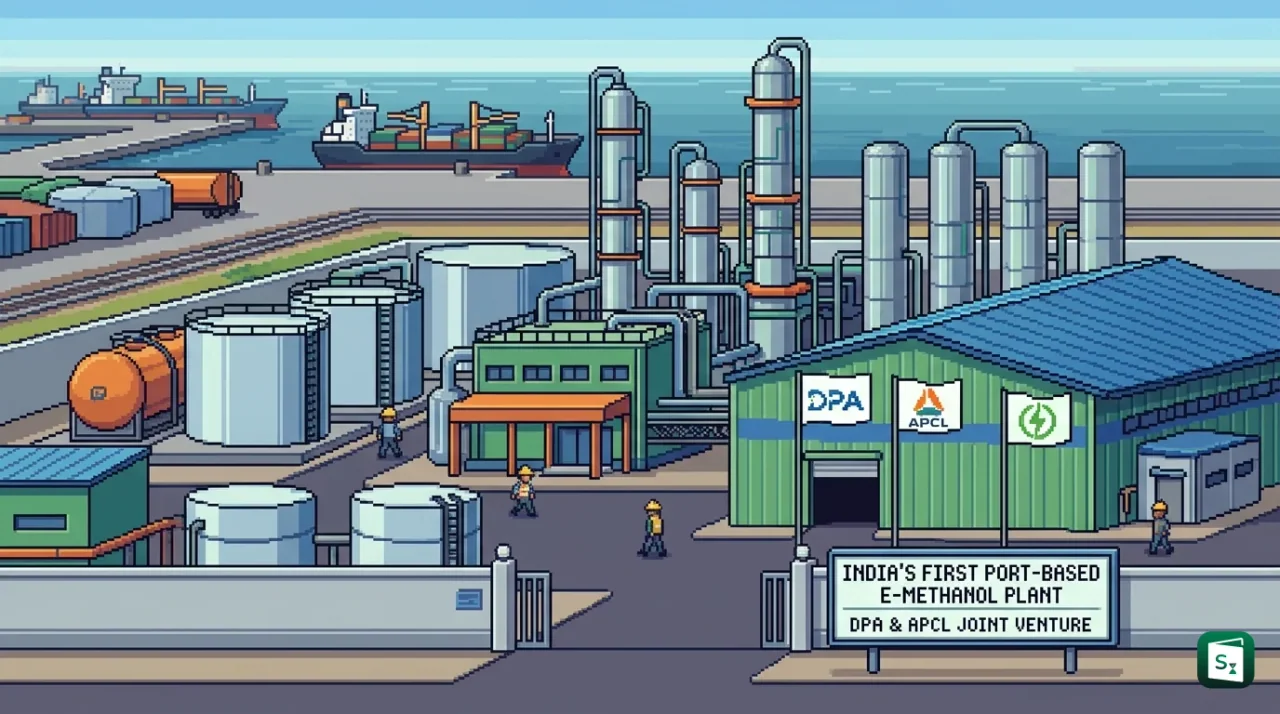
Gujarat Chief Minister Bhupendra Patel, Union Minister for Ports, Shipping and Waterways Sarbananda Sonowal and Assam Chief Minister Himanta Biswa Sarma laid the foundation stone on 26 September 2026 for India’s first port-based e-methanol plant at the Deendayal Port Authority (DPA) in Kandla, Gujarat. The ₹2,300 crore joint venture between the DPA and Assam Petro-Chemicals Ltd (APCL) will produce 150 tonnes of e-methanol per day for ships. The project aims to turn Kandla into a green fuel bunkering hub on the Asia-Europe trade route and position India as an exporter of clean marine fuel.
What Is E-Methanol and How Is It Produced?
E-methanol, also called electro-methanol, is a clean liquid fuel with the chemical formula CH3OH. It is made by combining green hydrogen with captured carbon dioxide (CO2) using electricity from renewable sources such as solar and wind. Green methanol is a broader term that includes both e-methanol and bio-methanol made from biomass, and both types release far less carbon than methanol made from coal or natural gas.
The Deendayal Port Authority plant will use renewable power, water and biogenic CO2 to make e-methanol. In this process, water is first split through electrolysis to produce green hydrogen, which means hydrogen made without fossil fuels. The hydrogen is then combined with CO2 in a catalytic reactor at high temperature and pressure to form methanol and water. Because the electricity and raw materials are renewable, the fuel is nearly carbon neutral over its full life cycle and can cut greenhouse gas emissions by 70 to 95 percent compared to conventional marine fuels.
E-methanol looks and behaves like ordinary methanol, so ships with methanol-ready engines and existing storage tanks can use it without major changes. When it burns, it produces no sulphur and far less particulate matter and nitrogen oxides than heavy fuel oil used by most ships today. This makes it one of the most practical options for sectors that are hard to run on electricity alone, such as deep sea shipping, aviation and heavy industry.
First Port-Based E-Methanol Plant at Kandla: Project Details
The Kandla e-methanol plant is the first port-based e-methanol production facility in India. Port-based means the fuel is produced inside the port area itself, close to storage tanks, pipelines and jetties where ships refuel. This lowers transport cost and allows direct bunkering, which is the process of supplying fuel to ships.
The project grew out of a memorandum of understanding signed in January 2026 between the DPA and APCL in Dibrugarh, Assam. At that stage the estimated investment was more than ₹1,200 crore. The detailed project plan announced at the foundation stone ceremony has now raised the total investment to ₹2,300 crore for the full 150 tonnes per day capacity.
The plant will be built in scalable modules in two phases. Phase I will create 50 tonnes per day of capacity at a cost of ₹1,200 crore and is targeted for completion by January 2027. Phase II will add another 100 tonnes per day at a cost of ₹1,100 crore and is targeted for completion by March 2027.
| Feature | Detail |
|---|---|
| Location | Deendayal Port Authority, Kandla, Kutch district, Gujarat |
| Total capacity | 150 tonnes per day |
| Total investment | ₹2,300 crore |
| Phase I | 50 tonnes per day, ₹1,200 crore, by January 2027 |
| Phase II | 100 tonnes per day, ₹1,100 crore, by March 2027 |
| Ownership | DPA 76 percent, APCL 24 percent |
| DPA contribution | ₹567.32 crore equity, 75 acres land, desalinated water and green hydrogen |
| APCL role | Set up and operate the production facility |
| Jobs expected | More than 3,500 direct and indirect jobs |
| Fuel supply route | Asia-Europe International Trade Corridor, including Singapore to Rotterdam route |
The DPA will provide land, pipeline connectivity, storage and fuel handling systems. APCL will build and run the production unit. The plant is expected to produce e-methanol at about $750 per tonne, which is far below the current global rate of about $1,300 per tonne, giving India a strong price advantage in the global green fuel market.
Deendayal Port Authority: Location and New Identity
Kandla Port is located in Kutch district in the state of Gujarat, on the western coast of India near Gandhidham city. Deendayal Port is also located in Gujarat, as it is the new name of Kandla Port. The Union Government renamed Kandla Port Trust as Deendayal Port Trust on 25 September 2017 in honour of Pandit Deendayal Upadhyaya. After the Major Port Authorities Act, 2021 came into force on 3 November 2021, it became the Deendayal Port Authority (DPA).
The port was built in the 1950s to serve western India after Partition, when the port of Karachi went to Pakistan. The foundation stone for the new major port was laid by Prime Minister Jawaharlal Nehru on 10 January 1952, and Kandla was declared a major port on 8 April 1955. The port began with an RCC jetty built in 1931 by Maharao Khengarji III of Kutch. It handled only 8.44 lakh tonnes in 1957 to 58 but became India’s number one major port in 2007 to 08 and held that rank for 14 years. In 2023 to 24 it handled 132.3 million tonnes of cargo, the highest among major ports in India.
The port sits inside Kandla Creek, about 90 km from the mouth of the Gulf of Kutch. It lies about 256 nautical miles southeast of Karachi and about 430 nautical miles north northwest of Mumbai. It is an all weather tidal port with dry cargo berths, liquid jetties and an offshore oil terminal at Vadinar near Jamnagar. Its vast hinterland covers north, west and central India, and it handles crude oil, chemicals, fertilisers, food grains and containers. In 2016 it became the first major port in India to cross 100 million tonnes of cargo in a single year.
The DPA has now been declared one of three priority Green Hydrogen Hubs under the National Green Hydrogen Mission. The mission was approved in January 2023 with an outlay of ₹19,744 crore and aims to produce at least 5 million tonnes of green hydrogen per year by 2030. At Kandla, a 1 MW green hydrogen plant built by Larsen and Toubro was commissioned on 31 July 2025 as the first module of a planned 10 MW facility. The port also completed India’s first pilot shore to ship methanol bunkering trial in April 2026 and is working with the Solar Energy Corporation of India for long term supply of renewable e-methanol.
Assam Petro-Chemicals Ltd: Joint Venture Partner Profile
Assam Petro-Chemicals Ltd (APCL) is a state public sector undertaking of the Government of Assam. It was incorporated on 22 April 1971 and its foundation stone was laid at Namrup on 15 June 1971. The company was promoted by the Assam Industrial Development Corporation to make methanol from natural gas available in the oilfields of Upper Assam. Its complex at Namrup was the first in India to use natural gas as feedstock for petrochemicals.
APCL started commercial production of methanol and formalin in June 1976 with technology from Mitsubishi Gas Chemicals Company of Japan. Formalin, which is a solution of formaldehyde in water, is its main downstream product and is used in plywood, resins, textiles and pharmaceuticals. The company set up a 100 tonnes per day methanol plant in 1989 with technology from ICI of the United Kingdom and expanded formalin capacity to 100 tonnes per day in 1997. It later revamped formalin capacity to 125 tonnes per day in 2012.
After a major expansion costing ₹1,709 crore, APCL now operates a 500 tonnes per day methanol plant at Namrup, which was dedicated to the nation in April 2023, along with a 200 tonnes per day formaldehyde plant at Boitamari in Bongaigaon district commissioned in September 2025. With this, it is among the largest producers of methanol and formaldehyde in India. The Government of Assam along with Assam Gas Company and Assam Industrial Development Corporation holds 51 percent equity, while Oil India Ltd holds 49 percent.
For the Kandla project, APCL brings five decades of experience in handling methanol safely at scale. The partnership is seen as an example of cooperation between Assam and Gujarat, where Assam provides chemical expertise and Gujarat provides port land, renewable energy potential and access to global shipping lanes.
Methanol Uses, Fuel Cells and Green Shipping Role
Methanol uses extend far beyond fuel. Most methanol produced in the world today is used as a chemical feedstock to make formaldehyde, acetic acid, plastics, paints, adhesives and medicines. It is also used as a solvent in laboratories, including for a technique called HPLC, and as a raw material for producing olefins and biodiesel. In medicine, ethanol is used as an antidote for methanol poisoning, since both are alcohols but methanol is highly toxic if consumed.
A methanol fuel cell is a device that converts methanol directly into electricity without burning it. It works like a battery that keeps running as long as fuel is supplied and is useful for backup power, portable power and some transport uses. Direct methanol fuel cells are simpler to store and handle than hydrogen fuel cells because methanol is a liquid at room temperature, while hydrogen needs high pressure tanks or very low temperatures.
For shipping, green methanol is used in two ways. It can be burnt directly in methanol-ready marine engines, and it can also power fuel cells for onboard electricity. Global shipping companies such as Maersk have already ordered methanol capable vessels. This shift is driven by strict new rules such as the FuelEU Maritime regulation of the European Union and the Net Zero Framework of the International Maritime Organization (IMO), which is the United Nations agency for shipping safety and pollution control headquartered in London and established in 1948.
The Kandla plant will supply e-methanol through bunkering to vessels on the Asia-Europe corridor. Bunkering means filling a ship with fuel at port, and green bunkering means supplying low carbon fuel. Kandla already has methanol storage tanks, pipelines and jetties because it has long handled grey methanol as cargo. With new production, storage and safety systems, the port can emerge as a green bunkering hub. This supports the National Green Shipping Policy and the plan to develop coastal green shipping corridors with the Shipping Corporation of India, which was established in 1961 and is headquartered in Mumbai.
Methanol vs Ethanol and Price Competitiveness
The difference between methanol vs ethanol is important for both fuel policy and safety. Methanol has the formula CH3OH and contains one carbon atom, while ethanol has the formula C2H5OH and contains two carbon atoms. Ethanol is the alcohol found in beverages and is also blended with petrol in India under the ethanol blending programme. Methanol is more toxic and is not blended with petrol for cars in the same way, but it has higher energy efficiency in certain industrial and marine uses.
Methanol boils at about 64.7 degrees Celsius, while ethanol boils at about 78.4 degrees Celsius. A simple laboratory test to distinguish them is the iodoform test, where ethanol gives a yellow precipitate but methanol does not. In fuel terms, both can reduce oil imports, but ethanol in India comes mainly from sugarcane and grain, while e-methanol comes from green hydrogen and CO2 and does not compete directly for farmland.
Price is a central part of the Kandla story. Conventional grey methanol in India trades at a much lower price than green methanol because it is made from fossil fuels. Green methanol globally costs between $800 and $1,600 per tonne due to the high cost of green hydrogen and electrolysers. The Kandla plant aims to supply at about $750 per tonne, which would make it one of the cheapest sources in the world. This low cost comes from assured port land, low cost renewable power from Kutch and Gujarat, use of desalinated water and shared storage and pipeline systems that cut logistics cost.
Significance for India and The Way Forward
The Kandla e-methanol project links three national goals. The first is climate action. India has pledged to reach net zero by 2070, a commitment announced at the Glasgow climate conference in 2021. Green fuels for ships directly cut emissions from maritime transport, which carries about 90 percent of world trade by volume. The second goal is energy self reliance. India imports a large share of its crude oil, and domestic green fuel reduces that dependence. The third goal is manufacturing growth. The plant will create demand for electrolysers, solar panels, storage tanks and skilled workers around Kandla and Gandhidham.
The wider port plan strengthens this impact. The DPA is also developing facilities for green ammonia, green hydrogen and bio-methanol, along with a Smart Industrial Port City at Gandhidham. The Ministry of Ports, Shipping and Waterways has set a vision under the Maritime Amrit Kaal Vision 2047 to place India among the world’s five largest shipbuilding nations by 2047 and to add 100 new ships to the merchant fleet in the coming years. A reliable supply of low cost green fuel will help attract more deep sea vessels to Kandla, raise cargo volumes and support jobs in transport, storage and ancillary services.
The next steps will be closely watched. The DPA and APCL must complete Phase I by January 2027 and Phase II by March 2027, secure steady renewable power and biogenic CO2, and put in place safety and certification systems for large scale methanol bunkering. If these timelines are met, Kandla can serve as a model for other major ports such as V.O. Chidambaranar in Tamil Nadu and Paradip in Odisha, which have also been identified as green hydrogen hubs. Success would allow India to move from importing marine fuel to exporting clean fuel to the world.
Key Takeaways
- The foundation stone for India’s first port-based e-methanol plant was laid on 26 September 2026 at the Deendayal Port Authority in Kandla, Gujarat.
- The ₹2,300 crore joint venture between DPA (76 percent) and APCL (24 percent) will produce 150 tonnes per day in two phases by March 2027.
- E-methanol (CH3OH) is made from green hydrogen and captured CO2 using renewable electricity and can cut life cycle emissions by 70 to 95 percent.
- Kandla Port, renamed as Deendayal Port in 2017, is India’s largest major port by volume and is located in Kutch district, Gujarat.
- The plant will supply green fuel at about $750 per tonne for ships on the Asia-Europe corridor and is expected to create more than 3,500 jobs.