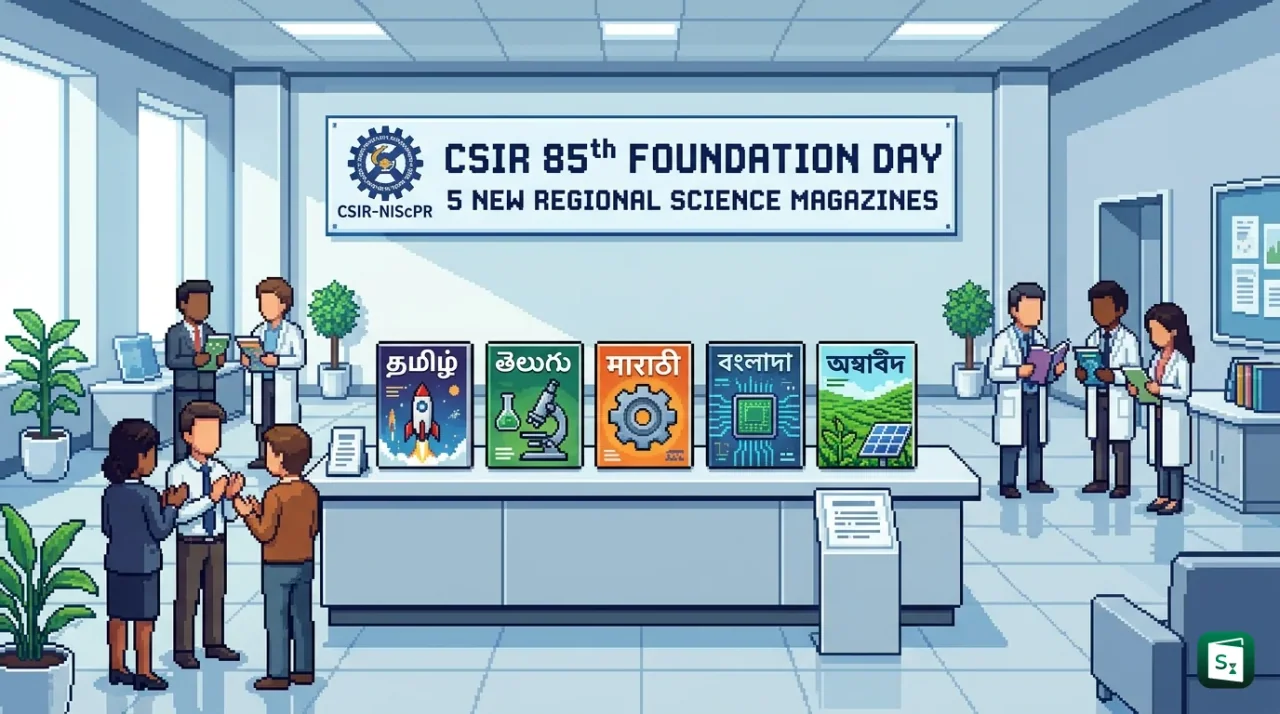
Union Minister of State for Science and Technology Jitendra Singh launched five new popular science magazines in Tamil, Telugu, Marathi, Bengali and Assamese on 26 September 2026 during the 85th Foundation Day celebrations of the Council of Scientific and Industrial Research (CSIR) in New Delhi. The magazines are published by the CSIR-National Institute of Science Communication and Policy Research (CSIR-NIScPR). The launch expands CSIR’s popular science family beyond English, Hindi and Urdu and aims to place trusted science in the reader’s mother tongue.
Five New Magazines in Five Languages
The Council of Scientific and Industrial Research launched one popular science magazine for each of the five languages. Each title has its own editorial team and will carry a mix of translated and original writing with a focus on its region.
| Language | Magazine Title | Script Form |
|---|---|---|
| Assamese | Bigyan Lahar | Bigyan Lahar |
| Bengali | Bigyan Brittanto | Bigyan Brittanto |
| Marathi | Vidnyan Kshitij | Vidnyan Kshitij |
| Tamil | Ariviyal Arikkaiyalar | Ariviyal Arikkaiyalar |
| Telugu | Vigyan Velugu | Vigyan Velugu |
The launch event was attended by N. Kalaiselvi, Director General of CSIR and Secretary of the Department of Scientific and Industrial Research (DSIR) (as of September 2026), and Geetha Vani Rayasam, Director of CSIR-NIScPR. DSIR is the department under the Ministry of Science and Technology that looks after industrial research and oversees CSIR. The publication work was coordinated by Mukesh Ambadas Pund and Meher Wan, along with editors, designers and editorial teams for each language. The editors present included Paramananda Barman for Assamese, Uttam Kumar Jana for Bengali, Mukesh Ambadas Pund for Marathi, S. Bhuvanesh for Tamil and N. K. Prasanna for Telugu.
How Will the Magazines Be Prepared?
The new magazines will use a two track method that combines speed with accuracy. Selected articles from CSIR-NIScPR’s existing popular science magazines will be translated with the help of Artificial Intelligence (AI). AI here means computer tools that can quickly convert text from one language to another.
Every AI assisted translation will then pass through human checking. Subject experts will review, proofread, fact check and edit each piece to ensure scientific accuracy, correct language and easy readability. This step is important because direct machine translation can miss technical meaning or local usage.
Along with translated content, each magazine will publish original articles written directly in Tamil, Telugu, Marathi, Bengali and Assamese. These articles will highlight scientific work, innovations and developments from the respective regions. The goal is to build a fresh pool of science writers in Indian languages and not depend only on English or Hindi source material.
What Is CSIR-NIScPR?
CSIR-NIScPR is the CSIR-National Institute of Science Communication and Policy Research based in New Delhi. It was formed on 14 January 2021 by merging NISCAIR and NISTADS. It acts as CSIR’s nodal body for popular science publishing and science policy research.
CSIR-NIScPR came into existence on 14 January 2021 with the merger of two older CSIR bodies. The first was the National Institute of Science Communication and Information Resources (NISCAIR), which handled science communication, science journals, the National Science Library and popular magazines. The second was the National Institute of Science, Technology and Development Studies (NISTADS), which studied the link between science, society and policy. The merger was designed to combine communication strength with policy research and to build the institute as a think tank for science, technology and innovation.
The institute runs the Popular Science Division, which publishes three well known titles. Science Reporter, launched in 1964, is the English monthly and one of India’s oldest popular science monthlies. Vigyan Pragati, launched in 1952, is the Hindi monthly and counts among the largest selling popular science magazines in the country. Science Ki Duniya is the Urdu quarterly. The five new regional magazines now expand this portfolio from three languages to eight.
What Is CSIR?
CSIR is the Council of Scientific and Industrial Research, India’s largest publicly funded industrial research organisation. It was established on 26 September 1942, is headquartered in New Delhi and functions under the Ministry of Science and Technology.
CSIR was set up as an autonomous body on 26 September 1942 to promote scientific knowledge, industrial growth and economic development. Its full form, Council of Scientific and Industrial Research, reflects this twin focus on science and industry. The idea grew from the earlier Board of Scientific and Industrial Research set up in 1940, and CSIR started functioning just before Independence.
CSIR now runs a network of 37 national laboratories, 39 outreach centres and three innovation units across India. Its headquarters is at Anusandhan Bhawan on Rafi Marg in New Delhi. The President of CSIR is the Prime Minister of India, and the executive head is the Director General, who also serves as Secretary of DSIR. The organisation works in areas ranging from chemicals, physics and biology to aerospace, ocean science, food, health and energy, and it supports human resource development through research fellowships and doctoral programmes.
Why Regional Language Science Communication Matters
Most Indians do not read or work in English on a daily basis. If reliable science stays only in English, a large share of students, teachers, farmers and small entrepreneurs cannot use it. Regional magazines close this gap by placing the same knowledge in the language the reader learns, thinks and speaks at home.
Mother tongue publishing also builds trust. Health advice, farm technology, weather information, new inventions and stories of local scientists feel more usable when explained with local terms and local examples. The new magazines plan to highlight achievements and needs of their own regions, so a reader in Assam or Tamil Nadu will see science linked to local crops, industry, ecology and institutions.
The move also supports the constitutional goal of developing scientific temper. Article 51A(h) of the Constitution lists development of scientific temper, humanism and spirit of inquiry as a fundamental duty of every citizen. By combining AI tools for fast translation with expert review for accuracy, CSIR aims to widen access without lowering quality, and to encourage more original science writing in Tamil, Telugu, Marathi, Bengali and Assamese.
Key Takeaways
- Jitendra Singh launched five new popular science magazines on 26 September 2026 during the 85th Foundation Day of CSIR.
- The five titles are Bigyan Lahar (Assamese), Bigyan Brittanto (Bengali), Vidnyan Kshitij (Marathi), Ariviyal Arikkaiyalar (Tamil) and Vigyan Velugu (Telugu).
- All five magazines are published by CSIR-NIScPR, which was formed on 14 January 2021 by merging NISCAIR and NISTADS.
- CSIR-NIScPR’s existing flagships are Science Reporter (1964, English), Vigyan Pragati (1952, Hindi) and Science Ki Duniya (Urdu).
- CSIR stands for the Council of Scientific and Industrial Research, established on 26 September 1942 and headquartered in New Delhi.
- The new magazines will use AI assisted translation followed by human proofreading and fact checking, plus original articles in each regional language.