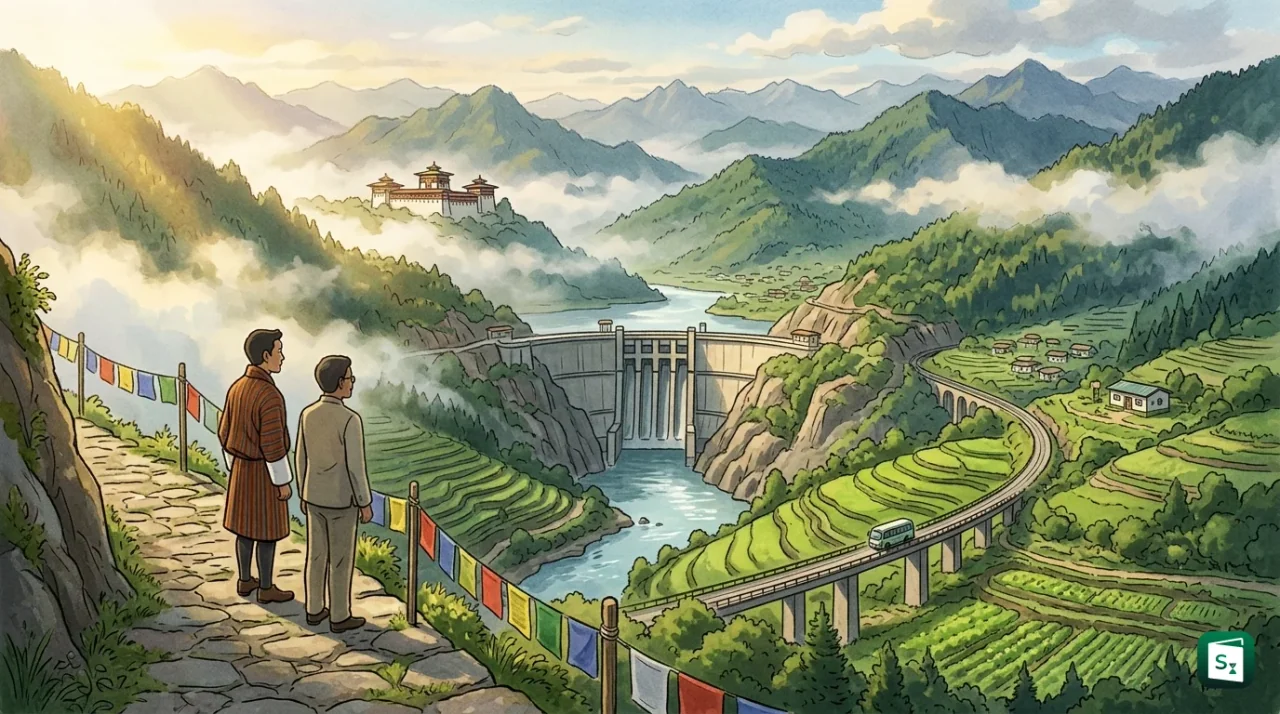
External Affairs Minister S Jaishankar paid an official visit to Bhutan from 16 to 18 September 2026 at the invitation of Bhutanese Foreign Minister D N Dhungyel. The visit reviewed India Bhutan relations in meetings with King Jigme Khesar Namgyel Wangchuck and Prime Minister Tshering Tobgay in Thimphu and Bumthang. The trip produced five new development launches, a review of two mega hydropower projects and a concessional credit line of ₹4,000 crore for energy.
Jaishankar Bhutan Visit: What Happened in Thimphu and Bumthang?
The Ministry of External Affairs of India announced that External Affairs Minister (EAM) S Jaishankar would visit Bhutan on 16 and 17 September 2026, and the visit finally ran from 16 to 18 September 2026. The invitation came from Lyonpo D N Dhungyel, the Minister for Foreign Affairs and External Trade of Bhutan. Lyonpo is a title of honour given to senior ministers and holders of high office in Bhutan.
The programme had two centres. The bilateral talks between the two foreign ministers were held in Bumthang, the historic valley in central Bhutan known for its monasteries and for the Wangduechhoeling Palace. The two ministers also visited Thimphu, the capital city of Bhutan, and Paro, where the international airport is located. In Thimphu, Jaishankar received an audience with King Jigme Khesar Namgyel Wangchuck and called on Prime Minister Tshering Tobgay. He also offered prayers at Kurjey Lhakhang in Bumthang and joined a prayer ceremony at Tashichhodzong in Thimphu to mark the friendship between the two countries.
The two sides reviewed all aspects of bilateral cooperation and also discussed regional and international issues of common interest. The joint press release issued on 18 September 2026 said both sides were satisfied with progress in development cooperation and the energy partnership. At the end of the visit, Jaishankar invited Foreign Minister Dhungyel to visit India at an early date. The visit followed the tradition of regular high level exchanges between the neighbours.
Where Is Bhutan Located and Why Is It Important for India?
Where is Bhutan located?
Bhutan is a landlocked Himalayan kingdom in South Asia between India and China. It shares a 605 kilometre border with India across Sikkim, West Bengal, Assam and Arunachal Pradesh, with Thimphu as its capital. Phuentsholing in the south is the main border gateway for trade and entry from India.
The Kingdom of Bhutan, often called the Bhutan kingdom in search records, has Thimphu as its capital and largest administrative centre. Phuentsholing, on the border with West Bengal, is the commercial gateway through which most overland trade and Indian tourists enter. Other key towns that often appear with this visit are Paro, which has the only international airport, Bumthang, the cultural valley where the 2026 talks were held, and Punakha, the old capital on the Punatsangchhu river.
| Fact | Detail |
|---|---|
| Location | Eastern Himalayas, between India in the south and China (Tibet) in the north |
| Capital | Thimphu |
| Border with India | About 605 kilometres |
| Currency | Bhutanese ngultrum, pegged at par with the Indian rupee, which is also accepted |
| System of government | Constitutional monarchy with parliamentary democracy since 2008 |
Bhutan is not a part of India and is not an Indian state. It is a sovereign country and a member of the United Nations since 1971. It keeps its own King, Prime Minister, Parliament and foreign ministry, while sharing very close ties with India.
Why is Bhutan important for India?
Bhutan is important for India because it guards the Siliguri Corridor and the Doklam tri junction near the India Bhutan China border. It is India’s close security partner, its largest aid recipient and a clean hydropower supplier. A stable Bhutan protects India’s Himalayan frontier and supports regional connectivity.
Three factors explain this value. First, geography. Bhutan sits above the Siliguri Corridor, the narrow strip that connects mainland India to the Northeast. The Doklam plateau at the India Bhutan China tri junction is sensitive for Indian border security. Peace on this frontier directly affects the safety of Sikkim and Arunachal Pradesh. Second, energy and trade. India is Bhutan’s largest trading partner and the main buyer of its hydropower, while Bhutan gets development funds, market access and transit through India. Third, trust. Bhutan has never allowed its soil to be used against India, a principle later written into the bilateral friendship treaty.
Five Development Initiatives Across Healthcare, Connectivity, Agriculture, Mobility and Energy
The two foreign ministers jointly unveiled plaques for new projects at the Wangduechhoeling Palace Museum in Bumthang. The five initiatives cover the exact sectors named in the briefing, which are healthcare, connectivity, agriculture, clean mobility and energy. Each project fills a clear local gap rather than acting as a symbolic gesture.
| Initiative | Location | What it does |
|---|---|---|
| Gyaltsuen Jetsun Pema Mother and Child Hospital, 65 beds | Mongar in eastern Bhutan | Provides specialist care for mothers and children in a region that earlier had to travel far for such services |
| Jaganathan Bridge, 80 metres | Samdrup Jongkhar on the Samdrup Jongkhar to Trashigang highway | Improves road link between Trashigang and Samdrup Jongkhar in the east |
| 43 pureline Jersey cows | National Cattle Breeding Centre, Bumthang | Supports dairy breeding to raise milk yield and farm income |
| 54 Made in India electric vehicles | Handed over in Thimphu | Supports clean transport for government use and cuts fuel costs |
| Lunana Hydropower Project, 500 kilowatts | Lunana in Gasa district of northern Bhutan | Supplies power to remote settlements that are still off the grid |
In healthcare, the 65 bed hospital in Mongar is a modern specialist facility for maternal and child health. Eastern Bhutan has difficult hill terrain, so a local referral hospital reduces travel to Thimphu and improves safety during childbirth and early childhood care.
In connectivity, the Jaganathan Bridge was built by Project Dantak. Project Dantak is the overseas arm of India’s Border Roads Organisation that has built roads and bridges in Bhutan since 1961. The 80 metre bridge strengthens the east to southeast road axis, which matters for trade, school and hospital access, and movement during monsoon landslides.
In agriculture, the 43 Jersey cows from India will be used as parent stock for breeding at the National Cattle Breeding Centre. The programme, supported under Project Tied Assistance, aims to spread higher milk yielding calves to local dairy farmers. Officials noted that the wider breeding network is expected to touch about 40,000 farmers and improve nutrition and rural earnings.
In clean mobility, the 54 electric vehicles made in India were handed to the Bhutan government during Jaishankar’s meeting with Prime Minister Tobgay. Bhutan already produces largely hydropower based electricity, so electric vehicles fit its clean energy mix and lower petrol imports.
In energy access, the foundation stone for the 500 kilowatt Lunana project is small in size but large in meaning. Jaishankar described it as a milestone in a partnership that began with the tiny Jungshina plant in Thimphu in 1967, Bhutan’s first hydro station built with Indian help. Lunana is aimed at lighting the last unelectrified high villages in Gasa, where grid extension through snow bound valleys is costly and technically hard.
Punatsangchhu-I and Punatsangchhu-II: Status of Hydropower Partnership
On which river is the Punatsangchhu-II project built?
The Punatsangchhu-II hydroelectric project stands on the Punatsangchhu river at Wangdue Phodrang in western Bhutan. The river is formed by the Pho Chhu and Mo Chhu at Punakha and flows south into India as the Sankosh, a tributary of the Brahmaputra.
Hydropower is the backbone of India Bhutan energy ties. Cooperation began in the 1960s, starting with small plants and growing into large joint projects. Under the Agreement on Cooperation in Hydroelectric Power of 2006 and its Protocol of 2008, both sides set a goal of developing 10,000 MW of hydropower in Bhutan for export and domestic use. The two Punatsangchhu projects, with a combined capacity of 2,220 MW, are the centre of that plan.
| Project | Capacity | Present status in September 2026 |
|---|---|---|
| Punatsangchhu-I Hydroelectric Project (HEP) | 1,200 MW | Dam construction resumed on 10 April 2026 after halt since 2019, first concrete pour done, completion expected in about five years |
| Punatsangchhu-II Hydroelectric Project (HEP) | 1,020 MW | Jointly inaugurated on 11 November 2025, power export to India started on 19 September 2025, Tariff Protocol signed in April 2026 |
Punatsangchhu-II is now the success story. The plant was jointly inaugurated by Prime Minister Narendra Modi and King Jigme Khesar Namgyel Wangchuck in November 2025. Surplus power flows to India at a mutually agreed starting tariff fixed through the Tariff Protocol. The two sides also agreed on a method for reactive energy accounting, a technical system that keeps the cross border grid stable and makes billing for power exchange smooth. Indian companies are also taking part in newer Bhutanese hydro ventures, which adds private dynamism to what was earlier only a government to government model.
Punatsangchhu-I is the delayed giant. Main dam work stopped in 2019 because of weak geology on the right bank of the river. After long technical talks, both governments agreed on 31 July 2025 to resume dam construction along with right bank stabilisation. The restart was marked by the concrete pour in April 2026 attended by India’s Power Minister and Bhutan’s Energy Minister. The project is funded by India on a 40 percent grant and 60 percent loan model. By February 2026 it had crossed about 93 percent financial progress and 88 percent physical progress, but full completion still needs slope cutting, design vetting by the Water and Power Consultancy Services (WAPCOS) and the Central Water Commission (CWC), and a supplementary agreement with contractor Larsen and Toubro. Surplus power from this plant will also be sold to India at a price to be fixed at commissioning.
India Bhutan Friendship Treaty and the Joint Vision on Energy Partnership
The legal base of the relationship is the India Bhutan Friendship Treaty. The first treaty was signed on 8 August 1949 at Darjeeling. It promised perpetual peace, free trade and non interference, but its Article 2 asked Bhutan to be guided by India in external relations. That clause reflected the British era Treaty of Punakha of 1910, when Bhutan had accepted British guidance in foreign affairs.
The treaty was updated on 8 February 2007 in New Delhi and came into force on 2 March 2007 after ratification papers were exchanged in Thimphu. The new Article 2 removed the guidance clause. It says both governments will cooperate closely on national interests and neither will allow its territory to be used for activities harmful to the security of the other. The treaty also keeps free trade and commerce, cooperation in education, health, culture, science and technology, and a promise to expand economic ties. It stays in force unless both sides agree to change it. The Doklam face off of 2017 on Bhutanese claimed land was handled within this cooperative frame.
On top of this treaty sits the Joint Vision on Energy Partnership issued in March 2024 during Prime Minister Modi’s visit to Thimphu. The Joint Vision says energy partnership can improve energy security, create jobs, raise export earnings and build industrial capacity in both countries. It moves beyond large hydro to include solar, wind, green hydrogen, e mobility, energy efficiency and cross border power trade. India promised to help Bhutan get finance from Indian institutions and access to the Indian power market for new projects. The September 2026 review noted satisfaction with this Vision, citing the Punatsangchhu-II inauguration and the Punatsangchhu-I restart as proof of delivery.
₹4,000 Crore Line of Credit and the Road Ahead
A Line of Credit (LoC) is a soft loan facility through which one government offers funds to another for specific projects at easy interest and long repayment terms. Concessional means the terms are softer than market loans. During the September 2026 visit, both sides welcomed the signing of an agreement for a concessional LoC of ₹4,000 crore for energy projects in Bhutan. The money will support hydropower and other clean energy works, related transmission lines, and project preparation. This credit sits inside the wider development partnership and does not replace grant aid.
The wider partnership is large. Prime Minister Modi announced ₹10,000 crore of support for Bhutan’s 13th Five Year Plan (2024 to 2029) during his March 2024 visit, double the ₹5,000 crore given for the 12th Plan. The package funds Project Tied Assistance (PTA) projects, High Impact Community Development Projects, an Economic Stimulus Programme of ₹1,500 crore and programme grants. By July 2026, the fifth round of Development Cooperation Talks had cleared 61 PTA projects worth about ₹4,958 crore plus 12 new projects worth ₹332 crore, covering roads, schools, health, agriculture, digital links and space cooperation.
Trade and connectivity form the next frontier. The Agreement on Trade, Commerce and Transit gives Bhutan free trade with India and transit for trade with other countries, except for a closed northern frontier. India agreed to allow 16 entry and exit points for such trade. Two rail links are now on paper through a memorandum of understanding, which are the Kokrajhar to Gelephu link in Assam and the Banarhat to Samtse link in West Bengal. India has also backed the Gelephu Mindfulness City, a planned economic hub and Special Administrative Region near the Assam border spread over about 2,000 square kilometres, which Bhutan hopes will attract investment and jobs while protecting forests and culture.
The road ahead will test execution. Early commissioning of Punatsangchhu-I, stable tariffs for Punatsangchhu-II, timely use of the ₹4,000 crore credit, and progress on rail and digital links will decide whether the goodwill of the September visit turns into lasting gains. For India, a prosperous Bhutan secures the Himalayan border and strengthens the Neighbourhood First policy. For Bhutan, Indian finance and market access support its aim to become a high income nation powered by clean electricity.
Key Takeaways
- External Affairs Minister S Jaishankar visited Bhutan from 16 to 18 September 2026 at the invitation of Foreign Minister D N Dhungyel and met King Jigme Khesar Namgyel Wangchuck and Prime Minister Tshering Tobgay.
- Five initiatives were launched, including the 65 bed Mongar hospital, the 80 metre Jaganathan Bridge, 43 Jersey cows, 54 electric vehicles and the 500 kilowatt Lunana hydropower project.
- The 1,020 MW Punatsangchhu-II plant on the Punatsangchhu river was inaugurated in November 2025 and started power export to India in September 2025.
- The 1,200 MW Punatsangchhu-I plant resumed dam construction on 10 April 2026 after a halt since 2019 due to right bank geological problems.
- India signed a concessional Line of Credit of ₹4,000 crore for energy projects in Bhutan under the Joint Vision on Energy Partnership of March 2024.
- The visit rests on the India Bhutan Friendship Treaty of 2007, which replaced the 1949 treaty and removed the clause for Indian guidance on foreign policy.