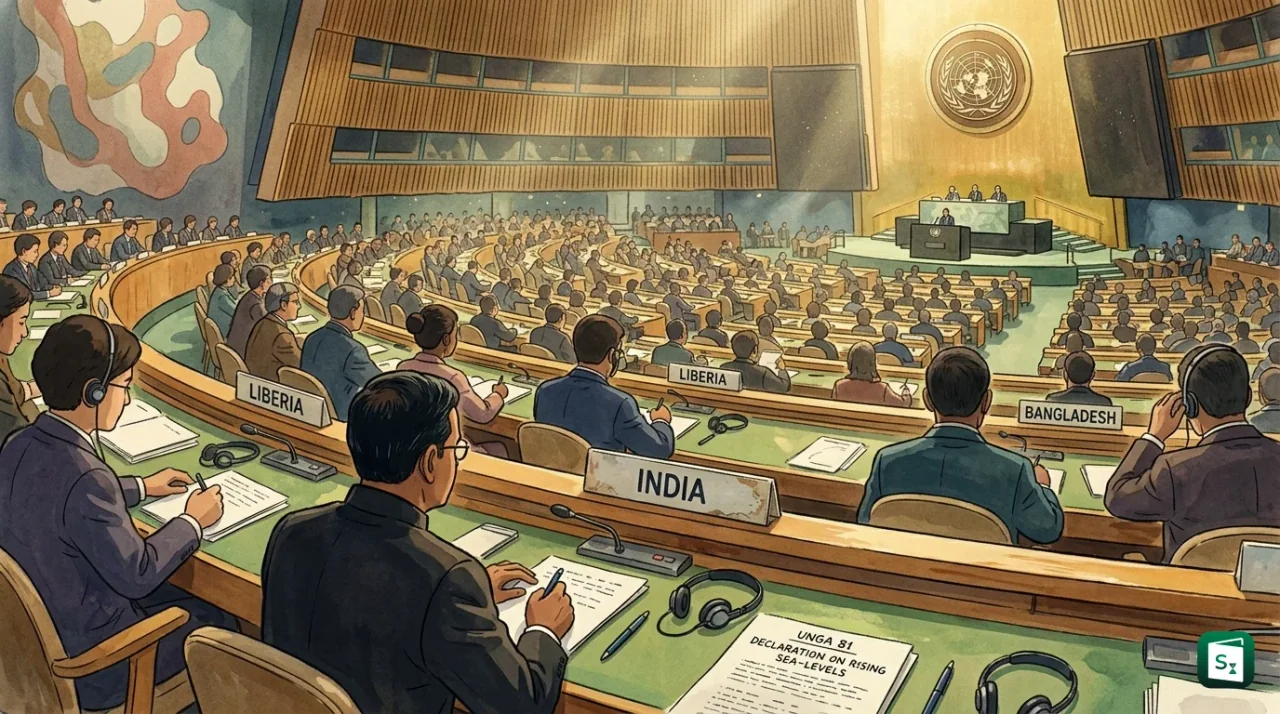
The 81st session of the United Nations General Assembly opened on 8 September 2026 at UN Headquarters in New York under President Khalilur Rahman of Bangladesh. World leaders gathered for High Level Week and the General Debate from 22 to 28 September under the theme Restoring Trust, Managing Transformation. The session produced the first UN declaration on sea level rise, India’s signing of the global cybercrime treaty and two new Indo Pacific maritime moves.
What Is UNGA and How Does It Function?
The United Nations General Assembly (UNGA) is the main deliberative and policymaking organ of the United Nations. It brings together all 193 Member States with one vote each. The Assembly debates global issues, adopts resolutions, approves the UN budget and elects members to other UN bodies.
UNGA stands for United Nations General Assembly. The Assembly was established in 1945 under the Charter of the United Nations. The Charter is the founding treaty of the organisation. UNGA meets in annual regular sessions at the General Assembly Building within UN Headquarters in New York. The 81st session opened on 8 September 2026 and will run till 7 September 2027.
The Assembly holds a unique place because it offers universal membership. Every Member State sits in the hall. Each gets one equal vote. Decisions on important questions such as peace and security, admission of new members and budget matters need a two thirds majority. Decisions on other questions pass by simple majority. The Assembly elects its President and 21 Vice Presidents for each session. It also elects the non permanent members of the Security Council and members of other councils. It appoints the Secretary General on the recommendation of the Security Council. Antonio Guterres is the Secretary General (as of September 2026).
UNGA powers cover a wide range. The Assembly can discuss any question within the scope of the Charter. It can make recommendations on peace and security, except when the Security Council is handling the same dispute. It initiates studies to promote political cooperation, development of international law, human rights and collaboration in economic, social, humanitarian and health fields. It considers reports from the Security Council and other organs. Resolutions of the Assembly carry political weight. They are not legally binding like Security Council decisions, but they shape norms and guide action.
| Feature | UNGA (General Assembly) | UNSC (Security Council) |
|---|---|---|
| Membership | 193 Member States, universal | 15 members, 5 permanent and 10 non permanent |
| Vote rule | One nation, one vote, majority or two thirds majority | Each member has one vote, permanent members hold veto |
| Main role | Deliberation, recommendations, budget, standard setting | Primary responsibility for peace and security, binding decisions |
| Meeting cycle | Annual session from September, High Level Week in September | Meets year round as needed |
UNGA High Level Week is the busiest diplomatic period of the year. Heads of state and government travel to New York. They deliver national statements in the General Debate. They join high level meetings and side events on climate, health, development and security. UNGA High Level Week in 2026 ran from 18 to 28 September.
UNGA 81st Session 2026: President, Theme and Schedule
The 81st UNGA session is presided over by Khalilur Rahman of Bangladesh. The Assembly elected him on 2 June 2026 as President of the 81st session. He secured 99 votes against 91 votes for Andreas Kakouris of Cyprus. A total of 190 ballots were cast. The post rotates among regional groups. The 81st session fell to the Asia Pacific group.
Khalilur Rahman is a long serving diplomat. He joined the diplomatic service of Bangladesh in 1979. He later served as Special Adviser at the UN Conference on Trade and Development in Geneva. He took charge as Foreign Minister of Bangladesh in February 2026 and left that post to lead the Assembly. He took office on 8 September 2026 for a one year term. He received the gavel from Annalena Baerbock of Germany, President of the 80th session.
The theme of the 81st session is Restoring Trust, Managing Transformation: A United Nations That Delivers for All. The theme responds to a trust deficit. Conflicts continue. Development gains remain fragile. Climate impacts are growing. The President said the UN must stay true to Charter values while adapting to a world very different from 1945. The UN80 Initiative and the Pact for the Future form the reform backdrop for this work. They aim to make the system more effective at a time of shrinking funds and rising needs.
The President set six priorities for the year. They are peace and security, faster progress on Sustainable Development Goals, climate action and environmental protection, human rights and humanitarian action, governance of emerging technology including artificial intelligence, and reform of multilateral institutions. These priorities guide negotiations, debates and high level meetings through September 2027.
| Date in September 2026 | Event |
|---|---|
| 8 September | Opening of 81st session |
| 18 September | SDG Moment on development goals |
| 22 to 26 September and 28 September | General Debate with heads of state and government |
| 23 September | High level meetings on right to development and climate action |
| 24 September | High level meeting on sea level rise |
| 25 September | High level meeting on pandemic preparedness |
| 28 September | Meeting on Durban Declaration against racism |
| 29 September | Plenary on elimination of nuclear weapons |
The Indian delegation was led by External Affairs Minister S Jaishankar (as of September 2026). He addressed the General Debate on 26 September. Brazil spoke first in the debate as per tradition, followed by the United States. The Indian statement flagged conflicts in the Gulf, Red Sea and Black Sea, concern over attacks on shipping, and support for peace efforts including in Ukraine. The delegation also held bilateral meetings on the margins, including talks with Russia and the India Gulf Cooperation Council Troika on the Joint Action Plan 2024 to 2028.
Sea Level Rise Declaration for Small Island Developing States
World leaders adopted the UN Declaration on Sea Level Rise by consensus on 24 September 2026. The adoption took place at a high level meeting held on the margins of the General Debate. The declaration is the first ever UN text dedicated only to sea level rise. Cabo Verde and Australia co facilitated the negotiations. The text was finalised in August 2026 under silence procedure.
Sea level rise refers to the long term increase in the average height of the ocean. It is driven mainly by ocean warming and melting of ice sheets and glaciers. Satellite records show the pace is quickening. Global mean sea level rose by almost 6 millimetres in 2024, the largest annual rise on record. The level at the end of 2025 stood about 11 centimetres higher than in January 1993. About 770 million people live in low coastal zones exposed to this risk. A half metre rise by the end of the century could force 150 million to 300 million people from their homes.
Small Island Developing States, known as SIDS, are a group of 39 small island and low coastal countries. They face the worst impact though they contribute little to global emissions. Many have most of their people and roads, ports, hospitals and power plants within a narrow coastal strip. In Saint Vincent and the Grenadines, about 85 percent of people and 90 percent of critical assets lie along the coast. Tuvalu, the Marshall Islands, the Bahamas and Cabo Verde have warned that entire communities could lose land, fresh water, farms and burial grounds.
The declaration gives four clear assurances. First, it presumes continuity of statehood. A state will not lose its legal existence even if its land shrinks or becomes uninhabitable. Second, it protects maritime zones. Once a country fixes its baselines and outer limits under the UN Convention on the Law of the Sea (UNCLOS), it can keep those zones despite physical shoreline change. UNCLOS is the 1982 treaty that sets rules for territorial seas, exclusive economic zones and the high seas. Third, it calls for scaled up and predictable finance for adaptation, early warning, data systems and resilient building, with focus on SIDS and Least Developed Countries (LDCs). Fourth, it seeks stronger science and legal cooperation. It backs better tide gauges, satellite tracking, ocean heat checks, shared data and links with the World Meteorological Organization and the UNESCO ocean body.
The declaration builds on earlier island led texts. It notes the 1989 Male Declaration on warming and sea rise, the 2021 Pacific Islands Forum declaration on preserving maritime zones, the 2023 Pacific Islands Forum declaration on continuity of statehood, and the Alliance of Small Island States leaders declarations of 2021 and 2024. Member States agreed to return to the issue at another high level meeting before the end of the 84th session. That follow up will review finance flows, science gaps and protection for displaced coastal people.
What Is the UN Convention Against Cybercrime Signed by India?
The United Nations Convention Against Cybercrime is the first global treaty to prevent and punish cybercrime. It was adopted on 24 December 2024 and opened for signature in Hanoi in October 2025. It sets rules for criminal law, evidence sharing, extradition and technical help among states.
The full title is long. It reads United Nations Convention Against Cybercrime: Strengthening International Cooperation for Combating Certain Crimes Committed by Means of Information and Communications Technology Systems and for the Sharing of Evidence in Electronic Form of Serious Crimes. The short name in diplomacy is the Hanoi Convention. The Assembly adopted the text on 24 December 2024 by Resolution 79/243 after about five years of talks. The treaty opened for signature in Hanoi on 25 and 26 October 2025 at a conference hosted by Vietnam with the UN Office on Drugs and Crime (UNODC). UNODC is the UN agency that supports action against drugs, organised crime and terrorism. It is based in Vienna in Austria. It now serves as secretariat for the treaty.
The treaty has nine chapters and 71 articles. It asks states to criminalise core cyber offences such as illegal access, data interference, system damage and online fraud. It creates a 24/7 network for quick police to police contact. It sets procedures for preserving and sharing electronic evidence across borders. It covers extradition, mutual legal assistance, joint probes and return of criminal earnings. It also calls for training and capacity help for developing states. The text says action must respect human rights, privacy and national sovereignty.
| Milestone | Detail |
|---|---|
| Adoption | 24 December 2024 by UN General Assembly |
| Opening for signature | 25 to 26 October 2025 in Hanoi, Vietnam |
| Open in New York | Till 31 December 2026 at UN Headquarters |
| Entry into force rule | 90 days after 40th ratification or accession |
| Position in September 2026 | More than 90 signatories listed, India signed on 25 September 2026 |
External Affairs Minister S Jaishankar signed the treaty on 25 September 2026 on the margins of UNGA 81 in New York. He said the move strengthens global cooperation for a safer digital future. The UN treaty record lists India as signatory on that date. Signing signals intent. It does not itself create binding duties. Binding duties start after domestic ratification. The choice of how India frames safeguards, judicial oversight and scope of offences during ratification and law making will shape the real impact on cross border fraud, data theft and online extortion cases that often run from servers outside the country.
India at UNGA 81: Pacific Islands, Shipping Safety and Gender Tech
India used UNGA 81 to deepen ties with the Pacific, to push for safer seas and to back work on gender and technology. These moves link development aid, maritime security and social policy. They also show how New Delhi pairs bilateral projects with wider multilateral platforms.
India Placed on Strategic Partner Stream in Pacific Islands Forum
The Pacific Islands Forum, known as PIF, is the main regional body of the Pacific. It was founded in 1971 and is headquartered in Suva in Fiji. It has 18 members including Australia, New Zealand, Fiji, Papua New Guinea, Samoa, Tonga, Tuvalu, Vanuatu, Solomon Islands, Palau, Kiribati and others. The Forum guides regional policy through the 2050 Strategy for the Blue Pacific Continent. That strategy is the long term plan for collective security, ocean care, climate strength and sustainable growth.
External Affairs Minister S Jaishankar co chaired the India Forum for India Pacific Islands Cooperation (FIPIC) Foreign Ministers meeting on 23 September 2026 at the Permanent Mission of India in New York. FIPIC is a grouping launched by India in 2014 for cooperation with 14 Pacific Island nations. The meeting reviewed progress since the third FIPIC Summit held in Port Moresby in May 2023. At the meeting Jaishankar shared a letter from PIF Secretary General Baron Waqa. The letter placed India on the Strategic Partner Stream in PIF. This status gives India a formal channel for regular dialogue, joint projects and closer coordination with the Forum secretariat.
Cooperation spans health, energy, connectivity and skills. India has solarised 2,800 households across 14 Pacific Island countries and trained 70 women as solar engineers. An artificial limb fitment camp in Fiji is planned for about 650 patients. A similar Jaipur Foot camp in Port Moresby in July 2024 helped about 300 amputees. Twelve haemodialysis machines have reached Port Moresby General Hospital with operator training to follow. India has urged partners to join the International Solar Alliance and the Coalition for Disaster Resilient Infrastructure. The Alliance promotes solar power and is headquartered in Gurugram in India. The Coalition supports climate proof roads, ports and power lines. India described its approach as demand driven, development oriented and people centric, with support for the Blue Pacific plan and help to cope with El Nino shocks to crops, water and fisheries.
India and Liberia Launch Group of Friends on Shipping Safety
India and Liberia jointly launched the Group of Friends on Safety and Security of Shipping and Seafarers, short named GoFonS4, during High Level Week. The inaugural ministerial meeting took place on 25 September 2026 in New York. S Jaishankar co chaired the session with Sara Beysolow Nyanti, Foreign Minister of Liberia. The group brings together major ship owning states, large flag registries and large crew supplying nations. India and 24 partners joined the effort. India is one of the largest sources of seafarers in the world. Liberia operates the largest ship registry in the world.
The trigger is a rise in attacks on civilian ships. From the Black Sea to the Red Sea to the Gulf, commercial vessels have faced drones, missiles and seizures. Two recent cases were cited in New York. The Antigua and Barbuda flagged bulk carrier MV Cape Dao came under attack in the Gulf of Oman two days before the launch and an Indian sailor lost his life. The Panama flagged tanker El Gaia was hit while crossing the Strait of Hormuz and an Indian crew member went missing. Such strikes disrupt trade and claim innocent lives. Oceans carry more than 80 percent of world trade. Daily trade value exceeds 140 billion dollars. Nearly two million seafarers serve on merchant fleets. A ship often flies one flag while its crew holds other nationalities, so single country action falls short.
The group will act as an inclusive forum. It will press for deterrence, respect for international law, safe passage through straits and rapid help for crews and families. Jaishankar said procedures and terms of reference will be set through talks among members. The idea follows earlier Indian steps. India co organised a Security Council meeting with Greece and the Philippines in November 2025 on seafarer protection and joined an April 2026 debate on waterway safety. At the BRICS summit hosted by India two weeks before UNGA 81, Prime Minister Narendra Modi proposed a seafarers emergency support network to link maritime centres and embassies for alerts, medical aid, family updates and evacuation.
UN Women Launches Digital, Innovation and AI Hub for Gender Equality
UN Women, formally the United Nations Entity for Gender Equality and the Empowerment of Women, launched a new hub for digital, innovation and artificial intelligence during the session. UN Women was created in 2010 and is headquartered in New York. It works for womens rights, leadership, economic security and freedom from violence. Artificial intelligence refers to computer systems that learn from data and perform tasks such as language, image and prediction work.
The hub will connect policy, data and practice. It will support gender responsive design of AI tools, better data on women at work, and wider access to digital skills and safety. The need is sharp because automation could affect up to one fourth of current jobs and risks may fall harder on women. A recent casebook prepared by the IndiaAI Mission with UN Women shows 23 AI solutions for health, safety, farm income and credit access, with stress on ethical data use and bias checks. The hub is expected to guide states on rules, training and funding so that new tools narrow gaps instead of widening them.
Key Takeaways
- The 81st UNGA session opened on 8 September 2026 at UN Headquarters in New York under President Khalilur Rahman of Bangladesh.
- The session theme is Restoring Trust, Managing Transformation: A United Nations That Delivers for All with the General Debate held from 22 to 28 September 2026.
- The UN Declaration on Sea Level Rise adopted on 24 September 2026 is the first UN declaration on sea rise and presumes continued statehood and retention of UNCLOS maritime zones.
- The UN Convention Against Cybercrime (Hanoi Convention) adopted on 24 December 2024 is the first global cybercrime treaty, and India signed it on 25 September 2026.
- India was placed on the Strategic Partner Stream of the Pacific Islands Forum, founded in 1971 and headquartered in Suva, Fiji.
- India and Liberia launched the Group of Friends on Safety and Security of Shipping and Seafarers (GoFonS4) on 25 September 2026 to protect civilian ships and crews.