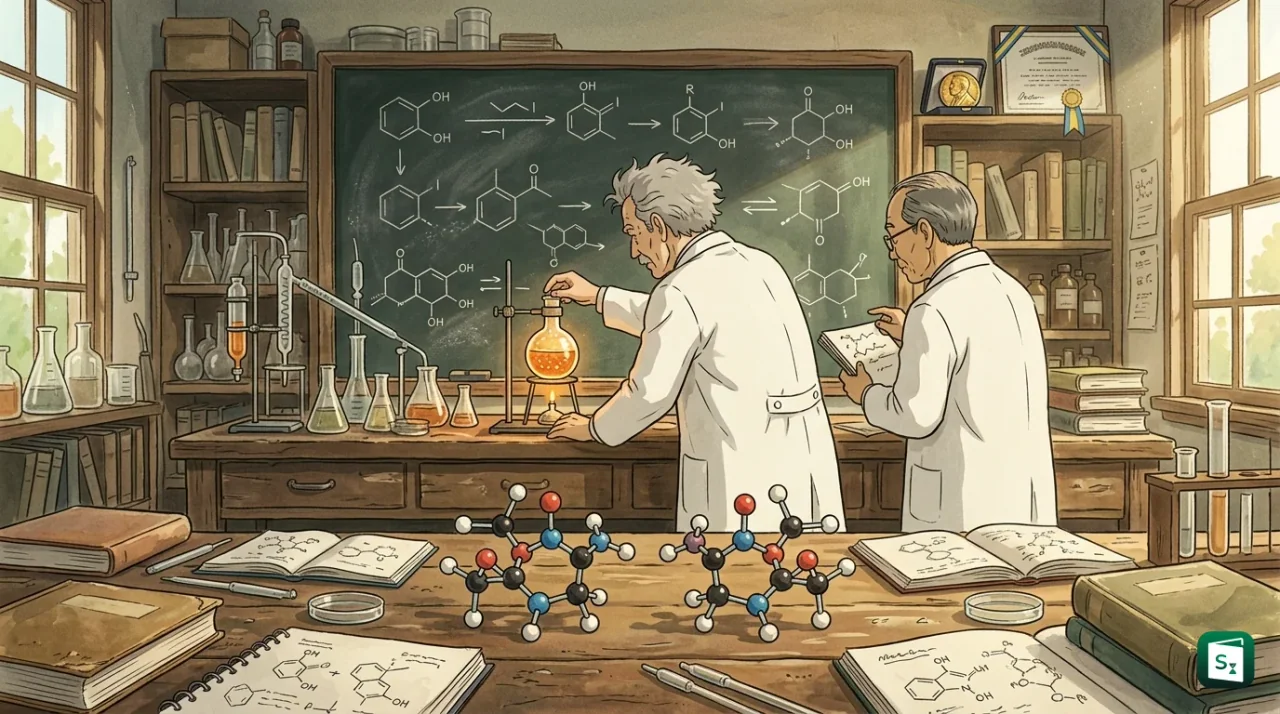
The Royal Swedish Academy of Sciences awarded the 2026 Nobel Prize in Chemistry on 7 October 2026 to Henri Boris Kagan of France and Kenso Soai of Japan for the discovery of nonlinear effects and autocatalysis in asymmetric organic synthesis. The two chemists will share the prize money of SEK 12 million equally. Their work solved a century old puzzle about how nature picks only one of two mirror image molecules, a principle that now guides safer drug manufacturing.
What Is the 2026 Nobel Prize in Chemistry Awarded For?
The 2026 Nobel Prize in Chemistry honours the discovery of nonlinear effects and autocatalysis in asymmetric organic synthesis by Henri Boris Kagan and Kenso Soai. The Royal Swedish Academy of Sciences, founded in 1739 and based in Stockholm, announced the award on 7 October 2026. Each laureate receives one half of the prize.
Asymmetric organic synthesis means building molecules so that only one mirror image forms instead of an equal mix. Kagan showed in 1986 that a small bias in a catalyst could produce a much larger bias in the product. Soai went further in 1995 and 2003 by designing a reaction in which the product copies itself and multiplies its own bias until almost only one mirror image remains.
The Nobel Committee for Chemistry described the achievement as a solution to the mystery of how homochirality can emerge spontaneously. Homochirality means life uses only one mirror form, such as left handed amino acids and right handed sugars, even though lab reactions normally make both in equal amounts. Committee chair Heiner Linke called the reactions developed by the two laureates spectacular and foundational for modern chemistry.
What Are Chirality, Enantiomers and Homochirality?
Chirality means handedness in molecules. A chiral molecule exists as two enantiomers, which are mirror images that cannot be placed exactly on top of each other, like left and right hands. Homochirality means a living system uses only one of those two forms throughout.
The Royal Swedish Academy of Sciences explains that all amino acids in human proteins occur almost entirely as left handed forms, while the DNA and RNA in cells use only right handed sugars. This strict selection keeps proteins folded correctly and lets enzymes recognise their targets. Lab synthesis without special control does the opposite. It produces a racemic mixture, an equal mix of both mirror images.
The idea began with French chemist Louis Pasteur, who in 1848 separated left and right crystals of tartaric acid by hand under a microscope. For more than a century after that, chemists could mix chemicals to make both mirror images but could not explain how nature ends up with only one. That gap is central to questions about drug safety and the origin of life.
How Did Henri Kagan Discover Nonlinear Effects?
Henri Boris Kagan, born on 15 December 1930 in Boulogne-Billancourt, France, is Professor Emeritus at Université Paris-Sud in Orsay. He earned his doctorate in 1960 from the Collège de France after studying at the Sorbonne and the École nationale supérieure de chimie de Paris. He is widely regarded as a pioneer of asymmetric catalysis.
In the early 1970s Kagan created DIOP, a C2 symmetric diphosphine ligand that binds to metals such as rhodium to guide hydrogenation toward one mirror image. The design helped open the field that later supported industrial production of drugs such as L-DOPA for Parkinson disease. He also developed the practical preparation of samarium diiodide (SmI2), a reagent now widely used to form carbon to carbon bonds.
The Nobel winning step came in 1986. Kagan and co workers published results on asymmetric oxidation and aldol reactions showing a nonlinear effect (NLE). In simple terms, a catalyst with only a small excess of one handed form produced a product with a much larger excess of that form. Chemists had expected a straight proportional link between catalyst purity and product purity. Kagan proved the link could bend upward.
The positive nonlinear effect happens because catalyst molecules pair up. Pairs made of two identical hands stay active and keep working, while mixed pairs of opposite hands become less active and drop out. The active pool thus becomes purer than the starting mix. Kagan built mathematical models to describe this pairing. The models gave chemists a practical tool to get high purity products without needing a fully pure catalyst, which cut cost and waste.
What Is the Soai Reaction and Asymmetric Autocatalysis?
Kenso Soai, born in 1950 in Hiroshima, Japan, is Professor Emeritus at the Tokyo University of Science. He received his doctorate in 1979 from the University of Tokyo. His group studies how a tiny initial bias in handedness can grow into near complete purity.
Autocatalysis means the product of a reaction speeds up its own formation. Asymmetric autocatalysis means a chiral product prefers to make more of its own mirror form and suppresses the opposite form. The Soai reaction, first reported in Nature in 1995, is the only known reaction that combines both copying and amplification so strongly.
In the reaction, pyrimidine-5-carbaldehyde reacts with diisopropylzinc to form a chiral alcohol called pyrimidyl alkanol. That alcohol then acts as the catalyst for the next round. A starting sample with an enantiomeric excess (ee) as low as 0.00005 percent reached more than 99.5 percent ee within three cycles. Enantiomeric excess is the measure of how much one mirror image dominates the mix. The majority form multiplied by a factor of about 630,000, while the minority form barely grew.
The result mattered because the initial trigger could be extremely small. Soai showed that chiral crystals, circularly polarised light, isotopically chiral compounds and even achiral compounds such as glycine in a chiral crystal form could start the process. In some runs the reaction amplified a random fluctuation with no added chiral substance, a process called absolute asymmetric synthesis. This gave scientists the first working lab model for how a near equal world could tip toward single handedness, as seen in living cells where proteins use L-amino acids and nucleic acids use D-sugars.
Why Does Selective Synthesis Matter for Medicines?
The human body is chiral. Enzymes, receptors and transport proteins recognise one mirror image much better than the other. One enantiomer of a drug may heal, while its mirror image may be inactive or harmful. Selective synthesis allows companies to make only the useful form from the start.
The danger of ignoring this difference became clear with thalidomide in the late 1950s. Doctors prescribed the drug as a racemic mix for morning sickness. One mirror form caused severe birth defects. Later work showed the forms also interconvert in the body, so separation alone could not remove the risk, but the tragedy forced regulators to demand strict control of chirality in every new drug.
Today most new small molecule drugs reach the market as single enantiomers. Common examples include L-DOPA for Parkinson disease, esomeprazole for acidity and many antibiotics and heart medicines. Asymmetric catalysis based on the principles clarified by Kagan reduces steps, solvents and purification. Autocatalytic amplification based on the principles shown by Soai points to cleaner routes where a small amount of chiral catalyst creates a large amount of pure product.
The discoveries also speak to biology. Living systems maintain homochirality to keep their chemistry reliable. A model that shows how a tiny bias can become complete purity helps researchers test ideas about how the first handed molecules on early Earth could have taken over.
Nobel Prize Money, Ceremony and Selection
The Nobel Foundation set the 2026 prize amount at SEK 12 million per full prize. The sum rose by SEK 1 million compared with recent years to mark the 125th anniversary of the Nobel Prize. Kagan and Soai share the amount equally, so each receives SEK 6 million. The total corresponds to a little more than $1.2 million or €1 million.
| Laureate | Born | Affiliation at Award (as of October 2026) | Prize Share |
|---|---|---|---|
| Henri Boris Kagan | 15 December 1930, Boulogne-Billancourt, France | Université Paris-Sud, Orsay, France | One half |
| Kenso Soai | 1950, Hiroshima, Japan | Tokyo University of Science, Tokyo, Japan | One half |
The Royal Swedish Academy of Sciences selects the Chemistry laureates. The Academy asked the Nobel Committee for Chemistry, chaired by Heiner Linke (as of October 2026), to review nominations and propose winners. The Chemistry prize is traditionally the third announcement in Nobel week. In 2026 the announcements ran from 5 to 12 October, with Medicine on 5 October and Physics on 6 October, followed by Chemistry on 7 October.
Laureates receive a medal, a diploma and a document confirming the prize amount. The award ceremony takes place on 10 December, the anniversary of Alfred Nobel’s death, in Stockholm. The Chemistry prize has been awarded 117 times to 200 laureates between 1901 and 2025. Frederick Sanger and Barry Sharpless have each won it twice, so the total number of individuals is 198 for that period.
Key Takeaways
- The 2026 Nobel Prize in Chemistry was awarded on 7 October 2026 to Henri Boris Kagan and Kenso Soai for nonlinear effects and autocatalysis in asymmetric synthesis.
- Henri Kagan discovered the nonlinear effect in 1986, showing a slightly biased catalyst can yield a highly pure single mirror image product.
- The Soai reaction, reported in 1995 and perfected in 2003, amplified an enantiomeric excess of 0.00005 percent to more than 99.5 percent in three cycles.
- Chirality means molecular handedness, enantiomers are non superimposable mirror images, and homochirality is life’s use of only one form such as L-amino acids.
- The prize money for 2026 is SEK 12 million shared equally, with the award ceremony in Stockholm on 10 December.