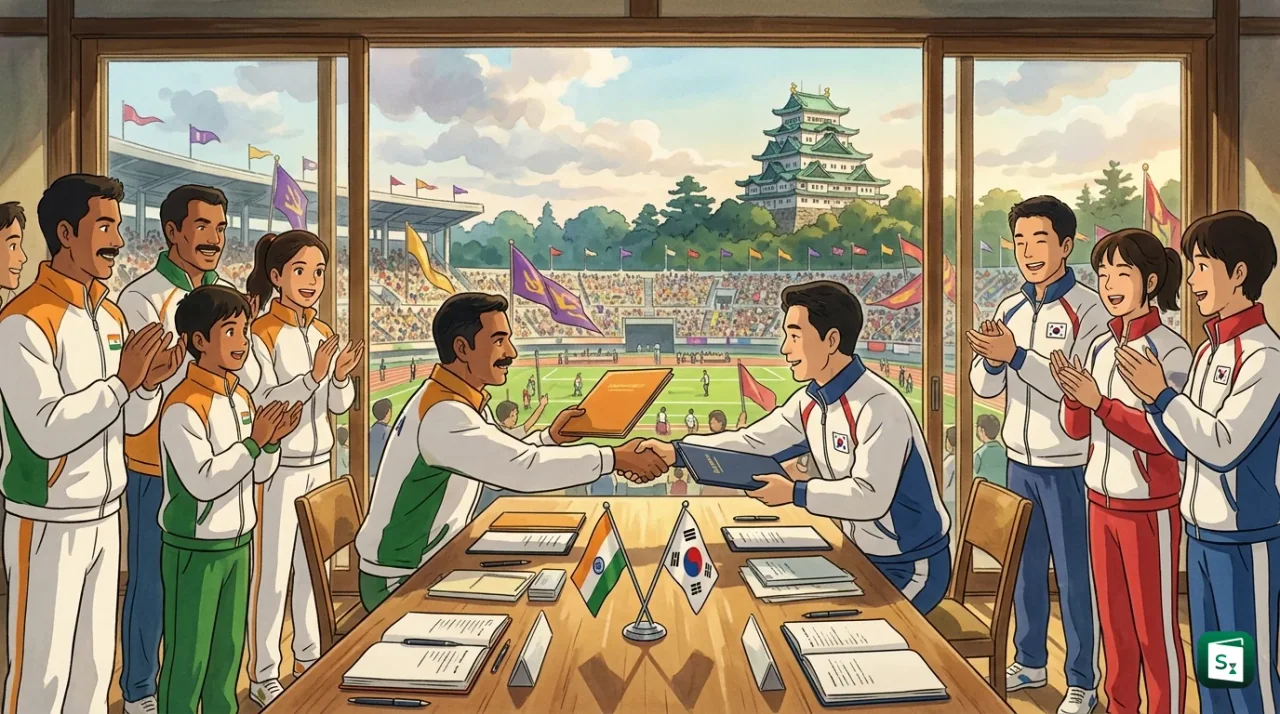
The Indian Olympic Association signed a Memorandum of Understanding with the Korean Sport and Olympic Committee at Korea House in Nagoya on 2 October 2026. The pact was finalised on the sidelines of the 20th Asian Games in Aichi-Nagoya to expand cooperation in athlete development, coaching and sports science. Signed by two former Olympians, P T Usha and Ryu Seung-min, it creates new training and professional opportunities for athletes from both India and South Korea.
What the IOA KSOC Sports MoU Covers
The Indian Olympic Association (IOA) and the Korean Sport and Olympic Committee (KSOC) signed the agreement at Korea House in Nagoya on 2 October 2026. IOA President P T Usha and KSOC President Ryu Seung-min signed the document in the presence of Indian Chef de Mission Sahdev Yadav and other officials. The date carried added meaning. It was the birth anniversary of Mahatma Gandhi, which the United Nations observes as the International Day of Non-Violence, and the Korean side linked the timing to the values of peace and friendship through sport.
The MoU is a framework for cooperation in athlete and youth development, high performance sport, coaching, sports science and good governance. The two bodies will expand exchanges of executives, coaches, referees and sports science experts. They will also support participation in seminars, joint studies in sports facility operations, and cooperation in sports planning and marketing. This last point is important. The pact goes beyond training tracks and gyms to cover how sport is managed and presented.
Joint training sits at the centre of the plan. The IOA and the KSOC will organise combined training programmes and allow athletes to use each other’s national training centres and facilities. The Korean committee operates major centres such as the Jincheon National Training Center and the Taereung National Training Center, while India is building its high performance network under the Sports Authority of India (SAI). For athletes, mutual access means more quality sparring partners, exposure to different coaching methods and better preparation across Olympic cycles leading to the Los Angeles 2028 Olympics.
Where Is the Asian Games 2026 Being Held?
The 20th Asian Games 2026 is being held in Aichi Prefecture and Nagoya city in Japan from 19 September to 4 October 2026. The main venue is the Nagoya City Mizuho Park Athletic Stadium. Around 45 Asian countries and regions are taking part, with nearly 10,787 athletes in 469 events.
The 20th Asian Games, officially called Aichi-Nagoya 2026, uses the motto Imagine One Asia. The opening ceremony took place on 19 September 2026 and the closing ceremony is scheduled for 4 October 2026 at the Paloma Mizuho Stadium, which is the rebuilt Mizuho Park Athletic Stadium with a capacity of about 35,000. Though early rounds in football, volleyball, basketball and cricket began from 10 September, the formal 16 day programme runs from 19 September. Some events use Tokyo 2020 legacy venues. Swimming and equestrian events are held in Tokyo, while track cycling is held in Izu.
The scale is large. Organisers list up to 15,000 athletes and team officials, with the athlete count capped at 10,000, along with about 45 countries and regions, 41 to 43 sports and 469 medal events. Cricket returns as a T20 event at Korogi Athletic Park in Nisshin, a point of high interest for Indian fans. Kabaddi, a strong sport for India, is scheduled at the Tokai Citizen Gymnasium. The next edition will be hosted by Doha, Qatar in 2030.
| Fact | Detail for Aichi-Nagoya 2026 |
|---|---|
| Edition | 20th Asian Games |
| Host | Aichi Prefecture and Nagoya, Japan |
| Dates | 19 September to 4 October 2026 (early events from 10 September) |
| Main stadium | Nagoya City Mizuho Park Athletic Stadium (Paloma Mizuho Stadium) |
| Motto | Imagine One Asia |
| Participation | About 45 countries and regions, nearly 10,787 athletes, 469 events |
What Is IOA and How Is It Different from IOC?
The Indian Olympic Association is India’s National Olympic Committee that selects and manages Team India for the Olympics, Asian Games and Commonwealth Games. The International Olympic Committee is the global governing body based in Lausanne, Switzerland. The IOA works in India under the IOC’s Olympic Charter.
The Indian Olympic Association, shortened to IOA, is the apex body for the Olympic Movement in India. It selects athletes to represent India at the Olympic Games, Asian Games and other IOC patronised multi sport events, and it also acts as the Indian Commonwealth Games Association for the Commonwealth Games. The IOA is headquartered at Olympic Bhawan, B-29, Qutub Institutional Area, New Delhi. It is registered as a non profit organisation under the Societies Registration Act, 1860. It is affiliated to the International Olympic Committee (IOC), the Olympic Council of Asia (OCA), the Commonwealth Games Federation and the Association of National Olympic Committees, and it is recognised by the Ministry of Youth Affairs and Sports.
The International Olympic Committee, shortened to IOC, is different in scale and role. The IOC is the supreme global authority for the Olympic Movement. It was formed in 1894 on the initiative of Pierre de Coubertin and is headquartered in Lausanne, Switzerland. It owns the Olympic Games, sets the Olympic Charter and recognises one National Olympic Committee per country. The IOA is that recognised committee for India since 1927.
| Point | IOA | IOC |
|---|---|---|
| Full name | Indian Olympic Association | International Olympic Committee |
| Level | National body for India | Global governing body for Olympic Movement |
| Formed | 1927 | 1894 |
| Headquarters | New Delhi, India | Lausanne, Switzerland |
| Main job | Selects and manages Team India, promotes Olympic values in India | Awards Olympic Games, sets rules, recognises National Olympic Committees |
When and Why Was the Indian Olympic Association Established?
The Indian Olympic Association was established in 1927 with Sir Dorabji Tata as founding president and Dr A G Noehren as secretary general. It was formed to create a national body for Olympic sport after India’s participation in the 1920 and 1924 Olympics exposed the need for organised selection.
The roots go back to the 1920 Antwerp Olympics, where India sent a small contingent of six members, including four athletes and two wrestlers. Sir Dorabji Tata, who financed the effort, became India’s first IOC member at those Games. After the return from Antwerp, Tata and Dr A G Noehren, then Physical Education Director of YMCA India, searched across the country for talent. A provisional All India Olympic Committee was set up in 1923-24. It organised the All India Olympic Games in Delhi in February 1924, which later evolved into the National Games of India. Eight athletes from those trials represented India at the 1924 Paris Olympics under manager Harry Crowe Buck.
The experience proved that India needed a permanent body. The IOA was therefore formed in 1927 at the initiative of Buck and Noehren, with Tata as the first president. Maharaja Bhupindra Singh of Patiala took over as president in 1928. The core purpose remains unchanged. The IOA develops, promotes and protects the Olympic Movement in India, enforces the Olympic Charter and the World Anti-Doping Code, supports ethics in sport and spreads physical, moral and cultural education among youth.
Who Leads the IOA and KSOC in 2026?
The IOA is led by P T Usha (as of October 2026), the legendary sprinter known as the Payyoli Express. She was elected unopposed on 10 December 2022 and became the first woman president of the IOA and the first Olympian to hold the post. Usha competed at three Olympics, at Moscow 1980, Los Angeles 1984 and Seoul 1988. At Los Angeles 1984 she became the first Indian woman to reach an Olympic athletics final, finishing fourth in the 400m hurdles in 55.42 seconds. At the 1986 Seoul Asian Games she won four gold medals and one silver, one of the finest performances by an Indian athlete. After retirement she founded the Usha School of Athletics in Kozhikode, Kerala to train young talent.
The KSOC is led by Ryu Seung-min, who took charge as president in 2025. Ryu was born on 5 August 1982 and is one of South Korea’s most decorated table tennis players. He won gold in men’s singles at the Athens 2004 Olympics by defeating China’s Wang Hao, after beating Sweden’s Jan-Ove Waldner in the semifinals. He added team bronze at Beijing 2008 and team silver at London 2012. He later served as a member of the IOC from 2016 to 2024 and headed the Korea Table Tennis Association. In January 2025 he defeated incumbent Lee Kee-heung by 417 votes to 379 and was formally inaugurated on 28 February 2025 for a term running through February 2029. The KSOC itself traces its origin to the Joseon Sports Council formed in 1920, was recognised by the IOC in 1947 and is based at 424, Olympic-ro, Songpa-gu, Seoul.
The fact that both presidents are former elite athletes shaped the message around the MoU. The joint handout described the pact as a milestone for the Olympic Movement because leaders who have lived the athlete’s life understand the need to create structured pathways for the next generation.
India South Korea Relations: The Wider Context of the Pact
The IOA KSOC agreement fits into a much larger partnership. India and South Korea established consular ties in 1962 and full diplomatic relations on 10 December 1973. The relationship became a Strategic Partnership in 2010 and was raised to a Special Strategic Partnership in 2015 during Prime Minister Narendra Modi’s state visit to Seoul. The two countries celebrated 50 years of diplomatic ties in 2023. India sees South Korea as a key partner in its Act East policy, while South Korea values India as a central partner for peace and growth in the Indo-Pacific.
Trade is the strongest pillar. The Comprehensive Economic Partnership Agreement (CEPA), a trade pact that is broader and more flexible than a standard free trade deal, was signed on 7 August 2009 and came into force in January 2010. Upgrade talks began in 2016, paused for a period and resumed after the Korean President’s state visit to India in April 2026. The 12th round was held in New Delhi from 25 to 27 May 2026 and the 13th round in Seoul from 19 to 21 August 2026. Bilateral trade stood at about $25.6 billion in 2025. India’s deficit has widened from $5.1 billion in 2009-10 to $15.6 billion in 2025-26, and both sides have agreed to address the gap within the CEPA framework. Leaders have set a goal to raise bilateral trade to $50 billion by 2030.
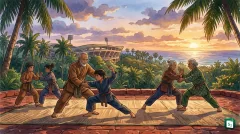
Sport has grown as a soft power link within this framework. The Ministry of Youth Affairs and Sports and South Korea’s Ministry of Culture, Sports and Tourism signed a sports cooperation MoU in November 2018, covering exchanges of coaches, joint training, sports science, anti-doping, taekwondo and kabaddi. A visible outcome came in February 2023, when the All India Taekwondo Championship was co-organised with the Korean Cultural Centre and Korean National Sport University to mark 50 years of ties, with 12 gold medallists offered three weeks of training in South Korea. A fresh government level sports MoU signed during the April 2026 state visit was listed under amplifying soft power. The IOA KSOC pact builds on that base, but at the level of the two National Olympic Committees, which gives it direct operational value for teams and training centres.
| Year | Milestone in India South Korea Ties |
|---|---|
| 1962 | Consular relations established |
| 1973 | Full diplomatic relations on 10 December |
| 2010 | Strategic Partnership and CEPA enters into force |
| 2015 | Special Strategic Partnership during Modi visit to Seoul |
| 2018 | First sports ministry level sports cooperation MoU |
| 2026 | Fresh sports MoU in April and IOA KSOC MoU on 2 October |
Why the Pact Matters and What Comes Next
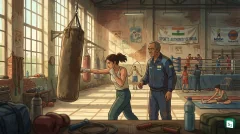
For India, the value lies in coaching method and sports science. Elite sport is now decided by small margins in recovery, injury management and data driven training. South Korea brings world class systems in archery, taekwondo, fencing and shooting, backed by strong university research and disciplined talent pathways. India brings depth in wrestling, boxing, badminton, shooting and kabaddi, along with large scale competitive exposure. Structured exchanges let both sides learn what the other does best. Women’s football is another natural area, since South Korea has a mature age group and senior women’s structure that can help India’s growing programme.
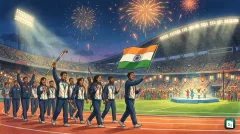
India arrived at Aichi-Nagoya with a 503 member contingent, better funded and better staffed than in earlier editions, and team leaders chose not to fix a public medal target. The focus is on process, preparation and support from federations, SAI and the sports ministry. The Korean partnership adds to that support system through joint camps, referee education and shared use of high performance centres. In the short term this should improve readiness for the 2030 Doha Asian Games and the Los Angeles 2028 Olympics. In the longer term it feeds India’s biggest sporting goal, a bid for the 2036 Olympic and Paralympic Games.
India has centred its 2036 bid on Ahmedabad (Amdavad), Gujarat under the vision Rising Together. India submitted its Expression of Interest in 2024 and is one of seven interested parties named by the IOC in October 2026, along with Germany, Hungary, Qatar, South Korea, South Africa and Turkiye. The first presentation to the IOC’s Future Host Commission is planned for the end of November 2026, with a final host vote expected in 2029. Partnerships such as the IOA KSOC MoU strengthen technical credibility in areas the IOC assesses closely, namely athlete experience, coaching standards, venue operations and legacy planning.
Key Takeaways
- The IOA KSOC sports MoU was signed on 2 October 2026 at Korea House in Nagoya by P T Usha and Ryu Seung-min during the 20th Asian Games.
- The pact covers athlete and youth development, high performance, coaching, sports science and good governance, with joint training and mutual use of facilities.
- The 20th Asian Games Aichi-Nagoya 2026 is being held from 19 September to 4 October 2026 with nearly 10,787 athletes in 469 events.
- The Indian Olympic Association was established in 1927 with Sir Dorabji Tata as founding president and is headquartered in New Delhi.
- The Korean Sport and Olympic Committee traces its origin to 1920, was recognised by the IOC in 1947 and is headquartered in Seoul.
- India and South Korea established diplomatic ties on 10 December 1973, became a Special Strategic Partnership in 2015, and aim to raise bilateral trade to $50 billion by 2030.