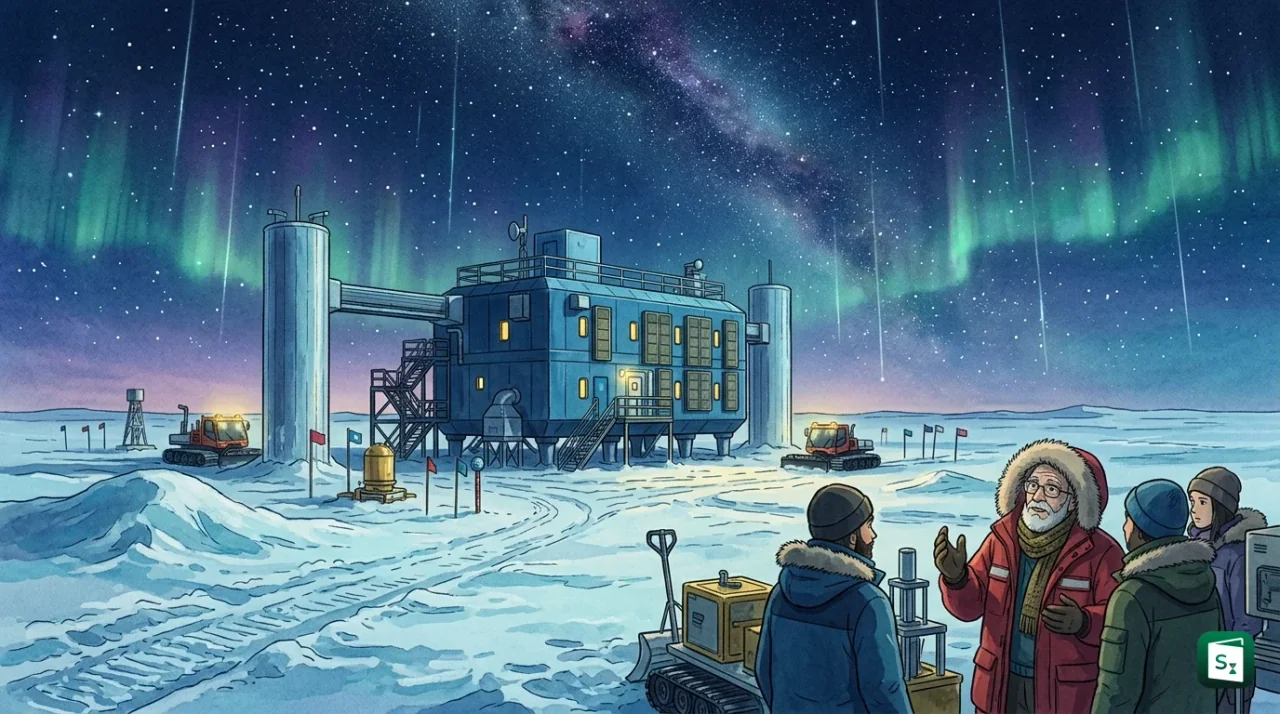
The Royal Swedish Academy of Sciences awarded the Nobel Prize in Physics 2026 to Francis Louis Halzen on 6 October 2026 for building the IceCube Neutrino Observatory at the South Pole and discovering high energy neutrinos from deep space. Halzen, an 82 year old Belgian American professor at the University of Wisconsin-Madison, first proposed in 1988 that clear Antarctic ice could be turned into a giant particle detector. The award carries 12 million Swedish kronor and honours a discovery that opened a new way to study the universe.
What Is a Neutrino?
The neutrino is a tiny, electrically neutral elementary particle that belongs to the lepton family in the Standard Model of particle physics. It interacts only through gravity and the weak nuclear force, so it passes through almost all matter untouched. Trillions of neutrinos cross the human body every second without any effect.
The neutrino comes in three types or flavours, called the electron neutrino, muon neutrino and tau neutrino. Each flavour has a matching antiparticle called an antineutrino, which carries opposite quantum numbers. The neutrino is far lighter than an electron and far smaller than an atom, and it travels at almost the speed of light, but not faster than light.
The Austrian physicist Wolfgang Pauli first proposed the neutrino in 1930 to explain missing energy in a process called beta decay, in which a neutron changes into a proton inside an atomic nucleus. American scientists Frederick Reines and Clyde Cowan confirmed its existence in 1956 using a detector placed near a nuclear reactor. This discovery later earned Reines the 1995 Nobel Prize in Physics.
Neutrinos are not completely massless. Experiments at Super-Kamiokande in Japan and the Sudbury Neutrino Observatory in Canada showed that neutrinos change from one flavour to another while travelling, a process called neutrino oscillation. This change is possible only if neutrinos have a very small mass. Takaaki Kajita and Arthur McDonald received the 2015 Nobel Prize in Physics for proving this oscillation. The 2026 prize takes this story forward, from neutrinos made in the Sun and air to neutrinos made in distant galaxies.
Who Is Francis Halzen?
Francis Louis Halzen is a Belgian born particle physicist who has taught at the University of Wisconsin-Madison in the United States since 1972. He was born on 23 March 1944 in Tienen, Belgium, and earned his Masters in 1966 and PhD in 1969 from the University of Louvain, now called KU Leuven. He later worked at CERN, the European particle physics laboratory near Geneva, before moving to Wisconsin. He now holds the titles of Gregory Breit Professor and Vilas Research Professor of Physics.
Halzen started his career as a theorist. He coauthored the classic textbook Quarks and Leptons and worked on early uses of the Standard Model in collider and cosmic ray physics. In the mid 1980s he shifted to a bold practical question. How can humans catch high energy neutrinos from space when they almost never hit anything. His answer shaped the rest of his career.
In 1987 Halzen joined the Antarctic Muon And Neutrino Detector Array (AMANDA), a small test detector at the South Pole. AMANDA proved that sensors frozen in ice could record particle signals. Halzen then led the campaign for a full scale detector. He serves as principal investigator of IceCube and as director of the university institute for elementary particle physics. His earlier honours include the 2015 Balzan Prize, the 2021 Bruno Rossi Prize and election to the US National Academy of Sciences in 2024.
What Is the IceCube Neutrino Observatory?
The IceCube Neutrino Observatory is the largest neutrino detector in the world. It is located at the Amundsen-Scott South Pole Station in Antarctica and is operated by the University of Wisconsin-Madison with primary funding from the US National Science Foundation (NSF). The observatory uses one cubic kilometre of clear Antarctic ice, between 1,450 metres and 2,450 metres below the surface, as its detection medium. Construction finished in December 2010 and full science operations started in 2011.
IceCube contains 5,160 light sensors, called Digital Optical Modules, hung on 86 vertical cables or strings. Each string holds 60 sensors. The sensors watch a block of ice that weighs more than a billion tonnes. The surface array IceTop and the dense inner array DeepCore support the main detector. More than 300 scientists from about 12 countries work in the IceCube Collaboration, which has its headquarters at the Wisconsin IceCube Particle Astrophysics Center (WIPAC).
| Feature of IceCube | Detail |
|---|---|
| Location | Amundsen-Scott South Pole Station, Antarctica |
| Ice volume used | 1 cubic kilometre |
| Depth of sensors | 1,450 metres to 2,450 metres |
| Number of sensors | 5,160 Digital Optical Modules |
| Number of strings | 86 strings |
| Lead institution | University of Wisconsin-Madison |
| Main funder | US National Science Foundation |
| Completed | December 2010 |
How Neutrinos Are Detected in Antarctic Ice
The IceCube Neutrino Observatory detects neutrinos by catching the faint blue flash they create on the rare occasion they strike an atomic nucleus in ice. That collision produces fast charged particles such as muons. These particles move faster than light can move in ice and release a cone of blue light called Cherenkov radiation. The buried sensors record the timing and pattern of this light. Computers then rebuild the path of the particle and trace it back to its source in the sky.
Antarctic ice is ideal for this task. Deep polar ice is extremely clear, dark and pure. It is free from background light and radio noise. The region is also geologically stable with no earthquakes to disturb the array. A huge volume is needed because cosmic neutrinos are extremely rare. Only a few dozen high energy events appear in a year even in a detector as large as IceCube.
From 1988 Idea to 2013 Discovery: Timeline of the Breakthrough
Francis Halzen first presented his vision for an ice based neutrino telescope in 1988. He argued that a kilometre scale array in South Pole ice could catch neutrinos with energies a million times higher than those produced in laboratories. Preliminary sensor tests in the early 1990s showed that the ice was clear enough to carry light over long distances. The AMANDA test array, built between 1993 and 2000, confirmed the method and served as the research base for IceCube.
Full drilling for IceCube ran from 2005 to 2010. Hot water drills melted 86 narrow holes deep in the ice sheet. Teams lowered sensor strings into the water filled holes and let the ice refreeze around them. The system started taking full data in 2011. In 2013 the collaboration announced 28 events with energies above 50 teraelectronvolts, including two landmark events nicknamed Bert and Ernie with energies near 1 petaelectronvolt. Analysis showed the signal stood well above background from atmospheric neutrinos and muons. The finding, published in the journal Science, gave the first solid proof of astrophysical neutrinos from outside the solar system and earned the 2013 Physics World Breakthrough of the Year.
| Year | Milestone in IceCube Journey |
|---|---|
| 1988 | Halzen proposes Antarctic ice as neutrino detector |
| 1993 to 2000 | AMANDA test array proves concept at South Pole |
| 2005 to 2010 | Construction of 86 string IceCube array |
| 2013 | First flux of 28 high energy cosmic neutrinos reported |
| 2017 | IC-170922A neutrino linked to flaring blazar TXS 0506+056 |
| 2023 | Neutrino glow from the plane of the Milky Way reported |
| 2025 to 2026 | IceCube Upgrade installed to sharpen direction and energy readings |
Later results strengthened the case. In September 2017 IceCube sent its first real time alert for a 300 teraelectronvolt track that matched a flare from the distant galaxy TXS 0506+056, a type of active galaxy called a blazar with a supermassive black hole at its centre. Telescopes across the world, including the Fermi-LAT gamma ray telescope, saw the same source flare at the same time. This was the first strong hint of a specific extragalactic neutrino source. In 2023 IceCube reported neutrinos from the plane of our own Milky Way galaxy. The IceCube Upgrade, installed in the 2025 to 2026 Antarctic season, lowers the energy threshold and improves calibration for future source hunts.
Why High Energy Astrophysical Neutrinos Matter
High energy astrophysical neutrinos are ghost messengers from the most violent places in the universe. The Nobel citation uses the term astrophysical origin to mean neutrinos born outside the solar system, in cosmic particle accelerators such as exploding stars, merging neutron stars and active galactic nuclei powered by supermassive black holes. These engines fire out particles with energies up to a million times higher than the best human built accelerators. Scientists have debated for more than a century where cosmic rays, the charged particles that constantly rain on Earth, actually come from.
Neutrinos solve a tracking problem. Cosmic rays are electrically charged, so magnetic fields bend their paths and hide their birthplaces. Light is blocked by dust and gas. Neutrinos carry no charge and almost never collide, so they travel in straight lines across billions of light years without losing direction or energy. A neutrino that arrives at the South Pole points straight back to its source. That property makes neutrino astronomy a new third window on the sky, alongside light based astronomy and gravitational wave astronomy.
The practical payoff is already visible. IceCube runs a real time alert system since 2016 that warns optical, radio and gamma ray telescopes within seconds of a likely cosmic neutrino. This network, called multimessenger astronomy, lets many instruments study the same blast together. The data also test the Standard Model at extreme energies, confirm predictions such as the Glashow resonance seen in 2016, and help set limits on dark matter. Continuous collection of neutrino events may yet reveal unknown cosmic phenomena, which the Nobel Committee named as a central promise of the field.
Prize Money, Award Process and Ceremony
The Nobel Prize in Physics 2026 carries 12 million Swedish kronor. The Nobel Foundation raised the amount by 1 million kronor for 2026 to mark the 125th anniversary of the prize. At exchange rates prevailing in October 2026 this sum equals roughly $1.15 million or about ₹10 crore. Since Francis Halzen is the sole laureate, he receives the full amount. A prize can be shared by up to three laureates.
The Royal Swedish Academy of Sciences, founded in 1739 and based in Stockholm, selects the physics laureates. Its Nobel Committee for Physics reviews nominations sent by invited scientists, university professors and past laureates. The Academy announced the 2026 physics prize on 6 October 2026, the second announcement of Nobel week after medicine on 5 October. The award ceremony will take place in Stockholm on 10 December 2026, the anniversary of the death of Alfred Nobel, the Swedish inventor of dynamite who created the prizes through his will of 1895. The first Nobel Prizes were awarded in 1901.
| Fact About Nobel Prize Physics 2026 | Detail |
|---|---|
| Laureate | Francis Halzen, University of Wisconsin-Madison |
| Citation | Decisive contributions to IceCube and discovery of high energy astrophysical neutrinos |
| Prize share | 1/1, sole winner |
| Prize money | 12 million Swedish kronor |
| Awarding body | Royal Swedish Academy of Sciences |
| Announcement date | 6 October 2026 |
| Award ceremony | 10 December 2026, Stockholm |
India Connection: Neutrino Observatory in Theni
The Nobel Prize Physics 2026 has renewed attention on the India based Neutrino Observatory (INO), planned at Pottipuram in the Bodi West Hills of Theni district in Tamil Nadu. The project aims to build a world class underground laboratory under about 1,200 metres of rock cover to study atmospheric neutrinos. The Tata Institute of Fundamental Research (TIFR) in Mumbai is the host institution. The project is jointly funded by the Department of Atomic Energy (DAE) and the Department of Science and Technology (DST).
The heart of INO is the Iron Calorimeter (ICAL), a 50,000 tonne magnetised iron detector with about 29,000 glass detector plates called Resistive Plate Chambers. The rock above the cavern blocks background cosmic rays, while the magnet helps separate neutrinos from antineutrinos and measure a property called mass ordering. An associated centre, the Inter Institutional Centre for High Energy Physics (IICHEP), is planned at Madurai for operations, training and detector research.
The project has faced a long clearance journey. The Ministry of Environment and Forests gave environmental and forest clearance in 2010, and the Tamil Nadu government allotted land in 2012. Work later paused amid court directions, green tribunal review and concerns raised by local bodies about the site near the Mathikettan Shola National Park and the Western Ghats landscape. The facility studies only naturally produced atmospheric neutrinos and releases no radioactive or toxic waste. It has no weapons or strategic use. For Indian science, INO remains the domestic counterpart to global efforts like IceCube, Super-Kamiokande in Japan and the Sudbury laboratory in Canada.
Key Takeaways
- Francis Louis Halzen won the Nobel Prize in Physics 2026 on 6 October 2026 for the IceCube Observatory and discovery of high energy astrophysical neutrinos.
- The IceCube Neutrino Observatory at the South Pole uses 5,160 sensors on 86 strings in 1 cubic kilometre of ice to detect Cherenkov radiation from neutrino collisions.
- Halzen first proposed the Antarctic ice detector concept in 1988, and IceCube reported its first 28 cosmic neutrinos in 2013.
- The 2026 Nobel Prize carries 12 million Swedish kronor and will be presented in Stockholm on 10 December 2026 by the Royal Swedish Academy of Sciences.
- The India based Neutrino Observatory is planned at Bodi West Hills in Theni, Tamil Nadu, with TIFR as host and a 50,000 tonne Iron Calorimeter to study atmospheric neutrinos.