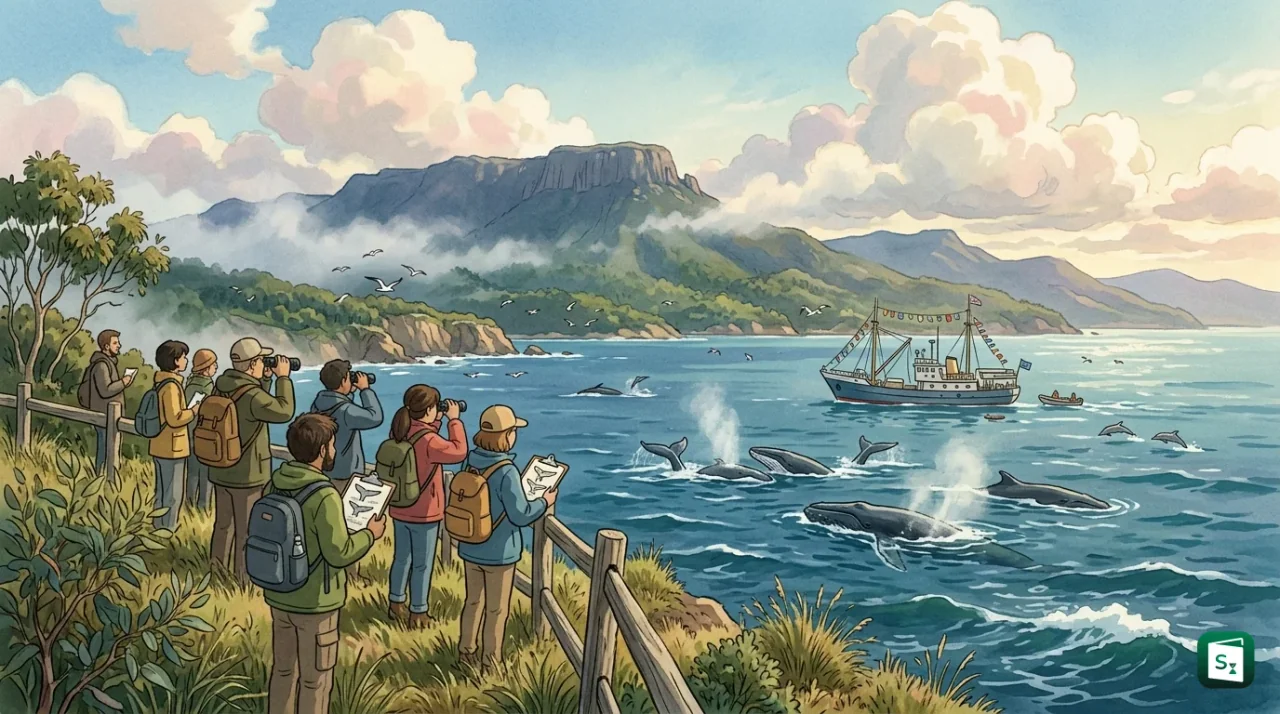
India reaffirmed its commitment to whale and cetacean conservation at the 70th meeting of the International Whaling Commission (IWC-70) held in Hobart, Australia from 28 September to 2 October 2026. The meeting adopted the Hobart Declaration by consensus to mark 80 years of the global whaling treaty and passed new resolutions on fish-maw bycatch, vessel strikes and strandings. India pushed for science based conservation and closer cooperation among range countries to protect shared marine mammals.
What Is the International Whaling Commission?
The International Whaling Commission is the global intergovernmental body responsible for the regulation of whaling and the conservation of whales. The Commission was set up under the International Convention for the Regulation of Whaling, which was signed in Washington DC on 2 December 1946 and is the core international whale treaty.
The Commission today has 89 member governments from around the world. Membership is open to any country that formally accepts the 1946 Convention. Each member is represented by a Commissioner nominated by its government. India has been a member of the International Whaling Commission since 1981 and has played an active role in whale conservation.
The headquarters of the International Whaling Commission is at Impington near Cambridge in the United Kingdom. The Commission works through a permanent Secretariat and three main committees, the Scientific Committee, the Conservation Committee and the Finance and Administration Committee. The Secretariat publishes the Journal of Cetacean Research and Management along with meeting reports and scientific advice.
| Fact | Detail |
|---|---|
| Full name | International Whaling Commission |
| Parent treaty | International Convention for the Regulation of Whaling, 1946 |
| Treaty signed | 2 December 1946, Washington DC |
| Headquarters | Impington near Cambridge, United Kingdom |
| Members | 89 governments |
| India joined | 1981 |
| Core work | Regulation of whaling, conservation of whales and cetaceans |
What Is Whaling and When Was Commercial Whaling Banned?
Whaling is the hunting of whales for meat, oil and other products. Commercial whaling is whaling done to sell and trade whale meat and products for profit, unlike small scale traditional hunting by indigenous communities for food and cultural needs.
The International Whaling Commission adopted a pause on commercial whaling in 1982, which came into full force in 1986. This pause is called the commercial whaling moratorium. Catch limits for commercial killing of all whale stocks were fixed at zero from the 1985/86 pelagic season and the 1986 coastal season. The moratorium remains in place today and marks its 40th anniversary in 2026.
Whaling was banned because many whale stocks had collapsed after decades of uncontrolled commercial hunting. The 1972 UN Conference on the Human Environment at Stockholm had recommended a ten year pause to let stocks recover. The Convention lists endangered whale species and scientific uncertainty about stock size also supported a precautionary pause.
The ban is not a complete global ban on all whaling. The Convention recognises three types of whaling, which are commercial whaling, aboriginal subsistence whaling and special permit or scientific whaling. Commercial whaling is under zero limits. Aboriginal subsistence whaling by indigenous communities in places such as Greenland, Alaska and Siberia continues under strict scientific advice and quotas.
In practice, only a few countries still conduct commercial whaling. Norway lodged a formal objection to the moratorium and sets its own limits for minke whales. Iceland left the Commission in 1992, rejoined in 2002 with a reservation to the moratorium and hunts minke and fin whales. Japan withdrew from the Commission in 2019 and now conducts commercial whaling in its own coastal waters. Japan reports its catches to the Commission as an observer.
IWC-70 in Hobart: Venue, Leadership and the Hobart Declaration
The 70th meeting of the International Whaling Commission (IWC-70) was held in Hobart, Australia from 28 September to 2 October 2026. Hobart is the capital and most populous city of the island state of Tasmania. The city sits on the estuary of the River Derwent in south east Tasmania and is the southernmost capital city in Australia.
The meeting coincided with the 80th anniversary of the signing of the International Convention for the Regulation of Whaling in 1946. Dr Urbain Brito of Benin was elected as the Chair of IWC-70 and Anne-Marie Svoboda of the Netherlands was appointed as the Vice Chair. Around 300 delegates from member governments, scientists and observer organisations attended the biennial session.
The main political outcome was the Hobart Declaration, adopted by consensus on 2 October 2026. The International Whaling Commission described the Hobart Declaration as the first single voice statement of the Commission on its role, history and future. The declaration notes the recovery of some whale populations after 40 years of the moratorium and also flags new non whaling threats such as ship strikes, ocean noise, entanglement in fishing gear and plastic pollution.
IWC-70 also took other key decisions. A proposal by Brazil, Argentina and Uruguay to create a South Atlantic Whale Sanctuary of about 21 million square kilometres failed because it did not get the required three quarters majority. The vote recorded 39 in favour and 18 against. A proposal aimed at restarting sustainable commercial whaling and diluting the moratorium was withdrawn after it failed to gain support. The Commission approved a 3 percent budget increase for the period 2027 to 2028.
Three New Resolutions: Fish-Maw Bycatch, Vessel Strikes and Strandings
IWC-70 adopted three conservation resolutions by vote or consensus to tackle modern threats that kill whales, dolphins and porpoises even where direct hunting has stopped. Cetaceans is the scientific group that includes all whales, dolphins and porpoises. These marine mammals breathe air, give birth to live young and feed milk to their calves.
Fish-maw trade and cetacean bycatch
Fish maw is the dried swim bladder of large fish. It is prized as a luxury food in parts of East Asia and can sell for thousands of dollars per kilogram. Bycatch is the accidental capture of non target animals in fishing gear. In maw fisheries, gillnets set for croakers also trap dolphins, porpoises, dugongs, sharks, rays and turtles.
The resolution on Global Trade in Fish Maw and Incidental Catches of Threatened Cetaceans expresses concern that rising maw demand is increasing gillnet effort in coastal waters. The most cited example is the vaquita porpoise in the Gulf of California in Mexico, which numbers fewer than 10 animals and is caught in illegal gillnets set for the totoaba fish whose bladder is traded illegally. Similar risks affect small cetaceans in the Bay of Bengal and in Papua New Guinea where blackspotted croaker and scaly croaker fisheries report high dolphin and dugong bycatch.
The resolution asks governments to monitor and regulate maw trade, assess bycatch risk, share catch and trade data and consider a separate customs code for maw. It directs the Bycatch Mitigation Initiative of the International Whaling Commission to work with the Convention on Migratory Species (CMS) and the International Union for Conservation of Nature (IUCN) to suggest practical steps to monitor, reduce and finally prevent such bycatch.
Vessel strikes on whales
Vessel strikes are collisions between ships or boats and whales. Most reported cases involve large whales, though all species face risk. Collisions often go unreported because crews on large ships do not feel the impact. Animals can suffer cuts, broken bones or death, while fast ferries and small craft can also face damage and injury to passengers.
The resolution on Vessel Strikes welcomes work by governments, the shipping industry and the Vessel Strike Expert Panel of the International Whaling Commission. It endorses scientific guidance for mapping strike risk and asks members to collect strike data and share it with the Global Vessel Strikes Database maintained since 2007. Proven mitigation is simple in concept. Keep whales and ships apart through rerouting where possible and, where they overlap, reduce speed, often to 10 knots, and keep a proper lookout.
The Commission works closely with the International Maritime Organization (IMO), headquartered in London, on routing measures, speed limits and sensitive sea areas. High risk areas discussed include the southern coast of Sri Lanka where shipping lanes overlap blue whale habitat, the Mediterranean where fin and sperm whales face heavy traffic, the Hauraki Gulf in New Zealand and waters off the east coast of the United States where the North Atlantic right whale is at risk.
Cetacean strandings as a cross cutting priority
Stranding is when a whale, dolphin or porpoise beaches itself or is found dead or in distress on the shore. Stranded animals give valuable data on ocean health, disease, pollution, food habits and population biology through post mortem study, which is the scientific examination of a dead animal.
The resolution on Cetacean Strandings as a Cross-Cutting Priority was adopted by consensus. It recognises that stranding data helps many committees, from science to conservation to health. It calls for stronger collaboration across committees and support for a Global Strandings Database in partnership with ASCOBANS, which is the Agreement on the Conservation of Small Cetaceans of the Baltic, North East Atlantic, Irish and North Seas. It also backs the Strandings Initiative of the International Whaling Commission, launched in 2016, which trains national teams, shares best practice on rescue and necropsy and provides real time expert advice during mass strandings.
India at IWC-70: Science Based Conservation and Domestic Action
The Indian delegation presented its Opening Statement through the Ministry of Environment, Forest and Climate Change. India said better scientific information on population size, distribution, movements, breeding ecology and threats is the base for sound decisions. The delegation asked that all conservation and management steps of the International Whaling Commission stay grounded in evidence rather than assumption.
India also stressed continued collaboration among range countries, scientific institutions, international organisations, researchers and coastal communities. Range countries are countries that share the natural habitat of the same animal population. India noted that protection in one country has limited value if the animal travels across borders, so shared data and joint plans are needed to design practical steps suited to local conditions.
At home, cetacean species found in Indian waters receive the highest level of legal protection under the Wild Life (Protection) Act, 1972. India has also notified several Marine Protected Areas to protect marine biodiversity including whales, dolphins, dugongs, sharks, rays, turtles and corals. The Gulf of Mannar Biosphere Reserve, Chilika Lake in Odisha and waters off Kerala, Karnataka and the Andaman and Nicobar Islands are among the important habitats studied for cetaceans.
India cited Project Dolphin, launched on 15 August 2020 on the lines of Project Tiger and Project Elephant, as its holistic programme for dolphins, whales, porpoises and their aquatic habitats. The project covers both river dolphins such as the Ganges river dolphin, which is the National Aquatic Animal of India, and marine dolphins and whales. It supports population monitoring, habitat restoration, rescue of stranded animals, removal of ghost nets, pollution control, community awareness and livelihood support for fishing families. 5 October is observed as National Dolphin Day under the project, and the National Dolphin Research Centre at Patna supports scientific study.
India gives special attention to the Arabian Sea humpback whale, listed among 25 species chosen for focused conservation. This small and genetically distinct population moves between India, Oman, Pakistan, Iran and Sri Lanka and faces risks from ship strikes, fishing gear entanglement, ocean noise and habitat damage. In December 2024, India achieved the first satellite tagging of a Ganges river dolphin in Assam to track movement and habitat use, a step that reflects the same science first method India advocated at Hobart.
Whales in India and the Indian Ocean Sanctuary
Marine mammals is a group that includes cetaceans along with dugongs, manatees, seals and sea otters. Indian waters host about 25 to 26 species of cetaceans. Surveys by research vessels such as Sagar Sampada have confirmed blue whales, sperm whales, Bryde whales, humpback whales, spinner dolphins, Indo Pacific bottlenose dolphins, Indo Pacific humpback dolphins, Risso dolphins and finless porpoises. The south eastern Arabian Sea off Kerala and Karnataka and waters south of Sri Lanka show the richest diversity. India has an Exclusive Economic Zone of about 2.02 million square kilometres in the Arabian Sea and the Bay of Bengal.
The entire Indian Exclusive Economic Zone lies inside the Indian Ocean Sanctuary. The International Whaling Commission created this sanctuary in 1979 to ban commercial whaling across the region and to promote research. A second sanctuary, the Southern Ocean Sanctuary, was created in 1994 around Antarctica. Commercial whaling is prohibited in both sanctuaries.
| Sanctuary | Year created | Coverage |
|---|---|---|
| Indian Ocean Sanctuary | 1979 | Waters of the Northern Hemisphere from the African coast to 100 degrees East including Red and Arabian Seas and Gulf of Oman, plus Southern Hemisphere waters from 20 degrees East to 130 degrees East down to 55 degrees South |
| Southern Ocean Sanctuary | 1994 | Waters of the Southern Hemisphere south of a line starting at 40 degrees South, 50 degrees West and circling Antarctica |
In 2018, the Commission adopted the Florianopolis Declaration in Brazil, which defines the present role of the International Whaling Commission as ensuring recovery of whale populations to pre industrial levels and reaffirms the moratorium. India supports this conservation direction. For India, the practical test after IWC-70 is clearer data on where whales breed and feed, safer shipping and fishing practices in those pockets and joint work with neighbours that share the same migratory populations.
Key Takeaways
- IWC-70 was held in Hobart, Australia from 28 September to 2 October 2026 with India reaffirming science based cetacean conservation.
- The Hobart Declaration was adopted by consensus to mark the 80th anniversary of the International Convention for the Regulation of Whaling signed in 1946.
- Dr Urbain Brito of Benin was elected as Chair and Anne-Marie Svoboda of the Netherlands as Vice Chair of IWC-70.
- IWC-70 passed resolutions on fish-maw trade related bycatch, vessel strikes and cetacean strandings, including support for a Global Strandings Database.
- The commercial whaling moratorium was adopted in 1982 and came into force in 1986, with catch limits set at zero, and it remains in force in 2026.
- The International Whaling Commission is headquartered at Impington near Cambridge, United Kingdom, has 89 members and India has been a member since 1981.
- Cetaceans in India get the highest protection under the Wild Life (Protection) Act, 1972, while Project Dolphin launched in 2020 covers river and marine dolphins and the Arabian Sea humpback whale is among 25 species for focused conservation.