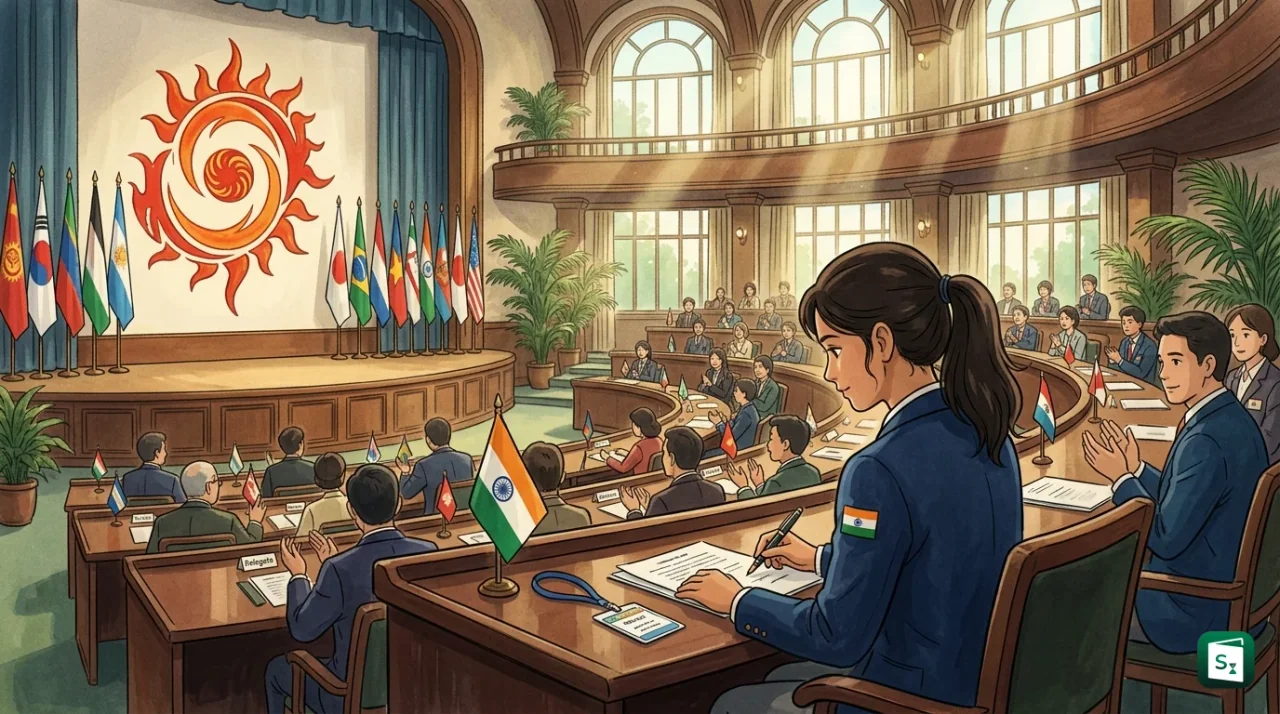
Former Indian trap shooter Rajeshwari Kumari has been unanimously elected as a member of the Olympic Council of Asia (OCA) Athletes Commission to represent South Asia for the term 2026 to 2030. The decision was announced on 3 to 4 October 2026 after the Athletes Committee elections held during the 20th Asian Games in Aichi-Nagoya, Japan. She is the second Indian on the commission after luge Olympian Shiva Keshavan, giving India a stronger voice in Asian sports governance.
Who Is Rajeshwari Kumari?
Rajeshwari Kumari, popularly known as Ria, is an Indian trap shooter born on 10 December 1991 in New Delhi. She is the daughter of former Olympian trap shooter Raja Randhir Singh and comes from the erstwhile Patiala royal family. She started competitive shooting before 2014 and built her career through the domestic circuit before joining the senior national team in 2021.
Rajeshwari Kumari won silver in the women’s trap team event at the 2022 Asian Games in Hangzhou (held in 2023). She secured India’s Olympic quota with a fifth place finish at the ISSF World Championships 2023 in Baku and represented India in women’s trap at the Paris Olympics 2024, where she placed 22nd in qualification. She holds the national record of 118 out of 125 set at the 63rd National Shotgun Championship in 2019 and was ranked world number 9 in women’s trap in 2024. She trained under Czech double Olympic medallist David Kostelecky and was supported under the Target Olympic Podium Scheme (TOPS), a Union Sports Ministry programme that funds elite athletes for Olympic preparation.
Beyond sport, Rajeshwari Kumari studied at the Manav Rachna International Institute of Research and Studies and co-founded the luxury clothing label Saurab Rajeshwari in 2021. Her nomination to the OCA body was backed by the Indian Olympic Association (IOA), the national Olympic body headed by P. T. Usha (as of October 2026). She has said she will serve the Olympic movement with integrity and work to strengthen the voice of athletes.
What Is the OCA Athletes Commission?
The OCA Athletes Commission is the official voice of athletes inside the Olympic Council of Asia (OCA), the continental body that governs sport in Asia. The OCA is a non governmental international sports organisation recognised by the International Olympic Committee (IOC). The Athletes Commission makes sure the views of athletes are collected and counted in OCA decisions. Its core aims are to protect athletes rights, advise the OCA Executive Board, and link Asian athletes with the global athletes commissions of the IOC and the Association of National Olympic Committees (ANOC).
The OCA Athletes Commission has ten elected members, with one man and one woman from each of the five OCA zones. These zones are East Asia, South Asia, South East Asia, Central Asia and West Asia. The OCA Executive Board can add up to four more members to keep regional, gender and sport balance and to ensure smooth changeover between terms. The Chair of the Commission sits as an ex officio voting member of the OCA Executive Board, so athletes take part directly in top level decision making. No more than one elected member can come from the same National Olympic Committee (NOC), which is the national body that represents each country in the Olympic system, or from the same sport.
The Chair of the OCA Athletes Committee (as of October 2026) is Chinese table tennis champion Ding Ning. The Commission sends delegations to the Asian Games, Asian Winter Games and other continental Games. It also suggests athlete representatives for other OCA committees and working groups on subjects such as anti doping and integrity.
How Was Rajeshwari Kumari Elected for South Asia?
The OCA announced the new members of its Athletes Committee on 3 October 2026 after voting held during the Aichi-Nagoya Asian Games from 20 September to 2 October 2026. Athletes taking part in the Games voted to fill four zonal seats. Rajeshwari Kumari did not face a vote. The OCA Executive Board directly nominated her to represent the South Asia zone under transitional arrangements approved in July 2026.
The OCA had stated on 21 July 2026 that no nominations would be invited for South Asia because the zone already had an approved representative from India. OCA Athletes Department Manager Jamyang Namgyal confirmed the nomination at a press conference in Nagoya. The Indian Olympic Association publicly welcomed the unanimous election on 4 to 5 October 2026.
Four other new members joined with Rajeshwari Kumari for the 2026 to 2030 term. The focus of the new term is to improve athlete engagement, strengthen links with National Olympic Committees, and ensure athlete views shape the growth of sport in Asia.
| New Member | Zone and Category |
|---|---|
| Rajeshwari Kumari (India) | South Asia, nominated by OCA Executive Board |
| Amir Maimuratov (Kazakhstan) | Central Asia, male athlete, elected |
| Reem Al Sharshani (Qatar) | West Asia, female athlete, elected |
| Naoto Tobe (Japan) | East Asia, male athlete, elected |
| Thanyalak Chophibunsin (Thailand) | South East Asia, female athlete, elected |
Shiva Keshavan: The First Indian on the Commission
Shiva Keshavan is India’s first representative on the OCA Athletes Commission and serves as its Vice-Chairman (as of October 2026). He competes in luge, a winter sliding sport where a single athlete lies on the back on a small sled and races feet first down an icy track at speeds above 130 kilometres per hour. Keshavan was born on 25 August 1981 and is India’s best known winter Olympian.
Shiva Keshavan took part in six Winter Olympics from Nagano 1998 to PyeongChang 2018. He made his debut at age 16 and remains the youngest luge Olympian in history and the first Indian to compete in luge at the Winter Games. His best Olympic result was 25th place at Turin 2006, and he set an Asian speed record of 134.3 kilometres per hour. He won gold at the Asian Luge Cup in 2011 and 2012 and became the first winter sports athlete to receive the Arjuna Award in 2020.
After retirement, Shiva Keshavan became founder president of the Olympians Association of India and later served as chief coach and High Performance Director of the national luge team. His presence as Vice-Chairman means India now has two voices on the commission. That is rare, because the rules normally allow only one elected member per National Olympic Committee, and Rajeshwari Kumari joined through a Board nomination for zonal balance.
What Is Trap Shooting and Its Olympic Status?
Trap shooting is a shotgun discipline in which shooters use a shotgun to hit saucer shaped clay targets thrown into the air. A machine called a trap throws the target away from the shooter at speeds above 100 kilometres per hour. The shooter stands at one of five stations placed 15 metres behind the trap house and fires on call. Each broken target scores one point. The name comes from the early practice of releasing live pigeons from cages or box traps in England in the late 18th century, later replaced by clay discs.
Trap shooting is an Olympic sport and has featured in the Olympic programme, with few breaks, since 1900. In the Olympic format, men and women each shoot 125 targets over two days in qualification, with the top six moving to a short final. The International Shooting Sport Federation (ISSF), founded in 1907 and headquartered in Munich, Germany, governs the sport worldwide. In India, the National Rifle Association of India (NRAI), founded in 1951 and based in New Delhi, selects and trains the national shooting squad.
India fielded its largest ever Olympic shooting squad of 21 shooters at Paris 2024, competing in all 15 shooting events. Rajeshwari Kumari became only the second Indian woman to win an Olympic quota in women’s trap. Her rise shows the growth of the Indian trap shooting team, which has won medals at the Asian Games, Asian Championships and ISSF World Cups in recent years.
Continental Context: Asian Games 2026, OCA and Indian Olympic Association
The election took place during the 20th Asian Games in Aichi-Nagoya, Japan, held from 19 September to 4 October 2026. The Asian Games are Asia’s largest multi sport event, held every four years under OCA authority. Shooting at Aichi-Nagoya included 28 events across rifle, pistol and shotgun, with trap qualification held from 27 to 29 September 2026 at the Aichi Prefectural General Shooting Gallery in Toyota City. The 2026 Games carry added weight as a ranking and exposure stage for Asian athletes on the road to the next Olympics.
The Olympic Council of Asia was established on 16 November 1982 in New Delhi and is now headquartered in Kuwait City, Kuwait. It brings together 45 National Olympic Committees from across Asia. The OCA organises the Asian Games, Asian Winter Games, Asian Indoor and Martial Arts Games, Asian Beach Games and Asian Youth Games. The OCA President (as of January 2026) is Sheikh Joaan bin Hamad Al Thani of Qatar, elected at the 46th OCA General Assembly in Tashkent after former president Raja Randhir Singh stepped down for health reasons.
India is represented in the OCA by the Indian Olympic Association, which was formed in 1927 with Sir Dorabji Tata as founding president. The IOA is headquartered at Olympic Bhawan, New Delhi, and is recognised by the IOC and OCA as India’s national Olympic body. Its role is to develop and protect the Olympic movement in India, select teams for continental and Olympic Games, and back Indian candidates for international sports bodies. The backing for Rajeshwari Kumari fits this role and strengthens South Asian athlete representation at a time when Asian sport is planning for the 2030 Asian Games in Doha.
Key Takeaways
- Rajeshwari Kumari was unanimously elected to the OCA Athletes Commission to represent South Asia for the term 2026 to 2030.
- She is the second Indian on the commission after Vice-Chairman Shiva Keshavan, a six time Winter Olympian in luge.
- Rajeshwari Kumari won silver in women’s trap team at the 2022 Hangzhou Asian Games and placed 22nd at the Paris Olympics 2024.
- The OCA, established on 16 November 1982 and headquartered in Kuwait City, has 45 member National Olympic Committees.
- The Indian Olympic Association, formed in 1927 and based in New Delhi, backed her nomination under president P. T. Usha.