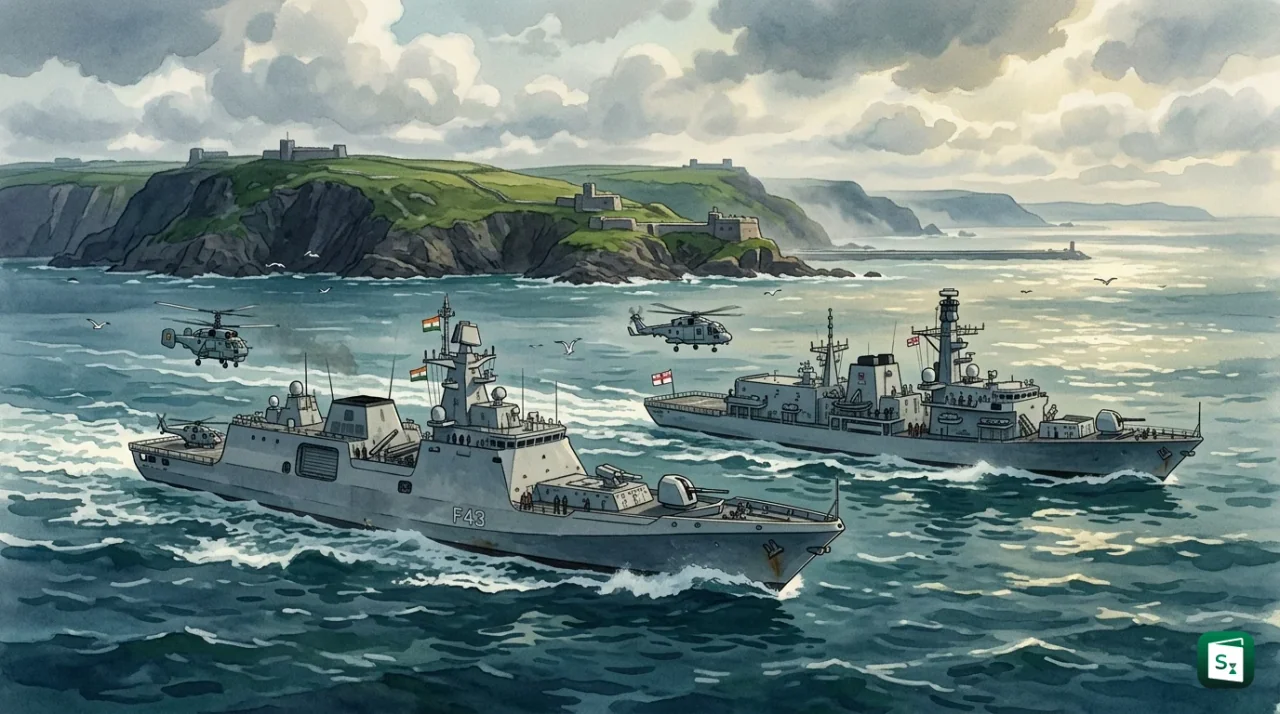
The Indian Navy’s guided missile stealth frigate INS Trishul arrived at Plymouth, United Kingdom, to take part in Exercise KONKAN 2026 with the British Royal Navy. The Indian Navy and the Royal Navy conducted the annual bilateral maritime exercise off Plymouth from 8 to 15 October 2026 with HMS Richmond as the British participant. The edition drills ships and aircraft across air, surface and sub surface warfare to sharpen interoperability under the India UK Vision 2035 partnership.
What Is Exercise KONKAN?
Exercise KONKAN is the annual bilateral maritime exercise between the Indian Navy and the British Royal Navy. The KONKAN exercise focuses on joint operations at sea, sharing of best practices and building the ability of both navies to work together in complex maritime scenarios.
The name KONKAN comes from the Konkan coast, the western coastal region of India facing the Arabian Sea. A bilateral naval exercise is a structured drill conducted by the navies of two countries together, while interoperability is the ability of personnel, ships and aircraft from different navies to understand each others procedures and operate as one team.
The Indian Navy and the Royal Navy institutionalised the KONKAN series in 2004. The two navies host the exercise in rotation, alternately off India and off the United Kingdom. Over more than two decades the scale and complexity have grown steadily, from basic seamanship and communication drills to multi domain warfighting serials involving air, surface and sub surface forces.
KONKAN Exercise Between Which Countries and Started in Which Year?
The KONKAN exercise is conducted between India and the United Kingdom, represented by the Indian Navy and the British Royal Navy. The KONKAN exercise started in 2004 and has since been held every year in rotation off India and the United Kingdom.
This is the most asked factual pairing around the drill. The KONKAN exercise is between India and the UK alone. No third navy participates as a permanent member, though partner assets have joined specific editions. The start year 2004 matters because it places KONKAN among Indias oldest continuous bilateral naval exercises with a European power.
The word Konkan often creates confusion. In this context Konkan does not mean Konkan Railway or the Konkani language. It refers to the coastal plains of Maharashtra, Goa and Karnataka. The Indian Navy names the series after this coastline to underline home waters and maritime heritage.
Recent editions show how the template has expanded:
| Edition | Venue and Dates | Main Participants and Note |
|---|---|---|
| KONKAN 2021 | English Channel, UK waters | INS Tabar with HMS Westminster, last edition in UK waters before 2026 |
| KONKAN 2023 | Off Konkan coast, India | INS Trishul participated off Indias west coast |
| KONKAN 2025 | Off western coast of India, 5 to 12 October 2025 | First combined carrier operation with INS Vikrant and HMS Prince of Wales, with assets from Norway and Japan |
| KONKAN 2026 | Off Plymouth, UK, 8 to 15 October 2026 | INS Trishul with HMS Richmond, frigate level anti submarine and air defence focus |
KONKAN 2026 Off Plymouth: Dates, Harbour Phase and Sea Phase
Exercise KONKAN 2026 was conducted off Plymouth in the United Kingdom from 8 to 15 October 2026. The Ministry of Defence announced on 11 October 2026 that the Indian Navys guided missile stealth frigate INS Trishul had arrived at Plymouth for the drill. Plymouth, home to HMNB Devonport, is the Royal Navys principal base for amphibious and frigate operations in southwest England.
The exercise followed a two phase format that KONKAN has used for many years. The harbour phase builds personal familiarity. The sea phase tests that familiarity under operational pressure.
| Phase | Venue and Period | Activities |
|---|---|---|
| Harbour Phase | Plymouth, first part of 8 to 15 October window | Professional interactions, exercise planning, cross deck visits, sports fixtures, cultural engagements, ship open to visitors |
| Sea Phase | Waters off Plymouth, second part of window | Drills across air, surface and sub surface domains, flying operations with cross deck landings, firing serials, air defence exercises, complex seamanship evolutions, anti submarine exercises |
A cross deck landing means a helicopter from one navy lands on the deck of the other navys ship. A firing serial is a scheduled live or practice gunnery shoot. An air defence exercise tests detection, tracking and engagement of simulated air threats. These serials raise complexity because two crews must use common communication procedures, shared tactical picture and mutually understood safety rules.
INS Trishul reached Plymouth after an extended European deployment. The frigate had taken part in the 24th edition of Exercise Varuna with the French Navy off Toulon in late September 2026, operating with the destroyer Forbin, the frigate La Fayette and the nuclear powered attack submarine Suffren. It then called at Valencia in Spain on 30 September and conducted a passage exercise with the Spanish ship ESPS Reina Sofia on departure on 4 October, covering manoeuvring, cross deck landings, boarding and communication drills. That sequence placed KONKAN 2026 inside a wider Indian Navy outreach to European navies across the Mediterranean and Atlantic.
INS Trishul and the Talwar Class: Indian Participation
INS Trishul is the Indian participant in Exercise KONKAN 2026. The ship is a frontline Talwar class guided missile stealth frigate with pennant number F43. A frigate is a medium sized warship built for escort, patrol and multi role combat, while stealth in this context means shaping of hull and superstructure to reduce radar, infrared, acoustic and electromagnetic signatures.
INS Trishul is the second ship of the original three ship Talwar class programme. The keel was laid on 24 September 1999 and the ship was launched on 24 November 2000 at Baltiysky Zavod in St. Petersburg, Russia. The ship was commissioned into the Indian Navy on 25 June 2003. The name Trishul comes from the Sanskrit word for trident, the three pronged weapon associated with Lord Shiva. The ships crest shows a strong arm rising from the sea holding the trident, which signals power across air, surface and sub surface warfare.
The Talwar class is designated Project 11356 in Russia. The design is a modified Krivak III class tailored to Indian requirements, drawn up by the Severnoye Design Bureau. India ordered the first three ships under a 1997 agreement with Russia to replace ageing Leander class frigates and to hold capability until indigenous designs matured. India now operates eight Talwar class frigates, with two more under construction at Goa Shipyard.
| Feature | INS Trishul and Talwar Class Profile |
|---|---|
| Type | Guided missile stealth frigate, Project 11356 |
| Displacement | About 3,620 tons standard and 4,035 tons full load |
| Dimensions | Length 124.8 metres, beam 15.2 metres |
| Propulsion | Combined gas and gas plant with two DS-71 cruise turbines and two DT-59 boost turbines |
| Speed and Range | About 30 knots maximum, 4,850 nautical miles at 14 knots, endurance 30 days |
| Complement | About 180 personnel, including 18 officers |
| Main Weapons | Eight cell vertical launcher for Klub anti ship cruise missiles with later fit for BrahMos supersonic cruise missiles, Shtil-1 medium range surface to air missiles, 76 mm Super Rapid Gun Mount, AK-630 close in weapon systems, twin 533 mm torpedo tubes, RBU-6000 anti submarine rocket launcher |
| Aircraft | One Ka-28 anti submarine helicopter or Ka-31 airborne early warning helicopter or HAL Dhruv |
| Sensors | Fregat 3D air search radar, Garpun-B surface search radar, HUMSA hull mounted sonar array for underwater detection |
A vertical launching system is a set of deck cells that fire missiles straight up. Close in weapon systems are rapid fire guns that form the last layer of defence against incoming missiles and aircraft. During the Valencia port call, the Commanding Officer of INS Trishul was identified as Captain Charit Kapil.
HMS Richmond and the Type 23 Class: British Participation
HMS Richmond is the British participant in Exercise KONKAN 2026. The ship is a Type 23 anti submarine warfare frigate with pennant number F239. Anti submarine warfare is the task of finding, tracking and neutralising enemy submarines using sonar, helicopters, torpedoes and coordinated ship manoeuvres.
HMS Richmond is the seventh Royal Navy ship to carry the name Richmond, linked to the Dukedom of Richmond. The ship is the tenth of sixteen Type 23 or Duke class frigates. The Duke class is named after British dukes and was first designed during the Cold War to hunt submarines in the North Atlantic. The class later grew into the core of the frontline fleet for counter narcotics, anti piracy, maritime security and carrier escort tasks.
The ship was built by Swan Hunter at Wallsend on the River Tyne. The keel was laid on 16 February 1992. The ship was launched on 6 April 1993 and commissioned on 22 June 1995. The homeport is HMNB Devonport at Plymouth. The ships motto is A Deo et Rege, which means From God and the King.
| Feature | HMS Richmond and Type 23 Profile |
|---|---|
| Type | Duke class Type 23 frigate, anti submarine variant |
| Displacement | About 4,900 tons |
| Dimensions | Length 133 metres, beam 16.1 metres, draught 7.3 metres |
| Propulsion | CODLAG, which means combined diesel electric and gas, with diesel generators, electric motors and Rolls Royce Spey gas turbines |
| Speed and Range | More than 28 knots, range 7,500 nautical miles at 15 knots |
| Complement | About 185 personnel, with accommodation for up to 205 |
| Main Weapons | 32 cell Sea Ceptor vertical launcher for air defence missiles with range beyond 25 km, Naval Strike Missiles for anti ship strike, twin Sting Ray torpedo tubes, 4.5 inch Mk 8 naval gun, 30 mm guns |
| Aircraft | One Wildcat HMA2 or Merlin HM2 helicopter with torpedoes, anti ship missiles and dipping sonar |
| Sensors | Artisan 3D radar for air and surface search, bow sonar and towed array Sonar 2087 for long range submarine detection |
The Type 23 frigates are being replaced in Royal Navy service by the Type 26 City class and the Type 31 Inspiration class. For KONKAN 2026, the pairing of a Talwar class stealth frigate with a Type 23 anti submarine frigate placed underwater detection, helicopter cross deck operations and air defence at the centre of the sea phase.
India UK Naval Cooperation and Vision 2035 Context
The Indian Navy describes Exercise KONKAN 2026 as a reaffirmation of the shared commitment to secure, open and free seas. The exercise sits inside the Comprehensive Strategic Partnership between India and the United Kingdom and the India UK Vision 2035 roadmap. The two prime ministers endorsed Vision 2035 in London on 24 July 2025. The document sets goals to 2035 for trade, technology, education, climate and defence.
Defence is a central pillar of that roadmap. India and the United Kingdom adopted a 10 year Defence Industrial Roadmap with a senior official mechanism to track progress. The plan supports co design, co development and co production of weapons and systems. Two flagship technology programmes are the Electric Propulsion Capability Partnership for warship propulsion, which uses electric drive for fuel efficiency, quiet running and power for future sensors, and the Jet Engine Advanced Core Technologies programme for aero engine cooperation. The roadmap also upgrades the foreign and defence 2+2 dialogue, expands joint exercises and training across all three services, posts instructors in each others training institutions and treats India as a regional hub for logistics support to British forces in the Indian Ocean Region.
KONKAN serves the operational side of that partnership. Regular drills improve common procedures for communication, manoeuvring, air control and submarine prosecution. This matters because modern naval tasks need precise coordination. A combined anti submarine hunt, for example, may join a frigate, a helicopter with dipping sonar and a maritime patrol aircraft on one tactical net. KONKAN 2025 showed the high end of this logic when carrier groups led by INS Vikrant and HMS Prince of Wales operated together for the first time, with F-35B and MiG-29K flying serials and a joint submarine hunt. KONKAN 2026 applies the same logic at frigate level, with focus on gunnery, air defence, seamanship and anti submarine serials.
The drill also fits a wider web of Indian Navy exercises with other countries. The Indian Navy conducts Exercise Varuna with France, Exercise Malabar with the United States, Japan and Australia under the Quad framework, Exercise Milan as a multilateral naval gathering hosted by India, and passage exercises with navies in the Mediterranean, Atlantic and Indian Ocean. Cooperation with the United Kingdom extends beyond KONKAN to army exercise Ajeya Warrior and expanding air and industrial links. The proposed Regional Maritime Security Centre of Excellence under the Indo Pacific Oceans Initiative adds a capacity building layer on piracy, trafficking and other non traditional threats.
For both sides, the gain is practical. The Indian Navy sustains presence and professional exposure in European waters. The Royal Navy sustains engagement in the Indo Pacific construct and in Indian Ocean security. The exchange of best practices during harbour and sea phases helps both fleets operate seamlessly in complex scenarios, from humanitarian assistance to high intensity maritime security.
Key Takeaways
- Exercise KONKAN is the annual bilateral maritime exercise between India and the United Kingdom, started in 2004 and named after the Konkan coast.
- KONKAN 2026 was held off Plymouth, UK, from 8 to 15 October 2026 in harbour and sea phases across air, surface and sub surface domains.
- Indian participant INS Trishul (F43) is a Talwar class guided missile stealth frigate commissioned on 25 June 2003 at St. Petersburg.
- British participant HMS Richmond (F239) is a Type 23 Duke class anti submarine warfare frigate commissioned on 22 June 1995 and based at HMNB Devonport.
- KONKAN 2025 saw the first combined carrier operation with INS Vikrant and HMS Prince of Wales off Indias western coast from 5 to 12 October 2025.
- The exercise supports the India UK Vision 2035 endorsed on 24 July 2025, including a 10 year Defence Industrial Roadmap and secure, open and free seas.