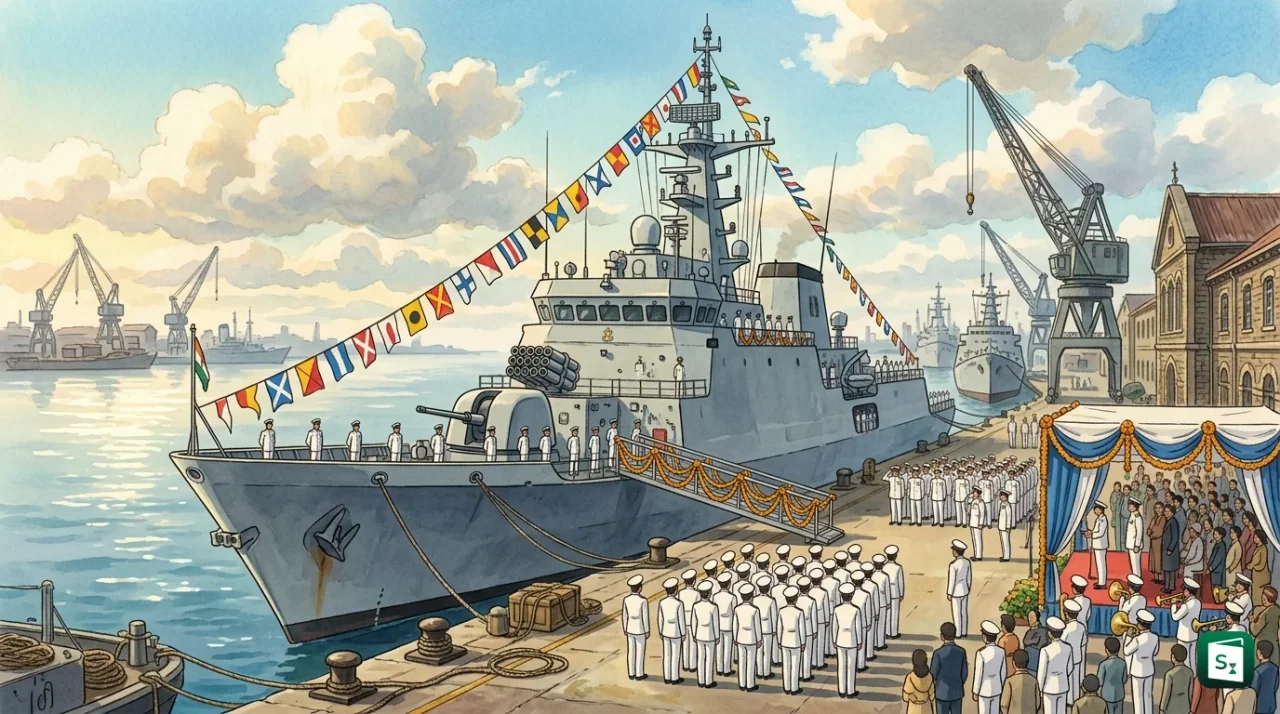
The Indian Navy commissioned INS Mangrol on 12 October 2026 at the Naval Dockyard in Mumbai, strengthening its ability to hunt submarines close to the coast. The ship is the third Mahe class Anti-Submarine Warfare Shallow Water Craft (ASW SWC), built by Cochin Shipyard Ltd (CSL) in Kochi with more than 80 percent indigenous content. The ceremony was presided over by Vice Admiral Sanjay Vatsayan, Flag Officer Commanding-in-Chief of the Western Naval Command.
What Is an Anti Submarine Warfare Shallow Water Craft?
The Anti Submarine Warfare Shallow Water Craft (ASW SWC) is a small, fast warship designed to find and destroy enemy submarines in coastal waters. ASW means anti submarine warfare, which is the task of detecting, tracking and neutralising submarines. SWC stands for Shallow Water Craft, which means a vessel built to operate safely where the sea is not deep, such as near ports, harbours and narrow channels.
Large destroyers and frigates are powerful in the open ocean but face limits in crowded, shallow zones. Their size, draft and noise make hunting difficult close to shore. The ASW SWC fills this gap. It works close to the coast, guards entry routes to harbours and operates together with maritime patrol aircraft, helicopters and larger warships to build a layered underwater defence.
Commissioning at Naval Dockyard Mumbai
The Naval Dockyard in Mumbai is the Indian Navy’s primary refit and commissioning base on the west coast, functioning under the Western Naval Command headquartered in Mumbai. INS Mangrol was commissioned there on 12 October 2026, with senior Navy officers, Ministry of Defence officials, shipyard teams and equipment makers present.
Vice Admiral Sanjay Vatsayan reviewed the commissioning parade and stressed the need for home built warships in a changing maritime security environment. He noted that the Navy had commissioned 10 ships in 2026, with more inductions expected before the year ends, and pointed to 42 ships under construction at Indian yards. The Commanding Officer of INS Mangrol highlighted the rise in submarine deployments by foreign navies in the Indian Ocean Region and said the ship will strengthen near shore underwater defence.
INS Mangrol was delivered to the Navy by Cochin Shipyard on 21 August 2026, after launch on 30 November 2023 and keel laying on 21 February 2023. The gap between delivery and commissioning covers final trials, crew work up and formal acceptance into naval service.
Design, Weapons and Sensors on Board
INS Mangrol is about 78 metres long, with a beam of 11.26 metres and a shallow draft of only 2.7 metres. The ship displaces roughly 896 to 1,100 tonnes, reaches a top speed of 25 knots and has a range of about 1,800 nautical miles at a cruising speed of 14 knots. It can stay at sea for 14 days and carries a crew of 57 personnel, including 7 officers and 50 sailors.
Three diesel engines linked to waterjets drive the ship. Waterjet propulsion pushes water out at high speed to move the vessel, which gives sharp manoeuvrability in tight waters and keeps underwater noise low. Low noise matters because a quieter ship is harder for an enemy submarine to detect. The Mahe class ships are among the largest Indian naval vessels to use a diesel engine and waterjet combination and are built to Det Norske Veritas classification standards for safety and quality.
For hunting submarines, the ship carries the Abhay hull mounted sonar, a compact active sonar developed by the Naval Physical and Oceanographic Laboratory (NPOL) of the Defence Research and Development Organisation (DRDO) and made by Bharat Electronics Ltd (BEL). A hull mounted sonar sits on the ship’s hull and sends sound pulses into the water to locate hidden objects. Mangrol also carries a low frequency variable depth sonar, which can be lowered to different depths to listen over longer distances.
Its weapons include lightweight torpedoes fired from two triple launchers, an indigenous anti submarine rocket launcher and mine laying rails for laying anti submarine mines on the sea bed. For self protection it has a 30 mm naval surface gun and two 12.7 mm stabilised remote controlled guns. The Mareech Advanced Torpedo Decoy System helps the ship mislead incoming torpedoes. Beyond submarine hunting, the vessel can handle underwater surveillance, low intensity maritime operations and mine related tasks.
Mahe Class and the 16 Ship ASW SWC Project
The ASW SWC project covers 16 ships in total. Cochin Shipyard Ltd (CSL) in Kochi is building eight ships of the Mahe class for the Western Fleet, while Garden Reach Shipbuilders and Engineers (GRSE) in Kolkata is building eight ships of the Arnala class for the Eastern Fleet. CSL was established in 1972 and is headquartered in Kochi, Kerala. GRSE, founded in 1884 as a private unit and later taken over by the government in 1960, is based in Kolkata.
The programme began when the Defence Acquisition Council approved 16 shallow water anti submarine vessels in December 2013 at a cost of about ₹13,440 crore, to replace the ageing Abhay class corvettes commissioned between 1989 and 1991. Contracts for eight ships each were signed with CSL and GRSE on 30 April 2019. CSL’s order was valued at about ₹6,311 crore. Keel laying, which marks the formal start of hull construction, began at CSL on 1 December 2020.
INS Mangrol is the third Mahe class ship to join service, after INS Mahe commissioned on 24 November 2025 at Mumbai and INS Malvan commissioned on 22 July 2026 at Karwar. The remaining Mahe class ships are named Malpe, Mulki, Magdala and Machilipatnam, with one more hull under construction.
INS Mahe and INS Malvan: Which Class Do They Belong To?
INS Mahe belongs to the Mahe class, while INS Malvan also belongs to the Mahe class. Both are Cochin Shipyard built Anti-Submarine Warfare Shallow Water Craft for the Western Fleet, sharing the same shallow water design as INS Mangrol today.
INS Mahe is the lead ship of the class and was commissioned at Naval Dockyard Mumbai on 24 November 2025. INS Malvan is the second ship and was commissioned at Karwar Naval Base on 22 July 2026. Both carry the Abhay sonar fit and waterjet propulsion seen on INS Mangrol.
Mahe Class Versus Arnala Class
The two sub classes share the same mission but have separate designs and build lines. The Mahe class is built by CSL in Kochi and serves the western seaboard. The Arnala class is built by GRSE with support from Larsen and Toubro’s Kattupalli yard and serves the eastern seaboard. Both have more than 80 percent indigenous content and similar top speed, range and crew size, with only minor design differences in dimensions and fittings.
| Feature | Mahe Class (CSL) | Arnala Class (GRSE) |
|---|---|---|
| Builder | Cochin Shipyard Ltd, Kochi | Garden Reach Shipbuilders and Engineers, Kolkata |
| Fleet | Western Fleet | Eastern Fleet |
| Lead ship | INS Mahe (P80) | INS Arnala (P68) |
| Ships in series | Mahe, Malvan, Mangrol, Malpe, Mulki, Magdala, Machilipatnam and one more | Arnala, Androth, Anjadip, Amini, Abhay, Agray, Ajay, Akshay |
| First commissioning | 24 November 2025 | 18 June 2025 |
| Length and displacement | About 78 metres, 896 to 1,100 tonnes | About 77.6 metres, about 900 tonnes |
The Arnala class lead ship INS Arnala was commissioned on 18 June 2025 at Visakhapatnam, followed by INS Androth on 6 October 2025. Together, the two classes will give the Navy 16 dedicated coastal submarine hunters once deliveries finish around 2028.
Why INS Mangrol Matters for Coastal Security
India has a coastline of about 7,516 km, with 12 major ports, 184 minor ports and 1,197 islands. Ports, offshore oil assets and sea trade routes sit close to shore, where small diesel electric submarines can hide easily in noisy, shallow water. A dedicated shallow water hunter can patrol these crowded zones, screen harbour approaches and free larger destroyers and frigates for open ocean tasks.
Mangrol’s name continues a naval tradition. It is named after Mangrol, a coastal town and fishing harbour in Junagadh district of Gujarat, and carries forward the legacy of the earlier INS Mangrol (M85), a minesweeper that served until April 2004. With over 80 percent home made parts from Bharat Electronics, Larsen and Toubro Defence, Mahindra Defence Systems and more than 20 Indian MSMEs, the ship also supports the Make in India push for self reliance in warship building.
Key Takeaways
- INS Mangrol was commissioned on 12 October 2026 at Naval Dockyard Mumbai as the third Mahe class ASW SWC.
- The ship was built by Cochin Shipyard Ltd with more than 80 percent indigenous content, including the Abhay hull mounted sonar developed by DRDO.
- The 16 ship ASW SWC project splits eight Mahe class ships to CSL and eight Arnala class ships to GRSE under contracts signed on 30 April 2019.
- INS Mahe and INS Malvan both belong to the Mahe class, commissioned in November 2025 and July 2026 respectively.
- The Defence Acquisition Council approved the programme in December 2013 to replace Abhay class corvettes commissioned between 1989 and 1991.
- INS Mangrol displaces 896 to 1,100 tonnes, sails at 25 knots and carries lightweight torpedoes, an anti submarine rocket launcher and the Mareech decoy system.