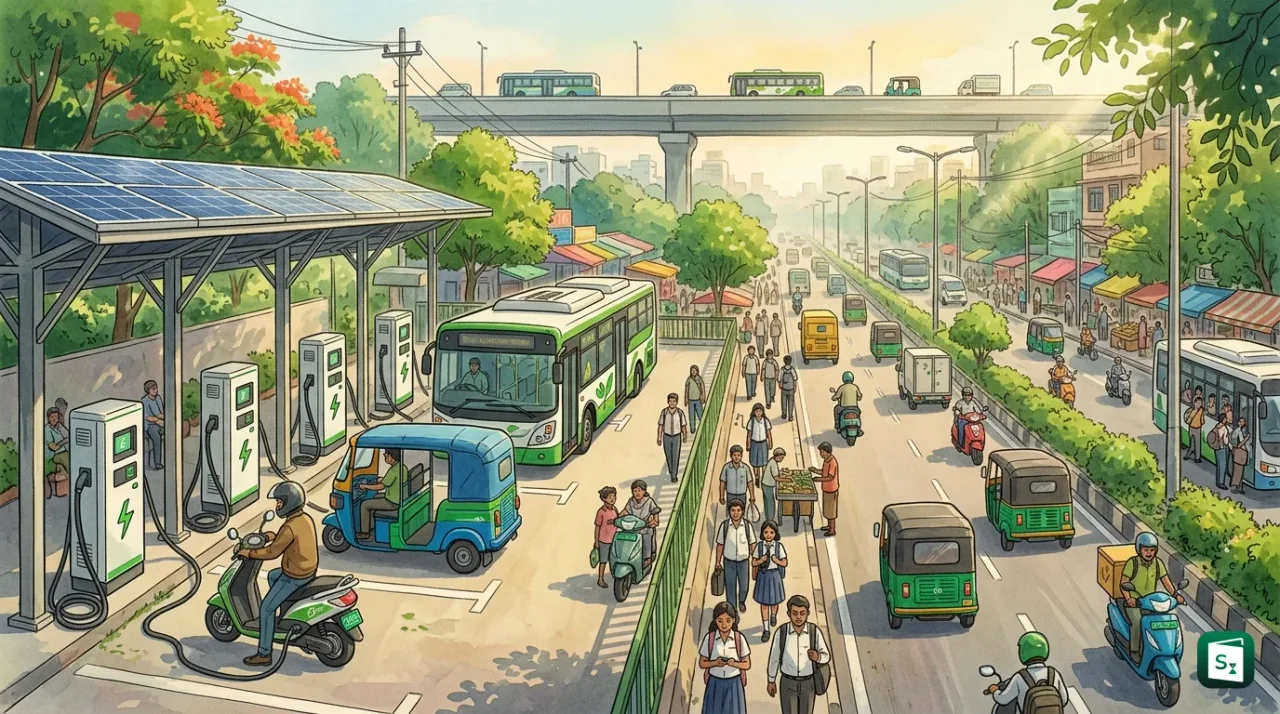
The PM Electric Drive Revolution in Innovative Vehicle Enhancement (PM E-DRIVE) scheme has completed two years of implementation with 26.59 lakh electric vehicles sold as of June 2026. The Ministry of Heavy Industries launched the scheme in September 2024 for an initial period of two years and has now extended it till 31 March 2028 with the total outlay raised to ₹11,900 crore. The extension gives more time for e-buses, e-trucks, charging stations and testing facilities while demand support for small electric two and three wheelers moves towards fixed closing dates.
What Is PM E-DRIVE Scheme and Which Ministry Implements It?
The PM E-DRIVE scheme is a central sector initiative of the Ministry of Heavy Industries to speed up electric vehicle adoption in India. It gives upfront purchase incentives for e-two wheelers, e-three wheelers, e-trucks, e-ambulances and e-buses. It also funds charging stations and testing labs.
PM E-DRIVE stands for PM Electric Drive Revolution in Innovative Vehicle Enhancement. The Ministry of Heavy Industries (MHI) is the nodal ministry for implementation. A central sector scheme means the Union government funds it fully. It is implemented on a pan India basis.
The scheme has three clear goals. It promotes faster purchase of electric vehicles. It creates public charging infrastructure. It builds a domestic EV manufacturing ecosystem. Only vehicles fitted with advanced batteries qualify. Advanced batteries here mean modern lithium ion type chemistries that give longer range and life. This rule pushes makers toward better technology.
Scheme Launch, Duration and Extension Till March 2028
The Union Cabinet approved PM E-DRIVE on 11 September 2024 with an outlay of ₹10,900 crore for two years. The Ministry of Heavy Industries notified the scheme on 29 September 2024 through Gazette notification S.O. 4259(E). The scheme started from 1 October 2024 at Bharat Mandapam in New Delhi. The Electric Mobility Promotion Scheme 2024 (EMPS-2024), which ran from 1 April 2024 to 30 September 2024, was merged into it. So the effective period for accounting support starts from 1 April 2024.
The scheme was first meant to close on 31 March 2026. The Ministry of Heavy Industries extended its tenure by two years on 8 August 2025. The scheme will now run till 31 March 2028 within the sanctioned funds. Later amendments in March and August 2026 raised the total outlay to ₹11,900 crore to support larger volumes, especially electric two wheelers. The number of supported electric two wheelers rose from 24.79 lakh to 45.79 lakh units.
This is a fund limited scheme. If money under any part runs out before 31 March 2028, that part closes early. No payments will be made after 31 March 2028. The last date for makers to submit claims is 31 December 2027.
Subsidy Framework and Vehicles Covered
The PM E-DRIVE scheme supports around 28.30 lakh electric vehicles across many categories. It has reached 26.59 lakh sales as of June 2026. State wise quota has not been fixed for demand incentives. So pan India data is tracked without state allocation.
Subsidy under the scheme means a direct price cut given at the time of purchase. The dealer reduces the price. The maker later claims the amount from the government. The benefit applies mainly to vehicles used for public transport or commercial registration. Private or company owned registered electric two wheelers are also eligible.
How the Incentive Is Calculated
The demand incentive for electric two and three wheelers is linked to battery size. Battery size is measured in kilowatt hour (kWh). Kilowatt hour indicates how much energy the battery can store. The incentive is paid per kWh and capped at a fixed amount per vehicle. It is also limited to 15 percent of the factory price.
| Vehicle Type | FY 2024-25 Rate | Later Period Rate |
|---|---|---|
| Electric two wheelers (e-2W) | ₹5,000 per kWh, capped at ₹10,000 per vehicle | ₹2,500 per kWh, capped at ₹5,000 per vehicle |
| E-rickshaws and e-carts | ₹5,000 per kWh, capped at ₹25,000 per vehicle | ₹2,500 per kWh, capped at ₹12,500 per vehicle |
| Electric three wheelers, L5 category | ₹5,000 per kWh, capped at ₹50,000 per vehicle till 7 November 2024 | ₹2,500 per kWh, capped at ₹25,000 per vehicle |
The maximum factory price to qualify is ₹1.5 lakh for electric two wheelers and ₹2.5 lakh for e-rickshaws and e-carts. This keeps the support focused on affordable models.
Subsidy for Electric Two Wheelers and Last Date
The two wheeler subsidy moves in two phases. For FY 2024-25, buyers got ₹5,000 per kWh up to ₹10,000. From 1 April 2025 onward, the rate is ₹2,500 per kWh up to ₹5,000. As of July 2026, more than 20.56 lakh electric two wheelers have been incentivised with reimbursement of about ₹1,505.30 crore to makers.
The terminal date for registered electric two wheelers was fixed as 31 July 2026 in the March 2026 amendment. The August 2026 amendment extended the support window for electric two wheelers till 31 March 2028 with higher volume coverage. Buyers should check the live status on the PM E-DRIVE portal as fund limits can close a segment early.
E-rickshaws, E-carts, E-ambulances and E-trucks
For L5 category three wheelers, which are larger auto rickshaws used for goods and passengers, the three wheeler L5 window closed on 26 December 2025 after achieving its target. Around 2.60 lakh L5 vehicles received about ₹769.02 crore in support. Support for e-rickshaws and e-carts continues longer.
Electric ambulances get ₹30,000 per kWh capped at 35 percent of the factory price. Eligible types follow AIS 125 safety norms and include patient transport, basic life support and advanced life support ambulances. The scheme has set aside ₹500 crore for 3,811 e-ambulances. The standards are fixed in consultation with the Ministry of Health and Family Welfare and the Ministry of Road Transport and Highways.
Electric trucks get ₹5,000 per kWh capped at 10 percent of the factory price. The scheme has set aside ₹500 crore for 5,643 e-trucks. Buyers need a scrapping certificate from a registered vehicle scrapping facility. This links new truck sales to removal of old polluting trucks. Only 55 e-trucks had been supported by July 2026. The market is still at an early stage.
E-buses, Charging Stations and Testing Labs
Electric buses get the largest share of funds. The scheme allocates ₹4,391 crore for 14,028 e-buses. The incentive is ₹10,000 per kWh capped at 20 percent of bus cost found through bidding. The cap is ₹35 lakh for standard buses of 10 to 12 metre length, ₹25 lakh for midi buses of 8 to 10 metres and ₹20 lakh for mini buses of 6 to 8 metres.
Convergence Energy Services Limited (CESL) collects demand and conducts bidding. CESL is a central public sector company under the Ministry of Power that aggregates electric bus orders. Support is given only on operating cost or gross cost contract model through state and city transport bodies. By August 2026, 14,000 e-buses were allocated and quantity confirmation was issued for 13,800 buses. Surat and Hyderabad signed concession pacts for 600 and 915 buses.
Charging infrastructure has ₹2,000 crore for public chargers. The plan includes 22,100 fast chargers for electric four wheelers, 1,800 for e-buses and 48,400 for electric two and three wheelers. Sites are chosen in cities with high EV use and along selected highways. By 1 July 2026, ₹689 crore was approved for 6,562 chargers to three oil marketing companies and nine states. Karnataka, Delhi, Rajasthan, Uttar Pradesh and Andhra Pradesh form a large share of approved sites.
Testing agency upgrade has ₹780 crore. Labs under the Ministry of Heavy Industries will get new equipment to check new battery, safety and charging technologies.
How to Apply for PM E-DRIVE Subsidy, Portal Login and Status Check?
The Ministry of Heavy Industries runs the scheme through the PM E-DRIVE portal (pmedrive.heavyindustries.gov.in). The portal carries the dashboard, dealer login, maker login and vehicle eligibility lists. Buyers do not apply directly on the portal for the price cut. The subsidy is adjusted in the bill at the dealer.
The government uses an e-voucher system to confirm genuine buyers. At the time of purchase, the dealer completes Aadhaar based face verification of the customer through the PM E-DRIVE app. The portal then creates an electronic voucher and sends a download link to the registered mobile number. The buyer signs it. The dealer signs and uploads it on the portal. The maker needs this signed voucher to claim reimbursement.
To check the subsidy status, buyers can use the download link sent by SMS or ask the dealer for the customer ID. The dashboard shows vehicles supported, incentives reimbursed and charger sanctions. Detailed steps for registration, voucher download and verification are listed under the portal help section. For complaints, the portal lists a helpline and customer care contact.
PM E-DRIVE Versus FAME India Scheme
PM E-DRIVE is the successor of the Faster Adoption and Manufacturing of Electric Vehicles (FAME) India scheme. FAME Phase II ran from 1 April 2019 to 31 March 2024 with an outlay of ₹11,500 crore. It supported about 16.71 lakh electric vehicles, 5,297 e-buses and 9,583 charging stations.
PM E-DRIVE builds on that base with a bigger target of around 28.30 lakh vehicles in a shorter period. Per vehicle support is lower because the same level of funds must cover more units. For example, FAME gave higher per unit aid. PM E-DRIVE gives ₹2,500 per kWh for electric two wheelers after the first year.
The focus has also shifted. FAME Phase II covered electric four wheelers for commercial use. PM E-DRIVE stops demand aid for electric cars and instead funds 22,100 fast chargers for four wheelers. It adds e-ambulances and e-trucks for the first time. It doubles attention to buses, chargers and local manufacturing.
Local manufacturing runs through the Phased Manufacturing Programme (PMP). Phased Manufacturing Programme means makers must gradually use more parts made in India to qualify for aid. Makers need certificates of compliance from MHI testing agencies. For chargers, at least 50 percent domestic value addition is needed.
EV penetration in India rose from 0.7 percent in FY 2019-20 to 8.2 percent in FY 2025-26. FAME II, PM E-DRIVE and state policies together supported this rise. This matters for air quality, fuel imports and the goal of net zero emissions by 2070.
Key Takeaways
- The full form of PM E-DRIVE is PM Electric Drive Revolution in Innovative Vehicle Enhancement, implemented by the Ministry of Heavy Industries.
- PM E-DRIVE was notified on 29 September 2024 with an initial outlay of ₹10,900 crore, later raised to ₹11,900 crore.
- The scheme was extended from 31 March 2026 to 31 March 2028 to complete e-bus, e-truck, charger and testing lab work.
- 26.59 lakh electric vehicles were sold under PM E-DRIVE as of June 2026 against a target of about 28.30 lakh vehicles.
- Electric two wheelers get ₹2,500 per kWh capped at ₹5,000 per vehicle from 1 April 2025, with support linked to the PM E-DRIVE portal e-voucher system.