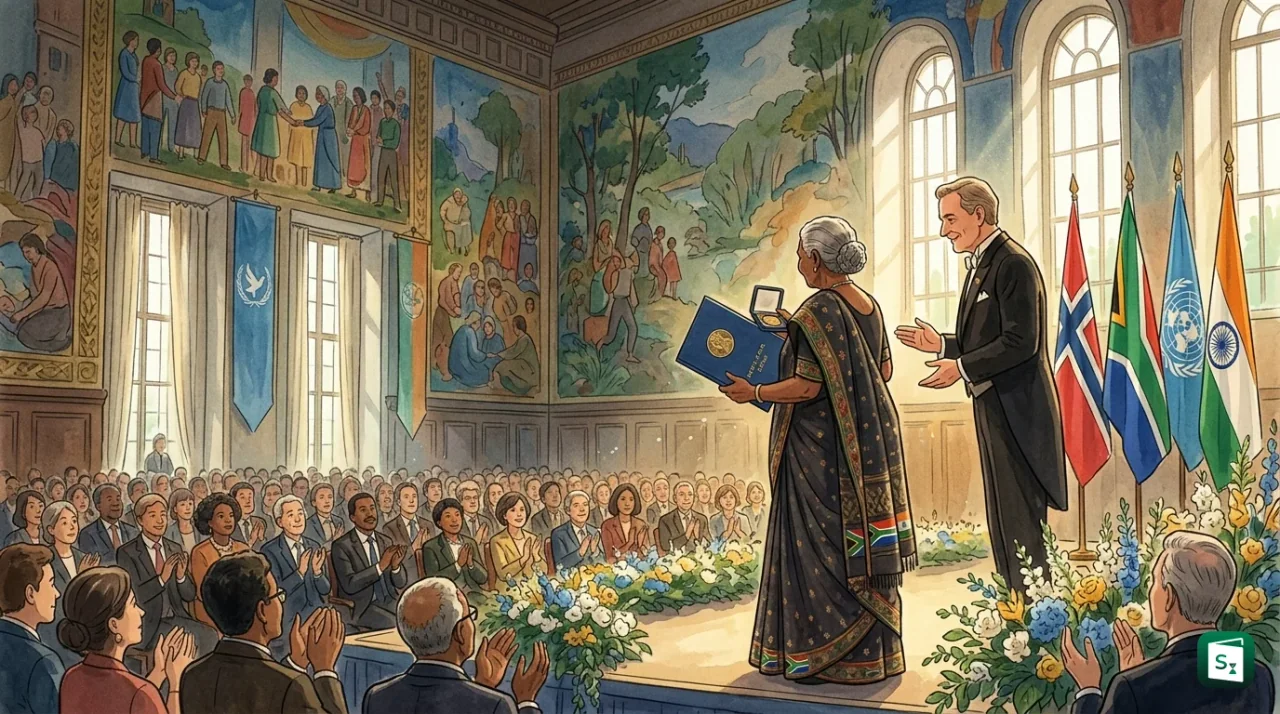
The Norwegian Nobel Committee awarded the Nobel Peace Prize 2026 to Navanethem “Navi” Pillay on 9 October 2026 in Oslo for her efforts to promote peace and international law. The 85 year old South African jurist of Indian Tamil origin was honoured for building a stronger global legal order that punishes war crimes, crimes against humanity and genocide. The award will be presented in Oslo on 10 December 2026, along with prize money of SEK 12 million.
What Is the Nobel Prize?
The Nobel Prize is a set of international awards given each year to people who have conferred the greatest benefit to humankind. Swedish inventor and industrialist Alfred Nobel, best known for inventing dynamite, created the prizes through his will signed in Paris on 27 November 1895. The first prizes were awarded in 1901, and they have been awarded almost every year since then, with gaps mainly during the two World Wars.
Nobel originally created five prizes for Physics, Chemistry, Physiology or Medicine, Literature and Peace. In 1968, Sweden’s central bank, Sveriges Riksbank, added a sixth prize in Economic Sciences in memory of Alfred Nobel, first awarded in 1969. Each person who receives a prize is called a Nobel laureate, a term that simply means a person honoured with the prize.
The Peace Prize is different from the other five. While Swedish institutions in Stockholm select the science, literature and economics winners, the Peace Prize is selected by a five member Norwegian Nobel Committee elected by the Norwegian Parliament, the Storting. By Nobel’s wish, the Peace Prize is presented in Oslo, while all other prizes are presented in Stockholm. The Peace Prize can also be given to organisations, while the other prizes go only to individuals, with a maximum of three persons sharing one prize.
Who Won the Nobel Peace Prize 2026?
The Norwegian Nobel Committee announced on 9 October 2026 that the 2026 Peace Prize goes to Navanethem “Navi” Pillay for her efforts to promote peace and international law. The Committee, chaired by Jorgen Watne Frydnes, described her as one of the most respected international jurists of our time. It said she had shown exceptional courage and integrity in building a more complete global legal order.
The Committee noted that Pillay was instrumental in ensuring that war crimes, crimes against humanity and genocide are actually prosecuted. At a time when wars are rising and international courts face political pressure, the Committee said the choice was a reminder that peace depends on the international rule of law, not the use of force.
The 2026 award is the 125th Nobel Peace Prize since the first award in 1901. The Norwegian Nobel Committee considered 287 candidates for 2026, including 208 individuals and 79 organisations. Pillay received the full prize share of 1/1. She learnt about the win while attending a conference in Courtroom 600 of the Nuremberg Palace of Justice, the historic hall where the post war trials took place, and received a standing ovation there.
Navi Pillay: From Apartheid South Africa to Global Justice
Navanethem Pillay was born on 23 September 1941 in Clairwood, Durban, in what was then Natal Province of South Africa. She belongs to a family of Indian Tamil descent. Her grandparents travelled from India in the 1890s as indentured labourers to work on sugar plantations in Natal. Her father was a bus driver and her mother was a homemaker, and Pillay was the fifth of eight children.
Pillay studied at the University of Natal, earning a BA in 1963 and an LLB in 1965. She later earned a Master of Law in 1982 and a Doctor of Juridical Science in 1988 from Harvard Law School, becoming the first South African to earn a law doctorate from Harvard. In 1967, she became the first woman to open a law practice in Natal province. For nearly three decades she defended anti apartheid activists, exposed the use of torture in detention, and in 1973 secured legal representation for political prisoners on Robben Island.
After apartheid ended in 1994, President Nelson Mandela nominated her as an acting judge of the High Court of South Africa in 1995, making her the first non white woman on that court. The same year, the United Nations General Assembly elected her as a judge of the International Criminal Tribunal for Rwanda (ICTR), where she served for eight years, including as President from 1999 to 2003. She was the only woman judge on the tribunal during its first four years.
Her work on the Rwanda tribunal changed international law. In the landmark Akayesu case, the tribunal held for the first time that rape and sexual violence could constitute acts of genocide. In the separate Media case, it held that hate propaganda spread through radio and print could amount to incitement to genocide. She then served as a judge in the Appeals Chamber of the International Criminal Court (ICC) in The Hague from 2003 to 2008.
From 2008 to 2014, Pillay served as the United Nations High Commissioner for Human Rights, the fifth person to hold the post and the voice of victims across the world. From 2021 to 2025, she chaired the UN Independent International Commission of Inquiry on the Occupied Palestinian Territory. She also co founded the global women’s rights organisation Equality Now in 1985 and helped include the equality clause banning discrimination on grounds of race, gender, religion and sexual orientation in South Africa’s post apartheid Constitution. Since 2019 she has served as an ad hoc judge of the International Court of Justice (ICJ) in the case where Myanmar faces charges of genocide against the Rohingya.
How Nobel Peace Prize Winners Are Selected
Nobel laureates are never allowed to nominate themselves. Each year in September, invitations to nominate go to thousands of qualified people, including academics, former laureates, parliamentarians and government ministers. For the Peace Prize, nominations close on 31 January of the award year. Names of nominees stay sealed for 50 years.
The five member Norwegian Nobel Committee then studies the nominations with help from experts and permanent advisers at the Norwegian Nobel Institute in Oslo. The Committee meets in the Institute building, and its chair announces the winner, usually on a Friday in early October. The chair of the 2026 Committee is Jorgen Watne Frydnes, with Asle Toje as vice chair. The other members are Anne Enger, Kristin Clemet and Gry Larsen.
The winner receives three things on Nobel Day, 10 December, the anniversary of Alfred Nobel’s death. These are a gold medal made of 18 carat recycled gold, a unique hand crafted diploma, and a document confirming the prize money. The Peace Prize ceremony takes place at Oslo City Hall, and the Committee chair hands over the prize. Winners usually deliver a Nobel Lecture around the ceremony.
Nobel Prize Money in 2026
The Nobel Foundation raised the 2026 prize amount to SEK 12 million per full prize, an increase of SEK 1 million over 2025. At prevailing exchange rates in early October 2026, this equals about $1.2 million and roughly ₹11.5 crore. Since Pillay won the full prize alone, she receives the entire amount. If a prize is shared, the money is split equally or in defined shares among up to three winners.
Nobel Peace Prize Winners: India Context and 2025 Winner
Pillay’s Indian Tamil roots have drawn special attention in India, though she is a South African national and laureate. India’s direct Peace Prize record remains narrow. Mother Teresa won in 1979 for service to the poor and destitute through the Missionaries of Charity. Kailash Satyarthi shared the prize in 2014 with Malala Yousafzai for the struggle against child labour and for the right of children to education. The 14th Dalai Lama, who lives in exile in India, won in 1989 for non violent efforts for Tibet.
The 2025 Peace Prize provides the immediate baseline for 2026. In October 2025, the Committee awarded the prize to Venezuela’s Maria Corina Machado for her work for democratic rights and a peaceful transition from dictatorship to democracy in Venezuela. That prize carried SEK 11 million.
By 2025, the Peace Prize had been awarded 105 times to a mix of individuals and organisations. Women remain a small share of winners. Before 2026, only 19 women had won the Peace Prize against 92 men, which makes Pillay’s win part of the growing but still short list of women Nobel Peace Prize winners.
| Year | Winner | Citation in brief |
|---|---|---|
| 1979 | Mother Teresa | Service to the poor and sick through Missionaries of Charity |
| 1989 | 14th Dalai Lama (in exile in India) | Non violent struggle for Tibet |
| 2014 | Kailash Satyarthi (shared with Malala Yousafzai) | Fight against child labour and for child education |
| 2025 | Maria Corina Machado | Democratic rights and peaceful transition in Venezuela |
| 2026 | Navanethem Navi Pillay | Efforts to promote peace and international law |
Key Takeaways
- Navanethem Navi Pillay won the Nobel Peace Prize 2026 for her efforts to promote peace and international law.
- The prize was announced on 9 October 2026 by the Norwegian Nobel Committee and will be presented in Oslo on 10 December 2026.
- Pillay became the first woman to open a law practice in Natal province in 1967 and later the first non white woman judge of South Africa’s High Court in 1995.
- She served as President of the Rwanda Tribunal (1999 to 2003), judge of the ICC (2003 to 2008), and UN High Commissioner for Human Rights (2008 to 2014).
- The 2026 prize money is SEK 12 million, roughly ₹11.5 crore, awarded in full to Pillay.
- The Peace Prize is selected by a five member committee elected by Norway’s Parliament and presented in Oslo, while other Nobel Prizes are presented in Stockholm.