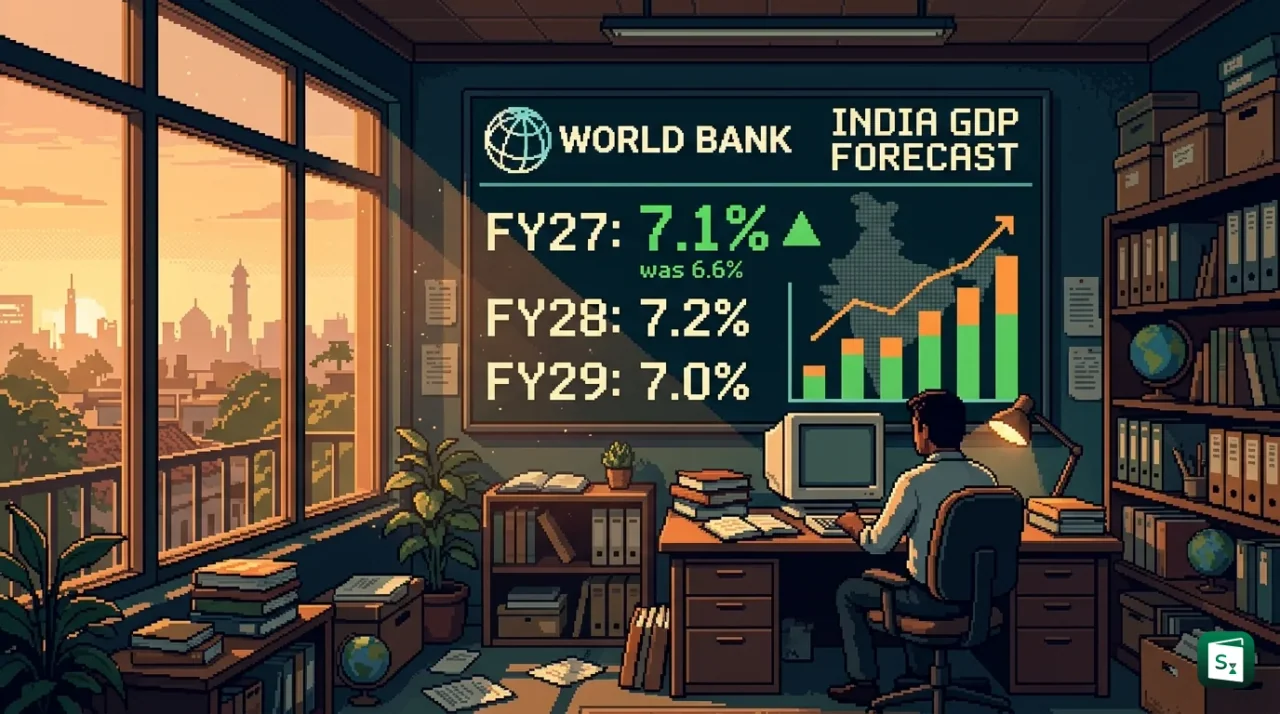
The World Bank raised its GDP growth forecast for India for FY27 to 7.1 percent from 6.6 percent in its October 2026 India Development Update. The upgrade follows stronger than expected growth of 7.8 percent in the April to June quarter of FY27. The World Bank also projected growth at 7.2 percent for FY28 and 7 percent for FY29 as energy pressures ease.
What Is the Latest World Bank Forecast for India?
The World Bank expects India to grow at 7.1 percent in FY27, which covers April 2026 to March 2027. This is a rise of 0.5 percentage point from the 6.6 percent forecast made in April 2026. The World Bank kept its FY28 forecast at 7.2 percent and placed FY29 growth at 7 percent, close to the medium term potential of the economy.
| Fiscal Year | Latest Projection | Earlier Projection |
|---|---|---|
| FY27 (2026 to 27) | 7.1 percent | 6.6 percent in April 2026 |
| FY28 (2027 to 28) | 7.2 percent | 7.2 percent, unchanged |
| FY29 (2028 to 29) | 7 percent | New projection in October 2026 |
The World Bank said growth will slow in the second half of FY27 after the strong first quarter, then pick up again in FY28. The FY28 and FY29 path assumes that energy supply linked to the West Asia conflict returns to pre conflict conditions in early 2027. The World Bank also projected South Asia to grow at 6.9 percent in 2026 and 6.7 percent in 2027, with India as the main driver of regional growth.
Why Did the World Bank Raise the FY27 Forecast?
The World Bank raised the FY27 forecast because domestic demand held up better than expected despite trade tension and geopolitical uncertainty. Private consumption stayed strong. Exports performed better than expected. Industrial activity also beat earlier estimates.
Real GDP grew 7.8 percent in the first quarter of FY27 (April to June 2026). The full FY26 growth was also 7.8 percent, up from 7.2 percent in FY25, supported by investment and private consumption. The World Bank said exports will provide the main upside to the FY27 outlook compared with the April forecasts.
On the supply side, industry offset weakness in agriculture. Industrial growth reached 8.6 percent in the first quarter of FY27. Manufacturing growth rose to 9.2 percent from 8.3 percent a year earlier. Services growth strengthened to 10 percent from 8 percent. Investment growth touched 11.9 percent in the same quarter, helped by frontloading of public capital spending and easier credit conditions.
The World Bank also pointed to reforms that support medium term potential. These include consolidation of labour codes, Goods and Services Tax (GST) reforms, tariff rationalisation, the Insolvency and Bankruptcy Code, and investment in physical and digital infrastructure.
What Are the Risks to the Outlook?
The World Bank said external risks are elevated even though the medium term outlook is strong. A prolonged conflict in West Asia could keep oil prices high. That would push up inflation, widen the current account deficit, and strain public finances. The projections assume crude prices around 90 to 100 dollars per barrel in FY27, easing later.
A second risk is El Nino. India recorded its fourth driest June to August period since 1960. A larger rainfall deficit could cut farm output, raise food prices, and weaken rural demand. The World Bank expects private consumption to stay the main growth driver, but rural demand could soften if rains fail.
A third risk is volatility in capital flows. A sharp correction in stock markets could trigger outflows and tighten financial conditions. The World Bank projected the current account deficit to widen to 1.5 percent of GDP in FY27 from 0.7 percent in FY26, before narrowing to 1.2 percent in FY28 and 0.6 percent in FY29. Net foreign direct investment is expected to rise to about 0.6 percent of GDP over the medium term.
India enters this period with stronger buffers than in the past. Foreign exchange reserves touched a record 785.7 billion dollars on 4 September 2026. Services now form nearly half of exports, up from about one third in FY13. Corporate leverage and banking stress have also fallen.
What Is GDP of India?
Gross Domestic Product, or GDP, is the total market value of all final goods and services produced within a country in a given period. In India, the National Statistics Office (NSO) under the Ministry of Statistics and Programme Implementation (MoSPI) compiles the estimates. GDP can be measured from the production side by adding value added across sectors, or from the expenditure side as consumption plus investment plus government spending plus net exports.
India GDP in 2026 stands at about 4.15 trillion dollars in nominal terms. The figure moves with exchange rates and revisions to national accounts. In purchasing power parity terms, which adjust for price differences across countries, India GDP is about 18.9 trillion dollars, the third largest in the world after China and the United States.
India GDP is calculated using a base year for constant price comparisons. MoSPI shifted the base year from 2011 to 12 to 2022 to 23 in February 2026, the eighth base revision. The new series uses wider administrative data, annual surveys such as the Annual Survey of Unincorporated Sector Enterprises and the Periodic Labour Force Survey, and improved deflation methods. Quarterly estimates use high frequency indicators benchmarked to annual totals.
India Global Position and Ranking Context
India is the fastest growing major economy in FY27 even after revisions by other agencies. The growth differential matters because India real growth of over 7 percent is far above the global average of around 3 percent and above China at about 4.5 percent.
By nominal GDP rank in 2026, India stands sixth at about 4.15 trillion dollars, behind the United States, China, Germany, Japan, and the United Kingdom. The slip from the fifth spot reflects rupee depreciation and the lower nominal total under the new 2022 to 23 base series, not a fall in real output. The World Bank projects India to regain higher ranks as growth stays strong in FY28.
India GDP per capita remains low compared with advanced economies because the large output is shared by a very large population. Nominal per capita income is about 2,800 dollars. The gap explains why aggregate rank and average living standards tell different stories. Rapid growth, rising services exports, and wider use of digital infrastructure are seen as the main routes to lift per capita income over time.
How Do RBI, IMF, and Other Forecasts Compare?
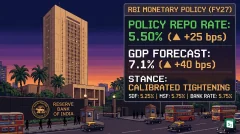
The Reserve Bank of India (RBI) raised its FY27 real GDP forecast to 7.1 percent from 6.7 percent in its October 2026 policy, matching the World Bank and the Organisation for Economic Cooperation and Development (OECD). The RBI also raised the repo rate to 5.5 percent and shifted its stance to calibrated tightening, signalling concern over inflation from high oil and food prices.
Other agencies have also lifted their views after the strong June quarter. S and P Global Ratings, Moody’s, Fitch Ratings, and the Asian Development Bank (ADB) placed FY27 growth at 6.9 to 7.1 percent. The ADB raised its forecast to 7 percent from 6.6 percent. The OECD raised its forecast to 7.1 percent.
The International Monetary Fund (IMF) is more cautious. The IMF, headquartered in Washington D.C. and established in 1944 alongside the World Bank at the Bretton Woods Conference, cut its FY27 forecast to 6.4 percent in July 2026 from 6.5 percent in April, citing energy prices. It raised the FY28 forecast to 6.7 percent. The gap shows the RBI gdp forecast for India and the World Bank view rest more on domestic resilience, while the IMF gives greater weight to oil and global shocks.
| Agency | FY27 Forecast | Note |
|---|---|---|
| World Bank (October 2026) | 7.1 percent | Up from 6.6 percent in April |
| RBI (October 2026) | 7.1 percent | Up from 6.7 percent |
| OECD | 7.1 percent | Up by 0.8 point |
| ADB | 7 percent | Up from 6.6 percent |
| S and P, Moody’s | Around 7 percent | Revised up after Q1 data |
| IMF (July 2026) | 6.4 percent | Cut from 6.5 percent |
What Is the World Bank and World Bank Group?
The World Bank is an international development lender that gives loans, grants, and advice to developing countries to cut poverty and support growth. It was conceived at the Bretton Woods Conference in 1944 and began work in 1946. It is headquartered at 1818 H Street, Washington D.C., United States.
The World Bank Group has five arms. The International Bank for Reconstruction and Development (IBRD), set up in 1944, lends to middle income governments. The International Development Association (IDA), set up in 1960, gives concessional loans to poor countries. The International Finance Corporation (IFC), set up in 1956, funds private firms. The Multilateral Investment Guarantee Agency (MIGA), set up in 1988, insures investors against political risk. The International Centre for Settlement of Investment Disputes (ICSID), set up in 1965, settles investment disputes.
The President of the World Bank Group (as of October 2026) is Ajay Banga, former chief executive of Mastercard, who took charge on 2 June 2023 for a five year term. He is the 14th president and the first Indian American to hold the post. India is among the largest borrowers from the group. The October forecasts for India formed part of the India Development Update, a twice yearly review, and the South Asia Economic Update, which also studied artificial intelligence adoption and energy transition in the region.
Key Takeaways
- The World Bank raised India FY27 GDP growth forecast to 7.1 percent from 6.6 percent in the October 2026 India Development Update.
- The World Bank projected India growth at 7.2 percent for FY28 and 7 percent for FY29 assuming energy supply normalises in early 2027.
- India GDP grew 7.8 percent in Q1 FY27 and 7.8 percent in FY26, with industry at 8.6 percent and investment at 11.9 percent in Q1.
- The World Bank placed nominal India GDP at about 4.15 trillion dollars in 2026, ranked sixth globally, and about 18.9 trillion dollars in PPP terms, ranked third.
- The World Bank Group, headquartered in Washington D.C. and conceived in 1944, has five arms including IBRD, IDA, IFC, MIGA, and ICSID.
- The RBI matched the World Bank with a 7.1 percent FY27 forecast in October 2026, while the IMF stayed cautious at 6.4 percent for FY27.