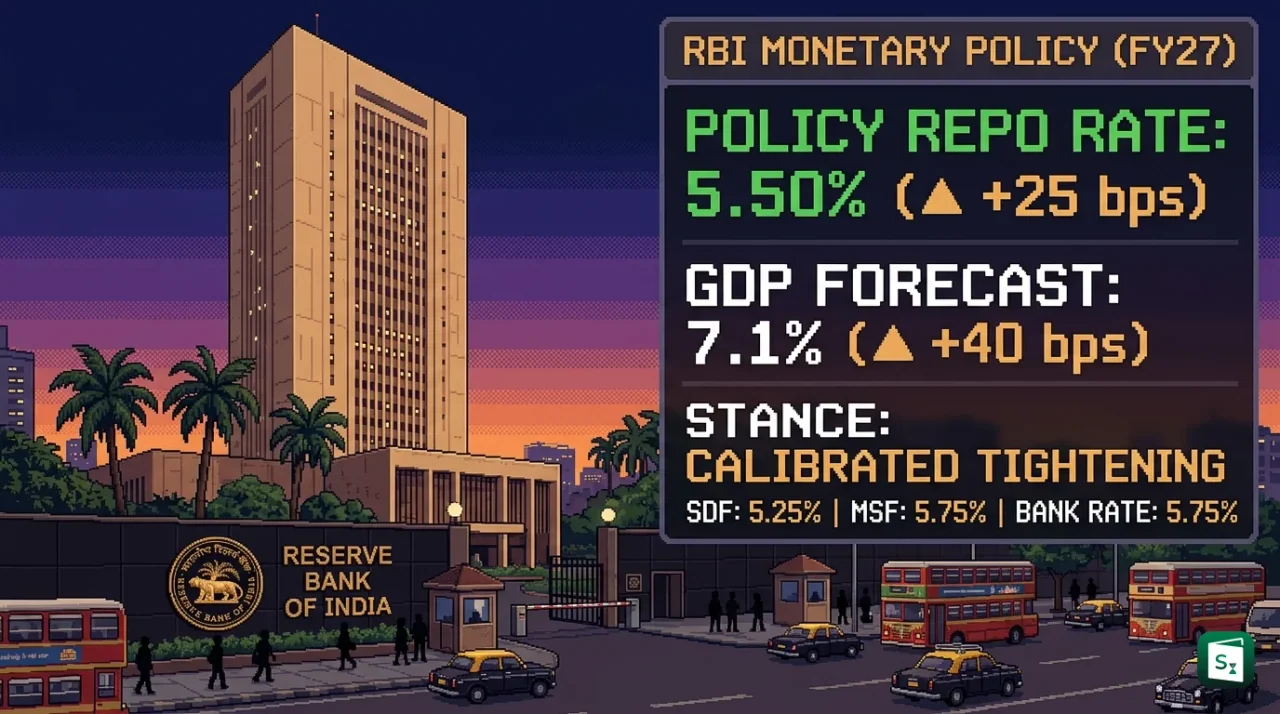
The Reserve Bank of India raised the policy repo rate by 25 basis points to 5.50 percent on 7 October 2026 after its fourth bi-monthly Monetary Policy Committee meeting of FY27 in Mumbai. The six member committee headed by Governor Sanjay Malhotra voted unanimously for the hike, the first increase since February 2023, and shifted the policy stance from neutral to calibrated tightening. The move pairs a stronger FY27 GDP growth forecast of 7.1 percent with a clear warning that rate cuts are off the table in the near term as inflation risks rise.
What Is Repo Rate?
The repo rate is the interest rate at which the Reserve Bank of India (RBI) lends money to commercial banks against government securities under the Liquidity Adjustment Facility (LAF). Banks borrow at this rate when they need funds and repay later by repurchasing the securities at a higher price.
The term repo comes from repurchase agreement. A basis point is one hundredth of a percentage point, so the current 25 basis points hike equals 0.25 percent. When the RBI raises the repo rate, borrowing from the central bank becomes costlier for banks. Banks usually pass on that higher cost to customers through higher loan interest rates, which reduces spending and helps control inflation.
RBI Policy Decision and 25 Basis Points Hike
The Monetary Policy Committee (MPC) held its 63rd meeting from 5 to 7 October 2026 in Mumbai under the chairmanship of Governor Sanjay Malhotra. The six member panel voted unanimously to raise the policy repo rate under the LAF by 25 basis points to 5.50 percent with immediate effect. The RBI described the decision as a recalibration of the policy rate after a detailed review of macroeconomic and financial conditions.
The hike marks the first increase in the current repo rate since February 2023, a gap of nearly three and a half years. In February 2023 the RBI had raised the repo rate to 6.50 percent after a tightening cycle that began in May 2022 and added a total of 250 basis points. Rates were later reduced in stages during 2025, including a cut in December 2025 from 5.50 percent to 5.25 percent. Through the first three bi-monthly meetings of FY27 in April, June and August 2026, the MPC had kept the rate steady at 5.25 percent with a neutral stance while waiting for clarity on inflation.
| Policy Event | Repo Rate Decision |
|---|---|
| February 2023 hike | Raised to 6.50 percent |
| December 2025 cut | Reduced to 5.25 percent |
| April to August 2026 (first three meetings of FY27) | Held at 5.25 percent |
| 7 October 2026 (fourth meeting of FY27) | Raised to 5.50 percent |
The next MPC meeting is scheduled for 2 to 4 December 2026. Minutes of the October meeting will be published on 21 October 2026.
Repo Rate Today in India and LAF Corridor
The repo rate today in India stands at 5.50 percent. The latest RBI announcement automatically reset the other policy rates that form the LAF corridor, a narrow band within which short term money market rates move. The policy repo rate sits in the middle of the corridor.
| Policy Rate | Current Rate After October 2026 Hike | Position in Corridor |
|---|---|---|
| Standing Deposit Facility (SDF) rate | 5.25 percent | Floor, 25 basis points below repo rate |
| Policy repo rate | 5.50 percent | Middle of corridor |
| Marginal Standing Facility (MSF) rate | 5.75 percent | Ceiling, 25 basis points above repo rate |
| Bank Rate | 5.75 percent | Aligned with MSF rate |
What Is LAF in Banking?
The Liquidity Adjustment Facility (LAF) refers to the RBI operations through which the central bank injects money into the banking system or absorbs surplus money from it. It includes overnight and term repo and reverse repo operations along with the SDF and MSF. The weighted average call money rate, the overnight rate banks charge each other, is the operating target that the RBI keeps inside the corridor.
What Is SDF, MSF and Bank Rate?
The Standing Deposit Facility (SDF) is the rate at which the RBI accepts overnight deposits from banks without any collateral. The RBI introduced the SDF on 8 April 2022 under powers given by the 2018 amendment to the RBI Act, 1934. It replaced the fixed rate reverse repo as the floor of the corridor. The reverse repo facility still exists in the RBI toolkit but is now used only at the discretion of the central bank.
The Marginal Standing Facility (MSF) is the penal rate at which banks can borrow overnight from the RBI against their Statutory Liquidity Ratio (SLR) securities up to a fixed limit. It acts as a safety valve during sudden fund shortages and forms the ceiling of the corridor. The Bank Rate is the standard rate at which the RBI buys or rediscounts bills of exchange and commercial paper. In practice the Bank Rate moves in line with the MSF rate, so both stand at 5.75 percent after the October hike. The corridor width is now a symmetric 50 basis points, with 25 basis points on either side of the repo rate.
Why Did the RBI Increase the Repo Rate?
The RBI increased the repo rate because inflation and its outlook are no longer benign. Consumer Price Index (CPI) inflation rose to 4.8 percent in August 2026 from 4.5 percent in July, driven mainly by higher food and fuel prices. The RBI now expects headline inflation to average nearly 5.8 percent over the next three quarters and has raised its FY27 inflation projection to 5.2 percent. Core inflation, which excludes food and fuel, is projected at 4.4 percent for the year.
A higher repo rate helps control inflation by making credit costlier across the system. When banks pay more to borrow from the RBI, they raise lending rates for homes, cars and business loans. Costlier loans reduce demand for goods and services. Lower demand limits the ability of firms to raise prices and prevents one time supply shocks from spreading into wages and long term inflation expectations.
The RBI pointed to a clear supply shock. The continuing West Asia conflict, volatile global crude prices and higher international commodity prices have pushed up fuel costs. A sub normal southwest monsoon and strong El Nino conditions have added risks to farm output and food prices. The central bank noted some signs of elevated inflation expectations and broader price pressures, along with strong growth in money and credit. Monetary policy works mainly by curbing these second round effects before supply pressures get fixed in pricing behaviour.
How Will the Hike Affect Home Loans and Fixed Deposits?
The current RBI repo rate for home loans matters because most floating rate home loans are linked to an external benchmark tied to the repo rate. When the repo rate rises by 25 basis points, banks review their Repo Linked Lending Rate (RLLR) and Marginal Cost of Funds Based Lending Rate (MCLR). New borrowers are likely to face higher interest rates, while existing floating rate borrowers may see either higher equated monthly instalments (EMIs) or a longer loan tenure.
Fixed deposit savers may gain from the same move. Banks often raise fixed deposit rates after a repo hike to attract deposits for lending. Small upward moves of 15 to 40 basis points across tenures are common after such decisions, though the final change depends on each bank and liquidity conditions. System liquidity was in an average daily surplus of ₹5.9 lakh crore after the August meeting, and large foreign currency deposit inflows have left banks with ample funds. Ample liquidity can lead banks to absorb part of the hike instead of passing the full increase to borrowers immediately.
For businesses, higher borrowing costs can slow fresh investment and working capital demand. For the stock market, a hike often weighs on rate sensitive sectors such as banking, auto and real estate in the short term because credit becomes costlier and future profits are discounted at higher rates.
MPC Meeting Structure, Members and Calibrated Tightening Stance
The Monetary Policy Committee (MPC) is the six member body that fixes the benchmark repo rate in India. The RBI Act, 1934 was amended by the Finance Act, 2016 to create a statutory framework for the committee under Section 45ZB. Three members come from the RBI, including the Governor as chairperson, the Deputy Governor in charge of monetary policy and one officer nominated by the Central Board. The Central Government appoints the other three members for a term of four years. The MPC must meet at least four times a year and publishes its decision after each meeting. In practice the RBI holds six bi-monthly meetings in a financial year.
The October 2026 meeting was chaired by Sanjay Malhotra, the 26th Governor of the RBI (as of October 2026) who took charge on 11 December 2024. The other members were Nagesh Kumar, Saugata Bhattacharya, Ram Singh, Poonam Gupta and Indranil Bhattacharyya. The RBI, established in 1935 and headquartered in Mumbai, is mandated to keep CPI inflation at 4 percent within a band of 2 to 6 percent while supporting growth.
The vote on the repo rate was unanimous. The decision on stance was carried by a majority of four to two. Nagesh Kumar and Ram Singh favoured retaining a neutral stance. The majority voted to shift from neutral to calibrated tightening. A neutral stance means the RBI can move rates in either direction based on data. Calibrated tightening means rate cuts are ruled out in the near term and future action can only be a pause or another hike, but in a measured manner linked to evolving conditions. Governor Malhotra clarified that the stance works as forward guidance and does not by itself tighten financial conditions.
Growth and Inflation Outlook With 7.1 Percent GDP Forecast
The RBI raised its real GDP growth forecast for FY27 by 40 basis points to 7.1 percent from 6.7 percent projected in August. The upgrade reflects resilient activity despite global headwinds. Domestic growth reached 7.8 percent in Q1 of FY27, supported by strong private consumption and investment along with a positive contribution from net exports. The RBI noted that economic momentum remains broad based.
| Period | RBI GDP Growth Projection |
|---|---|
| Q2 FY27 | 7.2 percent |
| Q3 FY27 | 6.9 percent |
| Q4 FY27 | 6.8 percent |
| Full year FY27 | 7.1 percent |
| Q1 FY28 | 7.1 percent |
Risks to growth remain evenly balanced. Prolonged geopolitical tensions, elevated commodity prices, frictions in global trade and tighter global financial conditions could weigh on the outlook. On the domestic side, weak monsoon rainfall and El Nino conditions could affect the rabi crop and rural demand.
On prices, the RBI raised the CPI inflation forecast for FY27 to 5.2 percent. Inflation for Q2 is placed at 4.9 percent, Q3 at 6.0 percent and Q4 at 5.7 percent, while Q1 of FY28 is projected at 5.6 percent. The central bank said food inflation had broadened across most items in May and June and fuel inflation had risen after retail price revisions linked to global energy costs. The World Bank has also placed India FY27 growth at 7.1 percent, citing strong industry and services momentum, while other forecasters have placed growth around 7 to 7.5 percent for the year.
New Regulatory Measures for Counterparty Risk and Financial Markets
Along with the policy rate decision, the RBI announced two regulatory measures for banks and financial markets. The first concerns capital rules for counterparty credit risk, the risk that the other party in a derivative or settlement transaction fails before completing payment. This risk arises in over the counter (OTC) derivatives, exchange traded derivatives, securities financing transactions and long settlement transactions.
The RBI has finalised the Standardised Approach for Counterparty Credit Risk (SA-CCR) to replace the older Current Exposure Method (CEM) for large banks. SA-CCR is the global standard developed by the Basel Committee on Banking Supervision, which is housed at the Bank for International Settlements in Basel, Switzerland. It measures exposure more accurately by considering replacement cost and potential future exposure after netting and collateral. The new method will apply from 1 April 2027 to commercial banks with an international presence or with derivative outstanding of ₹25,000 crore and above on a consolidated basis. Smaller banks without such exposure can choose between CEM and SA-CCR. The threshold was added after industry feedback that banks with negligible derivative books should not face heavy compliance costs.
The second measure is the creation of a Technical Consultative Committee for Financial Markets. The RBI said rapid changes in products and market infrastructure make structured dialogue necessary. The committee will provide a forum for engagement with market participants on policy and operational matters covering the money market, government securities market and foreign exchange market along with their derivatives and supporting infrastructure. The composition and terms of reference will be notified separately. The committee will be advisory in nature and final decisions will remain with the RBI.
Key Takeaways
- The MPC raised the repo rate to 5.50 percent on 7 October 2026 with a unanimous vote, the first hike since February 2023.
- The SDF rate stands at 5.25 percent while the MSF rate and Bank Rate stand at 5.75 percent under the 50 basis points LAF corridor.
- The MPC shifted its stance from neutral to calibrated tightening, signalling that rate cuts are off the table and only a pause or hike lies ahead.
- The RBI raised the FY27 GDP growth forecast to 7.1 percent after Q1 growth of 7.8 percent, and raised the FY27 CPI inflation forecast to 5.2 percent.
- The SA-CCR framework will apply from 1 April 2027 to banks with international presence or derivative books of ₹25,000 crore and above.
- The new Technical Consultative Committee for Financial Markets will advise on money, government securities and foreign exchange markets and their derivatives.