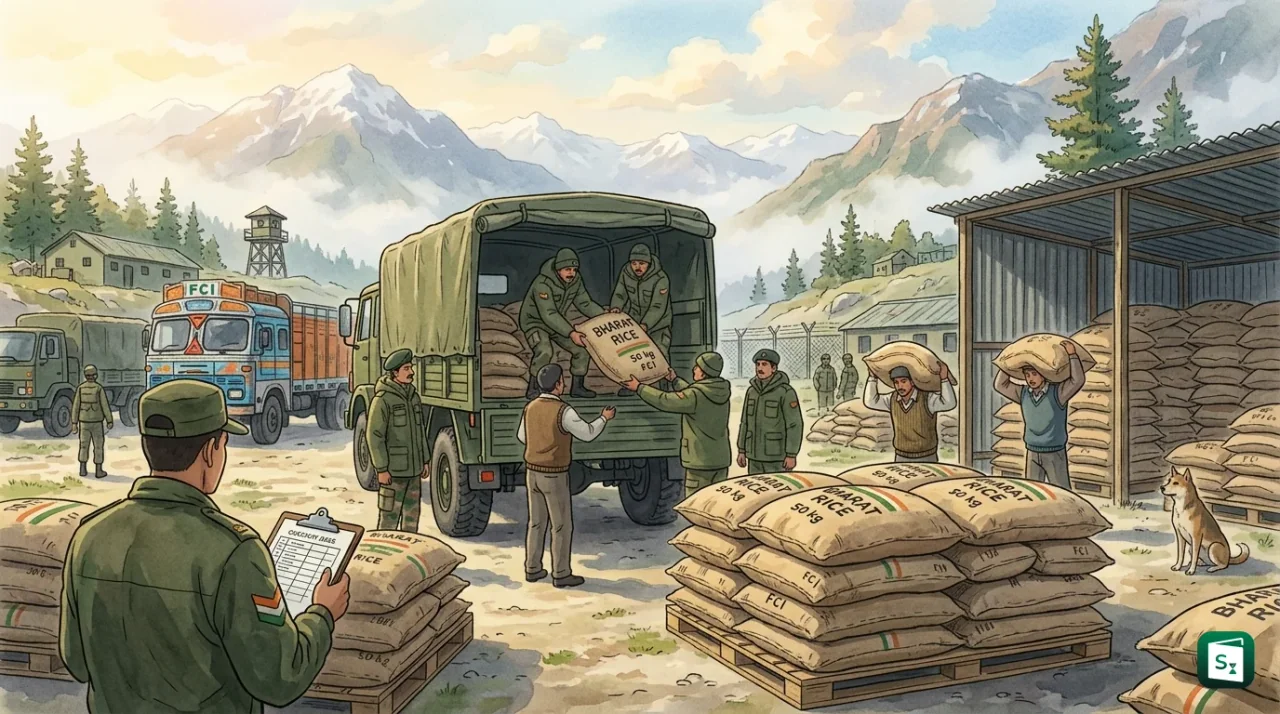
The Indian Army launched Bharat Rice for troops at the Manekshaw Centre in New Delhi on 12 October 2026, in the presence of Defence Minister Rajnath Singh and Consumer Affairs, Food and Public Distribution Minister Pralhad Joshi. The superior quality rice will now reach Army supply depots directly, including in Ladakh and the North East. At the same ceremony, the Army signed a five year MoU with the Food Corporation of India (FCI) to use its warehouses and handling infrastructure during operational contingencies.
What Is Bharat Rice?
Bharat Rice for the Army is superior quality rice milled to prescribed defence specifications and supplied through NAFED during Financial Year 2026-27. It is free from foreign matter with minimal broken grains and packed in 10 kg and 30 kg bags for direct delivery to Army supply depots.
The rice will undergo strict quality control checks before issue. It will be free from foreign matter and admixtures, with minimal broken, damaged and discoloured grains. The milling will follow standard specifications fixed for defence supplies, so troops get uniform grain quality across depots.
The Directorate General of Supplies and Transport (DGST) spearheaded the initiative. The DGST heads the Army Service Corps (ASC), the arm that procures, stores and issues food to Army units through its network of supply depots. The Bharat Rice plan was shaped by sustained feedback from troops and followed nearly 18 months of coordination among the Army, FCI, the National Agricultural Cooperative Marketing Federation of India Limited (NAFED) and the Department of Food and Public Distribution.
How Supply to Frontline Depots Will Change
Until now, Army depots collected rice from local FCI facilities. That added trips, handling and delays for field formations. Under the new system, milled Bharat Rice will move directly to Army supply depots, including those serving Ladakh and the North East.
This matters because both regions sit at the end of long, weather sensitive supply lines. Ladakh depends on high mountain passes that close in winter and needs advance winter stocking. Parts of the North East depend on narrow road and rail links through the Siliguri corridor. Direct delivery in ergonomic 10 kg and 30 kg packs cuts lifting effort for soldiers who carry rations to forward posts on steep tracks.
The small packs also help at the last mile. A soldier can load, count and carry a 10 kg bag far more easily at a high altitude post than a bulky gunny sack. Fewer broken and discoloured grains mean less wastage during cleaning and cooking at unit kitchens.
The Five Year Army FCI Pact
The MoU between the Indian Army and FCI will remain valid for five years and can be extended by mutual consent. It gives the Army a formal framework to use identified FCI warehouses, labour resources and material handling equipment during operational contingencies.
Coordination will happen at the formation level between Army supply and transport elements and FCI regional and divisional offices. The arrangements will be written into operational logistics plans, so both sides know in advance which godowns, silos and handling teams can be called upon.
The pact will support additional storage, rapid mobilisation, dispersion of stocks and forward positioning of rations and stores closer to operational areas. In simple terms, the Army can quickly park more food and material nearer the front when tensions rise, instead of building new depots from scratch. FCI brings a nationwide network of warehouses, modern silos and trained manpower, including in operationally important areas.
Rajnath Singh called the MoU far more than an administrative arrangement. He described it as a force multiplier for operational preparedness that reflects a whole of government and whole of nation approach.
Why Operation Sindoor Made Logistics the Focus
The MoU draws directly on lessons from Operation Sindoor, the four day India Pakistan military exchange in May 2025 that followed the 22 April 2025 Pahalgam terror attack. The operation involved intense ground exchanges and precision air and missile strikes, and it showed how fast a modern conflict can escalate.
Rajnath Singh said the strategic analysis of the operation showed that warning time in future conflicts could be extremely short. Zero warning situations and technology driven warfare could test both preparedness and the endurance of logistics chains. The MoU is meant to build that endurance, so supply networks keep working even if fighting starts at short notice and runs for a long period.
He underlined a core point. Logistics itself is combat power. Wars are not won on the front line alone. Storage capacity, transport networks, warehousing and timely replenishment matter as much as weapons and platforms. The FCI pact applies a dual use idea to food logistics. Civilian godowns built for food security will now double up as part of the military supply chain when needed. He compared it to fighter aircraft using expressways and Border Roads Organisation roads serving civilians, where one asset serves both civil and military needs.
Bharat Brand, FCI and NAFED: The Institutional Backbone
The Army version of Bharat Rice sits inside the larger Bharat brand family run by the Ministry of Consumer Affairs, Food and Public Distribution. The Centre first launched Bharat Atta at ₹27.50 per kg in November 2023, then launched civilian Bharat Rice at ₹29 per kg on 6 February 2024 to cool retail prices after a sharp rise in market rates.
Under the civilian scheme, FCI supplied about 5 lakh tonnes of rice to NAFED, the National Cooperative Consumers Federation of India (NCCF) and Kendriya Bhandar, which packed it in 5 kg and 10 kg bags and sold it through outlets, mobile vans and e commerce platforms. The same three agencies also handle Bharat Atta and Bharat Dal (chana dal at ₹60 per kg).
Two institutions make this chain work. FCI, set up in 1965 under the Food Corporations Act, 1964, is the central agency for purchase, storage, movement and distribution of foodgrains. It works under the Department of Food and Public Distribution and is headquartered in New Delhi. NAFED, established on 2 October 1958 and registered under the Multi State Cooperative Societies Act, is the apex marketing federation of agricultural cooperatives and acts as a nodal agency for price stabilisation and procurement.
| Institution | Full Form and Role | Key Fact |
|---|---|---|
| FCI | Food Corporation of India, central foodgrain purchase and storage agency | Set up in 1965 under the Act of 1964, headquarters in New Delhi |
| NAFED | National Agricultural Cooperative Marketing Federation of India Limited, apex farm marketing cooperative | Established on 2 October 1958, supplies Army Bharat Rice in 2026-27 |
| NCCF | National Cooperative Consumers Federation of India, consumer cooperative for retail distribution | Handles civilian Bharat brand sales with NAFED and Kendriya Bhandar |
| DGST and ASC | Directorate General of Supplies and Transport and Army Service Corps, Army ration supply arm | Spearheaded the Army Bharat Rice initiative |
For the Army, NAFED will mill and supply the rice through the 2026-27 cycle, while FCI provides the grain backbone and now the contingency warehousing network as well.
What Is the Army Ration System?
The Army feeds over a lakh of personnel every day through authorised ration scales, which fix how much rice, wheat, dal, sugar, oil, tea and other items each person gets per day. Dry rations like rice and wheat are procured centrally, with rice and wheat traditionally sourced from FCI after allocation by the Department of Food and Public Distribution. Fresh items like vegetables, fruit, milk and meat are bought locally through supply depots.
Quality is checked by Composite Food Laboratories before stocks move to rail head and field depots and then to units. Special scales apply for troops above 12,000 feet, including areas like Siachen, with extra or modified items for extreme cold. The Army has also announced allied steps such as additional rations for Agniveer recruits, greater commonality in scales across the three Services and a proposal for organic rations.
Significance and The Way Forward
Rajnath Singh framed Bharat Rice as a bond of trust from the farmer field to the soldier plate, giving practical shape to Jai Jawan, Jai Kisan. Pralhad Joshi said it was a matter of pride for his ministry to supply superior rice to the forces and called it a duty toward the protectors of the nation.
The deeper gain is readiness. Soldiers in harsh posts need steady, clean calories to hold health, stamina and morale. Direct delivery plus access to FCI godowns near operational areas means faster replenishment, less strain on Army transport columns and better use of national storage. The presence of Chief of the Army Staff General Dhiraj Seth and Food and Public Distribution Secretary Sanjeev Chopra at the event underlined joint ownership by the defence and food ministries.
Going ahead, the test will be execution. The Army and FCI must map specific warehouses, run joint drills and fold the tie up into each command logistics plan, in line with the PM Gati Shakti push for integrated infrastructure use. If that happens, civilian food capacity will quietly strengthen military endurance without duplicating costly assets.
Key Takeaways
- The Indian Army launched Bharat Rice for troops in New Delhi on 12 October 2026 in the presence of Rajnath Singh and Pralhad Joshi.
- The rice will be delivered directly to Army supply depots in Ladakh and the North East, milled to defence specifications and packed in 10 kg and 30 kg bags.
- Supply for 2026-27 will flow through NAFED after nearly 18 months of coordination led by the Directorate General of Supplies and Transport.
- The Army signed a five year MoU with FCI, extendable by mutual consent, to use its warehouses, labour and handling equipment during operations.
- The pact builds on lessons from Operation Sindoor of May 2025, with logistics framed as combat power and FCI godowns as dual use national assets.
- Civilian Bharat Rice at ₹29 per kg was first launched on 6 February 2024, while FCI was set up in 1965 and NAFED on 2 October 1958.