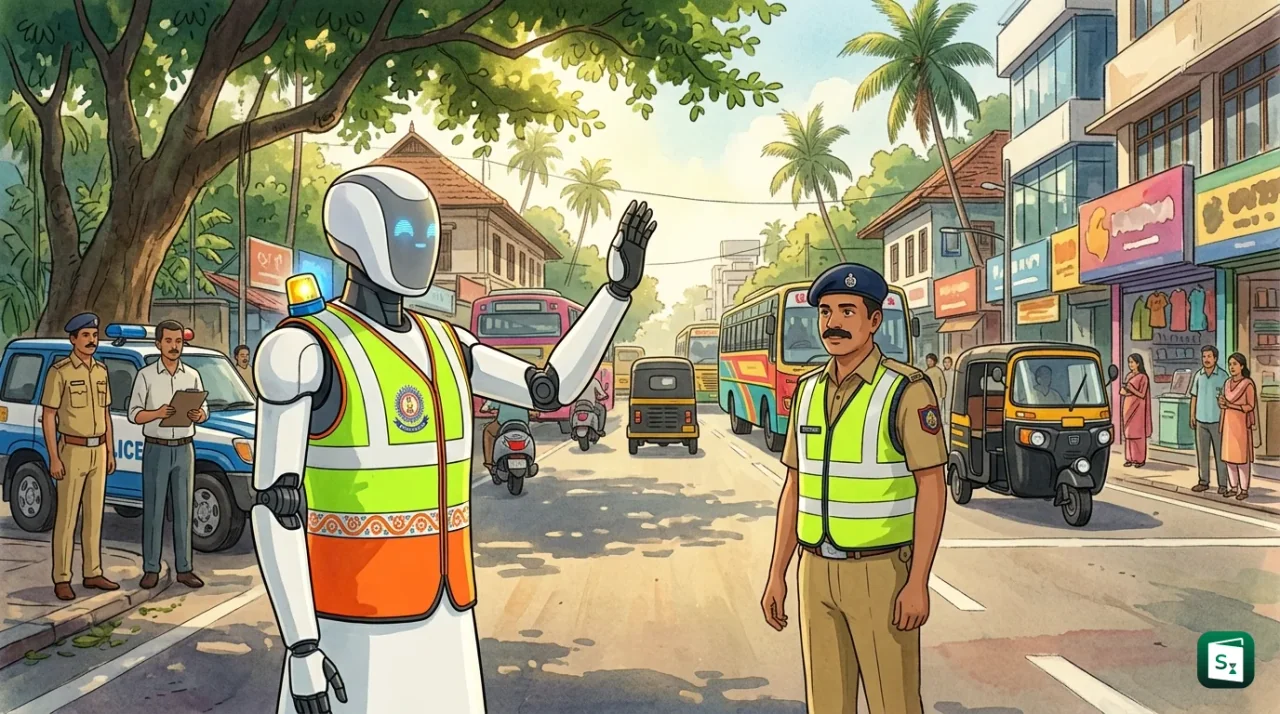
Kerala Police has signed a Memorandum of Understanding (MoU) with Kochi based I Hub Robotics for the trial deployment of Daksha, an AI powered humanoid robot for traffic management in Kochi. The robots were showcased at the c0c0n 2026 cybersecurity conference in Kochi on 9 October 2026 in the presence of senior police officers and state leaders. Daksha is described as India’s first humanoid traffic assistant that uses AI vision to direct vehicles and flag violations in real time.
What Has Kerala Police Decided on Daksha?
Kerala Police Cyberdome has signed an MoU with I Hub Research and Robotics Private Limited for joint development and trial based deployment of Daksha Generation 2 in Kochi. The force will first customise the military grade system for policing needs, test it on pilot basis, and then decide on procurement.
The agreement was signed at the c0c0n 2026 conference at the Grand Hyatt, Bolgatty in Kochi on 9 October 2026. The Kerala Police Cyberdome is a technology research centre of Kerala Police that works in public private partnership mode for cyber security. The MoU was received by Ankit Asokan, Superintendent of Police for Cyber Operations, from Athil Krishna, Founder and Chief Executive Officer of I Hub Robotics. Senior officers including Inspector General Prakash and State Police Chief Ravada A. Chandrasekhar were present along with state leaders.
Under the MoU, I Hub Robotics will provide technical expertise, technological support and professional help for approved police projects on a largely non monetary basis. In return, the company will get access to relevant police training programmes and seminars to improve its understanding of information security needs. The idea is joint development by the company, Kerala Police and Cyberdome, not an outright purchase at this stage.
Officers have made the trial path clear. The company will first adapt Daksha to suit field needs in Kerala. The adapted system will then be tested in a few designated areas in Kochi. If the pilot proves useful, Kerala Police will move to formal procurement as per rules. The company has said it aims to hand over the traffic system within six months, which points to field integration in the next two quarters.
What Is a Humanoid Robot and How Does Daksha Work?
A humanoid robot is a machine built in human like form with a head, torso, arms and legs that can sense its surroundings and perform physical tasks. Daksha is a mobile humanoid that combines cameras, sensors and AI software to see traffic, understand the scene and move its arms to give signals.
Daksha runs on Viveka, an indigenously developed Vision Language Action (VLA) foundation model with 3.3 billion parameters, built from scratch by I Hub Robotics. A VLA model joins three abilities in one system. Vision means it reads camera images to find vehicles, lanes and signals. Language means it understands written or spoken commands such as stop this lane or allow that turn. Action means it turns that understanding into physical steps such as raising an arm or turning its body. This closed loop of seeing, deciding and acting is what makes Daksha different from a fixed signal light or a remote controlled toy.
In simple terms, cameras act as the eyes, Viveka acts as the brain, and motors in the arms and base act as the hands and legs. At a four way junction, Daksha watches all arms of the road at once, studies vehicle build up, and changes its gestures the way a human traffic constable would. The company says the system has safeguards to avoid harm to people and can also learn from field data during trials. Daksha has earlier been used for industrial tasks in five countries and for defence related work, which gave the makers real world feedback before this policing trial.
How Will Daksha Manage Traffic in Kochi?
Daksha Generation 2 is designed as a vision based traffic assistant for busy intersections. The robot uses programmed hand gestures and visual cues to regulate movement. It can rotate its upper body, move its head and arms, and hold a clear posture so drivers can read its signals from a distance.
Its policing value lies in detection and reporting. Daksha can spot signal jumping and wrong lane use, capture number plates and images, and send instant alerts to the Cyberdome control room. Cameras on the robot keep a constant watch, while police staff in the control room verify the alert and take further action as per law. This creates an automated traffic policing loop where the robot observes and the control room decides.
The move also addresses a human problem. Traffic officers in Kochi often stand for long hours in high heat, heavy rain and polluted air. A robot assistant can hold a junction for longer stretches, keep behaviour consistent, and free officers for enforcement, diversion planning and emergency response. During the trial, Kerala Police will test whether drivers follow robot gestures, whether violation images are clear enough for legal use, and whether the system works in night light, rain and power cuts.
Who Built Daksha: I Hub Robotics Profile
I Hub Research and Robotics Private Limited, popularly known as I Hub Robotics, is a deep tech startup headquartered at Edappally in Kochi, Kerala. The company was incorporated on 3 March 2022 and is recognised by the Kerala Startup Mission. Its operating office is at Edappally and manufacturing takes place at Kalamassery, where the company is setting up a 24,000 square foot humanoid manufacturing and research facility.
The founders are Athil Krishna, Akhil K. Haridasan and Sarath S., three friends who studied mechatronics in Coimbatore and began working on humanoids around 2018. After early setbacks during the Covid period, they restarted as I Hub Robotics in 2022, starting with robotics education and components before moving to full robots. The team today has around 65 members and works on business to business and business to government orders. Operations extend to the UAE and Saudi Arabia with partnerships in more than ten countries.
Daksha is the company’s general purpose industrial humanoid. The first version was built for factories and can lift up to 25 kg and work at heights of 8 to 10 feet for checking and handling tasks. The company says one factory check that took five to six minutes by hand could be finished in about 35 seconds with high accuracy. Daksha Generation 2, launched at the AI Impact Summit 2026 in New Delhi, added autonomous mobility and the Viveka AI stack for wider deployment. Around 35 to 63 units of its service robot line Tara have been reported as deployed across three countries, while Daksha production is now the main focus at 10 to 20 robots per month.
Where Is Kochi and Why Was It Chosen for the Trial?
Kochi is a major port city on the Arabian Sea coast in Ernakulam district of Kerala. It is the most populous urban centre in the state, a hub for trade, information technology, tourism and the Cochin Port. Kochi faces dense junction traffic, rapid growth of private vehicles and monsoon related congestion, which makes traffic policing physically demanding.
The choice of Kochi for the trial is practical. I Hub Robotics is based in Kochi, so engineers can quickly service and update the robots. Kerala Police’s Cyberdome and the annual c0c0n conference are also anchored in Kochi. The 19th edition of c0c0n was held from 6 to 13 October 2026 at Kochi, with the main conference on 9 and 10 October. The main conference brings together police officers, researchers, industry and students to test new ideas in cyber security and policing. Launching the trial there allowed Kerala Police to show the system to experts, collect feedback and set trial protocols before street deployment.
Beyond Daksha: Kavach, Tara and Daksha Guardian
The MoU covers a small team of machines, not a single robot. Three humanoids were displayed at c0c0n 2026 along with an unmanned ground vehicle. Each has a different policing role, which helps Kerala Police test robotics for traffic, citizen service, patrolling and rescue in one programme.
| Robot System | Type | Planned Police Role |
|---|---|---|
| Daksha | Mobile humanoid traffic assistant | Direct traffic at junctions, detect violations, send alerts to control room |
| Tara Gen 1 (also reported as Thara) | Semi humanoid service robot | Guide visitors, answer queries in multiple languages, support front office work |
| Daksha Guardian | Humanoid for emergency response | Support patrolling, crowd watch and rapid response in risky spots |
| Kavach | Six wheel armoured all terrain Unmanned Ground Vehicle (UGV) | Disaster relief, rescue in difficult terrain, long patrolling, supply delivery |
Kavach is built for places where humans and normal vehicles cannot easily go. The makers say the vehicle has ballistic armour, 3D LiDAR and advanced sensors, and runs on Nvidia Jetson Thor processing for autonomous navigation without fixed paths. It can climb slopes of about 45 degrees, carry payloads of up to 2,000 kg in its heavy configuration, and run for two days on battery, extendable up to 12 days with an onboard generator. Kerala Police sees value in such a platform during landslides, floods and blocked roads, where it can create a path, carry essentials and keep watch without rest. The platform has already been used for Army linked work, and the police version will be scaled down from military grade to suit state needs.
From Indore Robocop to Daksha: How Traffic Robots Have Changed in India
India’s first traffic robot appeared in Indore, Madhya Pradesh, in June 2017. The Indore police, with the robotics team of the Shri Venkteshwar Institute of Technology, installed a 14 foot robot on a five foot pedestal at the MR 9 and Ring Road junction near Barfani Dham. The machine cost about ₹20 lakh, took two years to build, could rotate its upper body, move its head and arms, and carried a public address system with a WiFi camera to photograph violators. It was a fixed, remotely supported experiment that drew crowds and later needed design changes.
Daksha marks a clear shift from that model. The Indore system was largely a tall, static signal post with limited sensing. Daksha is a mobile, AI led humanoid that studies live video, plans its own gestures and links directly to a police control room. The change reflects nine years of progress in cameras, edge computing and AI models in India. If the Kochi trial succeeds, Kerala would become the first state to run an AI humanoid system for traffic policing rather than a single junction showpiece.
| Feature | Indore Robocop (2017) | Daksha (2026 trial) |
|---|---|---|
| Location | Indore, Madhya Pradesh | Kochi, Kerala |
| Builder | College team with city police | I Hub Robotics with Kerala Police Cyberdome |
| Form | 14 foot fixed robot on pedestal | Mobile humanoid, Generation 2 |
| Intelligence | Basic cameras and public address system | Viveka Vision Language Action model with AI vision |
| Function | Fixed hand signals at one square | Junction management plus violation detection and control room alerts |
How Does Daksha Compare With Global Humanoid Robots?
Humanoid robots for public use are a fast growing field. Global systems help place Daksha in context, though Daksha is built for a specific policing task and not as a general purpose home helper.
Tesla Optimus, developed by Tesla in the United States, is a general purpose humanoid meant for factory and household tasks. Sophia, developed by Hanson Robotics and based in Hong Kong, is a social humanoid known for conversation and public appearances. Atlas, developed by Boston Dynamics in the United States, is a research humanoid known for agility and movement. Older service systems such as ASIMO from Honda in Japan, Pepper from SoftBank Robotics and Nao robots are widely used in education, hospitality and research. Daksha differs because it pairs an Indian built body with an Indian AI model and targets Indian traffic conditions, with control room links that fit police procedure.
Significance and the Way Forward
The trial matters for practical reasons. It can cut the physical load on traffic staff and bring steadier junction control. It also links field policing to the Cyberdome control room, which supports evidence based challans and quicker diversions, while showing Indian deep tech manufacturing in action with design, AI and assembly centred in Kerala.
The path ahead will be decided by trial results. Kerala Police and I Hub Robotics will first finish customisation, then run pilots in a few areas and write operating protocols with Cyberdome. Issues to watch are accuracy in Indian traffic mix, data privacy in video capture, public response to robot signals, maintenance cost and clear legal backing for robot flagged violations. If these are resolved, the model can expand from Kochi to other cities and from traffic to patrolling, crowd management and disaster response.
Key Takeaways
- Kerala Police Cyberdome signed an MoU with I Hub Research and Robotics Private Limited on 9 October 2026 at c0c0n 2026 in Kochi for trial deployment of Daksha.
- Daksha Generation 2 is described as India’s first AI integrated humanoid traffic assistant for junction control and violation alerts.
- Daksha runs on Viveka, an indigenous 3.3 billion parameter Vision Language Action model that turns camera vision into physical traffic gestures.
- I Hub Robotics, founded in 2022 and based at Edappally, Kochi with manufacturing at Kalamassery, was founded by Athil Krishna with Akhil K. Haridasan and Sarath S.
- The programme also tests Kavach armoured UGV, Tara Gen 1 service robot and Daksha Guardian, with field integration targeted within six months.
- India’s first traffic robot was installed in Indore in June 2017 at the MR 9 junction, a 14 foot fixed system built with Shri Venkteshwar Institute of Technology.