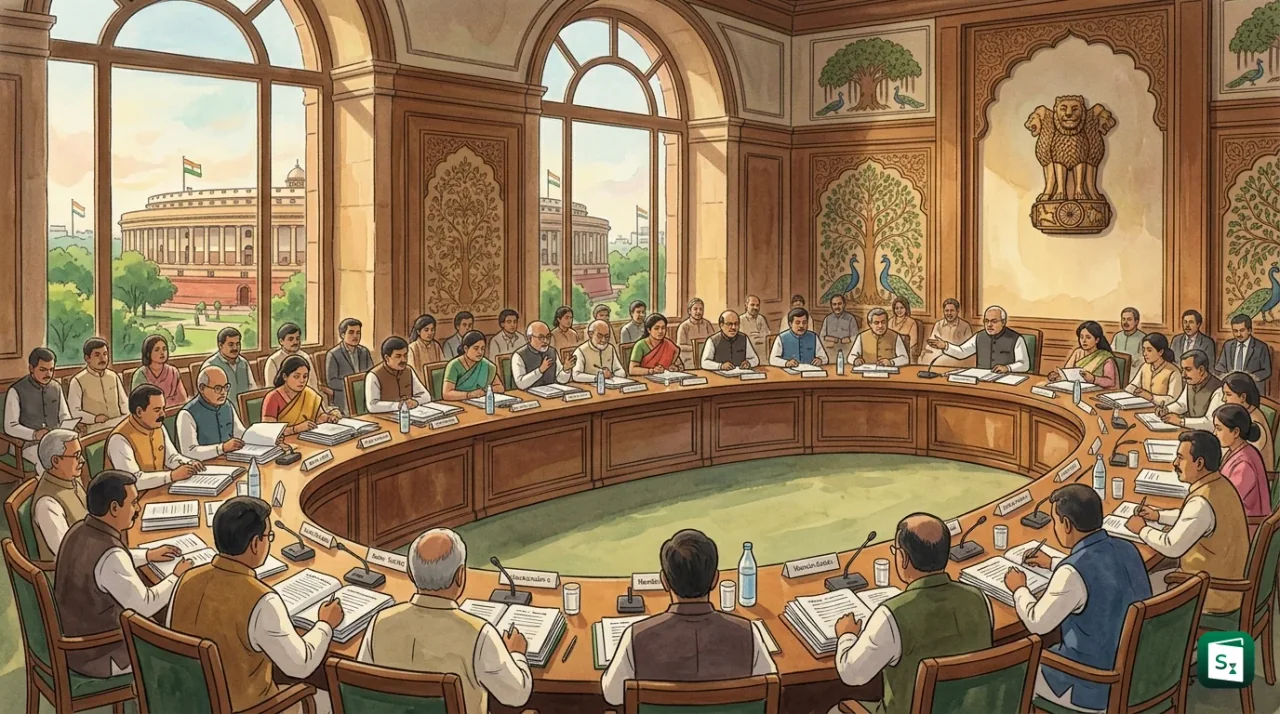
Lok Sabha Speaker Om Birla and Rajya Sabha Chairman C P Radhakrishnan have reconstituted all 24 Departmentally Related Standing Committees (DRSCs) of Parliament for the 2026-27 term with effect from 26 September 2026. BJP MP Bhartruhari Mahtab will head the Committee on Finance, Congress MP Shashi Tharoor will head the Committee on External Affairs, and BJP MP Radha Mohan Singh will head the Committee on Defence. The reset matters because these 31 member panels examine ministry budgets, scrutinise bills and prepare reports that guide debate in both Houses.
What Is a Parliamentary Committee?
A parliamentary committee is a small group of Members of Parliament formed to examine laws, budgets and policies in detail on behalf of the full House. Parliament creates these groups because the Lok Sabha and the Rajya Sabha are too large to study every bill clause by clause or to check every demand for grants. The committee calls officials, seeks written replies and then places its report in both Houses for debate.
Parliament divides its committees into two broad families. Standing committees are permanent and continue year after year, though their members change. Ad hoc committees are temporary and end after they finish one specific task. The 24 DRSCs belong to the first family, while Select Committees and Joint Parliamentary Committees (JPCs) set up for a single bill or inquiry belong to the second family.
| Type | Nature | Examples |
|---|---|---|
| Standing Financial Committees | Permanent, reconstituted every year | Public Accounts Committee (1921), Estimates Committee (1950), Committee on Public Undertakings (1964) |
| Departmentally Related Standing Committees | Permanent, reconstituted every year | Committee on Finance, Committee on Defence, Committee on External Affairs and 21 others |
| Other Standing Committees | Permanent, for House business and ethics | Business Advisory Committee, Committee of Privileges, Committee on Petitions |
| Ad hoc Committees | Temporary, dissolved after report | Select Committee on a Bill, Joint Parliamentary Committee on a specific issue |
What Is a Departmentally Related Standing Committee?
A Departmentally Related Standing Committee (DRSC) is a joint panel of both Houses that keeps watch over a group of Union ministries and departments. Each DRSC has 31 members, with 21 members from the Lok Sabha nominated by the Speaker and 10 members from the Rajya Sabha nominated by the Chairman. No minister can be a member, and a member who becomes a minister must give up the seat from the date of appointment.
The DRSC system began with three subject committees in 1989 on agriculture, science and technology, and environment and forests. Parliament created 17 DRSCs in April 1993 on the recommendation of the Lok Sabha Rules Committee to cover all central ministries. Parliament expanded the system to 24 DRSCs in July 2004 and fixed the present strength at 31 members per committee. Before 2004, each committee had 45 members.
The term of a DRSC does not exceed one year. Parliament therefore reconstitutes all 24 panels every year, though a fuller reshuffle follows each Lok Sabha election to reflect party strength through proportional representation. Of the 24 DRSCs, 16 function under the Lok Sabha Speaker and 8 function under the Rajya Sabha Chairman. The 8 panels serviced by the Rajya Sabha include commerce, home affairs, education, industry, science and technology, transport, health, and personnel and law.
Key Appointments in the 2026-27 Reconstitution
The Lok Sabha Secretariat issued the reconstitution bulletin on 3 October 2026, giving effect from 26 September 2026 for the 2026-27 term. Lok Sabha Speaker Om Birla, who has held the office since 19 June 2019 and represents Kota in Rajasthan, nominated the Lok Sabha members and appointed chairpersons for the 16 Lok Sabha serviced panels. Rajya Sabha Chairman C P Radhakrishnan, who took charge as the 15th Vice President of India on 12 September 2025, nominated the Rajya Sabha members and appointed chairpersons for the 8 Rajya Sabha serviced panels.
Most chairpersons continue from the previous year. The headline retentions are Bhartruhari Mahtab for finance, Shashi Tharoor for external affairs and Radha Mohan Singh for defence. Tharoor represents Thiruvananthapuram in Kerala and Mahtab is a long serving MP from Odisha now with the BJP. Singh represents Purvi Champaran in Bihar and has headed the defence panel since its constitution in September 2025.
Six panels changed hands. The Committee on Commerce moved from Dola Sen to BJP MP Sudhanshu Trivedi. The Committee on Chemicals and Fertilisers moved to Kakoli Ghosh Dastidar. The Committee on Personnel, Public Grievances, Law and Justice moved from Brij Lal to BJP MP Sujeet Kumar. The Committee on Railways moved to BJP MP Sudhir Gupta. The Committee on Labour, Textiles and Skill Development moved to BJP MP Shashank Mani. The Committee on Education, Women, Children, Youth and Sports is now chaired by Congress MP Mukul Wasnik.
Committee on Finance, External Affairs and Defence
The Committee on Finance watches the Ministry of Finance, the Ministry of Corporate Affairs, the Ministry of Statistics and Programme Implementation and NITI Aayog. NITI Aayog, which replaced the Planning Commission in 2015, is headquartered in New Delhi. The finance panel is serviced by the Lok Sabha Secretariat and its chairperson is appointed by the Speaker. Mahtab, who has chaired the panel since 26 September 2024, leads detailed checks of budget demands, proposed financial laws and annual reports of these bodies. Financial scrutiny of this kind matters because the Finance Ministry controls taxation, public spending and overall economic management.
The Committee on External Affairs watches the Ministry of External Affairs, which is headquartered in New Delhi and led by External Affairs Minister S Jaishankar (as of October 2026). Tharoor, a former diplomat and United Nations official, brings direct foreign policy experience to the role. The panel studies demands for grants of the ministry, examines foreign policy bills referred to it and reviews annual reports and long term policy papers on Indian diplomacy. The panel also includes members such as Raghav Chadha among its 31 MPs, reflecting cross party representation from both Houses.
The Committee on Defence watches the Ministry of Defence, which is headquartered in New Delhi. The panel examines defence budget demands, defence related bills referred by the presiding officers, the annual report of the ministry and long term policy documents. The 2026-27 panel includes senior MPs such as Rahul Gandhi, Dharmendra Pradhan, Karti P Chidambaram, Mahua Moitra and Kamal Haasan, which shows how closely parties follow defence spending and policy. Singh presides over sittings that consider oral evidence from defence officials and written replies from the ministry before reports are placed in both Houses.
How the 24 Committees Are Organised
Parliament assigns every central ministry to one of the 24 panels so that no ministry escapes detailed review. Each panel has the same 31 member formula, which makes DRSCs the largest parliamentary committees by membership. The Estimates Committee has 30 members, all from the Lok Sabha, while the Public Accounts Committee and the Committee on Public Undertakings have 22 members each.
| Committee | Chairperson for 2026-27 | Serviced By |
|---|---|---|
| Finance | Bhartruhari Mahtab (BJP) | Lok Sabha |
| External Affairs | Shashi Tharoor (Congress) | Lok Sabha |
| Defence | Radha Mohan Singh (BJP) | Lok Sabha |
| Home Affairs | Radha Mohan Das Agarwal (BJP) | Rajya Sabha |
| Agriculture, Animal Husbandry and Food Processing | Charanjit Singh Channi (Congress) | Lok Sabha |
| Railways | Sudhir Gupta (BJP) | Lok Sabha |
| Communications and Information Technology | Nishikant Dubey (BJP) | Lok Sabha |
| Energy | Shrirang Barne (Shiv Sena) | Lok Sabha |
| Coal, Mines and Steel | Anurag Thakur (BJP) | Lok Sabha |
| Water Resources | Rajiv Pratap Rudy (BJP) | Lok Sabha |
| Rural Development and Panchayati Raj | Saptagiri Ulaka (Congress) | Lok Sabha |
| Commerce | Sudhanshu Trivedi (BJP) | Rajya Sabha |
| Industry | Tiruchi Siva (DMK) | Rajya Sabha |
| Health and Family Welfare | Ram Gopal Yadav (Samajwadi Party) | Rajya Sabha |
| Education, Women, Children, Youth and Sports | Mukul Wasnik (Congress) | Rajya Sabha |
| Food, Consumer Affairs and Public Distribution | Kanimozhi (DMK) | Lok Sabha |
The remaining panels cover transport, tourism and culture, science and technology, environment, forests and climate change, chemicals and fertilisers, petroleum and natural gas, labour, textiles and skill development, social justice and empowerment, housing and urban affairs, and personnel, public grievances, law and justice. Each of these follows the same 21 plus 10 formula and the same one year tenure.
What DRSCs Do and How They Work
The Lok Sabha Rules 331C to 331N and the Rajya Sabha Rules 268 to 277 give DRSCs four clear tasks. Parliament assigns these tasks so that technical study happens in a small room and political decision stays in the full House.
First, the DRSC considers the Demands for Grants of its ministries. After the general discussion on the Union Budget, both Houses pause for about four weeks so committees can seek written replies and hear officials. The report cannot suggest cut motions, which are formal proposals to reduce a grant, but it forms the basis for detailed debate when the Lok Sabha later discusses ministry budgets.
Second, the DRSC examines bills referred to it by the Speaker or the Chairman. The panel studies the text clause by clause, hears experts and stakeholders, and reports back with suggested changes. The report carries strong persuasive value, though the House can still accept or reject it.
Third, the DRSC considers the annual reports of its ministries and departments. Fourth, it examines national basic long term policy documents placed before the House and referred to it. Every study ends in a report that is placed in both Houses, and the ministry later gives action taken replies.
DRSCs cannot look into day to day administration. Their recommendations are advisory and they cannot decide policy that the House itself must decide. Even so, the system improves the quality of laws and budgets because ministers must answer written questions, present data and defend spending before MPs from all major parties.
Key Takeaways
- All 24 DRSCs were reconstituted for 2026-27 with effect from 26 September 2026.
- The Committee on Finance is headed by Bhartruhari Mahtab and the Committee on External Affairs is headed by Shashi Tharoor.
- The Committee on Defence is headed by Radha Mohan Singh.
- Each DRSC has 31 members, with 21 from the Lok Sabha and 10 from the Rajya Sabha.
- The DRSC system started with 17 committees in 1993 and expanded to 24 committees in 2004.