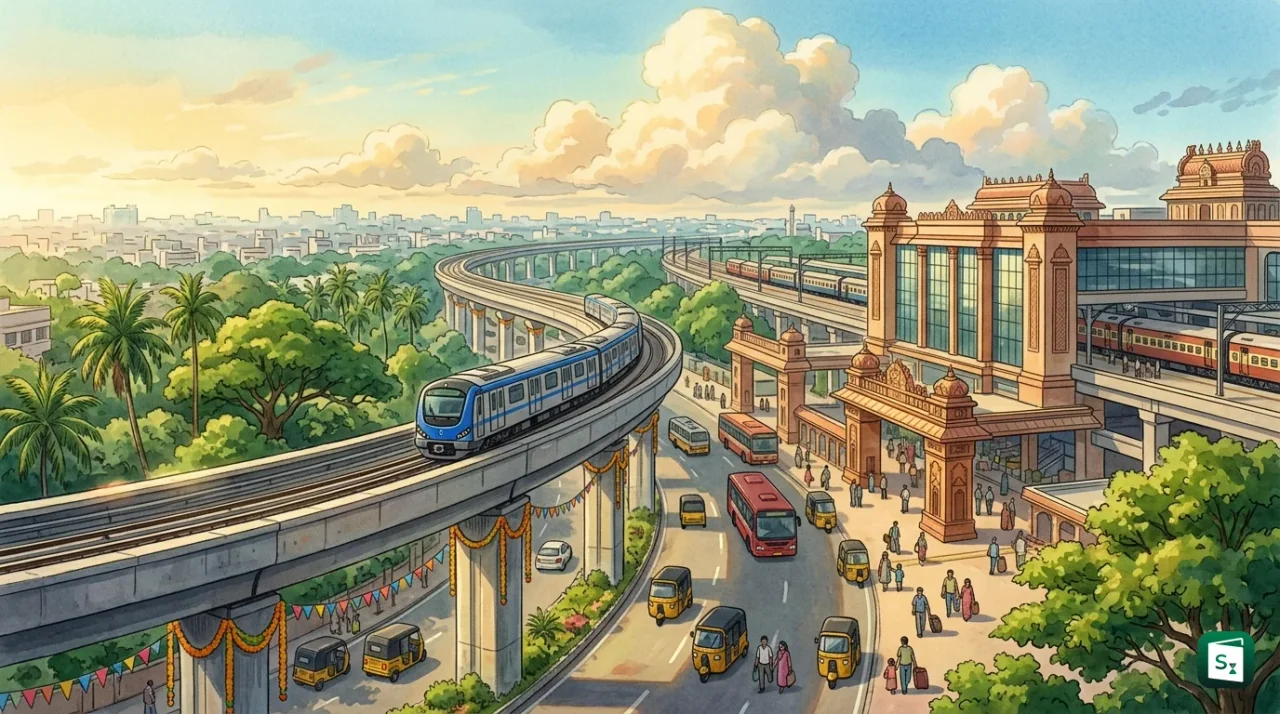
Prime Minister Narendra Modi inaugurated and laid the foundation stone for Chennai development projects worth over ₹13,000 crore at the Kendriya Vidyalaya Ground on the IIT Madras campus. The event marked the inauguration of the Poonamallee Vadapalani elevated stretch under Chennai Metro Phase 2 and five redeveloped Tamil Nadu railway stations under the Amrit Bharat Station Scheme. Together, the metro and railway launches strengthen urban transport within Chennai and long distance rail connectivity across Tamil Nadu.
Rs 13000 Crore Chennai Projects Package and PM Visit Schedule
The Chennai visit programme was organised at the Kendriya Vidyalaya Ground on the IIT Madras campus. The Prime Minister inaugurated completed projects and laid the foundation stone for new works in a single ceremony. The combined value of the projects is over ₹13,000 crore.
The package covers urban transport, railways and allied infrastructure in Chennai and other parts of Tamil Nadu. The metro inauguration improves daily travel inside the city. The railway station inaugurations improve passenger facilities for long distance and suburban travellers. Foundation stone works signal the next set of construction activity in the state pipeline.
Chennai Metro Phase 2 Inauguration: Poonamallee Vadapalani Elevated Stretch
The Poonamallee Vadapalani elevated stretch is part of Chennai Metro Phase 2. Phase 2 is a 118.9 km expansion with three corridors, namely Corridor 3, Corridor 4 and Corridor 5. The Poonamallee to Vadapalani section falls on Corridor 4, which connects Poonamallee Bypass with Lighthouse.
Poonamallee is a fast growing western suburb of Chennai. Vadapalani is a major commercial and residential hub with an existing Phase 1 metro station. The new elevated link connects the western suburbs directly to the central Chennai metro network. Commuters from Poonamallee, Porur and Alwarthirunagar can now reach Vadapalani, Ashok Nagar, Ekkattuthangal and Guindy with fewer road transfers.
The stretch is elevated, which means trains run on viaducts above the road. Elevated construction suits this corridor because it follows the busy Mount Poonamallee Road. Road widening on this route is difficult. A metro viaduct adds capacity without taking large additional land.
Chennai Metro Map, Lines and CMRL Framework
The Chennai Metro is the rapid transit system serving the Chennai metropolitan area. The Chennai Metro Rail Limited (CMRL) builds and operates the system. CMRL is a joint venture of the Government of India and the Government of Tamil Nadu and is headquartered in Chennai.
Chennai Metro services started on 29 June 2015 between Alandur and Koyambedu. Phase 1 covers about 54 km with two corridors, the Blue Line and the Green Line. Key interchange stations include Alandur, Chennai Central and Koyambedu. The Blue Line connects the airport with Wimco Nagar. The Green Line connects Chennai Central with St. Thomas Mount.
The Chennai metro route map now extends with Phase 2 construction across the city. The table below summarises the network structure relevant to the current inauguration.
| Network | Corridor and Route | Status |
|---|---|---|
| Phase 1 Blue Line | Wimco Nagar to Chennai Airport | Operational |
| Phase 1 Green Line | Chennai Central to St. Thomas Mount, with link to Koyambedu | Operational |
| Phase 2 Corridor 3 | Madhavaram to SIPCOT, Siruseri | Under construction in phases |
| Phase 2 Corridor 4 | Lighthouse to Poonamallee Bypass, including Poonamallee Vadapalani stretch | Poonamallee Vadapalani section inaugurated |
| Phase 2 Corridor 5 | Madhavaram to Sholinganallur | Under construction in phases |
Daily operations typically run from early morning to late night. CMRL issues single journey tokens, stored value cards and day passes. Chennai metro ticket booking is available at station counters, automatic vending machines and the CMRL mobile app with QR ticketing. Fares vary by distance. Online QR booking helps passengers skip queues during peak hours.
What Is the Amrit Bharat Station Scheme?
The Amrit Bharat Station Scheme is a Ministry of Railways programme to redevelop railway stations across India with modern concourses, lifts, escalators, clean waiting areas, free WiFi and better road access. It was launched in 2023 and covers more than 1,300 stations for phased upgradation.
The scheme focuses on the station building and passenger areas rather than only tracks and trains. Work includes new entrance porches, foot overbridges, platform resurfacing, toilets, drinking water points, signage and parking. Stations also get provision for future commercial space and city side development. The goal is safe access, smooth movement and clean surroundings for all passengers, including senior citizens and persons with disabilities.
Five Redeveloped Tamil Nadu Railway Stations Inaugurated
The Chennai event included the inauguration of five redeveloped railway stations in Tamil Nadu under the scheme. The redevelopment improves platform shelters, waiting halls, booking areas and toilet blocks. Better lighting, seating, display boards and announcement systems make travel information clearer. Improved approach roads and parking ease entry and exit during rush hours.
The Tamil Nadu railway zone benefits because Chennai is a major terminal for southern long distance trains and suburban services. Upgraded stations handle festival and holiday crowds better. Clean concourses and organised circulation reduce congestion on platforms. For daily passengers, the change is visible in shorter queues, safer foot movement and better basic amenities.
Amrit Bharat vs Vande Bharat
The Amrit Bharat Express is a train service with modern push pull coaches for long distance travel. The Vande Bharat Express is a semi high speed trainset with faster acceleration and sealed coaches. The Amrit Bharat Station Scheme is different from both. It is a station redevelopment programme, not a train. The table below keeps the distinction clear.
| Item | What It Is | Focus |
|---|---|---|
| Amrit Bharat Station Scheme | Station redevelopment programme of the Ministry of Railways | Station buildings, platforms and passenger amenities |
| Amrit Bharat Express | Long distance push pull train with modern coaches | Affordable long distance travel |
| Vande Bharat Express | Semi high speed trainset | Faster intercity travel with modern onboard facilities |
Significance for Tamil Nadu Rail and Urban Transport
Chennai faces heavy road pressure on western routes such as Mount Poonamallee Road. Office travel to Guindy, Vadapalani and Ashok Nagar creates peak hour jams. The Poonamallee Vadapalani metro link shifts part of this load to rail. Shorter and predictable travel time helps office staff, students and hospital visitors.
The link also supports interchange travel. Passengers can change at Vadapalani and Alandur to reach the airport, Chennai Central and Egmore. This metro to railway station connection matters for outstation travellers with luggage. Suburban and metro timings that align well can cut total door to door time.
The five station upgrades strengthen the second half of the journey. A metro brings passengers into the city core. Well designed railway stations send them safely to other districts and states. Together, the two projects improve first mile and last mile options around major terminals.
Key Takeaways
- Prime Minister Narendra Modi inaugurated Chennai development projects worth over ₹13,000 crore at the Kendriya Vidyalaya Ground on the IIT Madras campus.
- The Poonamallee Vadapalani elevated stretch inaugurated under Chennai Metro Phase 2 lies on Corridor 4 between Poonamallee Bypass and Lighthouse.
- Chennai Metro Phase 2 spans 118.9 km across Corridor 3, Corridor 4 and Corridor 5, while Phase 1 covers about 54 km.
- The Chennai Metro is built and operated by Chennai Metro Rail Limited (CMRL), with services started on 29 June 2015.
- The Amrit Bharat Station Scheme was launched by the Ministry of Railways in 2023 to redevelop more than 1,300 stations, including five redeveloped stations inaugurated in Tamil Nadu at the Chennai event.