The Ministry of Home Affairs notified the Immigration and Foreigners (Exemption) (Amendment) Order, 2026 on 5 November 2026 to ease passport and visa conditions for select long term residents and to clarify travel norms between India, Nepal and Bhutan. The order was issued under Section 33 of the Immigration and Foreigners Act, 2025 and amends the principal Immigration and Foreigners (Exemption) Order, 2025. It keeps visa free movement for direct India Nepal and India Bhutan travel but tightens identity checks and closes the route for third country transit.
What Is the Immigration and Foreigners Act 2025?
The Immigration and Foreigners Act, 2025 is the umbrella law that controls the entry, stay, movement and exit of foreign nationals in India. Parliament passed the law in March and April 2025, the President gave assent on 4 April 2025, and the Ministry of Home Affairs brought it into force on 1 September 2025.
Immigration in this context means the official system for checking who enters India, how long they stay, where they move inside the country, and how they leave. The Act requires every person entering India to hold a valid passport or other approved travel document. Every foreigner must also hold a valid visa, unless an exemption has been granted under Section 33 or through an agreement between governments.
The 2025 Act replaced four older laws and combined them into one code:
| Earlier Law | Year | What It Covered |
|---|---|---|
| Passport (Entry into India) Act | 1920 | Power to require passports for entry |
| Registration of Foreigners Act | 1939 | Registration of foreigners on arrival |
| Foreigners Act | 1946 | Powers of the Centre over foreigners, movement and removal |
| Immigration (Carriers Liability) Act | 2000 | Liability of airlines and ships bringing undocumented passengers |
The Bureau of Immigration, set up in 1971 under the Ministry of Home Affairs and headed by the Commissioner of Immigration, performs immigration functions at airports, seaports and integrated check posts. It is supported by Foreigners Regional Registration Officers (FRROs), Chief Immigration Officers and district registration officers. The Act gives the Bureau a clear statutory base, including supervision of visas and coordination on identification, detention and removal of persons staying without valid documents.
Penalties under the Act are strict. Entry without a valid passport or visa can lead to imprisonment up to five years and a fine up to ₹5 lakh under Section 21. Stay beyond the visa period or in violation of visa conditions can lead to imprisonment up to three years and a fine up to ₹3 lakh under Section 23. Use of a forged passport or visa can lead to imprisonment of two to seven years and a fine of ₹1 lakh to ₹10 lakh.
What the 2026 Amendment Order Changes
The Immigration and Foreigners (Exemption) (Amendment) Order, 2026 was notified as S.O. 6027(E) on 5 November 2026. It amends the principal Immigration and Foreigners (Exemption) Order, 2025, which was published on 2 September 2025.
The 2026 order does three things. It defines the Visa Manual, it rewrites the passport and visa exemptions for India Nepal Bhutan movement, and it adds fresh stay relaxations for select long term residents while keeping a visa requirement for their continued stay.
The order defines the Visa Manual as the manual issued by the Central Government from time to time with instructions on visas, immigration and connected matters. Immigration officers will now refer to this manual to decide which identity document is acceptable at the border. This replaces a loose list of identity cards with a single, updatable reference point, which helps officers apply the same standard at land borders and airports.
Who Is Exempt From Passport and Visa Requirements?
Visa exemption means a person is legally allowed to enter, stay in or leave India without the usual valid passport or visa. The 2026 order clarifies that exemption from holding a passport does not remove the need for a visa for continued stay in several categories. The table below summarises the main groups.
| Group Covered | Cutoff Date for Entry | Core Condition |
|---|---|---|
| Pakistani nationals settled permanently in India | On or before 31 December 2009 | Unable to renew Pakistani passport for want of Computerised National Identity Card (CNIC) |
| Muslim men of Indian origin who went to Pakistan after Partition and returned to Kerala | Went between 15 August 1947 and 31 December 1965, returned on or before 31 December 2009 | No marriage or property in Pakistan, family left in India, clean police record, will not return to Pakistan |
| Persons of Indian Origin who took Malaysia or Singapore citizenship and returned | Returned on or before 31 December 2009 | Expired foreign passport not renewed by that country, with proof of Indian origin |
| Hindus, Sikhs, Buddhists, Jains, Parsis and Christians from Afghanistan, Bangladesh and Pakistan | On or before 31 December 2024 | Compelled to seek shelter due to religious persecution or fear of it, with or without expired documents |
| Registered Sri Lankan Tamils who took shelter in India | Up to 9 January 2015 | Registered with the officer designated by the Centre or State |
| Tibetans entering via Kathmandu | After 1959 to before 30 May 2003, or after 30 May 2003 | Entry Permit or Special Entry Permit from the Indian Embassy in Kathmandu plus registration and certificate |
| Indian defence personnel and families on government transport | Applies to duty travel | Travelling on duty |
| Foreign crew of military vessels under repair in India | Applies during repair stay | Military Ship Repair Permit plus military identity documents |
Pakistani Residents Unable to Renew Passports
The most discussed clause covers citizens of Pakistan who entered India on or before 31 December 2009 on a valid Pakistani passport with the intention to live in India permanently. Pakistan issues passports only with a valid CNIC or its overseas equivalent issued by the National Database and Registration Authority. Persons who cannot obtain that card often cannot renew their passports, leaving them without a valid travel document through no action of their own.
The order states that the requirement of a valid passport for stay in India will not apply to such persons. Every person in this group must still obtain an appropriate category of visa for continued stay in India. A separate clause applies to male members of the Muslim community who were originally Indian citizens, went to Pakistan after Partition in the period from 15 August 1947 to 31 December 1965, left family in India, and later returned and settled in Kerala on or before 31 December 2009. They must meet five conditions: no marriage in Pakistan, no immovable property in Pakistan, family members who are Indian citizens left behind in India, an undertaking not to return to Pakistan, and no adverse police or security report. Their expired or lost Pakistani passport is then excused for stay, but a fresh Indian visa is still required.
Persons of Indian Origin From Malaysia and Singapore
The order gives similar stay relief to a Person of Indian Origin who later took citizenship of Malaysia or Singapore and returned to India on or before 31 December 2009 on a passport of that country. If that passport has expired and the country refuses renewal because the person does not meet its renewal conditions, the passport requirement for stay in India is waived. The person must produce documentary proof of Indian origin and must obtain an appropriate visa for continued stay.
For this clause, Person of Indian Origin means a foreign citizen, other than a citizen of Pakistan, Bangladesh, Sri Lanka, Afghanistan, Bhutan, Nepal and China, who at any time held an Indian passport, or whose parents, grandparents or great grandparents were born in and lived permanently in India as defined in the Government of India Act, 1935 and later Indian territories. Persons who were at any time citizens of the seven excluded countries do not qualify under this definition.
What Are the Revised Travel Rules for India, Nepal and Bhutan?
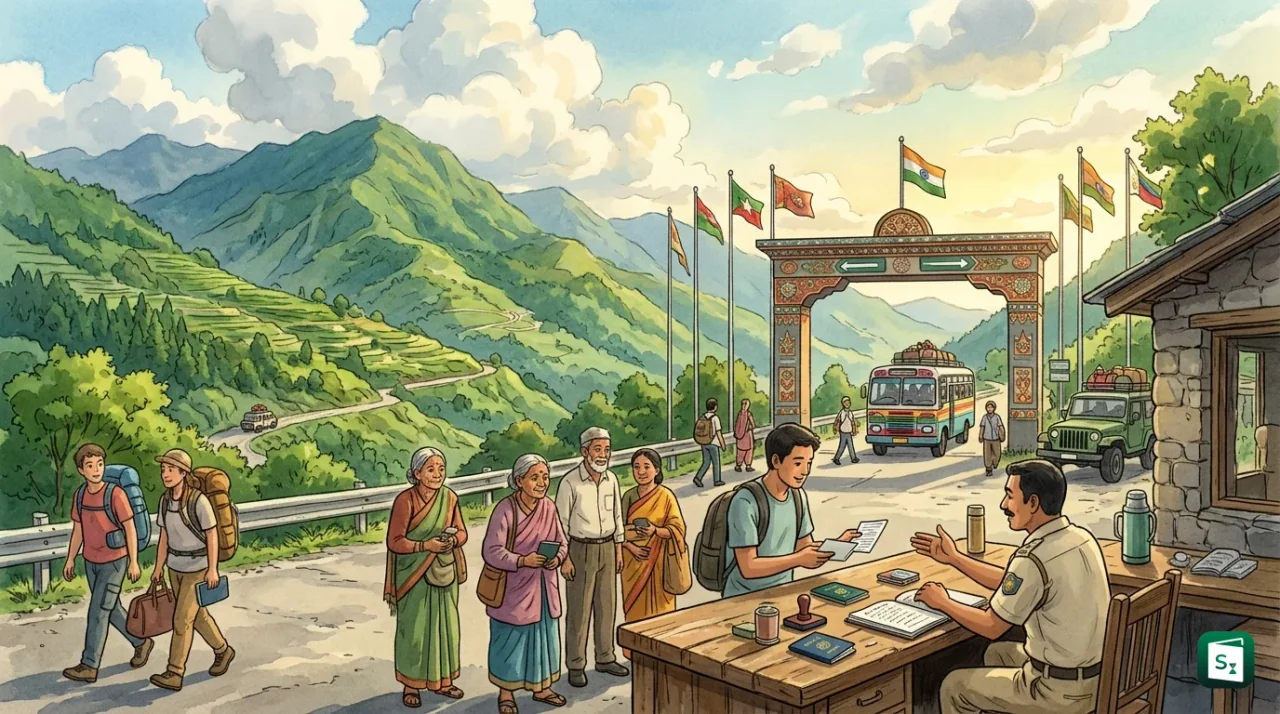
India has an open border arrangement with Nepal and Bhutan. Citizens moving directly between these countries do not need a visa. The 2026 order keeps that system but makes identity proof before an immigration officer compulsory.
For Indian citizens entering India from Nepal or Bhutan or departing from India to Nepal or Bhutan by land or by air, the rule is simple. The traveller must produce any one of the identity documents specified in the Visa Manual and provide any information the immigration officer asks for. The same rule applies to citizens of Nepal and Bhutan entering or leaving India by land or by air.
In practice, the accepted documents remain narrow. For air travel to Nepal, the Indian Embassy in Kathmandu recognises only a valid Indian passport or the original photo Voter Identity Card issued by the Election Commission of India. Downloaded copies, Aadhaar, PAN and driving licences are not accepted for that route. For Bhutan, Indian nationals can obtain an entry permit at Phuentsholing on the road border or at Paro airport with an original valid passport or original Voter Identity Card. Children below 18 years can use a birth certificate in original when accompanied by a parent with a valid document.
Is Visa Required for Nepal and Bhutan Travel From India?
No visa is required for Indians travelling directly to Nepal or Bhutan, and no visa is required for Nepalese and Bhutanese citizens travelling directly to India. The exemption is strictly limited to direct travel between India and Nepal or between India and Bhutan.
The exemption ends in two situations. First, an Indian citizen who uses the Indo Nepal or Indo Bhutan border to depart to a third country, or who returns from a third country through that border, must hold a valid passport and must use only a designated immigration post. Second, citizens of Nepal or Bhutan who enter or leave India from or to a place other than Nepal or Bhutan must hold a valid passport. Those who have embarked at or transited through China, Macau, Hong Kong or Pakistan must hold both a valid passport and a valid visa. These safeguards are meant to prevent third country nationals from using the open border to bypass normal immigration checks.
Visa vs Passport: What Is the Difference?
A passport and a visa serve different purposes, and the 2026 order treats them separately. A passport is a travel document issued by a government that proves the nationality and identity of the holder. A visa is a permission granted by the country to be visited that allows the holder to enter, stay for a fixed period, or leave, subject to conditions.
| Feature | Passport | Visa |
|---|---|---|
| Issued by | The country of nationality | The country to be visited |
| Proves | Identity and citizenship | Permission to enter and stay |
| Example in this order | Pakistani or Malaysian passport that has expired | Appropriate Indian visa to be obtained for continued stay |
That distinction explains why the order can waive the passport condition for stay but still require a visa. The long term Pakistani residents and the Malaysia Singapore returnees do not face action for lack of a valid passport, but they must regularise their stay with an Indian visa. The same logic applies to persecuted minorities from Afghanistan, Bangladesh and Pakistan who entered on or before 31 December 2024 without valid documents or with expired documents. They are protected from penalties for entry and stay without documents, but they must obtain an appropriate visa after entry.
The earlier Foreigners Act, 1946 had given the Centre broad powers over the entry, movement and removal of foreigners. The 2025 Act replaces that approach with detailed provisions on documents, registration, reporting by hotels, universities and hospitals, control of restricted areas, and graded penalties. Section 33 of the new Act preserves the power to grant exemptions by order, which is the legal base for both the 2025 Exemption Order and the 2026 Amendment Order.
Key Takeaways
- The Immigration and Foreigners (Exemption) (Amendment) Order, 2026 was notified on 5 November 2026 under Section 33 of the Immigration and Foreigners Act, 2025.
- Pakistani nationals who entered India on or before 31 December 2009 for permanent settlement are excused from passport renewal if they lack Pakistan’s CNIC, but must obtain an Indian visa.
- Persons of Indian Origin from Malaysia and Singapore who returned on or before 31 December 2009 with expired passports get similar stay relief on proof of Indian origin.
- No visa is needed for direct travel between India, Nepal and Bhutan, but travellers must show a Visa Manual identity document such as passport or Voter Identity Card.
- Nepalese and Bhutanese citizens who boarded at or transited through China, Macau, Hong Kong or Pakistan must hold both a valid passport and a valid visa.