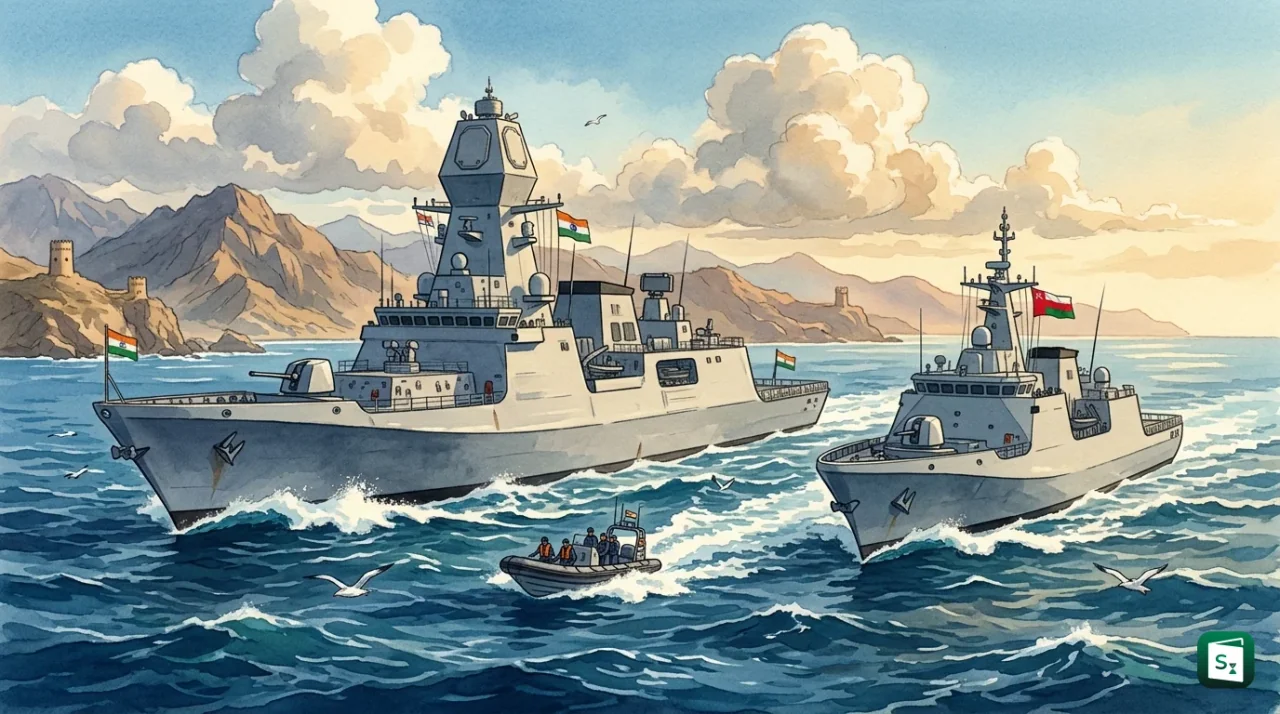
The Indian Navy and the Royal Navy of Oman conducted the 15th edition of the bilateral maritime exercise Naseem Al Bahr in Muscat from 8 to 11 November 2026. INS Surat represented India, while RNOV Al-Muazzar represented Oman. The exercise tested joint operations at sea and underlined Oman’s central role in India’s western maritime security.
Naseem Al Bahr Exercise Between India and Which Country?
The Naseem Al Bahr exercise is conducted between India and Oman. The name Naseem Al Bahr means Sea Breeze in Arabic. It is a bilateral naval exercise between the Indian Navy and the Royal Navy of Oman (RNO).
The first India Oman naval exercise was held in 1993. Since then the two navies have met every two years. The 9th edition was held in 2013 off Oman, and the 11th edition was held in December 2017 with ships Trikand and Teg. The 15th edition in 2026 continues this 33 year old practice.
India and Oman share one of India’s oldest defence partnerships in the Gulf region. India signed a Treaty of Friendship, Commerce and Navigation with Oman in 1953, the first such treaty with an Arab country. Diplomatic ties were formally set up in 1955 and raised to a strategic partnership in 2008. A memorandum on defence cooperation in December 2005, and the Joint Military Cooperation Committee (JMCC) set up in March 2006, gave regular structure to these ties.
How Did the 15th Edition Unfold in Muscat?
INS Surat reached Muscat on 8 November 2026. The exercise ran from 8 to 11 November 2026. A Coordinated Patrol (CORPAT) between the two navies was planned after the main exercise.
The harbour phase focused on professional exchanges. Specialist teams held Subject Matter Expert Exchanges (SMEE) on three subjects. These were Explosive Ordnance Disposal (EOD), mine countermeasure operations and hydrography. EOD deals with safe handling and disposal of explosives. Mine countermeasure operations detect and clear sea mines. Hydrography is the mapping of sea depth and sea floor for safe navigation.
The sea phase took the training to the water. INS Surat and RNOV Al-Muazzar carried out joint Visit, Board, Search and Seizure (VBSS) drills and cross deck operations. In a VBSS drill, teams board a suspect ship, search it and seize it if needed. In cross deck operations, personnel from one navy operate from the deck of the other navy’s ship. Both drills improve coordination during anti piracy tasks and maritime interception.
The exercise followed recent staff level talks. The 8th Navy Staff Talks were held in New Delhi on 27 and 28 October 2026. The talks were co chaired by Commodore Kartik Srimal of India and Commodore Ahmed Juma Salim Al Khatri of Oman. They reviewed operational engagement, training, information sharing and hydrographic cooperation. The 13th JMCC meeting on 24 November 2025 had set the wider defence agenda.
Which Ships Took Part: INS Surat and RNOV Al-Muazzar?
INS Surat is a guided missile destroyer of the Indian Navy. It is the fourth and last ship of the Visakhapatnam class built under Project 15B. The ship was designed by the Warship Design Bureau of the Indian Navy and built by Mazagon Dock Shipbuilders Limited (MDL) in Mumbai. Its keel was laid in November 2019, it was launched in May 2022 and commissioned on 15 January 2025.
Surat has a displacement of 7,400 tonnes and a length of about 163 metres. It uses Combined Gas and Gas propulsion with four gas turbines and can cross 30 knots. The ship carries 16 BrahMos anti ship cruise missiles and 32 Barak 8 surface to air missiles, along with torpedo tubes, anti submarine rockets and a 76 mm gun. The Navy describes it as its first artificial intelligence enabled warship, using locally developed software to improve efficiency.
RNOV Al-Muazzar belongs to Oman’s Qahir class of corvettes. A corvette is a small warship used for coastal patrol and escort duties. The ship was built by Vosper Thornycroft in the United Kingdom and commissioned on 13 April 1997. It displaces about 1,450 tonnes and carries Exocet anti ship missiles, Crotale surface to air missiles and a 76 mm gun. The Royal Navy of Oman is headquartered at Seeb near Muscat airport. It guards Oman’s long coastline and waters near the Strait of Hormuz, a narrow sea lane through which a large share of world oil supplies passes.
Why Is Oman Central to India’s Maritime Security?
Oman sits at the mouth of the Strait of Hormuz and overlooks the Gulf of Oman, the Arabian Sea and the Indian Ocean. This position places it close to India’s main energy and trade routes. A large share of India’s crude oil imports passes through these waters. Any disruption here can raise freight and insurance costs.
The Port of Duqm gives India a practical foothold in this zone. India secured access to Duqm for military use and logistical support through an annexure to the defence memorandum during the Prime Minister’s visit in February 2018. The port lies about 550 km south of Muscat in the Al Wusta region. It has a dry dock and ship repair yard. Indian ships use it to extend anti piracy patrols in the Gulf of Aden and to refuel and rest crew.
This role fits India’s wider maritime outlook. India announced Security and Growth for All in the Region (SAGAR) in March 2015 to build cooperation in the Indian Ocean. In March 2025 India expanded this approach as MAHASAGAR, which stands for Mutual and Holistic Advancement for Security and Growth Across Regions. The exercise press note linked Naseem Al Bahr directly to MAHASAGAR. The aim is steady engagement with regional partners, better awareness at sea and quick response to relief and security tasks.
People ties support the official partnership. About seven lakh Indians live and work in Oman. Oman was invited as a guest country during India’s G20 presidency in 2023 and took part in more than 150 working group meetings.
Which Other Exercises Connect India and Oman?
Oman is the first Gulf country with which all three Indian services hold regular bilateral exercises. Naseem Al Bahr covers the navy. Two other drills cover the air force and the army.
Eastern Bridge is the air exercise between India and Oman. It is conducted between the Indian Air Force (IAF) and the Royal Air Force of Oman (RAFO). The first edition was held in 2009 in Oman. The 7th edition was held at Masirah air base in Oman from 11 to 22 September 2024. India sent MiG-29 and Jaguar fighters and a C-17 transport aircraft. Oman fielded F-16 and Hawk aircraft. The 6th edition was held at Jodhpur in Rajasthan in February 2022.
Al Najah, which means success, is the army exercise between India and Oman. It is conducted between the Indian Army and the Royal Army of Oman. It began in 2015 and is held every two years in India and Oman by turn. The 5th edition was held at Rabkoot in Salalah, Oman, from 13 to 26 September 2024. Each side sent 60 personnel. India was represented by a battalion of the Mechanised Infantry Regiment. The focus was counter terrorism operations under Chapter VII of the United Nations Charter in desert terrain.
| Exercise | Services Involved | Started | Latest Completed Edition |
|---|---|---|---|
| Naseem Al Bahr | Indian Navy and Royal Navy of Oman | 1993 | 15th edition in Muscat in November 2026 |
| Eastern Bridge | Indian Air Force and Royal Air Force of Oman | 2009 | 7th edition at Masirah in September 2024 |
| Al Najah | Indian Army and Royal Army of Oman | 2015 | 5th edition at Salalah in September 2024 |
Key Takeaways
- The 15th Naseem Al Bahr exercise between India and Oman was held in Muscat from 8 to 11 November 2026.
- Naseem Al Bahr means Sea Breeze and the bilateral naval exercise began in 1993.
- INS Surat, a Project 15B destroyer commissioned in January 2025, represented India alongside Oman’s RNOV Al-Muazzar.
- The harbour phase covered EOD, mine countermeasures and hydrography, while the sea phase covered VBSS drills and cross deck operations.
- India and Oman also conduct Eastern Bridge for air forces since 2009 and Al Najah for armies since 2015.