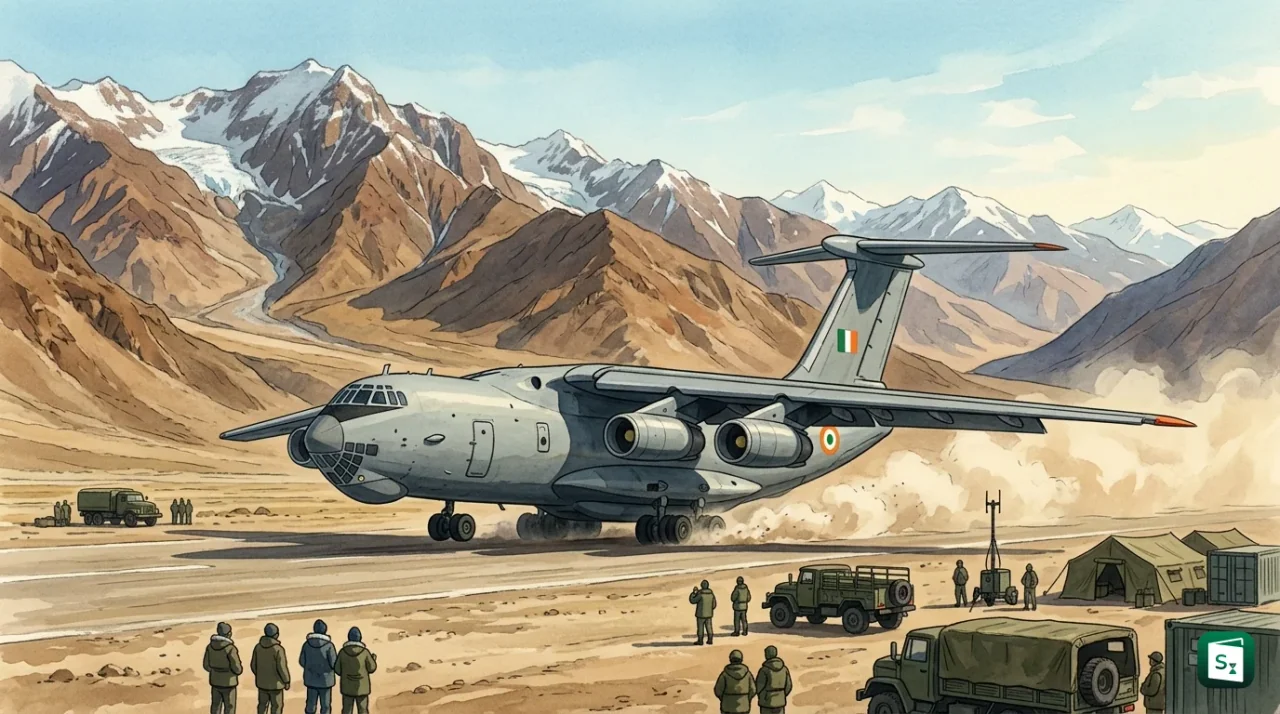
The Indian Air Force landed its Ilyushin IL-76MD Gajraj at Mudh-Nyoma airbase in eastern Ladakh on 6 November 2026. The airbase sits at 13,629 feet above sea level, making this the highest altitude landing ever achieved by this aircraft type in the world. The airbase lies only about 25 km from the Line of Actual Control, so the flight proves India can deliver heavy weapons and troops directly to the front line.
What Is the IL-76MD Gajraj?
The Ilyushin IL-76 is a four engine heavy lift military transport aircraft designed in the Soviet Union by the Ilyushin Design Bureau. Its NATO reporting name is Candid. The design requirement was set in 1967 for a freighter that could carry 40 tonnes over 5,000 km in less than six hours and operate from short and unpaved strips in harsh Siberian weather. The prototype first flew on 25 March 1971 and entered service in June 1974.
The IL-76 has a high mounted wing, a T tail and a rear loading ramp. It rides on 20 low pressure tyres, which spread its weight and help it land on rough or icy strips, including Antarctic ice runways. Military versions have a glazed navigator station under the cockpit and some carry two 23 mm cannon in the tail. The type also became the base for the IL-78 aerial refuelling tanker and the Beriev A-50 airborne warning aircraft.
The IL-76MD is the improved long range military version. The letter D stands for dalniy, a Russian word for long range. It uses four Soloviev D-30KP turbofan engines and has a higher take off weight of 190,000 kg from concrete runways. In Indian service it is called Gajraj, which means king of elephants.
| Feature of IL-76MD | Detail |
|---|---|
| Origin country | Soviet Union, now Russia |
| Manufacturer | Ilyushin, built first at Tashkent and now at Aviastar-SP |
| Engines | 4 x Soloviev D-30KP turbofans |
| Length | 46.6 metres |
| Wingspan | 50.5 metres |
| Crew | 5 to 7, including pilots, navigator, engineer and load handlers |
| Payload capacity | 42,000 to 48,000 kg, or 42 to 48 tonnes |
| Cargo hold | 20 metres long, 3.4 metres wide and 3.4 metres tall |
| Cruise speed | 750 to 800 km per hour |
| Range | About 5,000 km with full payload, up to 9,700 km ferry without payload |
| Service ceiling | 12,200 metres |
| Minimum landing run | About 450 metres with thrust reversers |
How Many IL-76 Does India Have?
The Indian Air Force inducted the IL-76MD on 16 June 1985 with No. 44 Squadron, known as the Mighty Jets and based at Chandigarh. India bought 17 aircraft between 1985 and 1989. Lists still show 17 on paper, but reports place the active fleet at 11 to 14 aircraft because of age, engine shortages and supply problems.
The fleet played a central role in Operation Pawan in Sri Lanka and Operation Cactus in 1988, when it flew paratroopers to the Maldives. It also served in the Kargil conflict, in evacuations from crisis zones, in Covid supply flights and in disaster relief missions abroad. After the 2020 Galwan clash, the Air Force airlifted more than 68,000 troops, around 90 tanks and nearly 330 infantry combat vehicles to Ladakh using IL-76s along with C-17 and C-130J aircraft. The IL-76 can carry T-72 tanks and BMP infantry combat vehicles in a single lift.
Age has reduced availability. A 2017 report of the Comptroller and Auditor General found average serviceability of only 37.99 percent between 2010-11 and 2015-16 against a target of 70 percent. Spares became scarce after the Soviet Union collapsed and the problem grew worse after the Russia Ukraine war disrupted supply chains. In 2024 the Air Force asked Russia to study whether 11 aircraft could have their life extended from 2035 to 2050 with new PS-90A engines and upgraded avionics. The Air Force is also pursuing a Medium Transport Aircraft programme in the 18 to 30 tonne class to replace the An-32 and part of the IL-76 role.
Where Is Nyoma Located?
Nyoma is a town on the northern bank of the Indus River in eastern Ladakh. It lies about 180 km southeast of Leh on the Leh to Hanle road and sits at an elevation of about 4,180 metres. Nyoma is the headquarters of Changthang district and Nyoma tehsil. The Mudh village next to Nyoma gives the airbase its full name of Mudh-Nyoma Air Force Station.
The airbase lies only 23 to 25 km from the Line of Actual Control with China. It sits south of Pangong Tso and Chushul and northwest of Demchok and Fukche. This position places it in the centre of the eastern Ladakh front, between the northern Sub Sector North around Daulat Beg Oldie and the southern Demchok sector.
Mudh-Nyoma Airbase Becomes Operational
Nyoma was first used as a landing ground during the 1962 India China war and then stayed unused for decades. The Air Force reactivated it as an Advanced Landing Ground on 18 September 2009, when an An-32 aircraft landed there. That flight was commanded by Group Captain S C Chafekar and carried the chiefs of the Western Air Command and the Northern Army Command. It was the third such strip reopened in Ladakh after Daulat Beg Oldie and Fukche.
The decision to build a full fighter capable base came after the 2020 standoff with China. Defence Minister Rajnath Singh laid the foundation stone in September 2023. The Border Roads Organisation built a 2.7 km long runway under Project Himank at a cost of about ₹218 crore, working in a season of only five to six months because of extreme cold. The base was operationalised on 12 November 2025, when Chief of the Air Staff Air Chief Marshal A P Singh landed a C-130J Super Hercules there with Western Air Command chief Air Marshal Jeetendra Mishra on board.
Mudh-Nyoma is the fourth airbase in Ladakh after Leh, Kargil and Thoise. It has hangars, an air traffic control building and hard standing for aircraft parking. It can handle fighter jets, transport aircraft and helicopters and is among the highest fighter capable airbases in the world.
Why Landing at 13,629 Feet Is So Difficult?
Landing a 190 tonne class aircraft at 13,629 feet is a physics test. The air at Nyoma is thin, so engines produce less thrust and wings produce less lift at the same speed. The aircraft must fly faster on approach and needs careful control of weight, speed and braking to stop safely on the runway.
Cold, gusty winds and sudden weather changes add more risk. Visibility can drop quickly and the mountain terrain leaves little room for a second attempt. The Air Force described the Nyoma landing as a demonstration of both the endurance of the old airframe and the precision of its crew. Indian engineers and test crews have spent years building their own performance charts from actual flight data, which helped pilots judge power settings and landing distances for this altitude.
How Does the IL-76MD Compare With the C-17 and C-130J?
The Air Force uses three main foreign built airlifters for Ladakh. The C-130J-30 Super Hercules is a tactical aircraft for special missions and short strips. The C-17 Globemaster III is the heaviest strategic lifter. The IL-76MD sits between them in age but remains the only Russian heavy jet in the fleet.
| Aircraft | Origin | Payload | Fleet in India | Base and Role |
|---|---|---|---|---|
| IL-76MD Gajraj | Soviet Union and Russia | 40 to 45 tonnes | 17 bought, 11 to 14 active with No. 44 Squadron | Chandigarh, strategic airlift of tanks, guns and troops |
| C-17 Globemaster III | United States, Boeing | About 77.5 tonnes, up to 134 troops | 11 with No. 81 Squadron | Hindan, outsize cargo and long range airlift |
| C-130J-30 Super Hercules | United States, Lockheed Martin | About 19 to 21 tonnes, 128 troops or 92 paratroops | 12 with No. 77 and No. 87 Squadrons | Hindan and Panagarh, special operations and high altitude strips |
The distinction in records matters. A C-130J landed at Daulat Beg Oldie at 16,614 feet on 20 August 2013, which is the world record for that medium lift class. The Nyoma flight is the world record for the heavier IL-76 class. The related IL-78MKI tanker version, of which India has six with No. 78 Squadron, shares the same basic airframe and supports refuelling.
Why the Nyoma Landing Strengthens Eastern Ladakh Airlift
Nyoma fills a gap in the middle of eastern Ladakh. Earlier, heavy jets had to use Leh at 10,630 feet or Thoise at 10,062 feet in the Nubra valley, which is the main hub for Siachen supplies. Forward strips at Daulat Beg Oldie at about 16,700 feet and Fukche at about 13,700 feet could take An-32 and C-130J aircraft but not heavy strategic jets. Nyoma now gives the Air Force a paved 2.7 km runway close to the front that can take a 40 tonne class aircraft.
That shortens response time. Troops, artillery, armoured vehicles and winter stocks can land almost at the border instead of moving by road for hours from Leh. Operations can continue when high passes close in winter. The base is also being prepared for fighter operations, including types such as the Rafale, Su-30MKI and Tejas, along with helicopters. Together, Leh, Thoise, Nyoma, Fukche and Daulat Beg Oldie form a connected grid, so aircraft can shift between bases if one is disrupted.
Key Takeaways
- The IL-76MD Gajraj landed at Mudh-Nyoma airbase at 13,629 feet on 6 November 2026, the highest landing ever by this aircraft type.
- The Ilyushin IL-76 is a Russian four engine heavy lifter with a payload of 42 to 48 tonnes and a range of about 5,000 km.
- India inducted the IL-76MD on 16 June 1985 and bought 17 aircraft for No. 44 Squadron at Chandigarh.
- Mudh-Nyoma was operationalised on 12 November 2025 with a 2.7 km runway built by the Border Roads Organisation for about ₹218 crore.
- Nyoma lies about 25 km from the Line of Actual Control and is the fourth airbase in Ladakh after Leh, Kargil and Thoise.