The Cabinet Committee on Economic Affairs approved the Yuge Yugeen Bharat Museum at the North and South Block Complex in New Delhi on 11 November 2026. The ₹3,230 crore project will cover a built-up area of about 1,78,509 square metres and is planned as the museum with the largest display area in the world. It will narrate 5,000 years of Indian civilisation by converting the historic Secretariat buildings into a public cultural institution.
What Is the Yuge Yugeen Bharat Museum?
The Yuge Yugeen Bharat Museum is a planned national museum that means Everlasting India. The name points to its central idea, to show India as a civilisation with an unbroken link from ancient times to the present.
Prime Minister Narendra Modi announced the project on 18 May 2023 at the International Museum Expo. The Ministry of Culture is the nodal ministry for execution. The museum is conceived as a landmark civilisational museum that tells an integrated story of tangible heritage, such as sculptures, coins, manuscripts and tools, and intangible heritage, such as knowledge systems, languages, music, crafts and spiritual traditions.
The plan is to use contemporary museum practice with immersive technology, visitor focused galleries, research areas, conservation laboratories and learning spaces.
Where Is the Yuge Yugeen Bharat National Museum Located?
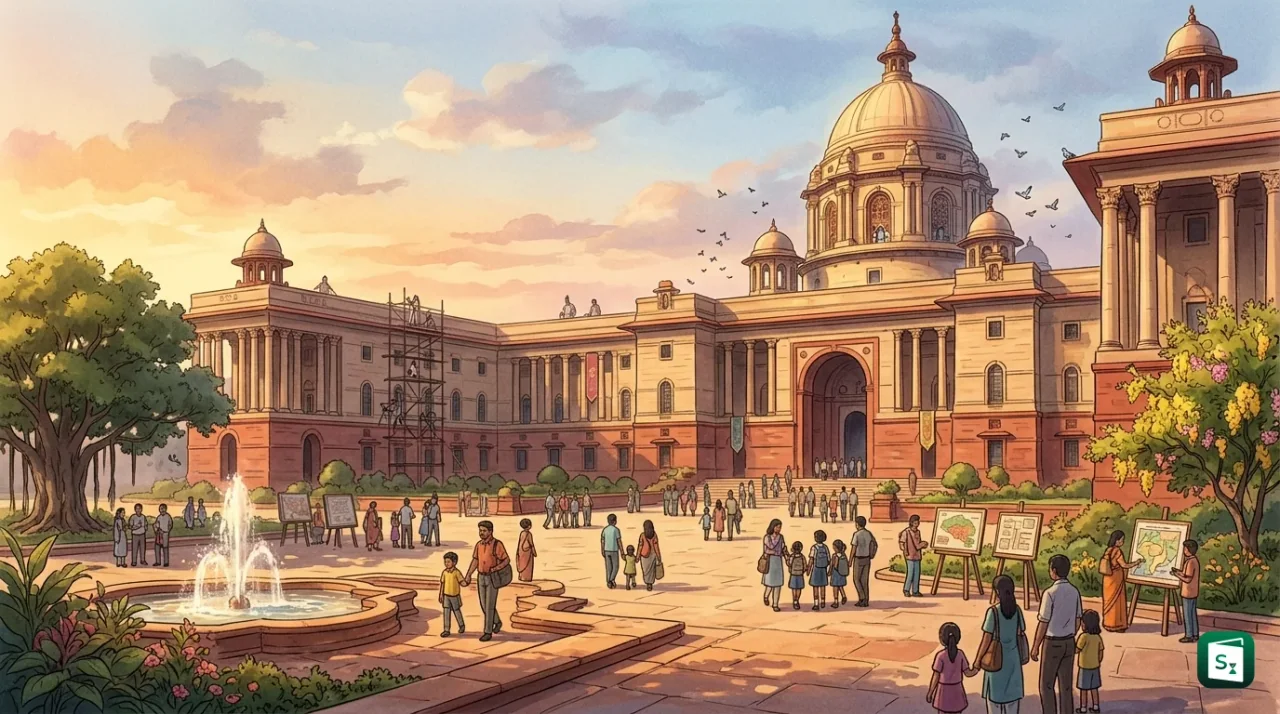
The Yuge Yugeen Bharat National Museum will come up at the North Block and South Block Complex on Raisina Hill in New Delhi. The two blocks stand on either side of the central axis of Kartavya Path and flank Rashtrapati Bhavan, the official residence of the President of India.
The site was chosen after government offices began moving to new buildings nearby. The Prime Minister Office has shifted to Seva Teerth, while the Home and Finance ministries are moving to the new Kartavya Bhavan buildings. This shift has freed the century old Secretariat buildings for adaptive reuse. Adaptive reuse means changing the use of a historic building while keeping its original structure and character intact.
What Are North Block and South Block?
North Block and South Block together form the Secretariat Building, the administrative heart of the central government since 1931. British architect Herbert Baker designed the two symmetrical blocks as part of the plan for New Delhi after the capital shifted from Calcutta to Delhi in 1911. Edwin Lutyens planned the wider city and designed Rashtrapati Bhavan, then known as Viceroy House.
The buildings use cream and red Dholpur sandstone from Rajasthan and combine classical style with Indian features such as jali (carved stone screens), chhajja (projecting eaves that give shade from sun and rain) and chhatri (small domed pavilions). Each block has about 1,000 rooms, inner courtyards, long corridors and a large central dome.
After Independence in 1947, South Block housed the Prime Minister Office along with the Ministry of Defence and the Ministry of External Affairs. North Block housed the Ministry of Finance and the Ministry of Home Affairs. Jawaharlal Nehru worked from South Block, while Vallabhbhai Patel worked from North Block during the integration of more than 562 princely states.
Yuge Yugeen Bharat Museum Cost, Area and Cabinet Approval
The Cabinet Committee on Economic Affairs (CCEA), chaired by Prime Minister Narendra Modi, approved the project on 11 November 2026. The CCEA is the cabinet panel that clears large economic and infrastructure proposals.
The total estimated cost is ₹3,230 crore. The Public Investment Board appraised the proposal on 27 July 2026, and the Ministry of Culture agreed with its recommendations. The estimate covers detailed architectural and exhibition design, engineering, heritage conservation, intelligent building systems, landscaping and visitor facilities.
The proposed built-up area is about 1,78,509 square metres. The government has said the museum will have the largest display area in the world when compared with major international museums. Built-up area covers all constructed space, while display area covers only exhibition space. The government has not yet released a separate final figure for display area alone.
| Museum | Display Area (approx) |
|---|---|
| Yuge Yugeen Bharat Museum (planned) | More than 1,00,000 sq metres |
| Louvre, Paris | 73,000 sq metres |
| British Museum, London | 70,000 sq metres |
| Hermitage, St Petersburg | 66,800 sq metres |
The museum is expected to earn recurring revenue from tickets, guided tours, food outlets, shops, events, venue rentals and digital experiences. It is being designed to handle 1 crore visitors in a year, with capacity for up to 30,000 visitors on a single day.
When Will Yuge Yugeen Bharat Open?
The Yuge Yugeen Bharat Museum will be built in phases from 2026-27 to 2030-31. The Ministry of Culture will implement the work in a modular manner, so some galleries open early while work continues on the rest.
The first inaugural gallery on the theme of Adornment is expected to open to the public in North Block in the later part of 2027. The plan includes glass roofs over the open courtyards, covering of verandas to create closed galleries, two glass entry pavilions called Peacock Pavilions on the Kartavya Path side, and a service tunnel to link North Block and South Block.
The Culture Ministry had earlier set a target to open a part of the museum by 2028. Full completion is now linked to the handover of South Block and is tentatively fixed for 2030-31.
What Will the Museum Display?
The museum will present India’s civilisational journey through curated thematic galleries rather than a simple year by year timeline. Officials have spoken of nearly 30 galleries across eight thematic segments that together cover more than 5,000 years, from the Indus Valley Civilisation to independent India.
Indicative themes reported by the Ministry of Culture include Adornment, Architecture and Cityscapes, Mathematics and Astronomy, Languages and Scripts, Faith and Spirituality, and Bharat Connects, which covers trade and ideas. An earlier concept note also listed ancient Indian knowledge, medieval periods, colonial rule, the freedom struggle and the first 100 years after 1947.
Content teams have identified about 1.8 million objects for study. These come from the National Museum in New Delhi, other museums under the Ministry of Culture, 52 site museums of the Archaeological Survey of India (ASI), state museums and private collections. About 25,000 artefacts are expected to be on show at a time.
The gallery concept draws on well known objects such as Indus Valley terracotta from Kalibangan dating to 2500 to 1750 BCE, a Mauryan edict pillar fragment from the 3rd century BCE, a Gupta period Surya sculpture from the 5th century CE, the Konark Sun Wheel from the 13th century and Chola Nataraja bronzes from the 10th and 11th centuries. Galleries will use manuscripts, inscriptions, coins, sculptures, murals and audio visual installations to explain town planning, metallurgy, science and tribal freedom fighters alongside dynastic history.
Yuge Yugeen Bharat National Museum Is Part of Which Initiative?
The Yuge Yugeen Bharat National Museum is part of the Central Vista Redevelopment Project. The Central Vista is the central administrative area of New Delhi around Kartavya Path, India Gate and Raisina Hill. The redevelopment, launched in 2020, includes the new Parliament House, Kartavya Bhavan office blocks, the Executive Enclave called Seva Teerth and the upgrade of public spaces.
Within this plan, the North and South Blocks will shift from offices to culture. The existing National Museum at Janpath will move its collection to the new site. The current National Museum was first opened at Rashtrapati Bhavan on 15 August 1949 and shifted to its Janpath building on 18 December 1960. Its building plan came from the Maurice Gwyer Committee of 1946. It now holds about 2,00,000 objects but shows only a small share at any time due to space limits.
With Which Country Is India Developing the Museum?
India is developing the museum with technical cooperation from France. On 19 December 2024, the National Museum signed an agreement with France Museums Developpement (FMD). FMD is the French public agency known for work on the Louvre, the Grand Palais and the Hotel de la Marine.
The cooperation began with a Letter of Intent on museum heritage in 2020 and grew after the Prime Minister visit to Paris in 2023. FMD completed a feasibility study in 2024 to 2025 covering strategy, market study, building analysis and the functional programme for galleries, storage, education and public areas. The Culture Ministry now plans to keep FMD as an adviser on visitor experience, business model, display methods and staff training.
The design approach follows the French Grands Projets model, where landmark government buildings were turned into cultural spaces. The Louvre Palace, which earlier housed ministries, became a museum on a similar principle.
How Will the New Museum Compare With the National Museum in New Delhi?
The National Museum in New Delhi at Janpath remains the largest museum in India today. It functions under the Ministry of Culture and covers more than 5,000 years from the prehistoric era to modern art. Its best known holdings include Harappan objects, including the Bronze Dancing Girl, jewellery, sculptures, manuscripts, coins, Central Asian antiquities from explorer Aurel Stein and arms and armour.
Space is the main difference. The Janpath museum has 29 galleries and displays only about 6 to 9 percent of its collection at a time. The Yuge Yugeen Bharat Museum is planned with about 950 rooms, storage and conservation blocks, learning zones and far larger exhibition floors. That scale is why officials describe it as the future biggest museum in India and the museum with the largest display area in the world.
The move also fits a wider museum network in Delhi, including the National Gallery of Modern Art in New Delhi, the National Museum of Natural History in New Delhi and the National Art Gallery. The new institution is meant to serve as the national museum of India for visitors from all states and Union Territories as well as international tourists, researchers and students.
Key Takeaways
- The Cabinet Committee on Economic Affairs approved the Yuge Yugeen Bharat Museum on 11 November 2026 at a cost of ₹3,230 crore.
- The museum will come up at the North Block and South Block Complex on Raisina Hill in New Delhi with a built-up area of 1,78,509 square metres.
- The Yuge Yugeen Bharat Museum is planned as the museum with the largest display area in the world, larger than the Louvre, British Museum and Hermitage.
- The first gallery on Adornment is expected to open in North Block in the later part of 2027, with full completion planned by 2030-31.
- The project is part of the Central Vista Redevelopment Project and is being developed with technical help from France Museums Developpement under a 19 December 2024 agreement.