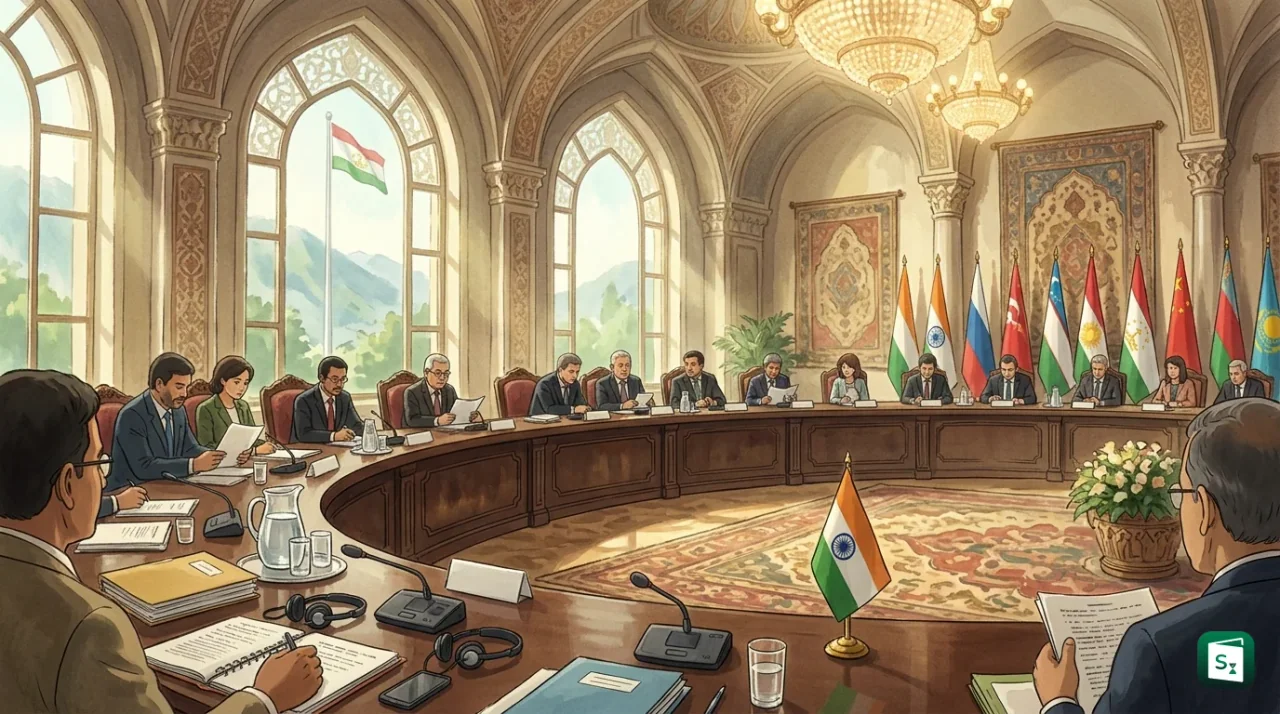
The 25th SCO Summit 2026 of the Council of Heads of Government met in Dushanbe, Tajikistan on 19 and 20 October 2026 under the chairmanship of Tajik Prime Minister Qohir Rasulzoda. Defence Minister Rajnath Singh represented India and announced that New Delhi will host the first SCO Civilisational Dialogue Forum from 20 to 22 November 2026. The meeting adopted a Joint Communique along with the PMTEC Action Plan for 2026 to 2030, the SCO budget for 2027 and new decisions on transport and industry.
What Is the SCO Summit?
The Shanghai Cooperation Organisation (SCO) is a ten member Eurasian political, economic and security grouping founded on 15 June 2001 in Shanghai. The SCO summit is its meeting in two formats, the Council of Heads of State and the Council of Heads of Government, to decide policy and cooperation plans.
The SCO grew out of the Shanghai Five, a border confidence group formed in 1996 by China, Russia, Kazakhstan, Kyrgyzstan and Tajikistan. Uzbekistan joined in 2001, and the six leaders signed the Declaration on the Establishment of the SCO on 15 June 2001. The SCO Charter, the basic legal document that defines its aims, structure and working methods, was signed in St. Petersburg in June 2002. The Charter commits members to mutual trust, good neighbourliness, joint protection of regional peace and step by step economic cooperation. It also lays down consensus as the method for all decisions, which means every member must agree before any decision is passed.
The SCO works through two permanent bodies. The SCO Secretariat in Beijing prepares documents, keeps records and coordinates daily work. The Executive Committee of the Regional Anti-Terrorist Structure (RATS) in Tashkent coordinates cooperation against terrorism, separatism and extremism. The Secretary General (as of October 2026, Nurlan Yermekbayev of Kazakhstan) and the RATS Director (Ularbek Sharsheev) hold three year terms. The top body is the Council of Heads of State (CHS), which meets once a year to decide all major questions. The Council of Heads of Government (CHG), made up of prime ministers, also meets once a year to review economic cooperation and approve the annual budget.
SCO Summit 2026 Held in Which Country?
The 25th SCO Council of Heads of Government meeting in 2026 was held in Dushanbe, Tajikistan on 19 and 20 October 2026. Tajik Prime Minister Qohir Rasulzoda chaired the meeting and President Emomali Rahmon received the delegations. The CHG chairmanship passed to Uzbekistan, which will host the meeting in 2027.
The Dushanbe meeting coincided with the 25th anniversary of the SCO, which was founded in 2001. Tajikistan hosted the event in both restricted and expanded formats. The restricted format brought together the ten heads of delegation, the SCO Secretary General and the RATS Director. The expanded format also included guests of the chair, observers and finance bodies. Mongolia and Turkmenistan attended as guests, along with representatives of the SCO Business Council and the SCO Interbank Consortium.
India was represented by Defence Minister Rajnath Singh. Other key participants included Chinese Premier Li Qiang, Russian Prime Minister Mikhail Mishustin, Pakistan Deputy Prime Minister and Foreign Minister Mohammad Ishaq Dar, Kazakhstan Prime Minister Olzhas Bektenov and Belarus Prime Minister Alexander Turchin. The choice of Dushanbe continued the rotation of SCO meetings among capitals. The previous CHG meeting was held in Moscow in November 2025 under Russian chairmanship.
Two chairmanships need clear separation. The CHG chairmanship for prime ministers moved from Tajikistan to Uzbekistan for 2027. The higher CHS chairmanship for heads of state moved from Kyrgyzstan, which hosted the Bishkek Summit on 1 September 2026, to Pakistan for 2026 to 2027. Pakistan is therefore expected to host the next heads of state summit, with Lahore already named as the SCO Tourism and Cultural Capital for 2026 to 2027.
SCO Members, Headquarters and Institutional Framework
The SCO has ten full members (as of October 2026). The full form is the Shanghai Cooperation Organisation. Its headquarters, meaning the seat of the Secretariat, is in Beijing, China. The working languages are Chinese and Russian.
| Member | Year of Joining | Note |
|---|---|---|
| China | 2001, founding member | Shanghai Five member since 1996 |
| Russia | 2001, founding member | Shanghai Five member since 1996 |
| Kazakhstan | 2001, founding member | Shanghai Five member since 1996 |
| Kyrgyzstan | 2001, founding member | Shanghai Five member since 1996 |
| Tajikistan | 2001, founding member | Shanghai Five member since 1996 |
| Uzbekistan | 2001, founding member | Joined Shanghai process in 2001 |
| India | 2017, Astana Summit | Full membership with Pakistan |
| Pakistan | 2017, Astana Summit | Full membership with India |
| Iran | 2023, process completed | Membership decision taken in Dushanbe in 2021 |
| Belarus | 2024, Astana Summit | Tenth and newest member |
India joined the SCO as a full member at the Astana Summit on 9 June 2017, after observer status since 2005 and a membership decision at Ufa in 2015. Iran completed its entry in 2023 and Belarus entered in July 2024, taking total membership from eight to ten.
Beyond members, the SCO has two observers, Afghanistan and Mongolia, and fifteen dialogue partners including Türkiye, Azerbaijan, Armenia, Nepal, Sri Lanka, Egypt, Saudi Arabia, Qatar and the United Arab Emirates. Dialogue partners take part in selected cooperation tracks but do not vote on core decisions.
The SCO Council of Heads of State is the apex body. The Council of Heads of Government is the second highest body and focuses on practical work such as trade, transport, finance, energy and the budget. Below them sit the Council of Foreign Ministers, which prepares summit agendas, and the Council of National Coordinators, which coordinates daily cooperation. Sectoral ministerial meetings on trade, transport, culture, health and emergency response feed proposals upward to the prime ministers.
What Was Decided at the 25th Meeting
The Dushanbe meeting adopted a Joint Communique and a package of economic and administrative decisions. The communique reviewed global economic pressures such as geopolitical tension, trade disruption, energy and food concerns and technology gaps. It reaffirmed the Shanghai Spirit of mutual trust, mutual benefit, equality, consultation, respect for diverse cultures and shared development. It also supported reform of global economic governance to give developing countries a stronger voice and opposed unilateral coercive measures that violate international law.
The central economic outcome was approval of the Action Plan for 2026 to 2030 to implement the Programme of Multilateral Trade and Economic Cooperation (PMTEC). The PMTEC is the SCO umbrella framework for trade and investment cooperation. It was first adopted in Beijing in September 2003 to promote free movement of goods, capital, services and technology. Trade ministers had finalised the new 2026 to 2030 draft at their meeting in Dushanbe on 17 September 2026, and the prime ministers gave final approval on 20 October 2026. The plan directs members to cut trade barriers, improve trade procedures, strengthen transport links and build resilient supply chains. It covers industry, energy, agriculture, customs, digital economy, innovation and support for small businesses.
| Decision in Dushanbe | What It Means |
|---|---|
| Joint Communique of the 25th CHG Meeting | Common political and economic statement marking 25 years of the SCO |
| PMTEC Action Plan 2026 to 2030 | Five year roadmap for trade, investment and economic cooperation |
| Concept for SCO digital platform for multimodal freight | Plan for a common digital system to track containers across road, rail and sea routes |
| Regulation for databank of industrial investment projects | Common list of factory and industry proposals to help investors find partners |
| SCO budget for 2027 plus financial and staff decisions | Annual funding and administration for the Secretariat and RATS |
The meeting also moved forward on connectivity and finance. Leaders welcomed work on a common digital platform for international multimodal freight transport to reduce transit time and cost. They cleared rules for the industrial project databank and noted reports from the Business Council and Interbank Consortium for 2025 to 2026. The SCO budget for 2027 was approved along with audit and staffing decisions.
The finance debate centred on the proposed SCO Development Bank. The political decision to create the bank was taken at Tianjin in September 2025, and the Bishkek Declaration of 1 September 2026 recorded progress during Kyrgyzstan chairmanship. In Dushanbe, Russia said its trade with SCO members crossed 30 trillion roubles in 2025 and pushed for settlements in national currencies and an independent bank. Members agreed to continue consultations on capital, shares and headquarters, with both Kyrgyzstan and Kazakhstan offering to host. No founding capital or launch date was finalised.
India at Dushanbe: Security, Connectivity and Civilisational Dialogue
Defence Minister Rajnath Singh led the Indian delegation at the Dushanbe meeting. The Defence Minister recalled Prime Minister Narendra Modi’s message at the Bishkek Summit on 1 September 2026 that SCO cooperation must rest on security, connectivity and opportunity. The Defence Minister said economic ties must remain inclusive and bring benefits to all sections of society.
On security, Rajnath Singh called terrorism one of the gravest threats to peace and development. The Defence Minister urged members to dismantle the entire ecosystem of terrorism and said there can be no justification and no double standards in dealing with terror. The statement underlined that financing, safe havens and support networks must find no place within the region. The message was delivered in the presence of Pakistan Deputy Prime Minister Ishaq Dar. Rajnath Singh also welcomed the Bishkek decision to make the Universal Centre for Countering Security Threats in Tashkent and the Anti-Drug Centre in Dushanbe permanent SCO bodies. The Defence Minister said their value will depend on clear tasks and timely execution.
On institutions, Rajnath Singh said a larger number of bodies does not automatically produce better results. The Defence Minister said new mechanisms must meet clearly identified needs, avoid duplication and deliver practical value. The position reflects India’s stress on consensus, sovereign equality and mutual respect inside the SCO.
On connectivity, Rajnath Singh supported projects that link markets and create new avenues for growth. The Defence Minister named the International North-South Transport Corridor (INSTC) and the Chabahar Port in Iran as routes that can connect Central Asia with wider markets. The INSTC is a 7,200 kilometre multimodal network linking India, Iran, the Caspian region and Russia. Chabahar gives landlocked Afghanistan and Central Asia access to the sea without passing through Pakistan. The Defence Minister added that connectivity must respect sovereignty and territorial integrity and follow consultation with all partners. The Defence Minister also called for paperless trade, simplified customs, better logistics and interoperable digital systems to cut business costs. The stand signals India’s reservation on projects built without consent, including parts of the China Pakistan Economic Corridor that pass through Pakistan occupied Kashmir.
The cultural highlight was the announcement that India will host the first SCO Civilisational Dialogue Forum in New Delhi from 20 to 22 November 2026. Prime Minister Modi had proposed the forum at the Tianjin Summit in September 2025 to share art, literature, traditions and ancient civilisational links. Rajnath Singh invited all members to attend. India later invited Pakistan Culture Minister Aurangzeb Khan Khichi, the first such ministerial invitation since 2025. The Defence Minister also flagged India’s clean energy platforms such as the International Solar Alliance (ISA), the Coalition for Disaster Resilient Infrastructure (CDRI), Mission LiFE for sustainable lifestyles and the Global Biofuels Alliance as contributions to climate resilient growth.
Objectives, Significance and SCO Versus BRICS
The SCO Charter lists clear objectives. The grouping seeks to build mutual trust and neighbourly ties, protect regional peace and stability, fight terrorism, separatism, extremism and drug trafficking, and expand cooperation in trade, energy, transport, science, culture and environment. The long term aim is a fair and democratic international order based on the Charter of the United Nations. The SCO Development Strategy until 2035 now guides this work, along with the Economic Development Strategy to 2030.
The Dushanbe meeting matters for three practical reasons. It gives SCO trade a dated five year programme at a time of supply chain stress. It pushes digital freight and industrial matchmaking, which can lower costs for landlocked Central Asia. It also tests whether the SCO can turn anniversary declarations into funded projects such as the Development Bank, the Tashkent centre and the Dushanbe anti-drug body. For India, the meeting links security concerns with trade interests and opens a cultural track through the November forum in New Delhi.
Readers often compare the SCO with BRICS, the grouping of Brazil, Russia, India, China and South Africa plus new members. Both include India, China and Russia, but their nature differs.
| Feature | SCO | BRICS |
|---|---|---|
| Founded | 2001 in Shanghai | 2009, first summit in Yekaterinburg |
| Core focus | Regional security plus economic cooperation in Eurasia | Global economic governance and development finance |
| Members in 2026 | 10, all in Eurasia | 10 plus partner countries across continents |
| Security arm | RATS in Tashkent for counter terrorism | No standing security structure |
| Finance arm | Proposed SCO Development Bank, still under discussion | New Development Bank in Shanghai, operational since 2015 |
| Headquarters | Secretariat in Beijing | No permanent secretariat, rotating chair |
India belongs to both forums. The SCO gives India direct access to Central Asia and a table to raise terrorism and connectivity. BRICS gives India a wider platform on trade, currency and reform of global institutions.
Key Takeaways
- The 25th SCO Council of Heads of Government meeting was held in Dushanbe on 19 and 20 October 2026 under the chairmanship of Qohir Rasulzoda.
- The meeting adopted the PMTEC Action Plan for 2026 to 2030 and the SCO budget for 2027 along with a Joint Communique.
- India announced that New Delhi will host the first SCO Civilisational Dialogue Forum from 20 to 22 November 2026.
- The Shanghai Cooperation Organisation, founded on 15 June 2001, has ten members and is headquartered in Beijing with RATS in Tashkent.
- The CHG chairmanship passed to Uzbekistan for 2027, while Pakistan holds the CHS chairmanship for 2026 to 2027.