India’s National Academy of Agricultural Sciences (NAAS) signed a five-year Memorandum of Understanding with the United States based Council for Agricultural Science and Technology (CAST) on 20 October 2026 in Des Moines, Iowa. The pact creates a joint framework for agricultural research, capacity development, publications and knowledge exchange between the two countries. It was signed on the sidelines of the 2026 Norman E. Borlaug International Dialogue with the theme Before Hunger Wins.
What Does the Five-Year NAAS CAST Agreement Cover?
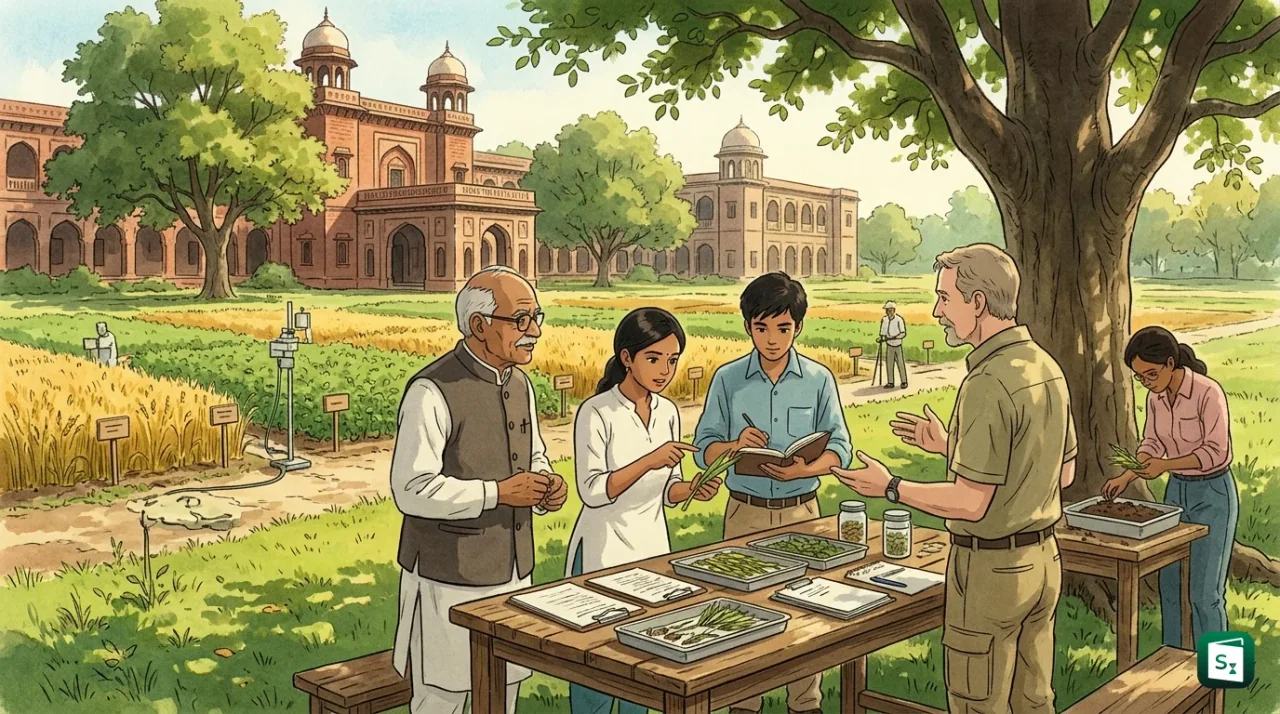
The National Academy of Agricultural Sciences and the Council for Agricultural Science and Technology signed a five-year cooperation agreement on 20 October 2026 to run joint educational programs, co-published science communication products, leadership exchanges and scientist exchanges between India and the United States.
The Memorandum of Understanding (MoU) is an initial five-year framework, not a single project grant. It allows NAAS and CAST to plan joint webinars, workshops and policy discussions, or to build on training and publication programs that each side already runs. The focus is on making farm science easy to use for policymakers, teachers, industry and the public.
The NAAS side was represented by Secretary B. S. Dwivedi and Foreign Secretary Karim Maredia, while the CAST side was represented by President P. V. Vara Prasad and Chief Executive Officer Chris Boomsma. NAAS President M. L. Jat, who is also Secretary of the Department of Agricultural Research and Education (DARE) and Director General of the Indian Council of Agricultural Research (ICAR), addressed the related roundtable virtually from India.
The first set of activities under the NAAS CAST MoU includes a jointly hosted webinar, a jointly produced science communication or policy product, and a leadership exchange on how science academies guide policy. The two bodies also plan to explore a CAST NAAS Distinguished Agricultural Science Lecture series and a regular joint presence at the Borlaug Dialogue and other shared meetings. Student and early career support through mentoring, science communication training and exchange visits is part of the plan.
Topics of Shared Interest for Agricultural Research Collaboration
The NAAS CAST agricultural research collaboration will focus on seven broad themes where Indian and American farm science needs overlap. These themes link field level farming with nutrition, water, climate, technology and energy.
The two academies have listed food and nutrition security as the central goal. Water availability and water quality form the second pillar, since irrigation and safe water shape yields in both countries. A third area is helping agriculture adjust to environmental stresses such as heat, drought, floods and soil loss.
| Shared Research Theme | What It Covers in Simple Terms |
|---|---|
| Food and nutrition security | Enough food that is also healthy and nourishing |
| Water availability and quality | Irrigation supply, groundwater care and clean water for farms |
| Environmental stress adaptation | Crops and practices that cope with heat, drought and floods |
| Artificial intelligence and digital tools | Data, sensors and AI advisories for precision farming |
| Biotechnology and gene editing | Improved seeds and traits developed through modern biology |
| Renewable energy in agriculture | Solar and bioenergy use on farms and in value chains |
| Natural resource protection | Care of soil, biodiversity and farm landscapes |
Artificial intelligence and digital farming tools cover a fast growing part of agri research that includes remote sensing, farm advisories and precision irrigation. Biotechnology and gene editing refer to methods that improve crop traits with greater speed and precision than older breeding alone. Renewable energy and natural resource protection connect farm output with long term care of soil, water and rural landscapes.
Why Was the MoU Signed at the Borlaug Dialogue?
The World Food Prize Foundation organised the 2026 Norman E. Borlaug International Dialogue from 20 to 22 October 2026 in Des Moines, Iowa. The event is an annual global meeting on food security named after Norman Borlaug, the American plant scientist known as the father of the Green Revolution. The 2026 theme was Before Hunger Wins.
The venue choice gave the NAAS CAST pact direct global visibility. NAAS set up an exhibition booth at Des Moines to display publications of NAAS and ICAR. Young Indian students also took part in the Global Youth Institute (GYI), a youth program linked to the World Food Prize that brings school students together with food and farm experts.
Alongside the main Dialogue, NAAS organised a special roundtable on agricultural higher education. The session discussed global partnerships, industry ready training and stronger links with the Indian agricultural diaspora. M. L. Jat said India must move from production centred farming to a full agrifood value chain approach that links research, education, industry and farmers.
What Is the National Academy of Agricultural Sciences?
The National Academy of Agricultural Sciences (NAAS), based in New Delhi, is India’s apex think tank for farm science policy, research guidance and recognition of scientists. NAAS was established on 5 June 1990 following the vision of noted plant breeder B. P. Pal. It works on crop husbandry, animal husbandry, fisheries, agroforestry, agro industry, environment and nutrition.
NAAS operates from the National Agricultural Science Centre Complex (NASC Complex) on Dev Prakash Shastri Marg at Pusa in New Delhi. It brings scientists together to discuss research, education and extension, and gives science based policy inputs to planners and decision makers. The Academy organises brainstorming sessions, congresses, strategy workshops and an Agricultural Science Congress. It also publishes policy papers, strategy papers and the journal Agricultural Research.
NAAS recognises excellence through election as Fellow, Associateship for young scientists, the NAAS Young Scientist Award, fellowships and scholarships such as the NAAS YUVA forum created in 2024. M. L. Jat is President of NAAS (as of October 2026), in addition to his roles in DARE and ICAR.
What Is NAAS Rating and How Is NAAS Score Calculated?
The NAAS rating is NAAS scoring of science journals to judge the quality of research papers submitted for Fellowship and Associateship. For journals with a Clarivate Impact Factor, the NAAS score equals 6 plus the Impact Factor, capped at 20. Other journals are scored after review of publisher details and scientific content.
The NAAS score matters because election of NAAS Fellows depends heavily on a clear and uniform check of publications. For Fellowship, the forty most important papers are counted for up to 50 marks. For Associateship, the twenty most important papers are counted for up to 60 marks. Review papers get no marks, and first and corresponding authors get full credit while other coauthors get 75 percent. The NAAS journal list 2026, effective from 1 January 2026, is widely used by farm universities and the Indian Council of Agricultural Research system for academic evaluation.
What Is the Council for Agricultural Science and Technology?
The Council for Agricultural Science and Technology (CAST), based in Ames, Iowa, is an independent nonprofit body that gives farm science a clear voice in public policy. CAST was founded in 1972 by a coalition of scientific societies following the idea put forward by Iowa State scientist Charles A. Black. It brings together expert networks and produces peer reviewed publications for policymakers, teachers, journalists and the public.
CAST is headquartered at 2625 North Loop Drive, Ames, inside the Iowa State University Research Park, after moving there in June 2024 from its earlier home on West Lincoln Way. CAST works nationally with more than 1,000 active members drawn from societies, universities, companies, nonprofits and individuals. Its reports have covered food safety, biotechnology, climate change, water and energy use, and genome edited crops.
P. V. Vara Prasad, a university distinguished professor at Kansas State University, is President of CAST (as of October 2026). Chris Boomsma serves as Chief Executive Officer. CAST also presents the Borlaug CAST Communication Award, which in 2026 went to Michigan State scientist Karim Maredia, who also serves as NAAS Foreign Secretary. This overlap of people shows how closely the two academies already work through shared expert networks.
How NAAS, CAST and ICAR Fit Into the Agricultural Research Network
The Indian Council of Agricultural Research (ICAR) is the apex body of India’s farm research and education system. ICAR was set up on 16 July 1929 as the Imperial Council of Agricultural Research and took its present name after Independence. It works under the Department of Agricultural Research and Education of the Ministry of Agriculture and Farmers Welfare and is headquartered in New Delhi. ICAR guides a vast network of about 102 research institutes, agricultural universities, Krishi Vigyan Kendras and technology application bodies.
NAAS works closely with this system but plays a different role. ICAR funds and runs research, teaching and field extension across the country. NAAS acts as an independent academy that reviews the science, honours top researchers and suggests policy directions. CAST plays a similar convening role in the United States, where it connects many societies and disciplines into one science based voice.
| Body | Set Up | Base | Core Role |
|---|---|---|---|
| NAAS | 1990 | New Delhi, India | Independent think tank, policy advice and scientist recognition |
| CAST | 1972 | Ames, Iowa, United States | Expert networks and peer reviewed publications for policy and public |
| ICAR | 1929 | New Delhi, India | Apex farm research, education and extension network |
The NAAS CAST link therefore connects two similar conveners on either side of the India US farm knowledge chain. It can help Indian regional agricultural research stations, central institutes for dryland agriculture, field crops research teams and agri universities tap into American multidisciplinary networks, and vice versa.
The Way Forward
The two academies have said their priority is to turn the paper agreement into working programs with clear planning and regular review. Joint webinars and a first joint publication will test how fast shared teams can produce useful guidance on food, water and climate. A leadership exchange will look at how to run science bodies that policymakers trust.
For India, the pact supports the shift toward agrifood systems thinking, industry ready farm graduates and stronger diaspora links. For both sides, mentoring of students and early career scientists can build a new generation that can explain complex farm issues in simple terms. If the early activities succeed, the lecture series and a standing presence at future Borlaug Dialogues can make the partnership a steady bridge for India US farm science.
Key Takeaways
- The NAAS CAST MoU is a five-year pact signed on 20 October 2026 in Des Moines to support joint programs, publications and scientist exchanges.
- The MoU was signed during the 2026 Norman E. Borlaug International Dialogue held from 20 to 22 October 2026 on the theme Before Hunger Wins.
- NAAS was established on 5 June 1990 in New Delhi on the vision of B. P. Pal and works as an apex farm science think tank.
- For journals with an Impact Factor, NAAS score equals 6 plus Impact Factor, capped at 20.
- CAST was founded in 1972 and is headquartered at Ames, Iowa, serving as an independent nonprofit convener of farm science.
- ICAR was set up on 16 July 1929 and functions under DARE with headquarters in New Delhi as India’s apex farm research body.