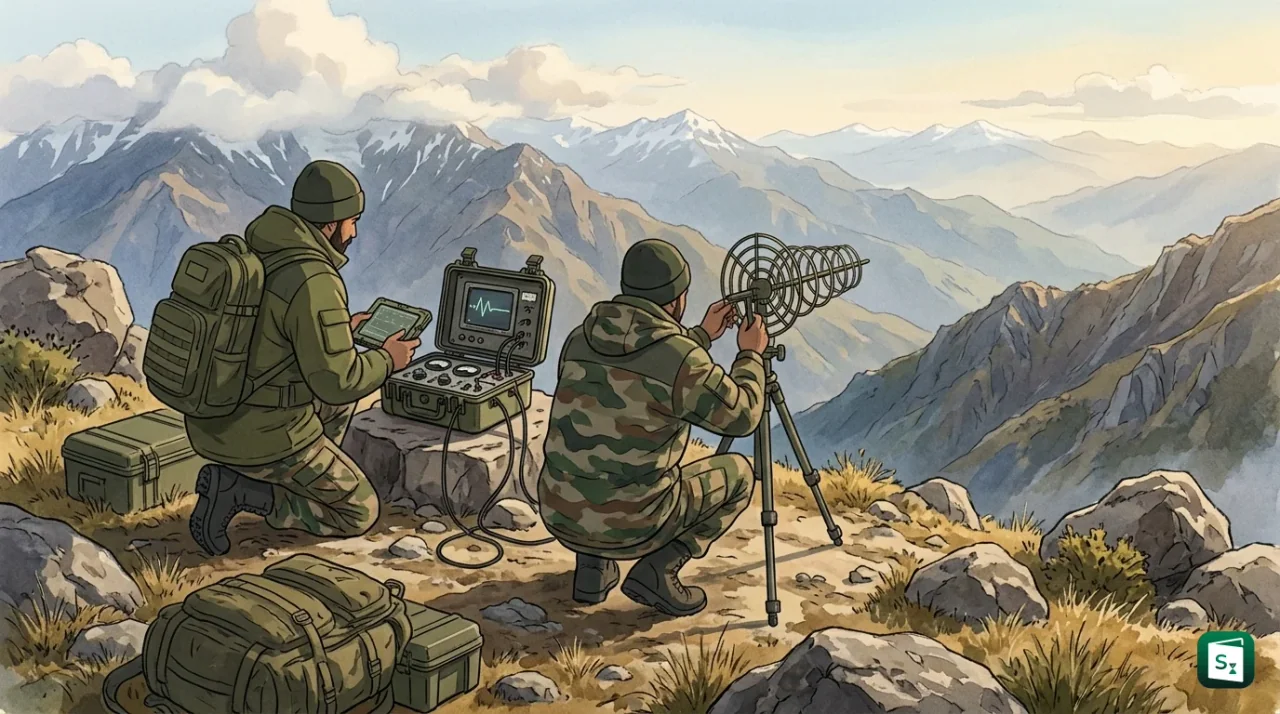
The Defence Research and Development Organisation has started work on man portable Electronic Intelligence modules through its Defence Electronics Research Laboratory in Hyderabad. The compact modules will passively intercept and analyse signals from enemy radars and other electronic equipment in the field. The project aims to give frontline units their own listening capability without depending on large vehicle mounted systems.
What Is Electronic Intelligence (ELINT)?
Electronic Intelligence, or ELINT, is intelligence gathered from non communication electronic emissions, mainly radars and other sensors. The Defence Electronics Research Laboratory in Hyderabad studies these emissions to identify the type of radar, its technical features and its location for electronic warfare operations.
ELINT stands for Electronic Intelligence. It focuses on signals that do not carry spoken messages or written data. A radar beam, the guidance signal of a weapon system and the control link of a drone are typical examples. Analysts record these emissions and study their physical character. The goal is to learn what equipment is operating across the border and how it behaves.
This work is passive. The ELINT receiver only listens. It does not send out any signal of its own. That makes it hard for the enemy to detect. At the same time, every active radar must transmit to scan the sky. That transmission gives away clues about its presence and type.
How ELINT Modules Detect and Identify Radar Signals
An ELINT system starts with an antenna and a sensitive receiver. The antenna picks up electromagnetic waves across different radar bands. The receiver converts these waves into digital data for further study. Modern receivers use fast sampling and digital processing to handle weak and brief pulses.
The system then measures key features of each pulse. These include frequency, pulse width, pulse repetition interval, signal strength, direction of arrival and internal modulation. Pulse width is the duration of a single burst. Pulse repetition interval is the gap between two bursts. Modulation refers to deliberate changes inside the pulse, such as chirp or phase codes, which help radars measure distance accurately.
In a real battlefield, several radars transmit at the same time. Their pulses mix at the receiver. The system must separate this jumble. This step is called deinterleaving. Software groups pulses by frequency and timing pattern. Machine learning tools now help speed up this sorting in dense signal environments.
Each separated group is then compared with a stored library of known radar signatures. This library holds the fingerprints of search radars, tracking radars and fire control radars. A search radar scans a wide area. A tracking radar follows a single target. A fire control radar guides a weapon. A match tells the operator what type of system is active. A change in the signal can also warn that a radar has shifted from search to tracking mode.
The module can also help fix the location of the emitter. If two or more sensors catch the same signal from different points, analysts combine the readings. Techniques such as triangulation and time difference of arrival give an approximate position. This location data supports jamming decisions and early warning against drones and low flying threats.
ELINT vs SIGINT vs COMINT: The Core Differences
Signals Intelligence, or SIGINT, is intelligence derived from intercepted electromagnetic signals, both communication and non communication types. The SIGINT family has two main branches, which are Communication Intelligence that studies messages between people and Electronic Intelligence that studies radar and other non message emissions.
Communication Intelligence, or COMINT, deals with communication between people. Voice calls, radio messages and data links fall in this group. Analysts focus on content, language, network and traffic pattern. COMINT needs linguists and decryption support when the message is encrypted.
ELINT deals with machines, not conversations. It studies the technical character of radars, beacons, jammers and missile telemetry. Foreign Instrumentation Signals Intelligence, or FISINT, is sometimes listed as a third branch. It tracks test data from weapons under trial, such as missile flight performance.
| Type | Full Form | What It Collects | Typical Source |
|---|---|---|---|
| SIGINT | Signals Intelligence | All intercepted electromagnetic signals | Parent category covering COMINT and ELINT |
| COMINT | Communication Intelligence | Messages and conversations | Radio nets, mobile phones, data links |
| ELINT | Electronic Intelligence | Non communication emissions | Search radars, tracking radars, drone links |
| FISINT | Foreign Instrumentation Signals Intelligence | Test and telemetry data | Missile trials, space launches |
Is ELINT a part of SIGINT. Yes. ELINT is a subset of SIGINT along with COMINT. In simple terms, SIGINT is the full set, while ELINT and COMINT are its two main parts.
DRDO and the Hyderabad Defence Cluster
The Defence Research and Development Organisation, or DRDO, is the research arm of the Ministry of Defence. The organisation was formed in 1958 through the merger of the Technical Development Establishments with the Defence Science Organisation. It is headquartered at DRDO Bhawan in New Delhi and functions under the Department of Defence Research and Development. The Chairman of DRDO also serves as Secretary of the department and Scientific Adviser to the Defence Minister.
DRDO runs a network of around 50 laboratories across the country. These labs cover aeronautics, missiles, armaments, naval systems, electronics, materials and life sciences. The target is self reliance in critical defence technologies so that the armed forces depend less on imports.
Hyderabad is one of the largest hubs in this network. The city hosts the Advanced Systems Laboratory (ASL), the Defence Research and Development Laboratory (DRDL), the Research Centre Imarat (RCI), the Defence Metallurgical Research Laboratory (DMRL) and the Defence Electronics Research Laboratory (DLRL). ASL and DRDL work on missiles and strategic systems. RCI leads seekers, avionics and the Very Short Range Air Defence System. DLRL leads electronic warfare. Together, they make Hyderabad central to missiles, materials and electronics.
Defence Electronics Research Laboratory: Mandate and Legacy
DLRL stands for Defence Electronics Research Laboratory. The laboratory is located at Chandrayangutta in Hyderabad, Telangana. It was established in 1961 to meet the electronic warfare needs of the armed forces and it was founded under the guidance of S. P. Chakravarti, a pioneer of electronics engineering in India.
DLRL designs integrated electronic warfare systems across radar and communication bands. Its work spans Electronic Intelligence, Communication Intelligence, Electronic Support Measures and Electronic Countermeasures. These systems are fitted on vehicles, ships, submarines, helicopters, aircraft, pods and static stations. The laboratory also runs specialised courses in electronic warfare for scientists and service officers.
The laboratory built the Samyukta system for the Indian Army, which is a large vehicle based electronic warfare network for tactical battlefields. It has also contributed to naval systems such as Sangraha and Varuna, airborne self protection jammers and support measures for the Airborne Early Warning and Control platform. To test large systems, DLRL operates an extension campus called the Electronics System Engineering Centre, or ELSEC, on a sprawling campus near Hyderabad with simulation, antenna and environmental test facilities.
Man Portable ELINT Modules: What DRDO Is Developing Now
The new requirement is listed as Man Portable ELINT Modules Development, Integration and Qualification, with reference DLRL/27DCT006/LP. The procurement record shows publication on 13 October 2026, bid closure on 27 October 2026 and bid opening on 28 October 2026 at DLRL Hyderabad. The listed work period is 450 days and the tender follows a two cover technical and financial bid system. The earnest money deposit is listed as ₹9,35,268.
The word development matters here. The project is at the build and prove stage. It is not an announcement of a completed product or an induction into service. DLRL seeks an industry partner to develop the modules, integrate them into a single working system and then qualify the system through trials.
Development covers the hardware and software blocks, including antenna, receiver, processor and power pack. Integration joins these blocks into a rugged field unit. Qualification tests the unit against technical and environmental standards such as temperature, humidity, vibration, shock and electromagnetic interference. Only after clearing these tests can user trials and production follow.
The design focus is portability. Large ELINT systems ride on vehicles or aircraft and give wide coverage. They cannot reach every ridge or forward post in mountains and remote terrain. A man portable unit can move with a small team. It gives that team direct awareness of nearby radar activity and drone control links without waiting for higher level assets.
| Feature | Man Portable ELINT Module | Man Portable Air Defence System |
|---|---|---|
| Full form example | Man Portable ELINT Modules (MPEM) | Very Short Range Air Defence System (VSHORADS) |
| Main task | Listen, record and identify signals | Shoot down low flying aircraft and drones |
| Nature | Passive sensor, emits nothing | Active weapon with missile and launcher |
| Developed by | DLRL Hyderabad | Research Centre Imarat Hyderabad with other labs |
| Use in field | Early warning and jamming support | Last layer point defence up to about 6 km |
This difference is important. A man portable air defence missile destroys a target. A man portable ELINT module finds and classifies the electronic trail that leads to the target. The two complement each other in counter drone and low level air defence drills.
Electronic Warfare in India: From Samyukta to Portable Systems
Electronic warfare has three broad parts. Electronic Support covers search, intercept and location fixing. Electronic Attack covers jamming and deception. Electronic Protection covers measures to keep own systems working despite enemy jamming. ELINT mainly feeds the first part, but its library data also guides jamming.
India already operates large electronic warfare networks. The Samyukta system, handed over to the Indian Army in 2004, is a mobile integrated network built by DLRL with Bharat Electronics Limited, Electronics Corporation of India and the Corps of Signals. Each Samyukta set uses around 145 mobile vehicles with communication and non communication segments and covers about 150 km by 70 km. It can survey, intercept, locate and jam signals from high frequency to millimetre wave bands.
The Defence Acquisition Council cleared new electronic warfare sets for plains and deserts in 2020 to give field formations comprehensive support and countermeasure capability. DRDO has also worked on naval suites, airborne pods and the Advanced Self Protection Jammer for fighters such as Tejas and Su-30MKI. The new man portable ELINT effort extends this ladder down to squad and platoon level.
Portability brings clear tactical value. A light team on a ridge can detect a surveillance radar across the valley. It can note when a fire control radar switches on. It can pick up a drone control link and alert counter drone guns. It can record unknown signals for the central library so that future jammers know the exact frequency to block. In mountains, where vehicles struggle and line of sight changes quickly, this local picture saves time.
Key Takeaways
- DRDO’s DLRL Hyderabad has initiated development of Man Portable ELINT Modules to detect and analyse enemy radar signals.
- ELINT means intelligence from non communication emissions, mainly radars, while SIGINT is the parent category covering both ELINT and COMINT.
- DLRL was established in 1961 at Chandrayangutta, Hyderabad and leads electronic warfare systems for the armed forces.
- The project covers development, integration and qualification, with bid opening scheduled on 28 October 2026 and a 450 day work period.
- Samyukta, developed by DLRL and partners and handed over in 2004, uses about 145 vehicles to cover 150 km by 70 km for tactical electronic warfare.