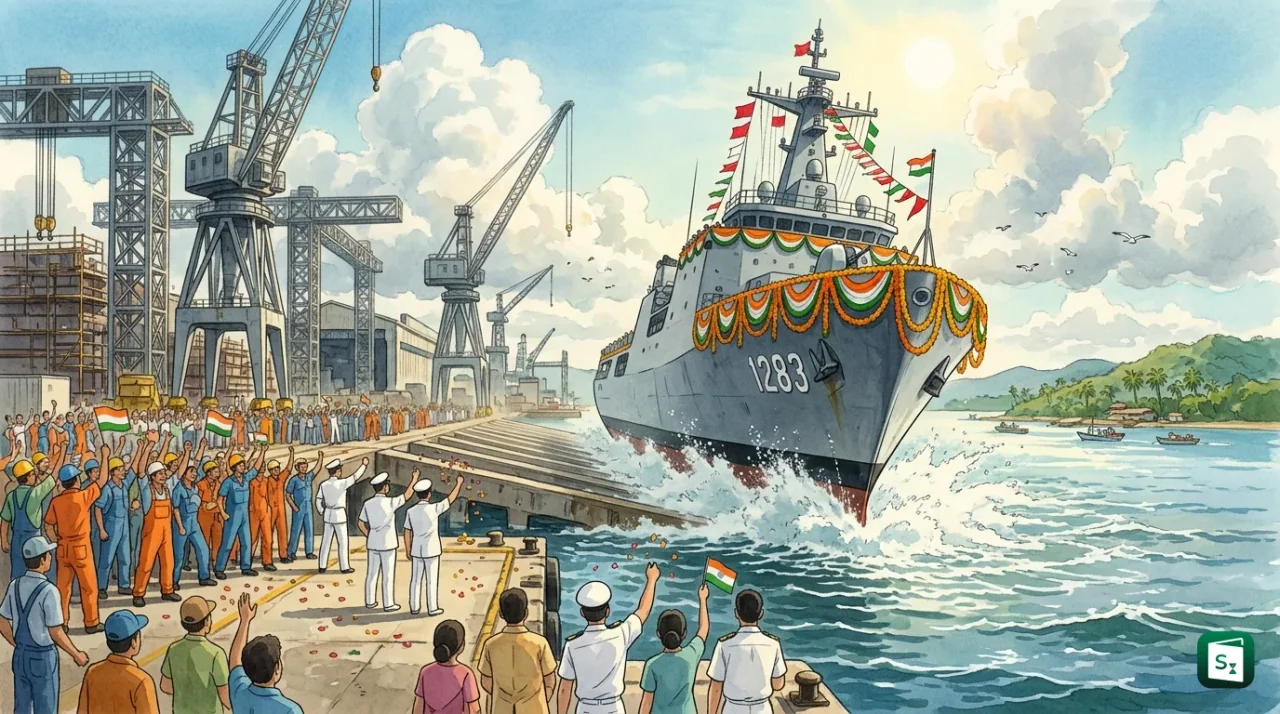
Goa Shipyard Limited launched INS Srishti (Yard 1283) at its Vaddem facility in Goa on 27 October 2026. The vessel is the fourth Next Generation Offshore Patrol Vessel (NGOPV) built by the yard for the Indian Navy. It is part of an 11-ship programme shared between Goa Shipyard and Garden Reach Shipbuilders and Engineers in Kolkata.
What Is NGOPV and What Is an Offshore Patrol Vessel?
NGOPV stands for Next Generation Offshore Patrol Vessel. It is the Indian Navy’s new class of large patrol ships designed in India for long patrols far from the coast. The NGOPV programme will add 11 ships to the Navy, and these ships will support the existing fleet of 10 older offshore patrol vessels.
An offshore patrol vessel (OPV) is a naval ship built for patrolling the vast ocean areas around a country, rather than for full scale battle. OPVs guard the Exclusive Economic Zone (EEZ), which is the 200 nautical mile sea zone where India has special rights over fishing, oil and other resources. They also check piracy, smuggling and intrusion, protect offshore oil platforms, and carry out search and rescue.
The word next generation signals a clear jump in size and ability. Older Navy OPVs were smaller and simpler. NGOPVs displace about 3,000 tonnes, carry helicopters, stay at sea longer, and use modern sensors and guns. In short, they can watch a larger area, respond faster, and handle several missions on one deployment.
The 11-Vessel NGOPV Programme
The Ministry of Defence signed the NGOPV contracts on 30 March 2023 under the Buy (Indian-IDDM) category. IDDM means Indigenously Designed, Developed and Manufactured, the highest grade of domestic content in defence purchase rules. The total cost for 11 NGOPVs was ₹9,781 crore. On the same day, the ministry also signed for six Next Generation Missile Vessels, taking the combined announcement to about ₹19,600 crore.
Goa Shipyard Limited is the lead yard with seven ships. Garden Reach Shipbuilders and Engineers (GRSE) in Kolkata is the follow yard with four ships. Both yards design and build their ships in India. The original schedule planned for deliveries to begin from September 2026.
Progress has been rapid in 2026. Goa Shipyard launched the first ship, Shachi (Yard 1280), on 31 March 2026. GRSE launched Sanghmitra (Yard 3039) on 20 May 2026, Shruti (Yard 3037) on 11 August 2026, and Shreyas on 10 October 2026. INS Srishti, launched on 27 October 2026, keeps that momentum going and shows that two shipyards can build the same class side by side.
| Fact | Detail |
|---|---|
| Total NGOPVs for Indian Navy | 11 ships |
| GSL share | 7 ships in Goa |
| GRSE share | 4 ships in Kolkata |
| Contract date | 30 March 2023 |
| Contract value for 11 NGOPVs | ₹9,781 crore |
| Category | Buy (Indian-IDDM) |
| Keel laying of Yard 1283 (Srishti) | 9 June 2025 |
| Planned start of deliveries | September 2026 |
INS Srishti (Yard 1283): The Launch at Vaddem
INS Srishti is Yard 1283, the fourth NGOPV hull launched by Goa Shipyard for this programme. The word launch has a precise meaning in shipbuilding. It means the completed hull is moved from the building berth into the water for the first time. Outfitting, trials and weapon fitting happen after the launch. The ship enters Navy service only after harbour and sea trials.
The launch took place at Goa Shipyard’s Vaddem facility in Vasco da Gama, Goa, on 27 October 2026. Sandeepa Sahay ceremonially launched the vessel, following naval tradition where a lady names and launches the ship. Vishvajit Sahay, Secretary (Defence Finance), attended as chief guest. Brajesh Kumar Upadhyay, Chairman and Managing Director of Goa Shipyard (as of October 2026), along with senior officers from the Indian Navy and the Ministry of Defence, was present.
The date matters. Srishti entered the water only 17 days after GRSE launched Shreyas in Kolkata. Five NGOPV hulls from two yards are now in the water within seven months. That pace points to stable designs, shared learning and better block construction methods.
At the ceremony, the Defence Finance Secretary stressed productivity, cost control and timely execution for the proposed shipbuilding project at Machilipatnam. Goa Shipyard linked the launch to digital planning, standard designs and stronger contract management. These are practical steps to cut delays, a long standing challenge in warship building.
Goa Shipyard Limited and GRSE: Builders of the Fleet
Goa Shipyard Limited (GSL) is a Defence Public Sector Undertaking under the Ministry of Defence. The yard stands on the southern bank of the Zuari river at Vasco da Gama. Its roots go back to 1957, when it was set up as Estaleiros Navais de Goa under Portuguese rule to build barges for Goa’s mining trade. After Goa’s liberation in December 1961, the Government of India took over the yard. It was leased to Mazagon Dock from 1962 to 1967 and renamed Goa Shipyard Limited with effect from 29 September 1967. It has worked under its own board since 1 October 1967.
GSL builds patrol vessels, missile boats, frigates and survey ships, and also repairs and modernises ships for the Navy and Coast Guard. It is certified for quality, environment and occupational health and safety systems. For NGOPVs, GSL is the lead shipyard. That means it anchors the basic design coordination for its seven ships and sets the pace for delivery.
Garden Reach Shipbuilders and Engineers (GRSE), headquartered in Kolkata, is the follow yard. GRSE is a major warship builder with a long record of frigates, corvettes and patrol vessels. It holds Navratna status among central public enterprises. GRSE builds four NGOPVs at its Kolkata complex. Its three launches between May and October 2026 show that capacity is now spread across both coasts, which reduces risk if one yard faces congestion.
Both yards feed the same national goal. The NGOPV programme keeps design jobs, steel work, equipment orders and testing inside India. Suppliers of cables, pumps, ventilation, galleys and electrical systems are largely domestic. That spread of work is the core of Make in India and Aatmanirbhar Bharat in shipbuilding.
Key Features and Operational Roles of NGOPVs
NGOPVs of the Indian Navy share a common size band. The ships are about 113 metres long with a beam of 14.6 metres. Design displacement is about 3,000 tonnes. Top speed is 23 knots. Endurance is about 8,000 to 8,500 nautical miles at 14 knots. That range lets a ship sail from Goa to the far reaches of the Indian Ocean and back with limited support. Crew strength is about 24 officers and over 100 sailors.
Firepower and aviation set NGOPVs apart from older patrol vessels. The ships carry a larger gun fit and modern surveillance radars. They have an integral helicopter capability with a hangar and flight deck, supported by a helicopter handling system. A helicopter extends the ship’s eyes by hundreds of kilometres. It helps in search and rescue, medical evacuation and anti piracy boarding support.
The listed missions are clear. The ships will handle coastal defence and surveillance, search and rescue, protection of offshore assets such as Bombay High oil fields, escort of shipping lanes and anti piracy missions. They will also support Humanitarian Assistance and Disaster Relief (HADR), which means quick aid after cyclones, floods or distress at sea.
In plain terms, think of an OPV as a long distance police patrol car for the sea. It does not fight fleet battles like a destroyer. It stays out long, watches wide, stops suspicious vessels, rescues crews and shows the flag in distant ports. NGOPVs do the same work, but with better reach, better sensors and a helicopter on board.
Names in the NGOPV Fleet: From Shachi to Srishti
Indian Navy NGOPVs take their names from India’s heritage. The naming is deliberate. It aids recall and links each hull to a cultural idea of service and vigilance.
The crest of NGOPVs depicts the constellation of Ursa Major and a red and white lighthouse. The stars suggest steady navigation. The lighthouse signals guidance and watchfulness at sea.
| Ship | Yard No. | Builder | Launch Date | Meaning of Name |
|---|---|---|---|---|
| Shachi | 1280 | GSL, Goa | 31 March 2026 | Wife of Indra in mythology, meaning one who renders assistance |
| Sanghmitra / Sanghamitra | 3039 | GRSE, Kolkata | 20 May 2026 | Daughter of Emperor Ashoka, known for spreading compassion and learning |
| Shruti | 3037 | GRSE, Kolkata | 11 August 2026 | That which is heard, referring to the four Vedas |
| Shreyas | Notified as third GRSE hull | GRSE, Kolkata | 10 October 2026 | Auspicious, the path of the highest good |
| Srishti | 1283 | GSL, Goa | 27 October 2026 | Creation or the universe in Sanskrit |
The name Srishti means creation. It points to the idea of building new capability at home. The earlier names Shachi and Shruti were also used for older Naval Offshore Patrol Vessels launched at Pipavav in 2017, which shows continuity in naval naming practice.
The Indian Navy uses the prefix INS, which stands for Indian Naval Ship, once a vessel is commissioned. Until commissioning, a hull is often referred to by yard number and name. So Yard 1283 Srishti will formally become INS Srishti on joining service after trials.
Why the NGOPV Fleet Matters for India
The Indian Navy watches over an Exclusive Economic Zone of more than 2 million square kilometres plus island territories and long sea lanes. Merchant ships carry most of India’s oil and trade through the Arabian Sea and Bay of Bengal. Piracy in the western Indian Ocean, smuggling, illegal fishing and grey zone intrusions keep that burden high. Older patrol ships cannot cover all of it.
Eleven NGOPVs add volume and staying power. Greater endurance means fewer gaps between patrols. Helicopter decks mean faster search. Modern guns and sensors mean stronger deterrence against armed pirates and intruders. The ships can also step into disaster relief when cyclones strike coastal states or island neighbours.
There is an industrial logic too. Warship orders sustain steel plants, engine service firms, electronics vendors and skilled welders. Two-yard construction builds spare capacity for future orders, including a separate six-ship NGOPV project for the Indian Coast Guard at Mazagon Dock Shipbuilders in Mumbai. That Coast Guard order, signed in December 2023 for about ₹1,600 crore, uses slightly different dimensions but the same self reliance model.
The way forward is now about outfitting and trials. Hull launch is the midpoint, not the finish. The yards must complete cabling, weapons, sensors and harbour checks, then prove speed, endurance and helicopter operations at sea. Timely delivery from late 2026 onward will decide whether the programme eases the Navy’s patrol load as planned.
Key Takeaways
- INS Srishti (Yard 1283) was launched by Goa Shipyard Limited at Vaddem, Goa on 27 October 2026.
- NGOPV stands for Next Generation Offshore Patrol Vessel, a 3,000-tonne class with 23 knots speed and 8,000 to 8,500 nautical miles endurance.
- The Indian Navy ordered 11 NGOPVs on 30 March 2023 for ₹9,781 crore, with 7 ships at GSL Goa and 4 ships at GRSE Kolkata.
- Goa Shipyard Limited, established in 1957 at Vasco da Gama, is the lead yard for the programme.
- The NGOPV crest shows the Ursa Major constellation and a red and white lighthouse, symbolising navigation and vigilance.