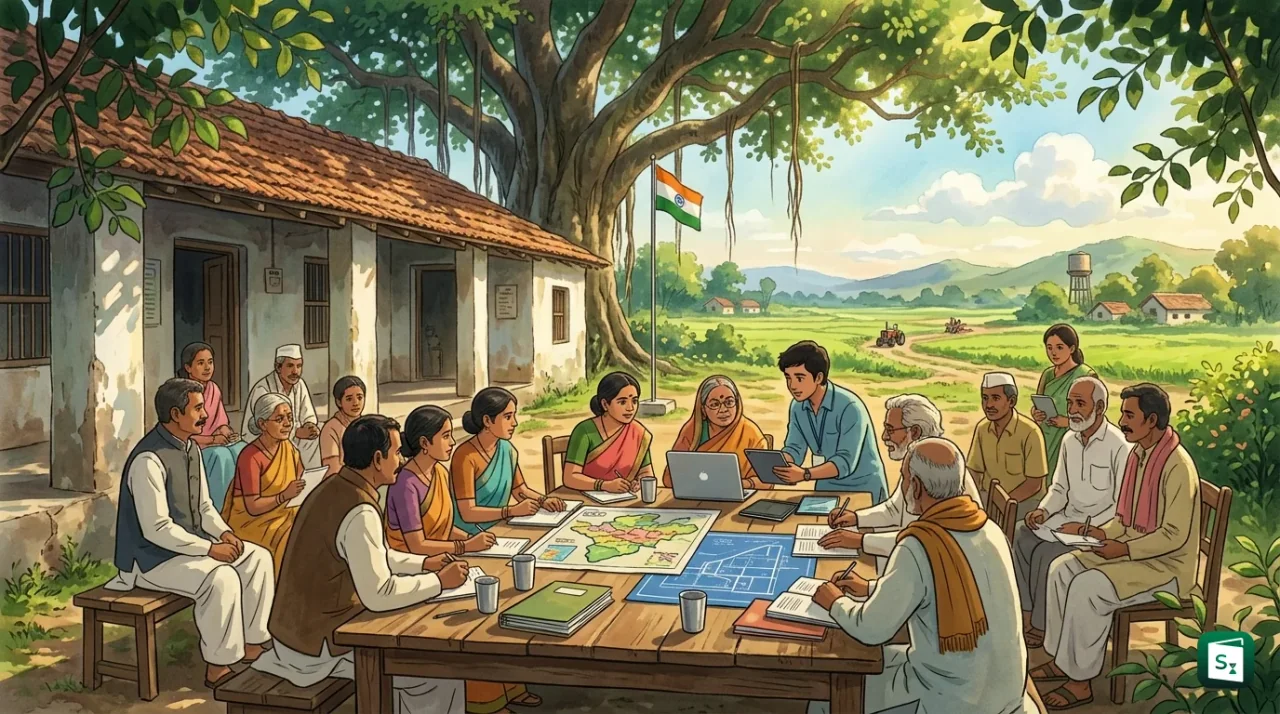
The Union Cabinet on 28 October 2026 approved the Pradhan Mantri Viksit Gram Swaraj Yojana (PM VGSY) as a Centrally Sponsored Scheme for 2026-27 to 2030-31 with a total outlay of ₹7,395.55 crore. The scheme will train around 32 lakh elected panchayat representatives every year and support the preparation of 2.55 lakh Gram Panchayat Development Plans on the e Gram Swaraj portal. It also targets 2.55 lakh online audit plans each year to make village accounts transparent and panchayats financially stronger.
What Is PM Viksit Gram Swaraj Yojana?
The PM Viksit Gram Swaraj Yojana (PM VGSY) is a five year national programme to strengthen village panchayats as centres of local self governance and economic growth. The Union Cabinet, chaired by Prime Minister Narendra Modi, approved PM VGSY on 28 October 2026 for implementation from 2026-27 to 2030-31. The Ministry of Panchayati Raj will steer the scheme in line with the national vision of Viksit Bharat by 2047.
PM VGSY covers all States and Union Territories. It also covers institutions of rural local government in areas where panchayats do not exist under Part IX of the Constitution. These are called Traditional Local Bodies and include village bodies in parts of the Northeast and Fifth and Sixth Schedule areas. Around 32 lakh elected representatives, panchayat functionaries and other stakeholders across more than 2.55 lakh panchayats and traditional bodies will benefit directly each year. Each coordinated awareness drive under the scheme is expected to reach at least 1 crore citizens.
From RGSA to PM VGSY: Background and Need
Training of panchayat members has been a central task of the Ministry of Panchayati Raj for many years. Early support came through programmes such as the Backward Regions Grant Fund and the Rajiv Gandhi Panchayat Sashaktikaran Abhiyan. The Rashtriya Gram Swaraj Abhiyan (RGSA) was then approved on 21 April 2018 for 2018-19 to 2021-22 with an outlay of ₹7,255.50 crore. It focused on strengthening panchayats to achieve the Sustainable Development Goals (SDGs) with attention to 117 aspirational districts.
The scheme was revamped on 13 April 2022 for 2022-23 to 2025-26, co-terminus with the Fifteenth Finance Commission period. The revamped RGSA had a total cost of ₹5,911 crore, including a Central Share of ₹3,700 crore. Its focus was to reimagine panchayats as vibrant centres of self governance through localisation of SDGs in nine themes such as poverty free, healthy, child friendly, water sufficient, clean and green, self sufficient infrastructure, socially secured, good governance and women friendly villages. Basic orientation training was to be completed within six months of election and refresher training within two years.
PM VGSY builds on this base but changes the method. Instead of prescribing fixed activities from above, the new scheme puts weight on local capacity, local planning and digital use. The idea is simple. If panchayat members can plan better, keep accounts online and raise their own income, village development becomes steady even after central funds slow down. The government has described this shift as a move from prescription based support to institution building at the village level.
| Feature | Revamped RGSA (2022-26) | PM VGSY (2026-31) |
|---|---|---|
| Period | 2022-23 to 2025-26, linked to Fifteenth Finance Commission | 2026-27 to 2030-31, linked to Sixteenth Finance Commission |
| Total outlay | ₹5,911 crore | ₹7,395.55 crore |
| Core focus | Localisation of SDGs through nine themes | Holistic planning, capacity building, digital handholding and financial self reliance |
| Planning tool | e Gram Swaraj portal for plan upload | 2.55 lakh integrated GPDPs prepared annually on e Gram Swaraj portal |
| Audit tool | AuditOnline for online panchayat audit | At least 2.55 lakh online audit plans prepared annually |
Outlay and Funding Pattern as a Centrally Sponsored Scheme
A Centrally Sponsored Scheme (CSS) is a scheme jointly funded by the Centre and the States but implemented by State governments. This is different from a Central Sector Scheme, which is fully funded and directly implemented by the Centre. Centrally Sponsored Schemes usually deal with subjects in the State List and Concurrent List to push national priorities through state machinery.
PM VGSY will run as a Centrally Sponsored Scheme with the following financial structure.
| Component of PM VGSY | Amount |
|---|---|
| Total outlay for five years | ₹7,395.55 crore |
| Central Share | ₹4,869.48 crore |
| State Share | ₹2,526.07 crore |
The standard sharing pattern for such schemes is 60:40 between the Centre and most States, 90:10 for Northeastern and Himalayan States and the Union Territory of Jammu and Kashmir, and 100% central funding for Union Territories without a legislature. The overall PM VGSY figures reflect this mix across all States and Union Territories.
The five year period matches the award period of the Sixteenth Finance Commission, which runs from 1 April 2026 to 31 March 2031. The Finance Commission is set up under Article 280 of the Constitution to divide tax revenue between the Union and States and to suggest grants for local bodies. The Sixteenth Finance Commission was constituted on 31 December 2023 with economist Arvind Panagariya as Chairperson. It submitted its report to the President on 17 November 2025. Aligning PM VGSY with this cycle helps panchayats use Finance Commission grants in a planned way during the same five years.
| Basis | Centrally Sponsored Scheme | Central Sector Scheme |
|---|---|---|
| Funded by | Centre and States jointly | Centre alone at 100% cost |
| Implemented by | State governments and local bodies | Central ministries and agencies |
| Example focus | Health mission, rural roads, PM VGSY | Food subsidy, crop insurance, fertilizer subsidy |
What Is Gram Swaraj?
The Gram Swaraj idea means village self rule where each village manages its own political, economic and moral life. Mahatma Gandhi presented it as self sufficient and self governing village republics. PM VGSY draws its name from this ideal of empowered and self reliant panchayats.
Gandhi argued that true independence must start in villages. In his writings, a Swaraj village would meet its basic needs from local resources, settle disputes locally and take part in collective decisions. This thought shaped later policy. The 73rd Constitutional Amendment Act, passed in 1992 and in force from 24 April 1993, gave constitutional status to panchayats through Part IX of the Constitution. It created a three tier system of Gram Panchayat at the village level, Panchayat Samiti or Block Panchayat at the intermediate level, and Zila Parishad or District Panchayat at the district level.
The law also listed 29 subjects in the Eleventh Schedule for panchayat planning, covering areas such as agriculture, health, education, drinking water and rural housing. The Gram Sabha, which includes all registered voters of a village, was made the base of this system. The Gram Sabha approves plans, selects beneficiaries and reviews accounts. PM VGSY uses the term Viksit Gram to link this old ideal of self rule with the present goal of developed and digitally connected villages.
What Is e Gram Swaraj Portal?
The e Gram Swaraj portal is the online platform of the Ministry of Panchayati Raj for village planning, accounting and monitoring. Panchayats upload profiles, development plans, expenditures and asset details on egramswaraj.gov.in. It links with audit and payment systems for transparent fund use.
e Gram Swaraj is part of the e-Panchayat Mission Mode Project and works with the National Informatics Centre. It brings the full life cycle of a panchayat work onto one screen. The portal has six working parts. The Panchayat Profile holds details of elected members and staff. The Planning module records works approved by the Gram Sabha. Progress Reporting tracks physical and financial completion. Accounting follows a work based system with voucher entries and digital signatures. The Asset Directory stores details of roads, ponds, buildings and other assets. User Management controls access for data entry, accounting and administration.
The system is linked to the Local Government Directory through unique codes, to the Public Financial Management System (PFMS) for online payments, and to AuditOnline for audit. A spatial application called Gram Manchitra uses maps and satellite images to help panchayats choose work sites sensibly. The scale is already large. During 2025-26, out of 2,58,730 Gram Panchayats and equivalents, 2,55,251 uploaded their plans on e Gram Swaraj and payments of ₹57,337 crore moved through the e Gram Swaraj to PFMS link. This digital base is what PM VGSY now wants to deepen with handholding for every panchayat.
What Is a Gram Panchayat Development Plan and How Is It Prepared?
A Gram Panchayat Development Plan (GPDP) is the annual integrated development plan of a village panchayat that joins local needs, department schemes and available funds into one document. It covers economic development and social justice across relevant subjects and is approved by the Gram Sabha before upload on e Gram Swaraj.
The GPDP is not a wish list. It brings together village priorities with interventions of Central and State departments and the actual money available in the resource envelope. That envelope includes Finance Commission grants, scheme funds and the panchayat’s own income. Planning is participatory and evidence based, which means data on households, assets and gaps is used along with open discussion in the village assembly.
How to Prepare a GPDP Plan?
A GPDP plan is prepared through Gram Sabha discussion, technical support and online upload on the e Gram Swaraj portal within the annual campaign cycle. Facilitators and frontline workers help conduct special Gram Sabhas, collect needs, prioritise works and enter the approved activities with costs and timelines for administrative approval.
In practice, the yearly cycle starts with the People’s Plan Campaign. Nodal officers and facilitators are appointed, Gram Sabhas are scheduled, and training images and meeting records are uploaded. The Gram Panchayat places its profile, last year’s progress and available funds before the Gram Sabha. Citizens suggest works for roads, water, sanitation, schools, health and livelihoods. The panchayat then matches each suggestion with a suitable scheme and fund head. The approved plan is entered on the portal as activities with location, cost and implementing agency. The District administration gives administrative sanction only for works entered on e Gram Swaraj. Under PM VGSY, support will be given to prepare 2.55 lakh such holistic plans every year, so that no panchayat is left with a weak or copy paste plan.
Online Audit Plans, Capacity Building and Financial Self Reliance
An online audit plan is a yearly schedule under which a panchayat’s accounts are checked on the AuditOnline platform. PM VGSY targets at least 2.55 lakh online audit plans every year with timely completion of the audits. AuditOnline was launched on 15 April 2020 and follows standards linked to the Comptroller and Auditor General (CAG). It allows creation of audit teams, fixing of audit schedules, recording of observations, replies by the panchayat and follow up on action taken. All steps stay visible online. This system meets a key reform condition stressed by Finance Commissions, which is that every local body should have its accounts available online both before and after audit. For the audit year 2024-25, audit reports for 2,33,743 Gram Panchayats were generated on the platform.
Capacity building is the second pillar. Around 32 lakh elected representatives will get training every year along with panchayat functionaries. The training will be both general and specialised. General training covers planning, Gram Sabha conduct, communication with citizens and progress towards local goals linked to SDGs. Specialised training covers budgeting, accounting on e Gram Swaraj, use of AuditOnline and mobilisation of own income. Digital handholding means ground level help to actually enter vouchers, close books and track payments, not just classroom lessons.
The third pillar is money in the panchayat’s own hands. Article 243H of the Constitution allows panchayats to levy and collect taxes, duties, tolls and fees as permitted by State law. Common sources are property or house tax, profession tax, advertisement tax, licence fees, market receipts, rents and user charges. In practice, collection is very low. In 2021-22, own revenue of panchayats in 30 States and Union Territories stood at about ₹4,813 crore against total panchayat resources of ₹74,253 crore, which is only about six to seven percent. Most grants are tied for water and sanitation. Higher own revenue gives untied money for local priorities. PM VGSY will therefore push better use of Finance Commission grants and stronger collection of Own Source Revenue (OSR) to make panchayats self reliant.
How the Scheme Will Be Implemented
The Ministry of Panchayati Raj will guide the scheme, but actual delivery will happen through State governments and Union Territory administrations. Each State and Union Territory will submit an Annual Action Plan stating activities, priorities and fund needs as per scheme guidelines. A designated Central Empowered Committee will appraise and approve these plans under set procedures and norms. The Centre will handle coordination, technical help, monitoring and review, while States will carry out capacity building, planning support and audit facilitation on the ground.
Existing systems will be used rather than building parallel offices. Training institutes, digital platforms, communication networks and Gram Sabha forums will support implementation. No permanent posts will be created under PM VGSY. The scheme allows need based contractual staff at State, District and Block levels to give technical support and keep the yearly cycle of plans, training rounds and audits on track. This lean design keeps administrative cost low and puts the focus on skills and systems inside panchayats.
The Way Forward
The test of PM VGSY will lie in three yearly outcomes. First, whether all 2.55 lakh plans uploaded on e Gram Swaraj are truly integrated and grounded in Gram Sabha debate. Second, whether 2.55 lakh audits are finished on time with public disclosure of reports and quick action on objections. Third, whether Finance Commission money is better used and own revenue actually rises in villages that today collect almost nothing.
If these three move together, panchayats can shift from spending agents to planning institutions. Real time data on plans, payments and audits will also help higher tiers and line departments converge their schemes at the village level. The connection with the Sixteenth Finance Commission cycle gives a stable five year window to show this change. The coming annual plans of States will indicate how fast training, digital support and audit discipline reach the last panchayat.
Key Takeaways
- The Union Cabinet approved the PM Viksit Gram Swaraj Yojana on 28 October 2026 as a Centrally Sponsored Scheme for 2026-27 to 2030-31.
- The scheme has a total outlay of ₹7,395.55 crore, with a Central Share of ₹4,869.48 crore and a State Share of ₹2,526.07 crore.
- PM VGSY will train around 32 lakh elected representatives annually and reach at least 1 crore citizens in each awareness drive.
- The scheme supports 2.55 lakh Gram Panchayat Development Plans every year on the e Gram Swaraj portal.
- The scheme targets at least 2.55 lakh online audit plans every year through AuditOnline to improve accountability and Own Source Revenue mobilisation.
- The period of PM VGSY matches the Sixteenth Finance Commission award period from 1 April 2026 to 31 March 2031.