The Ministry of Culture signed a Memorandum of Understanding with the Bibliotheque nationale de France in Paris on 26 October 2026 under the Gyan Bharatam Mission. The pact was signed by Vivek Aggarwal, Secretary in the Ministry of Culture, and Gilles Pecout, President of the BnF. It creates a formal framework for the two sides to jointly preserve, digitise and study manuscript and documentary heritage, including Indic origin manuscripts held in France.
What Is the Gyan Bharatam Mission?
The Gyan Bharatam Mission is the flagship initiative of the Ministry of Culture, Government of India for the survey, documentation, conservation, digitisation, translation, research and dissemination of India’s manuscript heritage. A manuscript is a handwritten text that is at least 75 years old and holds historical, literary, scientific or artistic value. Such texts in India are written on palm leaf, birch bark, cloth, paper and metal.
The Mission works through five verticals. These are survey and cataloguing, conservation and capacity building, technology and digitisation, linguistics and translation, and research, publication and outreach. The goal is to cover more than one crore manuscripts held in academic institutions, museums, libraries, temples, monasteries and private collections across the country. Digitised texts are brought together on the Gyan Bharatam Portal and the planned National Digital Repository so scholars and citizens can read them in a structured and permission based system.
The Mission links cultural preservation with technology. It uses high resolution imaging, Optical Character Recognition (OCR) which converts printed images into searchable text, Handwritten Text Recognition (HTR) which reads handwritten scripts, and artificial intelligence tools for transcription and translation across Indian languages and scripts.
When Was the Gyan Bharatam Mission Launched and Which Ministry Implements It?
The Ministry of Culture implements the Gyan Bharatam Mission. The Mission was announced in the Union Budget 2025-26 on 1 February 2025 and formally presented at the first Gyan Bharatam International Conference held from 11 to 13 September 2025 at Vigyan Bhawan, New Delhi. The conference adopted the Delhi Declaration (Gyan Bharatam Sankalp Patra) which set the national resolve to preserve and share manuscript knowledge with the world.
The Gyan Bharatam Mission grew out of the older National Mission for Manuscripts (NMM). The NMM was launched on 7 February 2003 by then Prime Minister Atal Bihari Vajpayee under the Ministry of Tourism and Culture. The Indira Gandhi National Centre for the Arts in New Delhi acted as its nodal agency for many years. The NMM created the Kriti Sampada database and documented over 44 lakh manuscripts. The Union Budget raised its yearly support from ₹3.5 crore to ₹60 crore and restructured it as Gyan Bharatam, a Central Sector Scheme for 2024-25 to 2030-31 with a total outlay of ₹482.85 crore. The Standing Finance Committee later sanctioned ₹491.66 crore for 2025 to 2031 to support the expanded scale of survey, conservation and digitisation.
A nationwide Gyan Bharatam National Manuscript Survey began on 16 March 2026 to map holdings down to the district level. The survey uses a dedicated mobile application for standard data entry, followed by physical verification, cataloguing of language, script and subject, and conservation support. Government data shared in 2026 reported more than 1.19 crore manuscripts traced during the survey, over 8 lakh manuscripts digitised across the country, and more than 4.4 lakh manuscripts available for public viewing on the Gyan Bharatam Portal.
What the Paris MoU Covers: Five Areas of Cooperation
The Ministry of Culture and the BnF signed and exchanged the Memorandum of Understanding in Paris on 26 October 2026. The Indian side was led by Vivek Aggarwal, Secretary, Ministry of Culture. The French side was led by Gilles Pecout, President of the BnF. The partnership also brings in two major Indian institutions, the National Archives of India in New Delhi, which is the central custodian of government records, and the National Library in Kolkata, which is India’s largest public library by collection.
The MoU sets cooperation across five defined areas. These are digitisation, cross sharing on the National Digital Repository, technology exchange, conservation, and research and development. The table below presents each pillar in simple terms.
| Cooperation Pillar | What It Involves |
|---|---|
| Digitisation | Identification and digital imaging of Indic origin manuscripts and collections held by the BnF |
| Cross Sharing on National Digital Repository | Structured and permission based access to digitised texts through India’s National Digital Repository |
| Technology Exchange | Sharing of tools for imaging, cataloguing standards, OCR and HTR for Indian scripts, and digital humanities |
| Conservation | Exchange of methods for preventive care, scientific restoration and long term storage of fragile materials |
| Research and Development | Joint research, publications, exhibitions, workshops and capacity building programmes |
The focus on Indic origin manuscripts is central. Several thousand Indian texts reached European collections over the past two centuries through scholars, travellers and colonial era transfers. Their digitisation will allow Indian researchers to study them without travel. Cross sharing means copies will sit in a secure Indian repository with clear access rules for study and research.
Technology, Conservation and Scholar Exchange
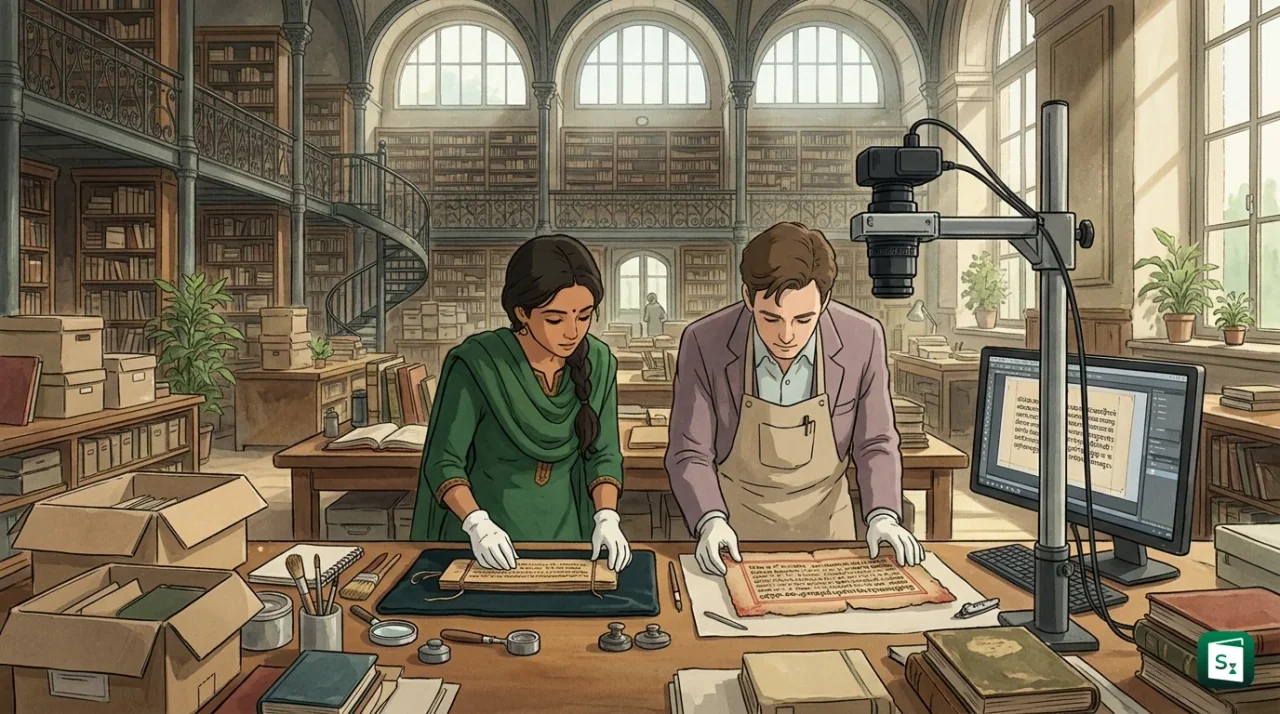
The Ministry of Culture and the BnF will exchange expertise in digitisation and preservation technologies, cataloguing standards and manuscript conservation. Cataloguing means creating a standard record for each text with details of title, author, language, script, material, size and condition. Common standards help Indian and French databases speak to each other.
Conservation covers both prevention and cure. Prevention includes control of temperature, humidity, light and pests in storage. Cure includes cleaning, repair of palm leaf and birch bark, deacidification of paper and restoration of damaged bindings. Palm leaf manuscripts need special care because the leaf becomes brittle with heat and moisture. The exchange will help Indian conservators learn French laboratory practices, while French teams will gain from India’s long experience with palm leaf and birch bark care.
The MoU also provides for joint workshops, capacity building programmes, research projects, publications and exhibitions. Exchange of scholars, researchers and experts will support translation of texts and studies in Indian Knowledge Systems, which refers to India’s traditional bodies of learning in fields such as philosophy, grammar, mathematics, astronomy, medicine and arts. The Gyan Mitram interface on the Gyan Bharatam Portal, an artificial intelligence based helper for reading manuscripts, is expected to benefit from French work on OCR and HTR tools.
Who Is the Partner: Bibliotheque nationale de France
The Bibliotheque nationale de France (BnF) is the National Library of France located in Paris. Its origins go back to the royal library founded in 1368 under King Charles V. The present institution was formed on 3 January 1994 through the merger of the Bibliotheque nationale and the Bibliotheque de France. The BnF functions under the French Ministry of Culture. Its main sites are the historic Richelieu site in central Paris and the modern Francois Mitterrand site on the banks of the Seine.
The BnF collects, catalogues, preserves and shares France’s documentary heritage. French law requires legal deposit, which means a copy of every work published in France must be sent to the library. The collection holds more than 13 million books and publications, along with maps, prints, photographs, coins and audio records.
The BnF runs Gallica, its digital library launched in 1997. Gallica offers free online access to several million books, newspapers, images and manuscripts and adds new items every week with the help of partner institutions. The BnF also runs shared heritage libraries such as the France South Asia digital collection. Experience with Gallica makes the BnF a useful partner for India’s National Digital Repository plans.
Gyan Bharatam Portal, Survey and Manuscript Preservation in India
The Gyan Bharatam Portal is the central digital platform for storing and viewing digitised manuscripts. It was launched during the Gyan Bharatam International Conference in September 2025 to speed up digitisation, preservation and public access. Readers can view texts state wise in view mode. The portal integrates transcription aids, search by language and script, and application interfaces that allow other national and international archives to connect.
Preservation of manuscripts in India covers many materials and scripts. India holds texts in Sanskrit, Pali, Prakrit, Tamil, Persian, Arabic, Tibetan and many other languages, written in scripts such as Brahmi, Sharada, Grantha, Modi and Nastaliq. Materials include palm leaf used widely in the south and east, birch bark used in the north, handmade paper, cloth and copper plates. Each material needs a different method of cleaning, storage and imaging. High standard digitisation creates a clear image of every folio, which is a single leaf or page, along with metadata for easy retrieval.
The table below places the Paris pact in the wider timeline of the Mission.
| Date | Development |
|---|---|
| 7 February 2003 | National Mission for Manuscripts launched in New Delhi |
| 1 February 2025 | Gyan Bharatam announced in Union Budget 2025-26 |
| 11 to 13 September 2025 | First Gyan Bharatam International Conference and launch of Gyan Bharatam Portal at Vigyan Bhawan |
| 16 March 2026 | Gyan Bharatam National Manuscript Survey launched across states and Union Territories |
| 26 October 2026 | Ministry of Culture and BnF sign MoU in Paris under Gyan Bharatam Mission |
Why the Agreement Matters for India and France
The Ministry of Culture gains direct access to conservation science, imaging systems and digital library management developed over three decades at the BnF. This support arrives at a key stage. India has mapped over a crore manuscripts but has so far digitised only a small share. French help with mass digitisation, Indian script recognition and long term digital storage can raise both speed and quality.
India’s research community gains as well. Students of history, philosophy, linguistics, medicine and astronomy will be able to read Indic texts held in Paris along with full catalogues and translations. Joint exhibitions and publications will bring this shared heritage to the public in both countries.
The pact also strengthens India France cultural cooperation. France holds one of the largest European collections of Indian manuscripts. A formal agreement on sharing, access and joint study reduces legal and technical barriers. It sets a model for similar cooperation with other libraries and archives that hold Indian origin collections, so more scattered heritage can be united digitally in the National Digital Repository.
Key Takeaways
- The Ministry of Culture and Bibliotheque nationale de France signed an MoU in Paris on 26 October 2026 under the Gyan Bharatam Mission.
- The MoU covers five areas: digitisation, cross sharing on the National Digital Repository, technology exchange, conservation, and research and development.
- The Gyan Bharatam Mission was announced in the Union Budget 2025-26 and is implemented by the Ministry of Culture with an outlay of ₹482.85 crore for 2024-25 to 2030-31.
- The Mission builds on the National Mission for Manuscripts, launched on 7 February 2003, which documented over 44 lakh manuscripts in Kriti Sampada.
- The Gyan Bharatam National Manuscript Survey launched on 16 March 2026 has traced more than 1.19 crore manuscripts, with over 4.4 lakh texts available on the Gyan Bharatam Portal.
- The BnF, formed in its present shape on 3 January 1994 and host of the Gallica digital library since 1997, will help digitise Indic origin manuscripts held in France.