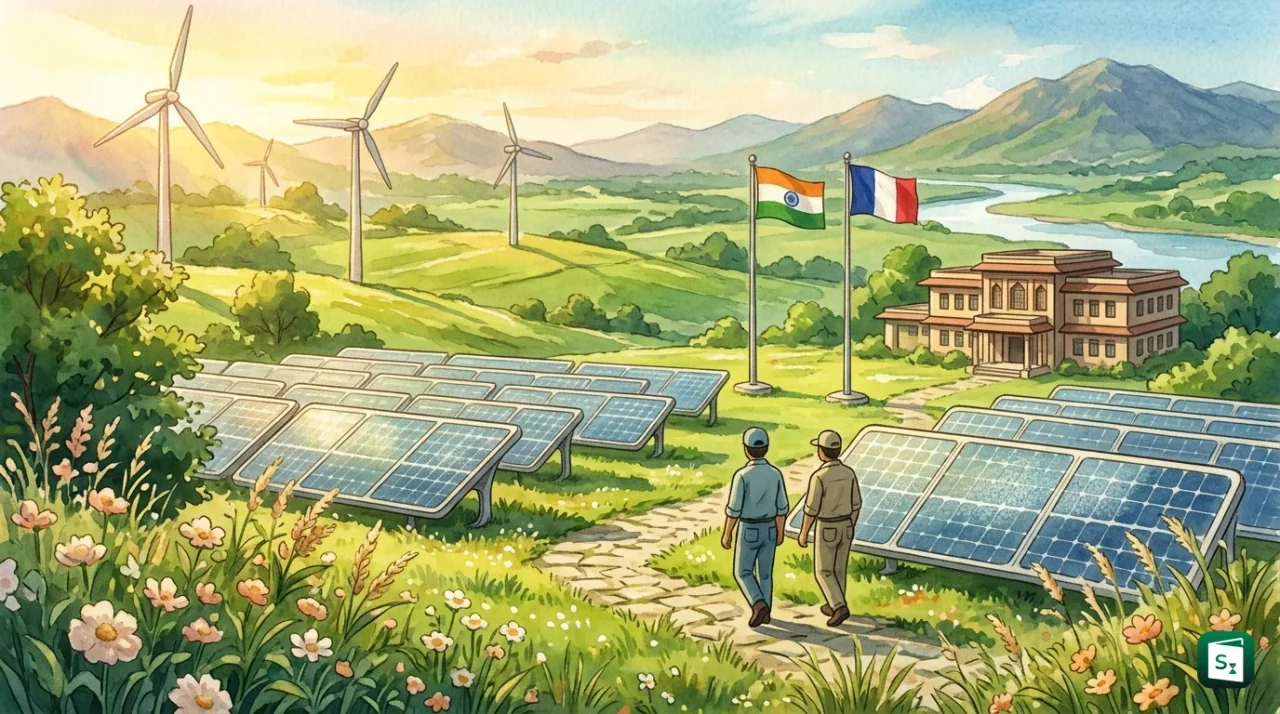
NTPC Ltd and EDF Power Solutions India Pvt Ltd signed a 50:50 joint venture agreement on 25 September 2026 to develop, own and operate low carbon energy projects in India and neighbouring countries. The NTPC EDF joint venture will focus on pumped storage, hydropower and other renewable projects along with distribution business. The partnership links India’s largest power producer with French clean energy expertise at a time when India is racing to add storage for its 500 GW non fossil target.
What Is NTPC?
NTPC Ltd, earlier called National Thermal Power Corporation, is India’s largest power utility and a Maharatna public sector company under the Ministry of Power. Founded in 1975 and headquartered in New Delhi, NTPC generates about one fourth of India’s electricity and crossed 90 GW installed capacity in May 2026.
NTPC is a government owned company, not a private company. The Government of India holds 51.10 percent equity in NTPC. NTPC received Maharatna status in May 2010, which gives large public sector firms greater financial freedom to approve investments and form joint ventures without repeated government clearance.
NTPC generates electricity mainly from coal and gas thermal plants, with a growing share from hydro, solar and wind. The NTPC Group held 90,807 MW of installed capacity as of March 2026, which was about 17 percent of national capacity while contributing about 24 percent of national generation because its plants run at higher efficiency. NTPC has set a target of 149 GW total capacity by 2032, including 60 GW from renewable sources. Its renewable push is led by subsidiaries such as NTPC Green Energy Ltd (NGEL) and NTPC Renewable Energy Ltd.
The Chairman and Managing Director of NTPC is Gurdeep Singh (as of September 2026). NTPC is listed on both the National Stock Exchange (NSE) and the Bombay Stock Exchange (BSE) and is part of the Nifty 50 index.
What Is EDF and EDF Power Solutions India?
EDF, short for Électricité de France which means Electricity of France, is the French multinational electric utility fully owned by the Government of France. Founded in 1946 and based in Paris, EDF is one of the world’s largest low carbon power producers with strengths in nuclear, hydro, solar and wind.
EDF was created by a law of 8 April 1946 that nationalised power generation and supply to rebuild post war France. After partial listing in 2005, the French state again took full control in June 2023 and delisted EDF from the Paris stock exchange. Today EDF operates in more than 30 countries and more than 99 percent of power it generates in France is low carbon, led by its large nuclear fleet.
EDF Power Solutions India Pvt Ltd is the Indian arm of EDF and a wholly owned subsidiary of the French group. EDF Power Solutions was formed in June 2025 by combining EDF Renewables and the EDF Group International Division to handle international low carbon business outside France. The entity holds about 31 GW of low carbon capacity in operation worldwide and employs about 10,000 people across 25 countries. Its work covers wind, solar, hydropower, biomass, grids, batteries, pumped storage and hybrid systems. The Chairman and Chief Executive Officer of EDF SA is Bernard Fontana (as of September 2026).
What Does the NTPC EDF Joint Venture Cover?
The NTPC EDF joint venture is a 50:50 joint venture, which means NTPC and EDF Power Solutions India will each hold half the equity and share control equally in the new company. A joint venture agreement is a legal contract under which two firms create a separate company to jointly invest, build and run projects and share risks and returns.
The new company will jointly develop, own and operate low carbon energy assets rather than act only as an advisory or technology platform. Its mandate covers the full project cycle from construction to operation and maintenance, including the option to create project subsidiaries for individual plants.
| Area Under the Joint Venture | What It Includes |
|---|---|
| Pumped storage projects | Large water based storage plants that release stored water to generate power at peak hours |
| Hydropower projects | Conventional hydroelectric plants, including hydro bundled with other renewables |
| Other renewable projects | Solar, wind and hybrid plants linked to storage or hydro |
| Distribution and flexibility | Power distribution business, battery type flexibility solutions and transmission assets |
The venture will take up projects within India and in neighbouring countries. The partners have stated that they will combine NTPC’s strength in building and running large plants in India with EDF’s global experience in decarbonisation and grid performance to offer customised clean power solutions.
From Term Sheet to Joint Venture Agreement: How the Deal Evolved
NTPC and EDF first signed a non binding term sheet on 23 February 2025 during Elecrama 2025. A term sheet records the broad intent of the partners but does not create final legal obligations. The 2025 document was signed by Federico D’Amico, Chief Executive Officer of EDF India, and J C Kakoti, General Manager for Hydro Engineering at NTPC. The signing took place in the presence of NTPC Chairman Gurdeep Singh, then EDF Chairman Luc Remont and Power Secretary Pankaj Agarwal.
| Date | Milestone |
|---|---|
| 23 February 2025 | NTPC and EDF India sign non binding term sheet for pumped storage, hydro and bundled renewable projects and distribution opportunities |
| February 2025 to September 2026 | Partners seek internal and Government of India approvals for a 50:50 joint venture company |
| 25 September 2026 | NTPC and EDF Power Solutions India sign final joint venture agreement in New Delhi |
The final joint venture agreement was signed on 25 September 2026 in New Delhi in the presence of NTPC Chairman Gurdeep Singh and EDF Chairman Bernard Fontana. Unlike the term sheet, this agreement creates binding commitments to form and fund the equal joint venture and to jointly develop, build and operate low carbon power plants as well as flexibility solutions and transmission assets.
Why Pumped Storage and Hydro Matter for India
A pumped storage plant is a large rechargeable water battery. When solar and wind power is surplus during the day, the plant uses that power to pump water from a lower reservoir to an upper reservoir. When demand peaks in the evening, the stored water is released downhill to run turbines and produce electricity. This cycle helps keep the grid stable even when sunlight and wind vary.
A hydropower plant uses flowing river water to run turbines directly, without the pumping cycle. When a hydro plant is bundled with solar or wind, the steady hydro output fills the gaps when solar or wind output drops. Together, pumped storage and hydro provide long duration storage, which batteries alone cannot yet provide cheaply at large scale.
India has an estimated pumped storage potential of about 267 GW, including about 58 GW on river sites and 209 GW off river sites. As of December 2025, only about 7 GW of pumped storage was in operation across 10 plants, with about 12 GW under construction and another 9.6 GW with designs approved by the Central Electricity Authority (CEA). The CEA is the technical planning body for the power sector in India. Its roadmap expects pumped storage capacity to reach about 87 GW by 2033-34 and cross 100 GW by 2035-36, with average additions of about 9 GW per year. The NTPC EDF venture directly supports this storage build out.
India’s Clean Energy Goals: The Bigger Picture
India has pledged to reach 500 GW of installed capacity from non fossil sources by 2030 under its Panchamrit climate commitments announced at the COP26 climate summit in Glasgow. Non fossil sources include solar, wind, hydro, biomass waste to energy and nuclear. India crossed 300 GW of non fossil capacity in August 2026, with solar at about 164.59 GW as the largest part, and added about 30.58 GW in the first half of 2026 alone.
Storage is the missing link in this plan. Solar and wind cannot produce power on demand, so the National Electricity Plan (Transmission) prepared by the CEA calls for about 47 GW of battery storage and 30 GW of pumped storage by 2030, along with new transmission lines to carry renewable power from Rajasthan, Gujarat, Ladakh and other resource rich zones. The Ministry of New and Renewable Energy (MNRE) is inviting bids for 50 GW of renewable capacity every year till 2027-28 to stay on track.
For NTPC, the joint venture fits its shift from a thermal heavy utility to a clean energy major. NTPC added a record 9,619 MW of total capacity in 2025-26, including 5,488 MW of renewables, and plans to add about 8 GW of renewable capacity in 2026-27 through NGEL. The venture also opens distribution and transmission work, which improves last mile supply and helps carry variable green power without wastage. For India France ties, the deal adds to cooperation in areas such as the proposed Jaitapur nuclear project and urban energy systems, and it signals that global utilities view India’s storage market as a long term growth opportunity on the path to net zero emissions by 2070.
Key Takeaways
- The NTPC EDF 50:50 joint venture agreement was signed on 25 September 2026 to develop low carbon projects in India and neighbouring countries.
- The venture will develop, own and operate pumped storage, hydropower, other renewables and distribution assets.
- NTPC, founded in 1975 and granted Maharatna status in 2010, crossed 90 GW installed capacity in May 2026.
- EDF, founded in 1946 and fully owned by the Government of France, formed EDF Power Solutions in June 2025 with about 31 GW of low carbon capacity worldwide.
- India targets 500 GW of non fossil capacity by 2030 and net zero by 2070, with a pumped storage roadmap of 100 GW by 2035-36.