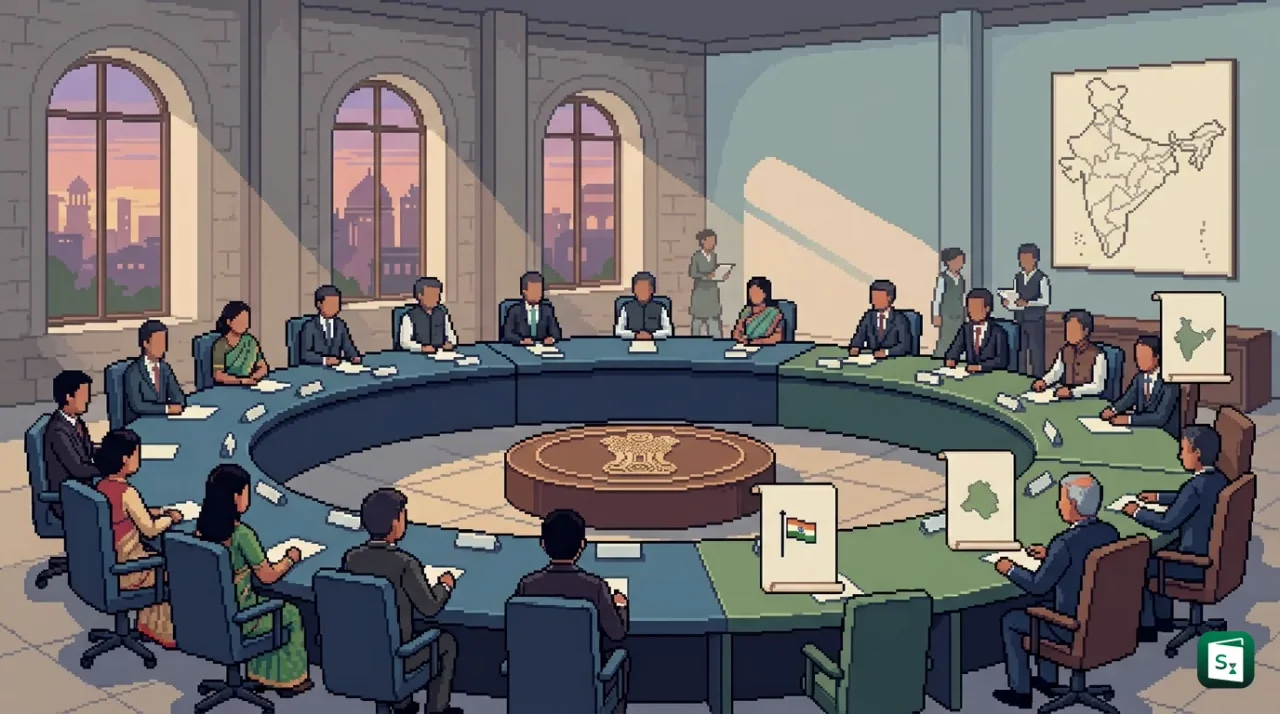
President Droupadi Murmu has issued the Inter-State Council (Amendment) Order, 2026 to update who represents a State or Union Territory in the Inter-State Council when its elected government is not functioning. The Order, notified by the Ministry of Home Affairs on 9 September 2026 and published in the Gazette of India on 18 September 2026, came into force at once. It replaces the earlier participation rule with a clear four part provision that covers States and the three Union Territories with legislatures, Delhi, Puducherry and Jammu and Kashmir.
What Is the Inter-State Council
The Inter-State Council is the national forum where the Union government and the States meet to discuss subjects of common interest and improve coordination of policy and action. The Prime Minister chairs the Council, and its members include the Chief Ministers of all States, the Chief Ministers of Union Territories with legislatures, Administrators of other Union Territories and six Union Cabinet Ministers nominated by the Prime Minister.
The Inter-State Council is an advisory and recommendatory body. It does not pass binding orders like a court and it does not make laws like Parliament. Decisions in the Council are taken by consensus, which helps build trust between the Centre and the States on sensitive subjects such as internal security, fiscal coordination, disaster management and inter-state cooperation.
Constitutional Basis Under Article 263
Article 263 of the Constitution, placed in Part XI on relations between the Union and the States, allows the President of India to establish an Inter-State Council if public interest would be served by it. Article 263 lists three possible duties for such a Council. These are inquiry and advice on disputes between States, investigation and discussion of subjects in which the Union and the States or some States have a common interest, and recommendations for better coordination of policy and action on such subjects.
Article 263 is an enabling provision. It permits the President to create the Council by order and to define its organisation, duties and procedure, but it does not create the Council by itself. This is why the provision remained unused for nearly 40 years after the Constitution commenced in 1950. The Inter-State Council Order of 28 May 1990 used Article 263(b) and 263(c), which relate to common interest subjects and coordination, and not Article 263(a) on disputes. Disputes that need a binding decision continue to go to the Supreme Court under Article 131, which gives the Court exclusive original jurisdiction over Centre State and inter-state legal disputes.
A common point of confusion is whether the Inter-State Council is a permanent or constitutional body. The Council draws its authority from the Constitution through a Presidential Order under Article 263, so it is often described as a constitutional body. At the same time, the language of Article 263 says the President may establish it at any time public interest requires, so it is not permanent in the same sense as institutions that function without break.
Historical Background and Establishment Basis
The Inter-State Council was established in 1990 on the recommendation of the Sarkaria Commission on Centre State Relations. The Sarkaria Commission was set up in 1983 under the chairmanship of Justice R. S. Sarkaria, a retired judge of the Supreme Court, to review working arrangements between the Union and the States. The Commission submitted its report in 1988 with 247 recommendations.
One of the central recommendations was that a permanent Inter-State Council, called the Inter-Governmental Council, should be set up under Article 263. The Commission argued that ad hoc meetings, Zonal Councils and the National Development Council could not fully fill the need for a regular national forum for consultation. The Union government accepted this recommendation and the President issued the Inter-State Council Order on 28 May 1990, published as G.S.R. 512(E).
The parent Order has been amended three times. It was first amended on 19 July 1990 through S.O. 575(E) to provide for invitation of the Governor of a State under central rule. It was amended again on 24 December 1996 through S.O. 902(E) to provide for permanent invitees from among other Union Ministers. The present change, the Inter-State Council (Amendment) Order, 2026, issued as S.O. 5143(E), is the third substantive amendment and the first to list separate provisions for Delhi, Puducherry and Jammu and Kashmir.
What Changes Under the Inter-State Council Amendment Order 2026
The Inter-State Council (Amendment) Order, 2026 substitutes the proviso to Clause 2 of the 1990 Order with a new four part proviso. The effect is simple. When a State or a Union Territory with a legislature is under central rule because its constitutional machinery has failed, its Governor or Lieutenant Governor shall be invited to attend meetings of the Council. This keeps the unit represented even when there is no Chief Minister to attend.
The earlier proviso, added in July 1990, had covered the Governor of a State under central rule and the position of the erstwhile State of Jammu and Kashmir. That language had become outdated after constitutional and statutory changes, including the reorganisation of Jammu and Kashmir in 2019. The 2026 Order updates the framework by naming the present legal trigger for each unit separately. The table below shows the four situations in one view.
| Unit | Head invited | Legal trigger for invitation |
|---|---|---|
| Any State | Governor of that State | Proclamation by the President under Article 356 is in force |
| National Capital Territory of Delhi | Lieutenant Governor of Delhi | Order by the President under Article 239AB is in force |
| Puducherry | Lieutenant Governor of Puducherry | Order by the President under Section 51 of the Government of Union Territories Act, 1963 is in force |
| Jammu and Kashmir | Lieutenant Governor of Jammu and Kashmir | Order by the President under Section 73 of the Jammu and Kashmir Reorganisation Act, 2019 is in force |
Article 356 Link and Governor Invitation Rule
Article 356 deals with failure of constitutional machinery in a State. It is commonly called President Rule. If the President, on receipt of a report from the Governor or otherwise, is satisfied that the government of a State cannot be carried on in line with the Constitution, the President can issue a proclamation to take over the functions of the State government. Executive authority is then exercised through the Governor, and the State Legislative Assembly may be suspended or dissolved.
Under the 2026 amendment, where such a proclamation under Article 356 is in force for a State, the Governor of that State shall be invited to Council meetings. The logic is practical. The Chief Minister is normally the member from that State. When there is no Council of Ministers, the Governor, who acts on behalf of the President during central rule, fills that representational gap.
Delhi, Puducherry and Jammu and Kashmir Provisions
Article 356 does not apply to Union Territories. Each Union Territory with a legislature has its own equivalent provision for failure of constitutional machinery, and the 2026 Order names each one.
Delhi is the National Capital Territory under Article 239AA, inserted by the Constitution (Sixty-ninth Amendment) Act, 1991. Article 239AA gives Delhi a Legislative Assembly and a Council of Ministers with a Chief Minister, with limits on subjects such as public order, police and land. Article 239AB, inserted by the same amendment, is the Delhi equivalent of President Rule. If the President is satisfied on a report from the Lieutenant Governor or otherwise that administration in Delhi cannot be carried on under Article 239AA, the President can suspend provisions of Article 239AA by order. In that situation, the Lieutenant Governor of Delhi shall now be invited to the Council.
Puducherry is governed by the Government of Union Territories Act, 1963. Section 51 of that Act is the equivalent provision. It allows the President, on a report from the Administrator or otherwise, to suspend provisions of the Act and make arrangements for administration under Article 239. When such an order under Section 51 is in force for Puducherry, the Lieutenant Governor of Puducherry shall be invited.
Jammu and Kashmir became a Union Territory with a legislature under the Jammu and Kashmir Reorganisation Act, 2019. Section 73 of that Act is its equivalent provision. It allows the President, on a report from the Lieutenant Governor or otherwise, to suspend provisions of the Act for administration of the Union Territory. When such an order under Section 73 is in force, the Lieutenant Governor of Jammu and Kashmir shall be invited.
Composition, Secretariat and Standing Committee
The composition of the Inter-State Council brings together the top political leadership of the Union and the States in one forum. The Prime Minister is the Chairperson. All Chief Ministers of States are members. The Chief Ministers of Union Territories with legislatures, which are Delhi, Puducherry and Jammu and Kashmir, are members when elected governments are in place. Administrators of Union Territories without legislatures are members. Six Union Cabinet Ministers nominated by the Prime Minister are also members, and additional Union Ministers attend as permanent invitees when nominated by the Chairperson.
The Council is supported by the Inter-State Council Secretariat, set up in 1991 under the Ministry of Home Affairs in New Delhi. The Secretariat is headed by an officer of the rank of Secretary to the Government of India. It prepares agenda papers, follows up on decisions and also handles secretarial work for the Zonal Councils. This link helps connect national level discussion in the Inter-State Council with regional work in the zones.
A Standing Committee was formed in 1996 for continuous consultation between full meetings of the Council. The Union Home Minister chairs the Standing Committee. It includes five Union Cabinet Ministers and nine Chief Ministers nominated by the Chairperson of the Council. The Standing Committee examines issues in detail and places mature proposals before the full Council. The Secretariat monitors implementation of recommendations, including the large number of accepted Sarkaria Commission recommendations that were divided among Ministries and State governments for action.
Inter-State Council Versus Zonal Council
The Inter-State Council is often confused with Zonal Councils, but the two are different in law, size and chairpersonship. The Inter-State Council is created by a Presidential Order under Article 263 and covers the whole country. Zonal Councils are statutory bodies created by Parliament under the States Reorganisation Act, 1956. They divide States and Union Territories into five regional zones for closer cooperation.
The Prime Minister chairs the Inter-State Council, while the Union Home Minister chairs each Zonal Council. In a Zonal Council, the Chief Ministers of the States in that zone act as Vice Chairperson by rotation for one year each. Both bodies are advisory in nature and decide through discussion and consensus. The key difference is scope. The Inter-State Council handles national subjects of common interest and Centre State coordination, while Zonal Councils focus on regional issues such as inter-state transport, border concerns, sharing of facilities and cultural linkage.
| Feature | Inter-State Council | Zonal Council |
|---|---|---|
| Legal basis | Article 263 and Presidential Order of 1990 | States Reorganisation Act, 1956 |
| Coverage | National, all States and Union Territories | Regional, five zones |
| Chairperson | Prime Minister | Union Home Minister |
| Core role | Centre State coordination and common interest policy | Regional cooperation and settlement of zone level issues |
| Nature of decisions | Recommendatory, by consensus | Advisory |
Centre State Relations and Cooperative Federalism
Centre State relations is the term for how powers, functions and responsibilities are shared between the Union government and the State governments. Cooperative federalism means that the two levels work together through discussion and joint action rather than through orders from above. The Inter-State Council is the main constitutional forum for this idea because it places the Prime Minister, Chief Ministers and Union Ministers around the same table.
The 2026 amendment supports this continuity. If a State is under President Rule, or if Delhi, Puducherry or Jammu and Kashmir is under its equivalent central rule provision, there is no elected Chief Minister to present that unit’s view. By inviting the Governor or the Lieutenant Governor in only those situations, the Order ensures that the unit is not left unrepresented when national subjects are discussed. The invitation is conditional and temporary. It applies only while the relevant proclamation or order is in force, and normal membership by the Chief Minister resumes once an elected government returns.
The Council has met infrequently since 1990, with the eleventh meeting held on 16 July 2016, so observers have often called for more regular meetings, at least three times a year, as suggested by later review bodies including the Punchhi Commission on Centre State Relations. The Punchhi Commission was set up in 2007 under Justice M. M. Punchhi and submitted its report in 2010 with 273 recommendations on strengthening federal coordination. Regular use of the Council and its Standing Committee would help pending subjects move faster and give the 2026 clarification real practical value.
Key Takeaways
- The Inter-State Council (Amendment) Order, 2026 was notified on 9 September 2026 and published on 18 September 2026, and it came into force at once.
- The Order substitutes the proviso to Clause 2 of the Inter-State Council Order of 28 May 1990, which was set up under Article 263 on the Sarkaria Commission recommendation.
- The Governor of a State shall be invited to Council meetings when a proclamation under Article 356 is in force in that State.
- The Lieutenant Governor of Delhi shall be invited when an order under Article 239AB is in force, while Puducherry is covered by Section 51 of the Government of Union Territories Act, 1963 and Jammu and Kashmir by Section 73 of the Jammu and Kashmir Reorganisation Act, 2019.
- The Council is chaired by the Prime Minister and supported by the Inter-State Council Secretariat set up in 1991 and the Standing Committee chaired by the Union Home Minister formed in 1996.